

 English
 Español
Miao Shuhan — Export Business Development Executive
Home / Author / Miao Shuhan — Export Business Development Executive / Large Rectangular Fruit Basket Mould: Design, Performance, and Custom Injection Manufacturing
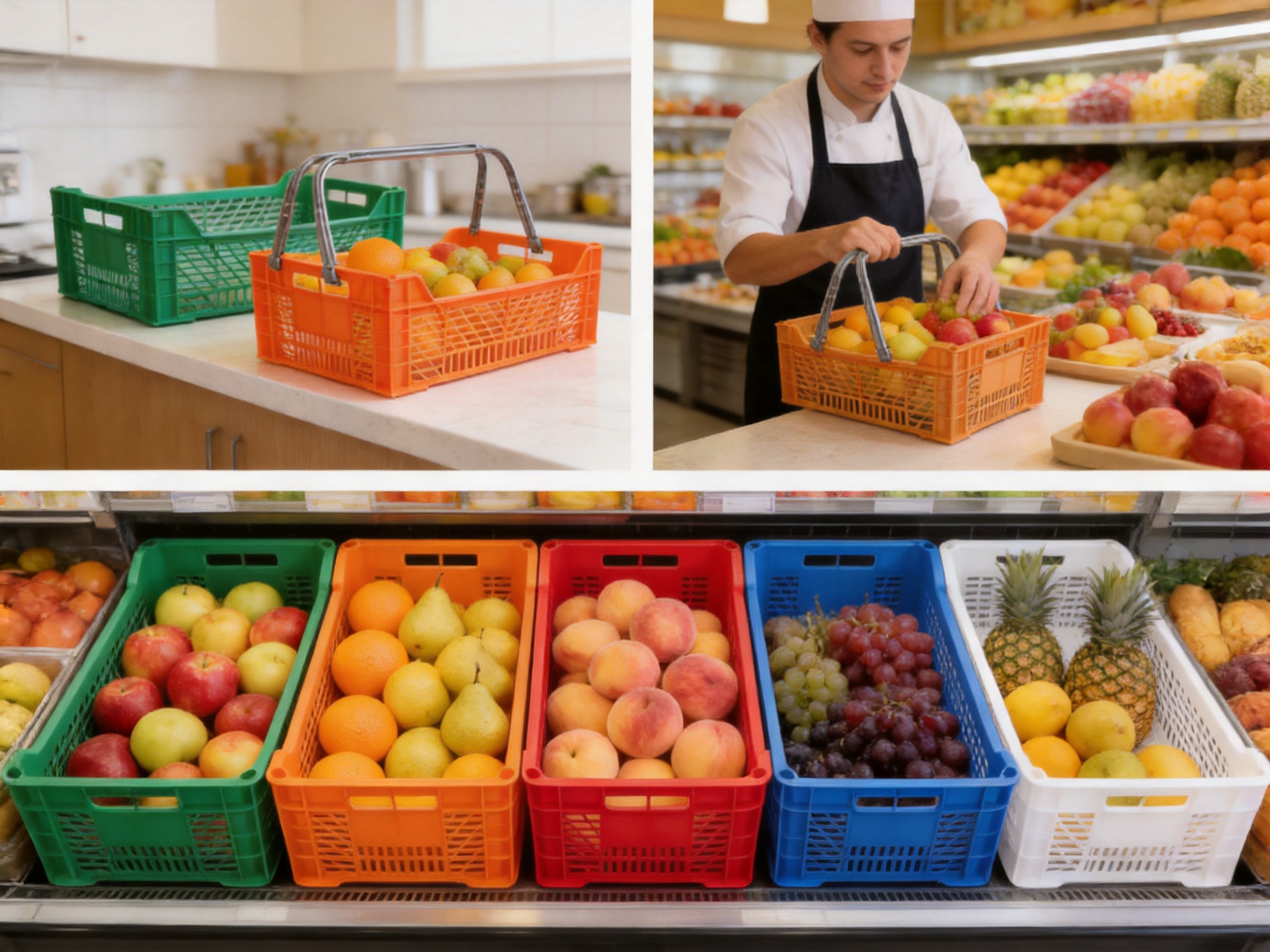
A large rectangular fruit basket is more than a simple household container. Its shape, ventilation pattern, wall thickness, carrying handles, rim structure, and base reinforcement all influence how safely and conveniently fruit can be stored, transported, displayed, and served. For manufacturers, retailers, fruit shops, supermarkets, and household-product distributors, the mould used to produce this type of basket is therefore a critical production asset. A well-engineered mould determines product consistency, cycle efficiency, surface quality, dimensional stability, and long-term manufacturing cost.
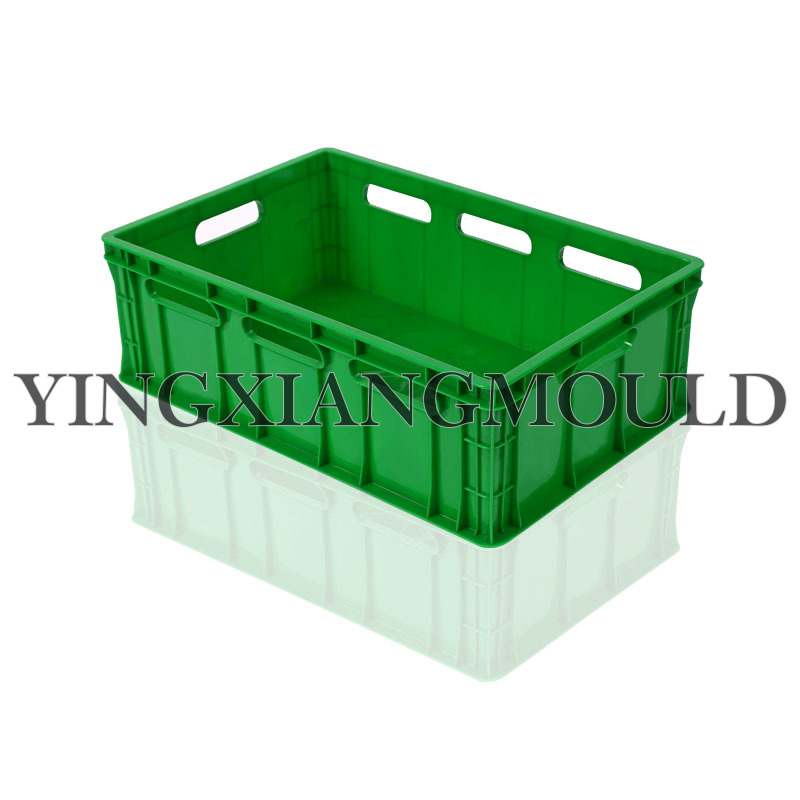
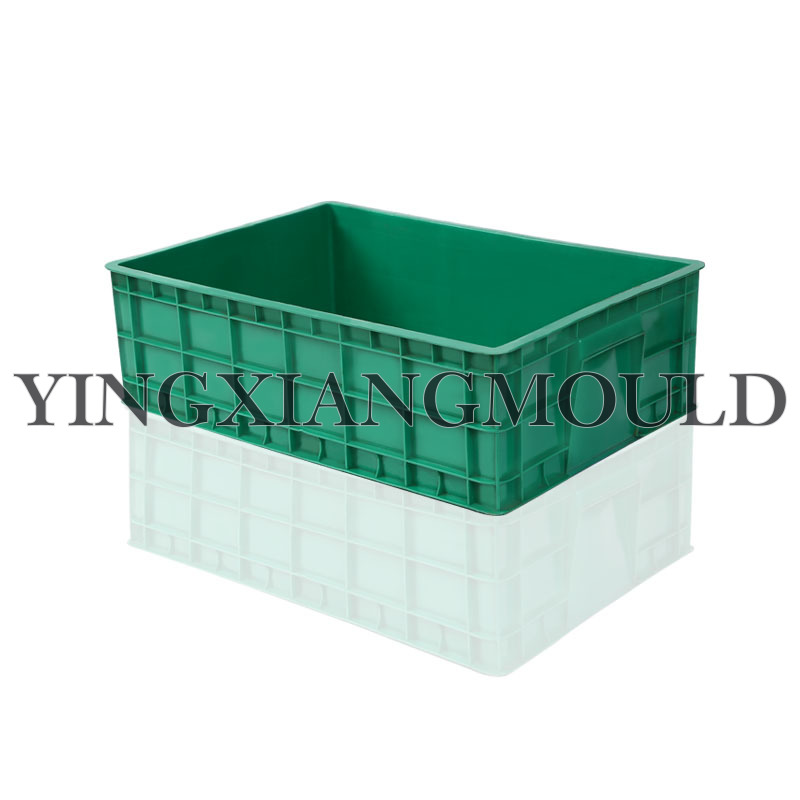
The rectangular large fruit basket mould is developed for injection-moulded plastic baskets that provide generous internal capacity while remaining practical to move and easy to clean. Its product concept combines a long and wide storage area, a semi-perforated mesh structure, reinforced carrying handles, a broad folded-over rim, and a strengthened base. These features allow the finished basket to accommodate large quantities of fruit while maintaining structural stability during daily use.
For customers seeking a customized plastic injection mould, this product offers a balanced solution between capacity, strength, ventilation, appearance, and manufacturing efficiency. The mould can be adapted to different dimensions, plastic materials, colours, surface details, and production requirements. It is suitable for household use, fruit and vegetable retail, market display, catering, event preparation, and other applications requiring large-capacity food storage.
The large rectangular fruit basket is designed around a practical rectangular footprint. Compared with a small round basket or a narrow household tray, the rectangular format makes better use of shelf, countertop, cabinet, and display space. Its long and wide interior can hold several kilograms of apples, oranges, pears, peaches, or similar produce. It can also accommodate larger fruits such as sliced watermelon, pineapple, and cantaloupe.
The form is especially useful where a broad base and organized placement are important. Fruit can be arranged in rows, separated by size, or displayed with the most attractive pieces visible from above. The rectangular shape also allows multiple baskets to be positioned side by side with less unused space than many curved or irregular containers.
The basket is manufactured by plastic injection moulding. This forming method is suitable for producing repeatable household products in medium and high volumes. Once the mould has been correctly designed, tested, and approved, each production cycle can reproduce the main dimensions, openings, ribs, handles, and surface features with a high level of consistency.
The product model, colour, and size can be customized. This gives importers, retailers, supermarket suppliers, and private-label product companies the flexibility to develop a basket that matches their market positioning. A customer may request a compact version for home kitchens, a wider version for fruit shops, or a larger commercial version for display and bulk handling.
| Product type | Large rectangular fruit basket |
| Product category | Fruit basket mould |
| Forming method | Plastic injection moulding |
| Product material options | PP, PC, PS, POM, PE, PU, PVC, ABS, PMMA, and other suitable plastics |
| Mould material options | 1CR13, 2CR13, 3CR13, 4CR13, S136, CR16, 2316, 718H, P20, and other customer-approved steels |
| Model | Customizable |
| Size | Customizable |
| Colour | Customizable |
| Packaging | Composite wooden box |
| Service | OEM and customized mould development |
| Application | Home storage, fruit shops, vegetable stores, retail display, parties, and food preparation |
| Approximate supply capacity | About 50 mould sets per month |
The specifications above describe a flexible moulding program rather than a single fixed product configuration. Because basket dimensions, plastic selection, opening geometry, and surface finish may vary according to the end market, the final engineering solution should be confirmed through product drawings, mould-flow review, material evaluation, and sample testing.
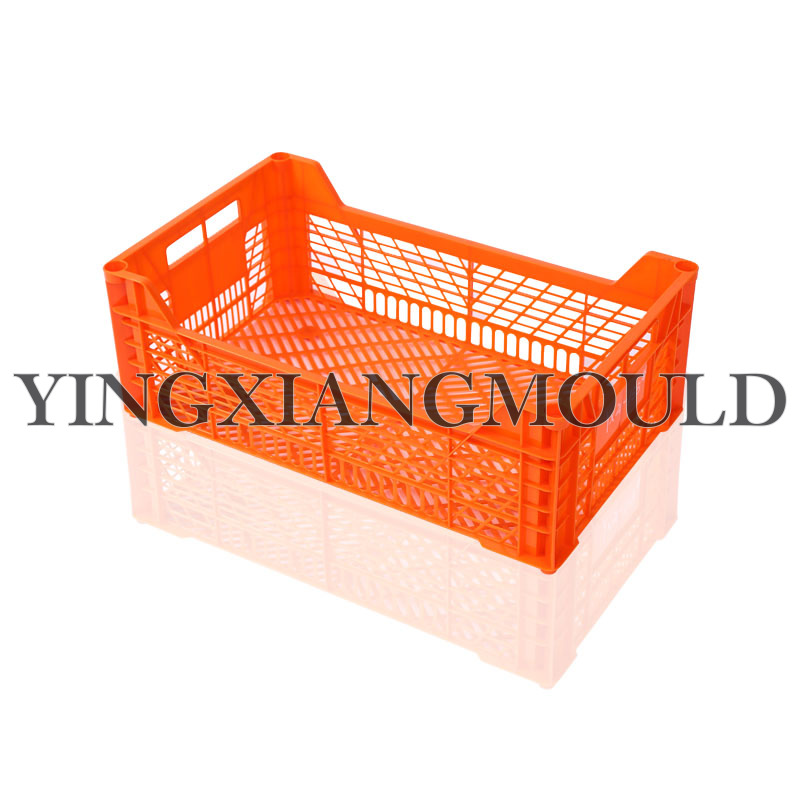
Rectangular large fruit basket
The principal advantage of this basket is its generous internal volume. A large rectangular container can hold more fruit than many compact household baskets while still maintaining an organized footprint. The long body is suitable for arranging fruit in layers or rows, and the broad base supports larger items that may not fit comfortably inside a narrow container.
Large capacity is particularly valuable for households that purchase fruit in bulk, stores that need a simple display container, and catering or event operators preparing fruit for groups of people. The basket can reduce the need for several smaller containers and may simplify handling during preparation, stocking, and presentation.
For mould manufacturers, creating a large product with adequate rigidity requires careful attention to wall thickness, corner transitions, rib placement, shrinkage control, and cooling balance. A basket that is large but insufficiently supported may warp, sag, or become uncomfortable to carry. The mould design must therefore combine spacious geometry with efficient reinforcement.
The semi-perforated mesh design allows air to circulate around the stored fruit. Ventilation helps reduce the accumulation of heat and moisture compared with a completely closed container. This can be beneficial when fruit is stored temporarily in kitchens, shops, preparation areas, or display locations.
The opening pattern also reduces the amount of plastic used in the side walls while preserving the visual character of a basket. Customers can see part of the contents without opening the container, which is useful for retail display and household organization. At the same time, the semi-perforated pattern can be designed to avoid excessive openness, helping prevent small items from falling through the sides.
Ventilation openings must be engineered with consistent edges and appropriate radii. Sharp or poorly finished openings may create stress concentration, difficult demoulding, or uncomfortable handling. A professionally manufactured mould uses suitable steel treatment, precise machining, and polishing or texturing methods to ensure that the mesh pattern is accurately reproduced across the production surface.
The basket is designed with thickened walls to improve load-bearing performance. When filled with several kilograms of apples, oranges, or other fruit, the side walls and base are subjected to continuous weight. During lifting, the load may also shift, creating additional stress around the handles, corners, and bottom perimeter.
Thickened areas and strategically positioned ribs help maintain the intended form under pressure. However, excessive wall thickness can increase material consumption, lengthen cooling time, and create sink marks or uneven shrinkage. The moulding solution must therefore achieve reinforcement through geometry rather than simply adding material everywhere.
Computer-aided engineering can assist with the evaluation of wall thickness, filling behaviour, cooling, warpage, and potential weak points. By reviewing these factors before mould machining, the manufacturer can reduce development risk and improve the likelihood that the first production samples will meet the customer’s expectations.
The extended handles at both ends are designed to make a fully loaded basket easier to lift and move. Handles are among the most important functional areas of a large basket because they transfer the weight of the contents directly to the user’s hands. Their length, width, thickness, attachment points, and surface treatment all influence comfort and safety.
Thickened handles provide greater resistance to bending and deformation. A smooth transition between the handle and basket wall helps distribute stress over a larger area. Rounded edges improve comfort, while an appropriate grip opening allows the user to hold the basket without excessive finger pressure.
During mould development, the handle area deserves special attention. It may require carefully designed sliders, lifters, inserts, or other mould components depending on the final geometry. The objective is to produce a clean handle opening and stable attachment structure without creating visible parting-line problems or difficult ejection conditions.
The wide folded-over rim contributes to both appearance and structural rigidity. It gives the basket a finished profile and creates a stronger perimeter around the upper opening. A broad rim can also improve the user’s experience by providing a more comfortable edge when the basket is carried, stacked, or handled during cleaning.
From a production perspective, the rim must be designed to fill evenly and cool consistently. Uneven thickness around the upper perimeter may cause distortion or cosmetic variation. The moulding team can use balanced gating, suitable cooling channels, and appropriate draft angles to improve dimensional stability.
The bottom of the basket includes multiple reinforcing ribs and anti-slip textures. The ribs support the base when the basket is fully loaded and help limit flexing when it is placed on a shelf, table, floor, or shop display surface. The anti-slip texture improves contact with the supporting surface and can help the basket remain stable during handling.
A textured base also reduces the visual impact of minor scratches that may occur during ordinary use. Depending on the customer’s requirements, the texture may be adjusted for appearance, grip, cleanability, and mould-release performance. Texture depth, draft angle, and steel finish must be considered together to prevent ejection difficulties.
Many traditional fruit baskets use circular or oval shapes that leave unused gaps when placed next to other containers. The rectangular configuration uses shelf and countertop space more efficiently. This can be important in supermarkets, fruit stores, kitchens, refrigerators, preparation rooms, and storage areas where every centimetre of space matters.
The shape also supports orderly merchandising. Retailers can create straight display lines, combine several basket sizes, or arrange baskets along the edge of a shelf. This can make the fruit presentation appear more organized and easier for customers to browse.
A large basket must provide significant volume without becoming visually cumbersome. The long rectangular body distributes the capacity along the length of the product. This can make the basket easier to organize than a very deep container, especially when users need to see and reach the fruit at the bottom.
The open upper area and semi-perforated side walls also make the basket appear lighter than a fully solid container of comparable size. This combination of capacity and visual lightness is a useful advantage for household-product retailers and brands seeking a practical but attractive design.
Solid storage containers may restrict airflow around fresh produce. The semi-perforated design of this basket offers a better balance between protection and ventilation. Air can pass through the openings, while the basket still provides a defined structure for holding and displaying the fruit.
Ventilation does not replace proper food-storage practices, temperature control, or hygiene management. Nevertheless, it can support more suitable short-term storage conditions by limiting heat accumulation and allowing moisture to escape more readily than in a sealed container.
Small baskets are often easy to carry when empty but uncomfortable when filled. The extended and thickened handles on this design are intended for more stable handling when the product is loaded. The reinforced connection between the handles and side walls can provide greater confidence during lifting and relocation.
Compared with thin-handled baskets, this construction is better suited to larger quantities of fruit. It can also be useful in shops, where employees may repeatedly move baskets from storage areas to display shelves. The precise performance depends on the selected plastic, product dimensions, mould design, and actual loading conditions.
The combination of a reinforced rim, thickened walls, structural ribs, and a strengthened base helps the basket resist deformation. This is a significant advantage over lightweight designs that may twist or bow when loaded. Stable geometry also supports better stacking, display, and long-term appearance.
For customers comparing mould suppliers, structural stability should be evaluated together with material efficiency. A competitive mould is not simply one that produces a thick product. It should produce a strong product with controlled weight, balanced cooling, acceptable cycle time, and reliable dimensional repeatability.
Generic baskets may limit a retailer to standard dimensions and colours. A customized mould allows the customer to develop a distinctive product for a particular sales channel. Dimensions can be adjusted for local shelf sizes, household habits, fruit varieties, packaging regulations, and target price points.
Colour changes can support seasonal promotions, private-label branding, supermarket identity, or coordinated household-product ranges. Surface texture, handle form, rim design, and opening pattern can also be adapted to create a recognizable product family.
Material selection affects the basket’s strength, flexibility, surface quality, chemical resistance, appearance, weight, and production cost. The most suitable plastic depends on the customer’s intended use, required service life, local regulations, food-contact requirements, and expected loading conditions.
Polypropylene, commonly known as PP, is frequently considered for household containers and baskets because it offers a useful combination of light weight, chemical resistance, toughness, and cost efficiency. It can be produced in many colours and is suitable for complex injection-moulded shapes. Its balance of rigidity and flexibility may be appropriate for a basket that needs to withstand repeated handling.
PP grades vary significantly. A customer may need to select a grade with suitable impact performance, flow characteristics, shrinkage behaviour, and food-contact compliance. The mould design should be reviewed together with the selected grade because material flow and cooling behaviour influence the final product.
Polyethylene, or PE, can provide toughness and impact resistance. Certain PE grades may be considered where flexibility and resistance to everyday handling are important. The exact grade should be selected according to the basket’s dimensions, wall structure, surface requirements, and expected load.
Because PE can have noticeable shrinkage characteristics, the mould designer must account for dimensional compensation and potential warpage. Balanced cooling and appropriate gate placement are important when producing a broad rectangular product.
ABS can provide a smooth appearance, good rigidity, and attractive surface quality. It may be considered for premium household-product designs where the visual finish is particularly important. However, the cost and performance requirements should be evaluated carefully because a fruit basket may not require the full characteristics of an engineering-grade plastic.
Other listed materials include PC, PS, POM, PU, PVC, and PMMA. These materials are not interchangeable and should not be selected solely because they are available. Their suitability depends on the required flexibility, impact resistance, transparency, temperature performance, processing conditions, and intended contact with food or household environments.
For any basket intended to hold food, the customer should confirm applicable food-contact requirements in the target market. Material certification, additive selection, pigment suitability, recycled-content policies, and cleaning conditions should be reviewed before mass production.
The mould can be manufactured using steel options such as 1CR13, 2CR13, 3CR13, 4CR13, S136, CR16, 2316, 718H, and P20, subject to the design and customer requirements. The selected steel affects wear resistance, corrosion resistance, polishability, hardness, machinability, maintenance requirements, and expected mould life.
For a fruit basket mould, corrosion resistance may be valuable because the product can be associated with washing, moisture, fresh produce, and humid storage environments. Stainless or corrosion-resistant mould steels may offer advantages where the production environment, cooling water, or maintenance conditions create a higher risk of corrosion.
P20 and similar pre-hardened steels may be selected for certain mould components when machinability, strength, and cost balance are important. Hardened or corrosion-resistant steels may be preferred for high-volume production, demanding surface finishes, or areas subject to repeated wear.
The best steel is not necessarily the most expensive steel. It should match the expected production quantity, plastic material, surface requirements, mould complexity, maintenance plan, and customer budget. A professional mould manufacturer can help compare these factors before finalizing the tool specification.
The manufacturing process begins with a detailed review of the product concept. The customer’s target dimensions, capacity, loading requirements, material, colour, surface finish, packaging method, production volume, and market application should be identified at the beginning of the project.
Special attention should be given to the basket’s functional areas: handles, mesh openings, rim, corners, side-wall ribs, base ribs, anti-slip texture, and ejection points. Early clarification reduces the risk of late design changes that could affect mould cost, delivery time, or product performance.
Three-dimensional CAD systems are used to develop the product model and evaluate its geometry. The design team can inspect wall thickness, draft angles, corner radii, handle transitions, opening dimensions, and the relationship between the basket and mould components.
For a large rectangular basket, the CAD stage is especially important because broad surfaces are sensitive to shrinkage and warpage. The design should avoid abrupt thickness changes where possible. Smooth transitions help improve filling and cooling while reducing stress concentration in the finished product.
Computer-aided engineering and mould-flow analysis can help predict how molten plastic will enter and fill the basket cavity. The analysis may evaluate filling balance, weld-line locations, air traps, pressure requirements, cooling performance, shrinkage, and warpage.
Mesh openings, handles, ribs, and a large rectangular base can create complex flow behaviour. A suitable gate arrangement should fill the product evenly and place visible weld lines away from critical handling areas when possible. Venting should be planned to allow trapped air to escape, especially around the ends of ribs, corners, and deep surface details.
CAE does not replace physical testing, but it can identify potential issues before steel is cut. This helps reduce unnecessary modification work and supports a more predictable development process.
After design approval, mould components are machined using advanced equipment. CNC machining creates the cavity, core, inserts, slides, and other precision features required to reproduce the basket. Accurate machining is essential for maintaining consistent wall dimensions, opening geometry, handle alignment, and surface quality.
The machining strategy should consider the mould’s complexity and the product’s visual requirements. Large cavity surfaces require stable processing and careful reference management. Fine ribs, anti-slip textures, and mesh details need appropriate cutting tools and machining parameters to avoid burrs, distortion, or incomplete definition.
Electrical discharge machining may be used for areas that are difficult to create through conventional cutting. It can help produce narrow ribs, deep corners, detailed texture regions, and complex mould features. The final result depends on electrode quality, machining control, flushing, and finishing work.
Fine detail work must be integrated with the mould’s draft and ejection strategy. A beautiful texture or narrow opening is not useful if it prevents the finished part from releasing smoothly. The engineering team must balance appearance with manufacturability and production reliability.
The mould surface can be polished, textured, or finished according to the required product appearance. A polished surface may be suitable for smooth areas, while a controlled texture can improve grip, hide minor handling marks, and add visual distinction.
Surface treatment should be consistent across the cavity and core. Variations may become visible on the basket, particularly on broad side walls and the rim. The manufacturer should also confirm that the selected finish is compatible with the plastic material and does not create demoulding problems.
After machining and finishing, the mould is assembled and inspected. Moving components, ejector systems, guide systems, cooling circuits, and interchangeable inserts are checked for correct operation. Trial production is then used to evaluate the actual part.
Samples are reviewed for filling quality, dimensional accuracy, flash, short shots, sink marks, warpage, weld lines, surface consistency, handle strength, base stability, and ease of ejection. If improvements are required, the mould may undergo controlled modifications before final approval.
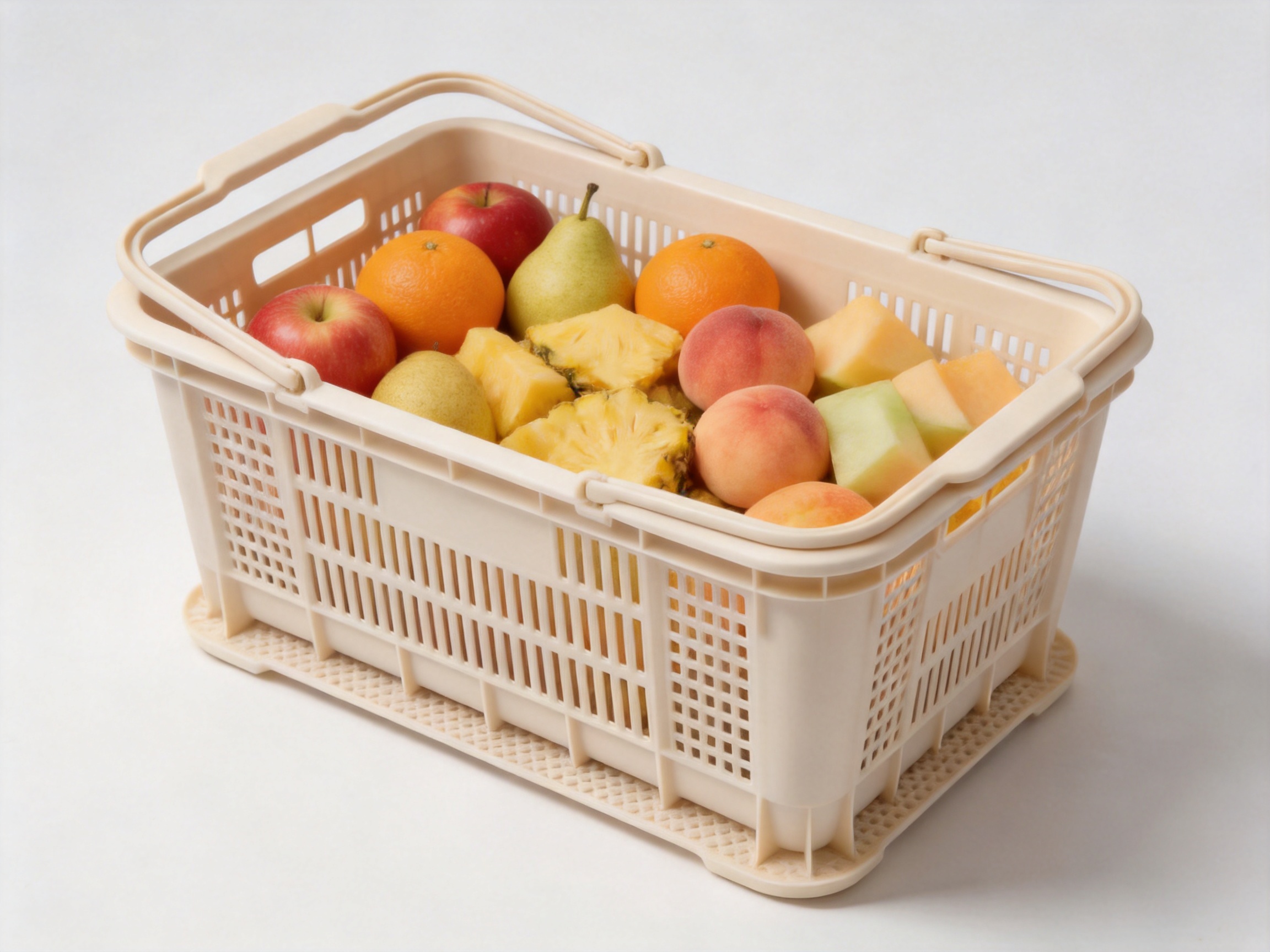
Balanced filling is essential for a product with long side walls, a wide base, multiple ribs, and several openings. If one region fills much earlier than another, the product may show uneven pressure, visible weld lines, trapped air, or deformation. Gate location and runner design should therefore be considered at the earliest engineering stage.
The correct solution depends on the basket’s size, wall thickness, plastic grade, injection machine, and expected cycle time. A mould designed for a specific production environment can perform more efficiently than a generic design transferred without adjustment.
Cooling is one of the main factors affecting cycle time and dimensional stability. Large flat areas can retain heat and may warp if cooling is uneven. Cooling channels should be arranged to support the cavity and core surfaces while avoiding interference with ejectors, sliders, inserts, and other mould components.
Efficient cooling can reduce production time and help maintain stable dimensions from one cycle to the next. It can also reduce the risk of deformation when the basket is ejected before it has developed sufficient rigidity.
A basket with ribs, mesh openings, a folded rim, and textured surfaces must be ejected without damaging the product. Ejector pins, sleeves, stripper systems, or other solutions may be considered depending on the product geometry. Ejection should be distributed to avoid localized stress and visible marks in important areas.
Draft angles must be sufficient for the plastic to release from the mould. If the customer requires very deep texture or nearly vertical walls, the mould designer may need to adjust the surface design or adopt special mechanisms.
The parting line should be positioned to protect the appearance and function of the finished basket. Poor placement can leave a noticeable mismatch, flash, or sharp edge on the rim, handles, or visible side walls. Careful parting-line planning helps improve product appearance and reduces post-processing.
For a custom product, the customer should review the parting-line concept during the design stage. This is an opportunity to confirm which surfaces are most visible and which areas can accept minor mould marks.
A well-designed mould should be maintainable throughout its service life. Wear-prone components, inserts, guide elements, ejectors, and sealing areas should be accessible for inspection and replacement. Replaceable inserts can be useful when customers expect future changes to mesh patterns, logos, handle details, or product dimensions.
Routine maintenance may include cleaning, lubrication, cooling-circuit inspection, rust prevention, alignment checks, and examination of the parting surface. Proper maintenance helps preserve product quality and reduces unexpected downtime.
TaiZhou HuangYan YingXiang Plastic Mould Co., Ltd. is located in Huangyan, Taizhou, Zhejiang, China, a region widely associated with mould manufacturing. Established in 2012, the company operates a plant covering approximately 7,000 square metres and has around 50 employees.
The supplier uses CAD, CAE, and CAM systems to support customized plastic mould development. These technologies allow product geometry, mould construction, flow behaviour, machining paths, and manufacturing details to be coordinated more effectively. For a product such as a large rectangular fruit basket, integrated digital planning can help reduce design conflicts between the mesh walls, handles, rim, ribs, cooling system, and ejection system.
The company’s equipment and experienced technicians support the production of moulds for crates, folding boxes, pallets, trays, beverage boxes, storage products, chairs, stools, household products, and other injection-moulded items. This range of experience is relevant because many of these products share engineering challenges involving large surfaces, reinforced structures, repeated handling, and high-volume production.
The stated manufacturing focus includes lean production, long mould life, on-time delivery, competitive cost, premium quality, and comprehensive customer service. These objectives are especially important for buyers who need a mould that can move from prototype development to stable mass production with limited interruption.
A supplier with experience across multiple product categories may also be able to transfer useful design knowledge from logistics crates, pallets, and household containers to fruit basket development. For example, crate and pallet moulds require attention to load-bearing ribs, deformation control, handling points, and repeatable production. Those skills can support the development of a stronger and more reliable fruit basket mould.
The length, width, height, corner radius, and internal depth can be customized to meet different capacity requirements. A household model may prioritize easy placement on kitchen counters, while a commercial model may require greater volume and stronger handles. The mould design should be based on the actual loading target rather than appearance alone.
The number, size, and arrangement of ventilation openings can be adjusted. Smaller openings may provide greater containment for small fruit, while larger openings may improve airflow and reduce product weight. The pattern can also be designed to create a distinctive visual identity.
Handle length, thickness, grip shape, opening size, and attachment position can be modified. Customers may request a more compact grip for home use or a larger grip for frequent commercial handling. The final configuration should be evaluated through both digital stress review and physical load testing.
The finished basket can be produced in customized colours using suitable plastic colourants or masterbatch systems. Colour selection may support retail branding, seasonal promotions, product differentiation, or coordination with other household items.
Surface finish can range from smooth and glossy to matte or textured. A matte or textured finish may reduce the visibility of handling marks and provide a more practical appearance, while a smoother finish may be preferred for premium presentation and easier visual inspection.
The customer can discuss the preferred plastic according to impact resistance, rigidity, flexibility, weight, surface quality, cost, and regulatory requirements. Material selection should be completed before final mould-flow analysis because different plastics have different processing and shrinkage behaviours.
Quality control begins with the review of raw materials and mould steel. Steel certificates, hardness requirements, component dimensions, and surface-treatment specifications should be checked according to the agreed project standard. Precision inspection is then used to verify critical mould components before assembly.
During mould trials, the supplier should evaluate the first samples against approved drawings or reference samples. Important inspection points include overall length and width, basket height, interior capacity, handle alignment, opening dimensions, rim shape, base flatness, rib definition, texture, and visible cosmetic areas.
Functional testing may include load testing, handle lifting, repeated placement, base stability, stacking evaluation, and cleaning assessment. If the basket is intended for food storage, the customer should also confirm material and regulatory compliance for the target market.
Dimensional inspection is particularly important for a rectangular basket because warpage can affect stacking and shelf presentation. Even small deviations in the long side walls may cause the basket to rock, fail to sit flush with neighbouring baskets, or show uneven gaps during display.
Sample approval should be based on agreed acceptance criteria. Clear documentation helps avoid uncertainty concerning acceptable weld lines, gate marks, ejection marks, colour variation, texture, and minor cosmetic characteristics that may occur in injection moulded products.
After final inspection and approval, the mould is packaged in a composite wooden box for transportation. Proper packaging protects the mould from impact, moisture, dust, and movement during handling. Moving components should be secured, exposed surfaces should be protected against corrosion, and lifting points should be identified clearly.
Project support may include product design communication, mould structure review, material recommendations, sample evaluation, modification, and production guidance. OEM service is available for customers that require a mould developed around their own drawings, brand strategy, dimensions, or distribution channel.
Effective communication is essential for custom mould projects. The customer should provide product references, estimated annual volume, preferred machine information, material requirements, target cycle time, packaging expectations, and delivery priorities. The supplier can then recommend a mould concept that balances performance, cost, and manufacturability.
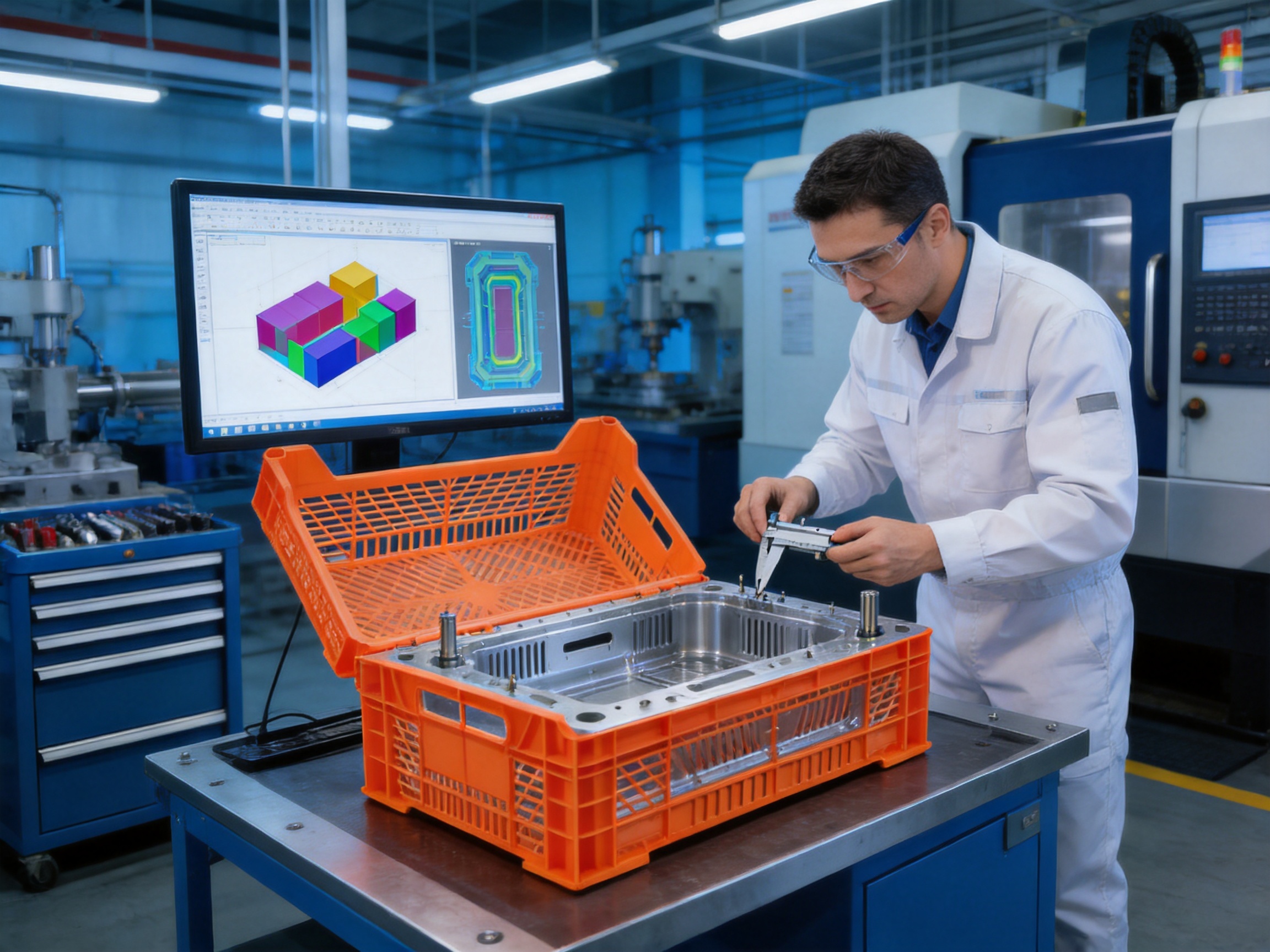
In homes, the basket can be used to store fruit in kitchens, dining rooms, pantries, utility rooms, or covered outdoor areas. Its large capacity allows families to organize weekly purchases in one container. Ventilation openings make it more suitable for temporary storage than a completely sealed box, while the handles make relocation easier.
Retail shops can use the basket for product display, back-room organization, or short-distance movement of produce. The rectangular footprint supports orderly shelf arrangements and allows employees to transport a substantial quantity without using several smaller containers.
Supermarkets may use customized colours and dimensions to create coordinated produce displays. The broad upper opening makes the contents visible, and the reinforced rim helps the basket maintain its appearance during repeated stocking and customer interaction.
The large internal space can be useful when preparing fruit for parties, meetings, picnics, restaurants, and catering events. Handles allow the basket to be moved from a preparation area to a serving or display area. The product should be cleaned and used according to the material and food-contact requirements established for the selected plastic.
The basket can be developed as part of a wider household storage range. Matching colours, surface textures, handles, and design language can link the fruit basket with storage boxes, trays, shopping baskets, stools, or other plastic products. A shared moulding strategy may help a retailer establish a consistent product family.
The cost of a fruit basket mould depends on product size, cavity quantity, steel grade, mould structure, surface finish, cooling design, ejection system, hot-runner or cold-runner configuration, and expected production volume. A low initial price does not always represent the lowest total cost. Mould reliability, cycle time, maintenance, part quality, and service life also affect the final economics.
A well-engineered mould can support lower rejection rates and more stable production. Balanced filling reduces short shots and cosmetic defects, efficient cooling may shorten the cycle, and reliable ejection helps protect the basket during removal. Over the mould’s service life, these factors can have a substantial effect on production cost.
Material efficiency is another important consideration. The product should be strong enough for its intended load without unnecessary thickness. Rib design, corner reinforcement, and handle geometry can provide structural performance while avoiding excessive material consumption. The correct balance should be confirmed through engineering analysis and physical testing.
For high-volume customers, multi-cavity moulds may be considered if the product size, machine capacity, production target, and budget support that approach. For customized or lower-volume products, a single-cavity or lower-cavity mould may provide greater flexibility and lower initial investment. The supplier can evaluate these alternatives according to the customer’s forecast.
Plastic baskets can provide long service life when designed and used correctly. Durable products may reduce the need for frequent replacement compared with fragile or short-lived alternatives. The choice of plastic, product weight, packaging, and transportation method should nevertheless be considered as part of the overall environmental profile.
Where appropriate, customers may investigate recyclable material options or controlled use of recycled content. Any recycled material must be evaluated for colour consistency, odour, mechanical performance, processing stability, and compliance with the intended application. For food-related use, regulatory requirements are particularly important.
The basket’s open design can support easy visual inspection and cleaning. Smoothly finished surfaces, rounded corners, and suitable drainage or ventilation features may improve hygiene management. The final cleaning method should be compatible with the selected plastic and the operating environment.
Buyers should assess whether the mould supplier has experience with products of similar size, structure, and production volume. Experience with crates, pallets, folding boxes, beverage boxes, storage containers, and other household products can indicate familiarity with reinforced plastic structures and repeated-use moulding.
The supplier’s design capability should include three-dimensional modelling, mould-flow or CAE support, cooling analysis, ejection planning, and practical manufacturability review. A supplier that only copies a surface model may overlook filling balance, shrinkage, maintenance, or long-term production requirements.
Customers should also ask about steel options, heat treatment, inspection equipment, trial procedures, modification policy, spare parts, packaging, and technical support. Clear answers in these areas can help reduce risk during mould acceptance and later production.
Communication speed and technical clarity are also important. Custom moulds involve decisions about dimensions, plastic, surface finish, tolerances, delivery, and machine compatibility. A capable supplier should be able to explain the consequences of each decision and recommend practical alternatives.
It is designed to manufacture a large rectangular plastic fruit basket with a spacious internal cavity, semi-perforated ventilation walls, reinforced handles, a wide folded-over rim, structural ribs, and an anti-slip base texture.
Yes. The model, length, width, height, internal capacity, handle configuration, opening pattern, and other design details can be customized according to the customer’s drawings, market requirements, and production objectives.
Possible materials include PP, PC, PS, POM, PE, PU, PVC, ABS, PMMA, and other suitable plastics. The final selection should be based on strength, flexibility, appearance, processing behaviour, cost, food-contact requirements, and the intended market.
Polypropylene is often considered suitable for household baskets because it can provide a useful balance of light weight, toughness, chemical resistance, colour flexibility, and cost efficiency. The specific PP grade should be confirmed according to the required load and processing conditions.
Possible mould steels include 1CR13, 2CR13, 3CR13, 4CR13, S136, CR16, 2316, 718H, and P20. The best choice depends on production volume, corrosion resistance, polishability, wear conditions, maintenance expectations, and budget.
The rectangular shape uses shelf and countertop space efficiently, supports organized fruit placement, and can hold a large quantity without requiring excessive depth. It is also convenient for retail display and side-by-side arrangement.
The semi-perforated mesh structure allows air to circulate around the fruit and helps reduce heat and moisture accumulation compared with a fully closed container. It is intended for practical short-term storage and display, not as a substitute for suitable food-storage controls.
The extended and thickened handles are designed to improve stability and comfort when the basket is fully loaded. Actual load performance depends on the final design, selected plastic, moulding conditions, and testing results.
The wide folded-over rim improves the basket’s perimeter rigidity, gives the product a finished appearance, and provides a more comfortable edge for handling. It may also help maintain the shape of the upper opening during repeated use.
Mould quality is evaluated through component inspection, assembly checks, trial production, and sample assessment. Important checks include filling, flash, short shots, warpage, sink marks, surface quality, handle alignment, dimensional accuracy, ejection, and base stability.
Yes. OEM service is available. Customers can provide their own drawings, product concepts, dimensions, colour requirements, surface details, and packaging expectations for a customized injection moulding solution.
The mould is packaged in a composite wooden box. The packaging is intended to protect the tool during transportation and handling, while exposed mould surfaces and moving components should be secured and protected against moisture and impact.
The customer should provide the product drawing or reference sample, target dimensions, estimated annual quantity, preferred plastic, colour, surface finish, expected mould life, production machine information, delivery target, and any special inspection or regulatory requirements.
The supplier is located in Huangyan, Taizhou, Zhejiang, China, an established mould-manufacturing area. The company operates an approximately 7,000-square-metre plant and has around 50 employees.
The large rectangular fruit basket mould is a practical solution for producing high-capacity plastic baskets intended for household storage, retail display, fruit shops, supermarkets, catering, and event preparation. Its principal advantages come from the combination of rectangular space efficiency, semi-perforated ventilation, thickened load-bearing walls, reinforced handles, a broad rigid rim, and a strengthened anti-slip base.
Compared with basic fruit baskets, this design is better positioned for users who need greater capacity, easier movement, improved organization, and stronger support under load. Its customization potential also allows buyers to adapt the size, colour, material, opening pattern, texture, and handle form to their target market.
The success of the finished product depends heavily on mould engineering. CAD, CAE, and CAM planning, accurate machining, suitable steel selection, balanced filling, efficient cooling, reliable ejection, careful surface finishing, and systematic trial testing all contribute to a dependable production tool. A supplier with experience in crates, pallets, folding boxes, storage products, and other injection-moulded household items can apply relevant knowledge to the design of this basket.
For customers seeking a durable and commercially viable plastic fruit basket, the mould should be evaluated not only by its quotation but also by its expected service life, production efficiency, maintenance requirements, product consistency, and technical support. A correctly engineered tool can provide a stable foundation for long-term manufacturing and a differentiated product for competitive household and retail markets.
1. Injection Moulding Design Principles: Gate Selection, Cooling, Draft, Ejection, and Warpage Control.
2. Engineering Plastics and Commodity Polymers: Material Selection for Household Injection-Moulded Products.
3. Plastic Product Development Practice: CAD, CAE, CAM, Mould-Flow Analysis, and Prototype Validation.
4. Mould Steel Selection Guide: Corrosion Resistance, Hardness, Polishability, Wear Performance, and Maintenance.
5. Quality Control Procedures for Custom Plastic Injection Moulds and Household Storage Containers.
6. General Food-Contact Product Considerations for Plastic Storage and Display Containers.
7. Technical information supplied for the rectangular large fruit basket mould and customized plastic injection manufacturing services.
If you are interested in any of our products or services, please feel free to ask and we can talk about your ideas.
 QUICK LINKSMOBILE SITE
 FACTORY ADDRESS
 CONTACT INFORMATION