A low stool with round holes is a simple household product, but producing it consistently at commercial scale requires a carefully engineered plastic injection mould. The stool must combine stability, comfort, impact resistance, easy cleaning, efficient material use, and attractive appearance. At the same time, the mould must support repeatable production, fast cycle times, reliable demoulding, and a long service life. These requirements make the design and manufacture of the stool mould especially important.
The low stool with round holes is suitable for homes, bathrooms, kitchens, balconies, workshops, retail stores, schools, and many other everyday environments. Its compact structure makes it easy to move and store, while the circular openings reduce visual weight and may help lower material consumption. The openings also provide a convenient handhold and contribute to the product’s recognizable appearance.
For manufacturers, the main challenge is to transform this functional product concept into a mould that can produce stable parts with consistent wall thickness, clean hole edges, controlled shrinkage, and a smooth surface finish. A well-designed mould directly influences the stool’s strength, appearance, production cost, and long-term market value.
With experience in household product moulds and customized plastic injection solutions, TaiZhou HuangYan YingXiang Plastic Mould Co., Ltd. provides engineering and manufacturing capabilities for low stool mould projects. The company combines product analysis, mould design, precision machining, assembly, testing, and technical support to help customers develop dependable plastic seating products for different markets.

Low Stool with Round Holes
A low stool with round holes is generally designed as a small, lightweight seat or support platform. Its low height makes it convenient for children, casual seating, dressing areas, bathrooms, kitchens, gardens, and short-duration work. Depending on the final design, it may also function as a footrest, step support, plant stand, display platform, or portable household accessory.
The round holes are one of the product’s most distinctive features. They can be distributed across the seat surface, side walls, or supporting structure according to the customer’s design. These openings may improve ventilation, prevent water accumulation, reduce the visual bulk of the stool, and make the product easier to carry. In some applications, the holes also create a decorative pattern that differentiates the product from ordinary solid stools.
A successful design must balance the number, size, and location of the holes with the load-bearing needs of the stool. If the openings are too large or too close to structural areas, they may weaken the seat or legs. If they are too small, they may be difficult to mould, difficult to clean, or visually ineffective. The mould design must therefore reflect the product’s functional requirements from the earliest development stage.
The stool can be manufactured from several injection moulding materials, including polypropylene, high-density polyethylene, acrylonitrile butadiene styrene, or other engineering and household plastics. Polypropylene is often selected for its low density, good impact resistance, chemical resistance, and suitability for daily-use products. The final resin depends on the required strength, surface appearance, colour, flexibility, environmental conditions, and target price.
Because low stools are frequently moved, stacked, washed, or exposed to changing temperatures, the product should be designed for repeated handling. Rounded corners, reinforced legs, stable feet, and correctly proportioned structural ribs can improve practical performance. The mould must reproduce these features accurately without creating excessive marks, uneven filling, or difficult ejection points.
The low stool can be made relatively lightweight while maintaining useful strength. Round openings reduce unnecessary material in selected areas and may make the product easier for children, elderly users, and retail customers to carry. A lighter stool also reduces transportation costs and makes warehouse handling more efficient.
Lightweight construction does not mean weak construction. Through suitable rib design, support geometry, material selection, and mould filling control, the product can achieve a strong balance between low weight and structural performance. A mould manufacturer with experience in plastic household products can help optimize this balance during the engineering stage.
In bathrooms, kitchens, outdoor areas, and cleaning environments, water drainage is an important consideration. Round openings can allow water and moisture to pass through more easily than a fully closed structure. This can help reduce standing water and improve drying after washing.
Ventilation is also useful in humid environments. A stool with suitable openings may be less likely to retain moisture beneath the seat or inside enclosed structural areas. The final result depends on the placement and size of the holes, as well as the overall design of the underside and legs.
The holes can serve as integrated handholds, allowing users to pick up the stool without adding a separate handle. This reduces the number of components and simplifies assembly because the stool can be produced as a single moulded product or as a small number of moulded parts.
A compact low stool may also be designed for stacking. If the customer requires stackability, the mould designer must carefully control the taper, leg position, seat underside, and clearance between nested products. Stackability can improve retail presentation, warehouse efficiency, and transport utilization.
Round holes offer a clean, modern, and approachable visual style. They can create a repeated pattern that makes the stool more appealing than a plain solid design. The pattern may be adapted for different customer brands, market preferences, age groups, and colour themes.
The appearance of the final product depends not only on the external geometry but also on mould surface quality, gate location, welding line control, ejection design, and cooling balance. A carefully manufactured mould can help create uniform surfaces and reduce visible defects that might otherwise affect the product’s perceived quality.
A stool used in household environments should be easy to clean. Smooth surfaces and appropriately radiused transitions help prevent dirt from accumulating in sharp corners. Openings can also improve access for washing and rinsing, especially when the stool is used in areas where dust, water, or food particles may be present.
When designing the mould, the manufacturer should avoid unnecessary deep recesses, undercuts, or narrow channels that could complicate cleaning or mould release. Good product design and good mould design work together to produce a stool that is practical throughout its service life.
In plastic injection moulding, the mould is the core production asset. It defines the product’s dimensions, surface texture, structural details, holes, ribs, feet, corners, and functional interfaces. Even if the original product concept is well designed, an inaccurate or poorly balanced mould may result in warping, short shots, flash, sink marks, burn marks, uneven holes, or inconsistent weight.
For a low stool with round holes, the mould must manage several complex areas. The seat may require a broad filling area, while the holes interrupt material flow. The supporting legs may be thicker than the seat and may cool at a different rate. Reinforcing ribs may create local changes in wall thickness. These differences can affect shrinkage and deformation if they are not addressed through simulation and practical engineering.
The mould should also provide reliable ejection. A stool may have a deep shape, multiple openings, or structural features that increase the risk of sticking. Ejector pins, stripper systems, lifters, sliders, and draft angles must be selected according to the specific product geometry. The objective is to remove the moulded part without whitening, scratches, distortion, or damage to the hole edges.
Mould longevity is another essential consideration. Household products are often manufactured in large quantities, so the mould may complete many production cycles over several years. Proper steel selection, heat treatment, cooling design, wear-resistant components, and maintenance access can reduce downtime and protect the customer’s investment.
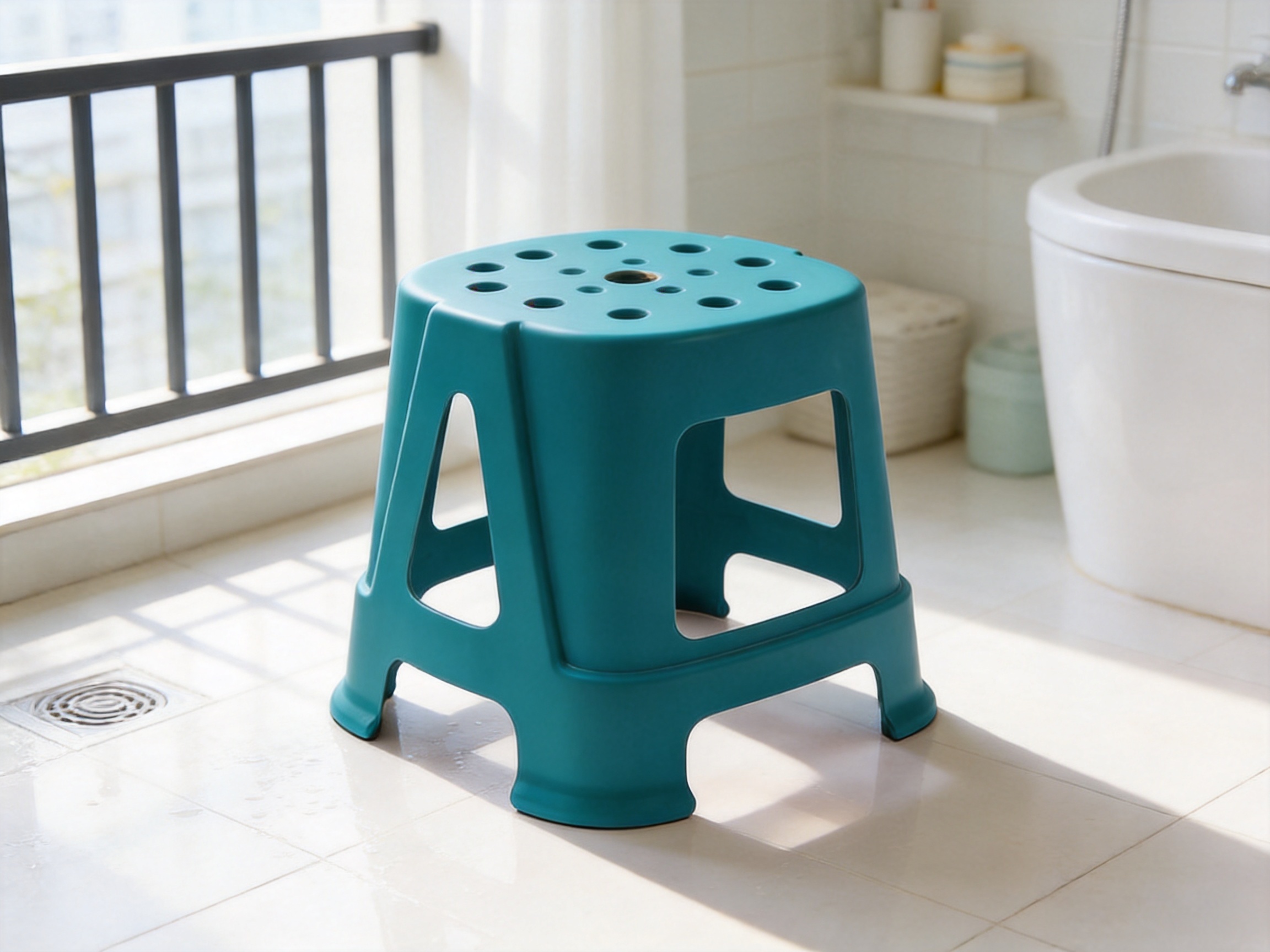
The seat and legs must distribute the user’s weight safely. A broad seat can improve comfort, but it may also require stronger support beneath the surface. Reinforcement ribs can increase rigidity without making every section excessively thick. The ribs should be positioned to support the main load paths while avoiding unnecessary material accumulation.
The transition between the seat and legs deserves special attention. Sharp changes in geometry can create stress concentration and may increase the risk of cracking or sink marks. Rounded transitions help the plastic flow more smoothly and can improve both strength and appearance.
The design should also consider uneven loading. Users may sit near the edge, stand briefly on the stool, or move it while carrying an object. The moulded product should therefore have adequate stability and resistance to localized force. Engineering analysis and prototype testing can help identify weak areas before mass production.
The holes should have clean edges and adequate draft where necessary. If the holes pass through a flat seat or vertical wall, the core features that create them must be rigid and accurately aligned. Small errors in core positioning can lead to uneven walls, partial flash, or inconsistent visual patterns.
Hole spacing should leave enough material between adjacent openings to preserve strength. The surrounding plastic must also be thick enough to fill correctly and withstand repeated use. The appropriate design depends on the stool’s dimensions, resin, expected load, and intended application.
Rounded hole edges may improve comfort and reduce the possibility of sharp contact points. They can also make the product easier to clean. However, edge radii must be carefully machined into the mould so that the final product has a consistent result across every production cycle.
Draft angles allow the moulded stool to separate from the cavity and core. Without sufficient draft, the part may stick, require excessive ejection force, or develop surface marks. The correct draft depends on the texture, depth, material, and geometry of each area.
Round openings can create special demoulding requirements. Straight-through holes are usually easier to form, while angled or interrupted holes may require additional core design or moving components. If the stool includes side openings, nested surfaces, or interlocking features, the mould may need sliders or lifters to release the part safely.
Early agreement between the product designer and mould engineer is important. Small changes to hole direction, wall angle, or rib placement can simplify the mould considerably while preserving the intended appearance of the stool.
Uniform wall thickness is a central principle in injection moulding. Excessively thick areas may develop sink marks, internal voids, or longer cooling times. Very thin sections may produce short shots or weak structures. The design should therefore seek a balanced wall thickness supported by ribs where extra rigidity is needed.
Plastic shrinkage varies according to material, mould temperature, packing pressure, cooling time, geometry, and fibre content. The mould dimensions must compensate for expected shrinkage, while the cooling system must remove heat evenly. Uneven cooling can cause the stool to warp, twist, or fail to sit level on a flat surface.
The mould development process begins with a feasibility review. Engineers examine the three-dimensional product data, intended material, target production volume, injection machine capacity, surface requirements, and expected product performance. They identify areas that may cause filling problems, difficult demoulding, excessive shrinkage, or high machining complexity.
At this stage, the customer may receive recommendations concerning wall thickness, draft angle, hole arrangement, rib structure, parting line position, gate location, and ejection method. Resolving these points before steel cutting can reduce development time and prevent expensive modifications later.
A feasibility review is particularly valuable for household stools because the product often has a large visible surface combined with multiple structural openings. A small design change may improve mould balance, production stability, and final appearance simultaneously.
Modern mould manufacturing depends on the integration of computer-aided design, engineering analysis, and manufacturing software. CAD systems are used to create the mould structure, cavity and core components, cooling channels, ejection mechanisms, inserts, and supporting plates.
CAE analysis can help predict filling behaviour, pressure requirements, weld lines, air traps, cooling imbalance, and possible warpage. Simulation does not replace practical experience, but it provides valuable insight before machining begins. Engineers can compare alternative gate locations and identify areas that may need venting or modified geometry.
CAM systems convert approved designs into machining strategies. Tool paths can be optimized for roughing, semi-finishing, finishing, drilling, and electrode manufacturing. The connection between design and machining reduces manual interpretation and helps maintain dimensional consistency across complex components.
Yingxiang uses CAD, CAE, and CAM systems as part of its mould engineering capabilities. This integrated approach supports customized mould development for stools, household products, logistics crates, folding boxes, pallets, trays, beverage boxes, and other injection-moulded products.
Mould steel must be selected according to the expected production volume, plastic material, surface requirements, structural complexity, and maintenance plan. A mould intended for extended production should use steel with appropriate toughness, hardness, machinability, and wear resistance.
Heat treatment can improve the performance of selected mould components. Properly treated steel can resist deformation, wear, and repeated thermal cycling. The choice of treatment depends on the steel grade and the function of the component. Core inserts, cavity blocks, sliders, guide components, and wear plates may require different specifications.
Good steel selection is a competitive advantage because it affects the mould’s service life and the stability of the moulded stool. A lower initial cost may not be beneficial if the mould requires frequent repairs, produces inconsistent parts, or loses surface quality after a limited number of cycles.
CNC machining is used to create cavity surfaces, core structures, inserts, ejector holes, cooling passages, and other mould components. High-quality machining helps achieve accurate dimensions and smooth transitions, particularly around the round holes and visible external surfaces of the product.
Rough machining removes most of the material efficiently, while semi-finishing establishes a controlled allowance for final operations. Finishing operations then refine the surface and geometry. The machining sequence must account for tool access, material stability, thermal effects, and the need to protect delicate core features.
For a stool mould, the round-hole cores may be relatively slender compared with surrounding cavity structures. They must be manufactured and supported accurately to prevent deflection or misalignment. Careful machining and inspection are important for keeping every hole consistent across the product.
Electrical discharge machining can be used for areas that are difficult to reach with conventional cutting tools. EDM is valuable for narrow slots, deep corners, complex ribs, sharp transitions, and detailed inserts. It can help produce features that would otherwise require compromises in geometry or tool access.
Electrodes must be designed and manufactured with appropriate allowance, alignment, and wear compensation. The EDM process should be controlled to achieve the required surface condition without creating excessive recast layers or dimensional variation.
The mould surface influences the appearance, release behaviour, and cleaning characteristics of the stool. Depending on the customer’s requirements, the surface may be polished, textured, etched, or finished with a controlled matte appearance.
Polishing must be carried out carefully around holes, ribs, corners, and parting lines. Over-polishing can alter dimensions or soften important details, while insufficient finishing may create visible machining marks. Consistent surface treatment is especially important when the stool is produced in bright colours or with a high-gloss appearance.
Texturing can improve grip, disguise minor flow marks, and create a distinctive product style. However, textured surfaces generally require greater draft to support demoulding. The texture specification should therefore be considered together with the mould release strategy.
The gate introduces molten plastic into the mould cavity. Its position affects filling balance, weld line location, packing pressure, surface appearance, and cycle time. For a low stool, the gate should help distribute material across the seat and supporting structures while minimizing visible marks in important areas.
Depending on the product design and production requirements, the mould may use a central gate, side gates, multiple gates, or a hot runner system. The best solution depends on the stool’s size, resin, colour, expected output, and acceptable cosmetic standards.
Multiple gates can improve filling balance for larger or more complex products, but they may create weld lines where material fronts meet. A properly designed runner system and suitable processing conditions can reduce this risk. Gate vestige should also be positioned where it is less visible or less likely to affect user comfort.
Cooling is one of the most important factors in injection moulding productivity. After the cavity is filled and packed, heat must be removed before the stool can be ejected. An efficient cooling system can shorten cycle time while reducing warpage and dimensional variation.
Cooling channels should be placed at suitable distances from the cavity surface and arranged to address thick areas, legs, ribs, and regions around the holes. Balanced cooling on both sides of the mould helps the product solidify more evenly. If one area remains hot while another cools quickly, internal stress and deformation may occur.
The mould designer must also consider the space required for ejector pins, screws, inserts, sliders, and structural supports. Cooling channels should be practical to manufacture, clean, and maintain. Proper sealing and pressure testing are necessary before the mould enters production.
The stool must be ejected without damage after cooling. Ejection systems may include ejector pins, sleeves, plates, stripper systems, or combinations of these methods. The force should be distributed across structurally strong areas rather than thin cosmetic surfaces.
If ejector pins are placed too close to holes or ribs, they may create marks or weaken the product. If too few ejectors are used, the part may bend or remain attached to the core. The mould engineer must consider the product’s shrinkage direction, contact area, release force, and production speed.
Reliable ejection improves automation potential and reduces operator intervention. It also protects the mould from excessive force, which can extend service life and reduce maintenance requirements.
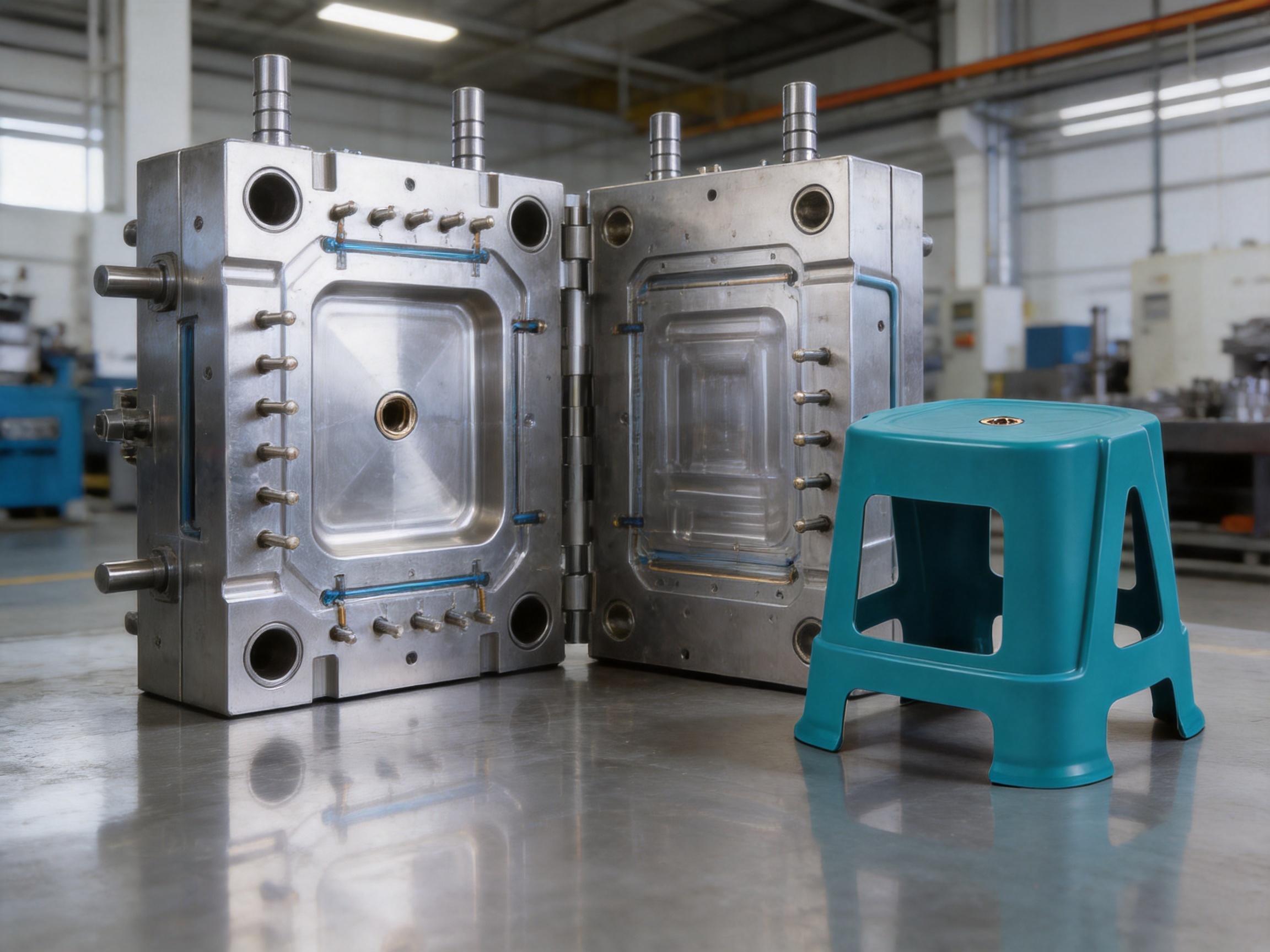
Quality control begins with the inspection of mould steel and purchased components. Material certificates, dimensions, hardness requirements, and supplier documentation should be reviewed according to the project specification. Correct material identification is important because hidden differences in steel quality can affect machining, heat treatment, wear resistance, and mould life.
Machined components should be inspected using appropriate measurement tools and procedures. Critical dimensions include cavity and core profiles, hole positions, parting surfaces, guide systems, ejector locations, cooling connections, and interchangeable inserts.
Dimensional inspection helps ensure that the moulded stool will meet the approved product design. It also confirms that moving parts have the correct clearances and that the mould can close evenly without excessive wear or flash.
During mould assembly, engineers check alignment, movement, contact, lubrication, fasteners, water connections, ejector travel, and safety features. Sliders and lifters should move smoothly without binding. Guide pillars and bushes should maintain accurate alignment throughout the opening and closing cycle.
Parting surfaces must be clean and properly matched. Any mismatch can create flash on the stool or damage the mould over time. Assembly verification is particularly important for a stool mould with numerous round-hole cores because all core features must remain correctly positioned during closure.
Trial moulding validates the mould under practical production conditions. The mould is installed on a suitable injection machine and tested with the intended or an approved equivalent resin. Engineers observe filling, pressure, cooling, ejection, cycle time, product weight, dimensions, and surface appearance.
Trial samples are examined for short shots, flash, sink marks, burn marks, warpage, weld lines, colour variation, hole deformation, and ejection marks. If necessary, adjustments are made to processing parameters, vents, gates, cooling, polishing, or mould components.
A successful trial should demonstrate that the mould can produce stable parts rather than only one acceptable sample. Repeat cycles help identify thermal or mechanical issues that may not appear during an initial inspection.
Final acceptance should be based on the approved product drawings, sample standards, functional requirements, and customer specifications. Important checks may include stool stability, load performance, levelness, hole dimensions, surface quality, stackability, colour, weight, and ease of demoulding.
Documentation may include mould inspection records, trial reports, product measurement data, material information, maintenance recommendations, and spare-part lists. Clear records help the customer operate and maintain the mould effectively after delivery.
The quality difference between a professional mould and an ordinary mould is often visible in production stability rather than in the first sample alone. A poorly engineered mould may produce an acceptable part at low speed but become unreliable when production volume increases. It may require frequent parameter adjustments, manual trimming, repeated polishing, or unexpected repairs.
A professionally engineered low stool mould offers better control over dimensional consistency. The round holes remain uniform, the stool sits level, the legs maintain their intended geometry, and the visible surfaces show fewer defects. Consistency is important for customers selling products through retail channels, contract supply, or large distribution networks.
Another advantage is improved cycle efficiency. Balanced filling, effective cooling, and reliable ejection can help reduce unnecessary production time. Even a small saving per cycle can create substantial value during high-volume manufacturing.
Durability is also a major differentiator. Strong mould construction, suitable steel, accurate machining, and replaceable wear components can reduce the risk of premature failure. The customer benefits from longer production continuity and lower total ownership cost.
Professional mould engineering also provides greater design flexibility. Customers may request changes in hole pattern, stool height, surface texture, colour, logo area, stacking arrangement, or structural reinforcement. A capable manufacturer can evaluate these requirements and propose practical solutions rather than simply reproducing a basic shape.
TaiZhou HuangYan YingXiang Plastic Mould Co., Ltd. is located in Huangyan, Taizhou, Zhejiang, China, a region widely recognized for mould manufacturing. The company was established in 2012 and operates a plant covering approximately 7,000 square metres with around 50 employees.
The company specializes in customized plastic mould solutions for household and industrial applications. Its product experience includes crate moulds, folding box moulds, tray moulds, pallet moulds, beverage box moulds, storage container moulds, chair moulds, stool moulds, floor mat moulds, hand basket moulds, trash can moulds, and other daily-use plastic products.
This broad product range is relevant to low stool mould development because many moulding principles are shared across household products. Experience with crates and pallets contributes knowledge of structural reinforcement, high-volume production, impact resistance, and long-life mould construction. Experience with chairs, baskets, containers, and other household products supports attention to ergonomics, surface quality, handling, and appearance.
The company’s use of advanced CAD, CAE, and CAM systems supports an integrated development process. Product geometry can be reviewed, mould structure can be evaluated, filling and cooling issues can be considered, and machining data can be prepared through connected engineering workflows.
Experienced technicians are important in converting digital designs into reliable moulds. Software can identify potential problems, but practical mould knowledge remains necessary for deciding how to polish a difficult area, support a slender core, arrange cooling channels, select an ejection position, or make a modification during trial moulding.
Yingxiang focuses on lean manufacturing, long-life moulds, on-time delivery, competitive costs, premium quality, and comprehensive customer service. These priorities are valuable to customers who need more than a basic tool. A complete mould project should include technical communication, design review, manufacturing, testing, delivery support, and follow-up assistance.
The low stool can be adapted to different market expectations. Some customers may require a very compact stool for children or bathrooms, while others may need a wider seat for general household use. Changes in height, seat diameter, leg shape, and footprint affect both product performance and mould structure.
Customized dimensions should be evaluated for stability, mould opening space, injection capacity, cooling time, and material usage. A larger stool may require a different gate system, additional reinforcement, or a larger machine than a small stool.
Round holes can be arranged in rows, rings, symmetrical groups, or decorative patterns. The pattern can become part of the product’s visual identity. Customers may also request different opening sizes or a combination of functional and decorative holes.
Any change to the hole pattern should be reviewed for strength, filling, venting, machining access, and demoulding. A pattern that appears attractive in a drawing may require additional mould mechanisms if the holes are angled or located on complex surfaces.
Plastic stools can be produced in many colours to suit retail collections, home décor, children’s products, commercial environments, or seasonal promotions. The mould surface finish should be selected according to the desired visual result.
Glossy surfaces can create a bright and polished appearance but may show flow marks and scratches more easily. Matte or textured finishes may provide a more forgiving appearance and improved grip. The customer can select a suitable finish based on product positioning and production conditions.
A logo, recycling symbol, material mark, size mark, or production code may be incorporated into the mould. These details should be positioned where they are visible but do not compromise comfort, cleaning, or structural integrity.
Raised or recessed identification features require careful consideration of draft, text depth, orientation, and polishing. Clear mould documentation helps ensure that the approved branding details are reproduced consistently.
For retail and wholesale distribution, stackability can reduce packaging volume and improve transportation efficiency. The product may be designed with controlled nesting clearance, reinforced contact points, and a stable stacking direction.
The mould manufacturer can review the interaction between product geometry and packaging requirements. This may include checking whether nested stools release easily, whether they become stuck together, and whether stacked loads place excessive pressure on visible surfaces.
Even a well-made mould requires suitable operation and maintenance. The injection machine should have enough clamping force, injection capacity, platen space, and ejection stroke for the mould. Processing parameters should be developed according to the chosen material and validated through trial production.
Operators should monitor mould temperature, injection pressure, holding pressure, cooling time, cycle time, and product weight. Sudden changes may indicate blocked cooling channels, damaged components, material variation, or developing wear.
After production, the mould should be cleaned and dried. Water circuits should be checked for leakage or blockage, and moving components should receive suitable lubrication. Parting surfaces should be protected from dust, rust, and impact.
Periodic maintenance should include inspection of guide systems, ejector pins, return springs, sliders, lifters, wear plates, screws, cooling connections, and vent areas. Small issues should be corrected before they cause production interruptions or damage to the cavity and core.
When the mould is stored for an extended period, it should be cleaned, dried, treated with an appropriate rust preventive, and stored in a controlled environment. The mould should be left in a safe condition with moving components positioned according to the manufacturer’s recommendations.
The purchase price of a mould is only one part of the total cost of ownership. Customers should also consider cycle time, scrap rate, maintenance frequency, mould life, product consistency, labour requirements, energy usage, and the cost of potential production interruptions.
A mould with a slightly higher initial investment may provide better value if it produces stable parts for a longer period and requires fewer repairs. Accurate cooling and ejection can reduce cycle time, while good cavity finishing can reduce manual trimming and post-processing.
Material efficiency is another important factor. A product designed with suitable wall thickness and reinforcement can reduce resin consumption without sacrificing strength. Since the stool is typically produced in large quantities, even a small reduction in product weight may create meaningful savings.
Lower scrap is equally valuable. Defective stools consume resin, machine time, labour, and packaging resources. A mould that controls warpage, flash, short shots, and hole defects can improve the overall efficiency of the production line.
The low stool with round holes can serve many customer segments. In residential environments, it may be used as a small seat, footrest, bathroom stool, children’s stool, or temporary step. Its easy-clean surface and compact form make it suitable for everyday domestic use.
In commercial settings, the stool may be used in salons, retail stores, classrooms, workshops, service areas, and hospitality environments. Commercial users often value durability, easy cleaning, stackability, and the ability to purchase consistent quantities.
Outdoor applications may include balconies, gardens, camping areas, market stalls, and recreational spaces. For outdoor use, the material and colour system should be selected for suitable resistance to moisture, sunlight, and temperature changes.
Retail brands may choose the product as part of a coordinated household collection. Matching colours, patterns, baskets, storage containers, and other plastic products can create a unified product line. A customized stool mould can help a brand achieve a distinctive style while using an efficient injection moulding process.
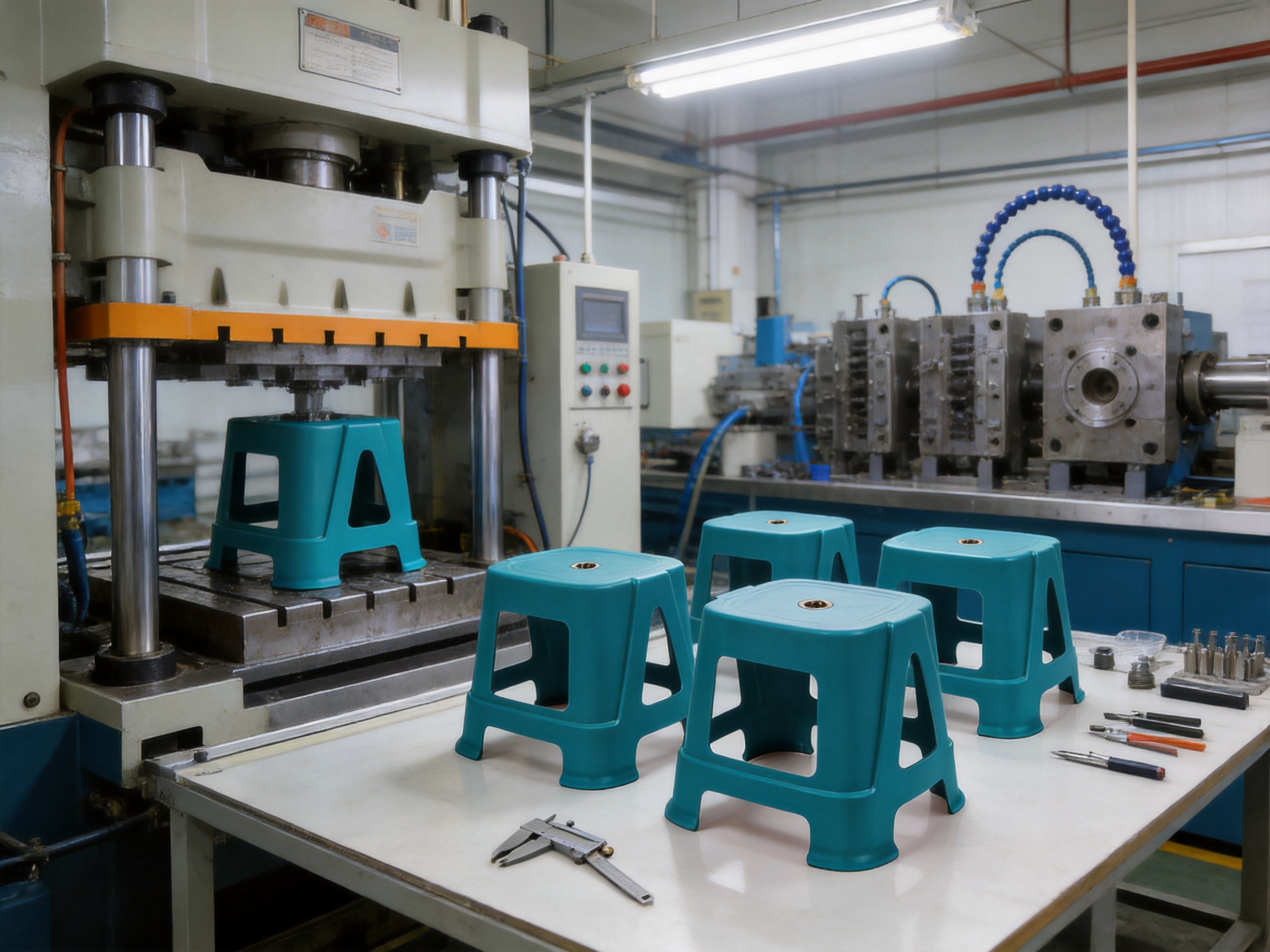
Successful mould development depends on clear communication between the customer and manufacturer. Important information includes three-dimensional product files, two-dimensional drawings, resin requirements, expected production quantity, injection machine details, surface finish, colour, tolerance, packaging method, and acceptance criteria.
If the customer does not yet have a final product design, the mould manufacturer may provide engineering recommendations based on practical injection moulding experience. Early discussion can identify opportunities to simplify the mould, improve strength, reduce material, or make the stool easier to stack and clean.
Communication should continue through design approval, mould manufacturing, trial moulding, sample confirmation, shipment, installation, and maintenance. A clear record of design changes prevents misunderstandings and allows future replacement parts or modifications to be produced accurately.
Yingxiang provides customer-oriented support for customized plastic mould projects. Its service approach emphasizes technical cooperation, quality control, delivery planning, and long-term customer relationships. For international customers, direct communication regarding specifications, samples, testing, and production conditions is especially important.
| Evaluation Area | Low Stool with Round Holes | Value to the Customer |
|---|---|---|
| Handling | Openings can provide integrated handholds and reduce product weight | Easier movement, storage, and retail handling |
| Ventilation | Open geometry allows air movement through selected areas | Useful in humid rooms and after washing |
| Drainage | Round openings can help water pass through the seat or side structure | Faster drying and easier cleaning |
| Appearance | Repeated circular details create a distinctive visual style | Improved product recognition and shelf appeal |
| Material Efficiency | Openings and optimized ribs can reduce unnecessary plastic | Lower part weight and potential material savings |
| Structural Design | Reinforced legs and seat transitions support practical use | Improved stability and impact resistance |
| Mould Accuracy | Precision cores reproduce consistent round holes | Uniform appearance and reliable product dimensions |
| Production Efficiency | Balanced filling, cooling, and ejection support stable cycles | Lower scrap and improved output |
| Service Life | Suitable steel and replaceable wear components support long-term use | Lower maintenance and replacement risk |
| Customization | Dimensions, colour, texture, hole pattern, and branding can be adapted | Better fit for different markets and product lines |
Choosing a mould manufacturer is a strategic decision because the mould affects every product made during its service life. An experienced supplier understands that the objective is not merely to produce a cavity and core, but to create a dependable manufacturing system.
For the low stool with round holes, experience is useful in several areas. The manufacturer must understand how holes interrupt material flow, how ribs affect cooling, how legs influence shrinkage, and how the final product should be supported during ejection. Practical experience can also help identify design details that are technically possible but unnecessarily expensive or difficult to maintain.
An experienced manufacturer can provide realistic feedback about mould cost, production volume, cycle time, material choice, and expected service life. This helps the customer make decisions based on total project value instead of only the initial quotation.
Yingxiang’s focus on household and industrial plastic moulds gives customers access to a broad base of relevant manufacturing knowledge. Its plant, technical staff, digital engineering systems, and mould production experience support projects ranging from standard household products to customized container and logistics solutions.
The holes can reduce weight, improve ventilation, assist drainage, provide a carrying point, and create a decorative appearance. Their exact function depends on the product design and location. The hole size and spacing should always be balanced with structural strength and moulding requirements.
Polypropylene is often suitable because it is lightweight, impact resistant, chemically resistant, and widely used for household injection-moulded products. Other materials may be selected when the customer needs different stiffness, surface appearance, temperature resistance, or special performance. The final choice should be confirmed through product testing and processing evaluation.
Yes. Seat size, height, leg geometry, hole pattern, wall thickness, surface texture, colour, and branding details can be customized. Each change should be reviewed for stability, injection filling, cooling, ejection, tooling cost, and production feasibility.
Yes. Stackability can be incorporated into the product design through controlled taper, suitable leg placement, underside clearance, and strengthened contact points. The nested products should be tested to ensure they do not become difficult to separate or suffer cosmetic damage during storage.
Filling and cooling analysis can help identify potential short shots, weld lines, air traps, pressure issues, cooling imbalance, and warpage before the mould is manufactured. Simulation supports engineering decisions, although trial moulding and practical testing remain necessary for final validation.
Flash may result from poor parting alignment, excessive injection pressure, inadequate clamping force, worn core features, incorrect clearance, or damage to the mould surfaces. Accurate machining, proper assembly, suitable processing parameters, and regular maintenance help control flash.
Warpage can be reduced through balanced wall thickness, suitable rib design, optimized gate location, uniform cooling, correct packing pressure, appropriate cooling time, and stable processing conditions. The mould structure and the injection parameters must be considered together.
Useful information includes product drawings or three-dimensional files, intended material, approximate dimensions, annual production volume, required surface finish, colour, branding details, injection machine information, packaging requirements, and desired delivery schedule. More complete information allows a more accurate technical and commercial evaluation.
Mould life depends on steel selection, production volume, plastic material, processing conditions, mould maintenance, and product geometry. A properly engineered mould made with suitable materials and maintained according to recommendations can support long-term production. The expected service life should be discussed according to the customer’s specific requirements.
The round-hole cores and surrounding areas should be inspected for wear, residue, damage, and alignment. Cleaning and lubrication should be performed as recommended. If the mould uses sliders, lifters, or replaceable inserts, these components should receive regular attention to maintain accurate hole geometry and reliable demoulding.
Yes. Injection-moulded stools can be produced in different colours by changing the resin colour or using masterbatch. Colour changes require proper purging and process control to prevent contamination or shade variation. The mould itself can normally support multiple colours unless special surface or material requirements apply.
Trial production confirms how the mould performs under actual injection conditions. It allows engineers to check filling, cooling, ejection, dimensions, appearance, product weight, and cycle stability. Trial samples provide practical evidence for adjustments before the mould is released for regular production.
The low stool with round holes combines practical household functionality with an efficient and attractive plastic product design. Its openings can support lightweight handling, drainage, ventilation, cleaning, storage, and visual differentiation. However, these benefits can only be achieved consistently when the injection mould is designed and manufactured with equal attention to product geometry, material flow, cooling, ejection, and long-term durability.
A professional mould solution should include feasibility analysis, CAD design, CAE evaluation, CAM machining, suitable steel selection, precision manufacturing, careful assembly, trial moulding, quality inspection, and maintenance support. These processes help reduce production defects, improve cycle stability, protect product quality, and increase the value of the customer’s tooling investment.
TaiZhou HuangYan YingXiang Plastic Mould Co., Ltd. offers relevant experience in household product moulds, stool moulds, chair moulds, storage products, logistics crates, folding boxes, pallets, trays, and other injection moulding applications. With a 7,000-square-metre plant, around 50 employees, advanced CAD/CAE/CAM systems, experienced technicians, and a focus on customized solutions, the company is positioned to support customers developing reliable low stools with round holes for different markets.
For customers seeking a durable, customizable, and production-ready mould, the most important decision is to work with a manufacturer capable of combining design understanding, precision manufacturing, practical testing, and responsive technical service. A well-engineered mould can turn a simple stool concept into a consistent, competitive, and commercially successful household product.
1. Injection Molding Handbook, principles of plastic part design, mould construction, process control, and production troubleshooting.
2. Plastics Design Guide, recommendations for wall thickness, ribs, draft angles, shrinkage, corners, and structural reinforcement.
3. Modern Mold Engineering Practice, guidelines for cavity and core design, cooling systems, ejection mechanisms, mould steel, and maintenance.
4. Plastics Materials and Processing, overview of thermoplastic behaviour, injection moulding parameters, cooling, warpage, and material selection.
5. Industrial Product Quality Control Principles, methods for dimensional inspection, mould trial validation, product sampling, and production acceptance.
6. Practical CAD, CAE, and CAM Applications in Toolmaking, integration of digital design, filling analysis, machining preparation, and manufacturing verification.
If you are interested in any of our products or services, please feel free to ask and we can talk about your ideas.
 QUICK LINKSMOBILE SITE
 FACTORY ADDRESS
 CONTACT INFORMATION



 English
 Español