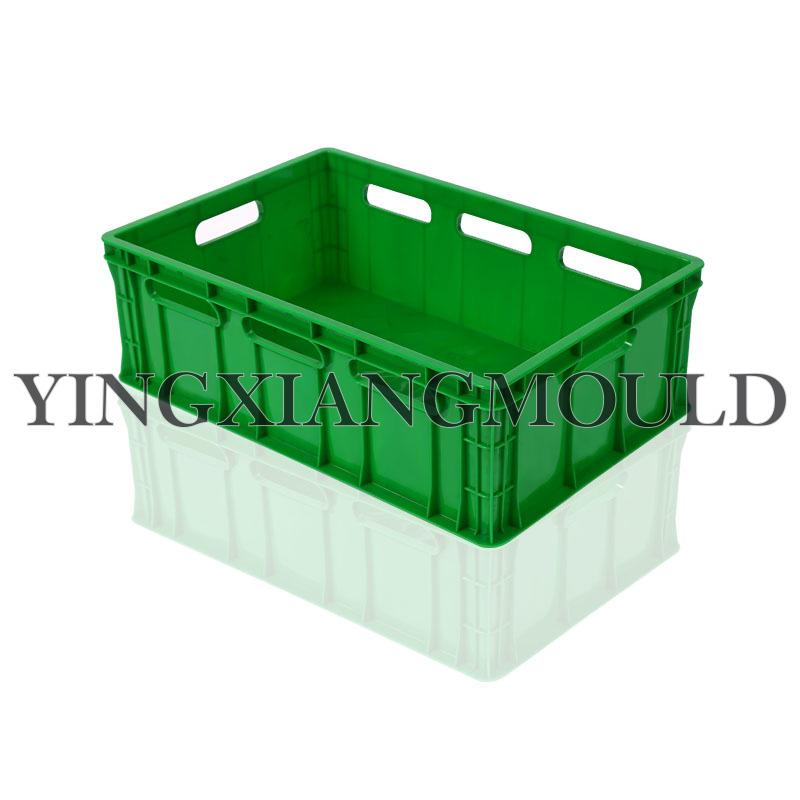
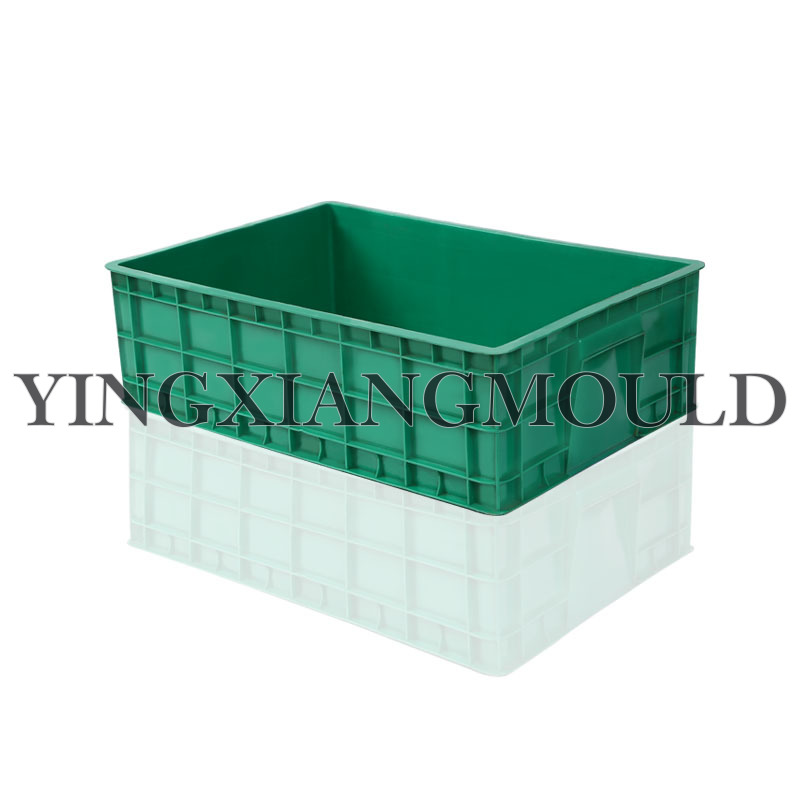
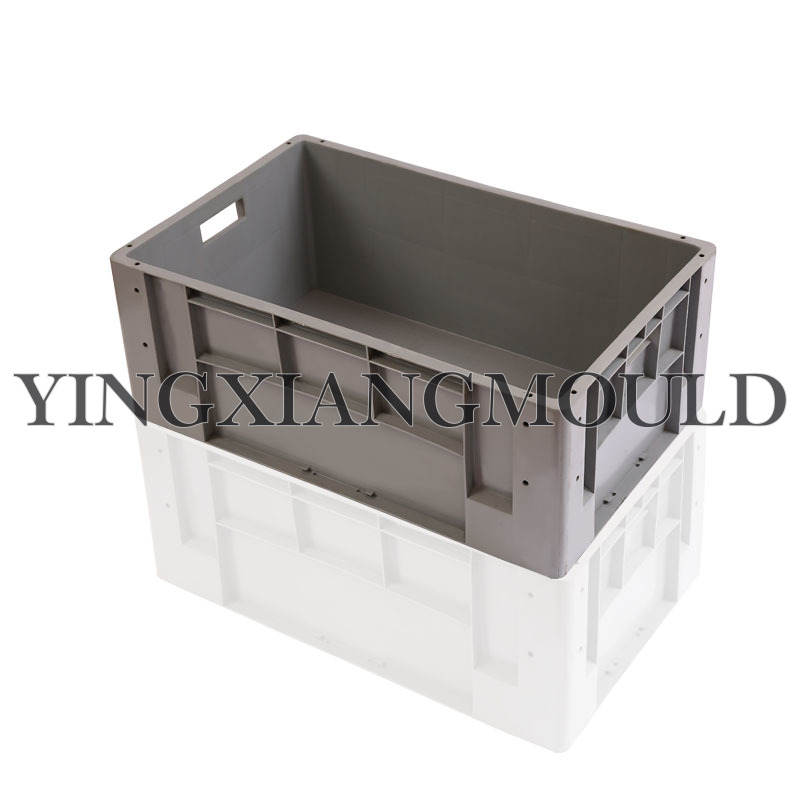
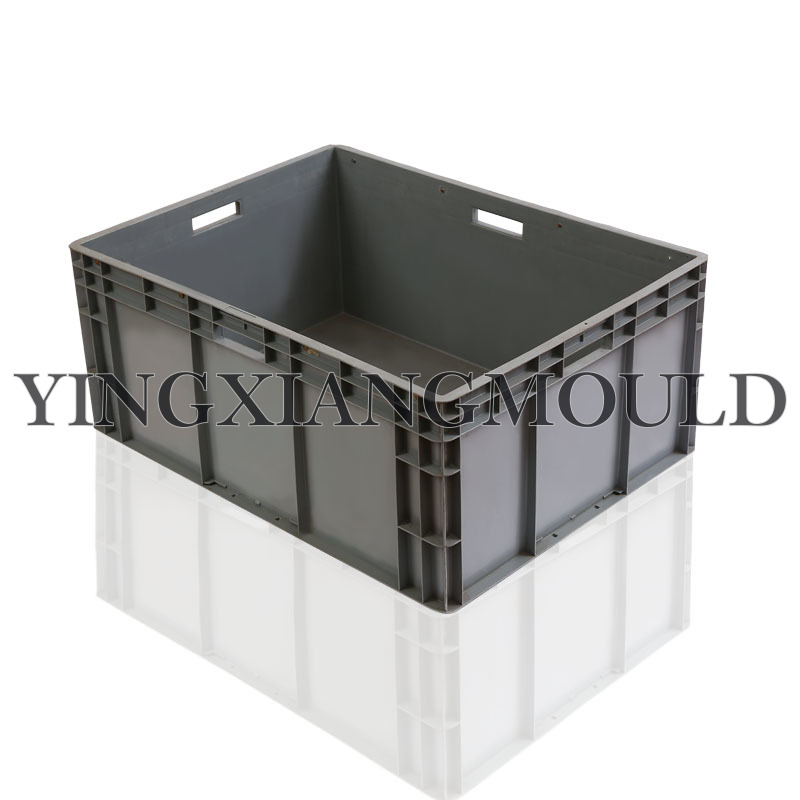
A Plastic Trash Can Mould forms a tall, hollow part around a long core, and the hardest moment in each cycle comes after the plastic has set, when the core has to leave the bin without tearing, whitening, or dragging the wall. TaiZhou HuangYan YingXiang Plastic Mould Co., Ltd. in Huangyan, Taizhou, Zhejiang, makes trash can moulds for round, square, double-layer, and openwork waste bins, and the way a tool handles release shows up directly in the quality of the finished bin.
As molten plastic cools, it shrinks, and in a deep part it shrinks onto the core like a sleeve tightening on a rod. The longer the core, the larger the contact area and the harder the grip. An indoor wastepaper basket may be 30 cm tall, while an industrial bin of 100 to 240 liters stands about a meter high, and the force needed to strip it grows with every centimeter of wall. A Plastic Trash Can Mould has to be designed so that this grip never exceeds what the part can survive.
The simplest relief is draft angle, a slight taper on the core and cavity walls so that the bin narrows toward the base. A taper of 1 degree opens the wall by about 8.7 mm over a depth of 500 mm, and that clearance is what lets the part slide free without scraping. Textured surfaces need more taper, because grain on the wall acts like fine teeth. The anti-slip and wear-resistant textures on trash can walls therefore call for a larger draft angle than a polished surface would. The draft angle chosen for each model at the factory can be confirmed before ordering.
A bin is closed at the base, so when the core withdraws, air cannot rush in behind it and a vacuum builds. A full vacuum on a base 30 cm across would hold with a force of roughly 7 kN, the weight of about 700 kg, which is more than enough to buckle a thin wall. A Plastic Trash Can Mould answers this with an air valve in the core that lets air in as the part releases, or with compressed air blown at the base. Without it, the bin collapses inward or sticks and stretches during ejection. Valve type and air supply for each tool can be confirmed with the factory before ordering.

The core of a deep bin sits inside the part, surrounded by hot plastic, and it is the hardest area to cool. Cooling water wells near bottom ribs and axle areas, a feature found on industrial bins, pull heat from the thickest regions. Baffles or bubblers inside the core carry water to its tip. If the core stays hot, the wall cools unevenly, the rim goes out of round, and the cycle runs long. A general cycle range of 60 to 120 seconds applies to high-quality tools, and the Plastic Trash Can Mould cycle for a given bin depends on its wall and size.
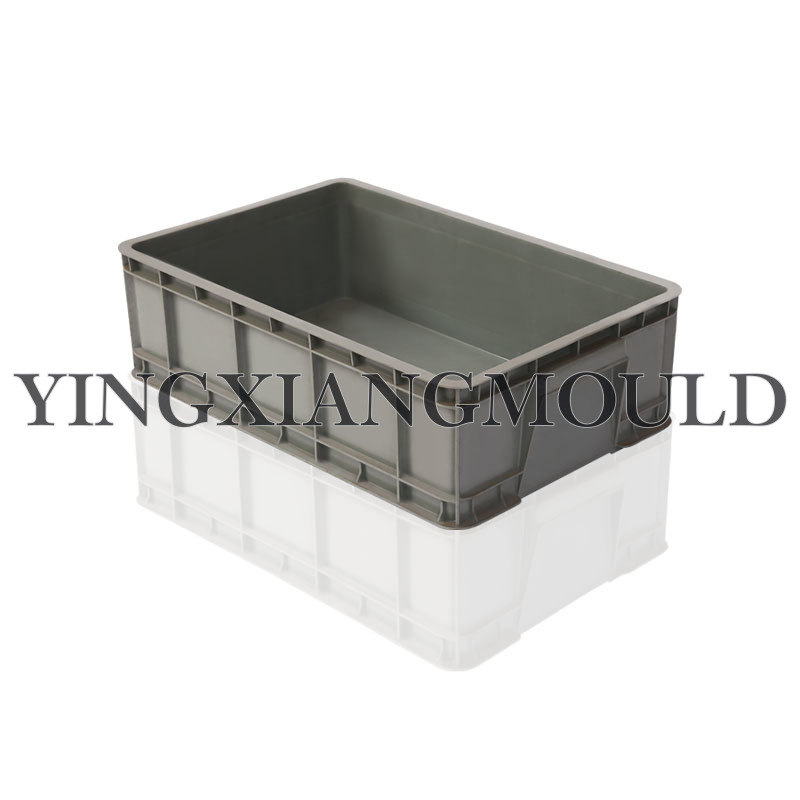
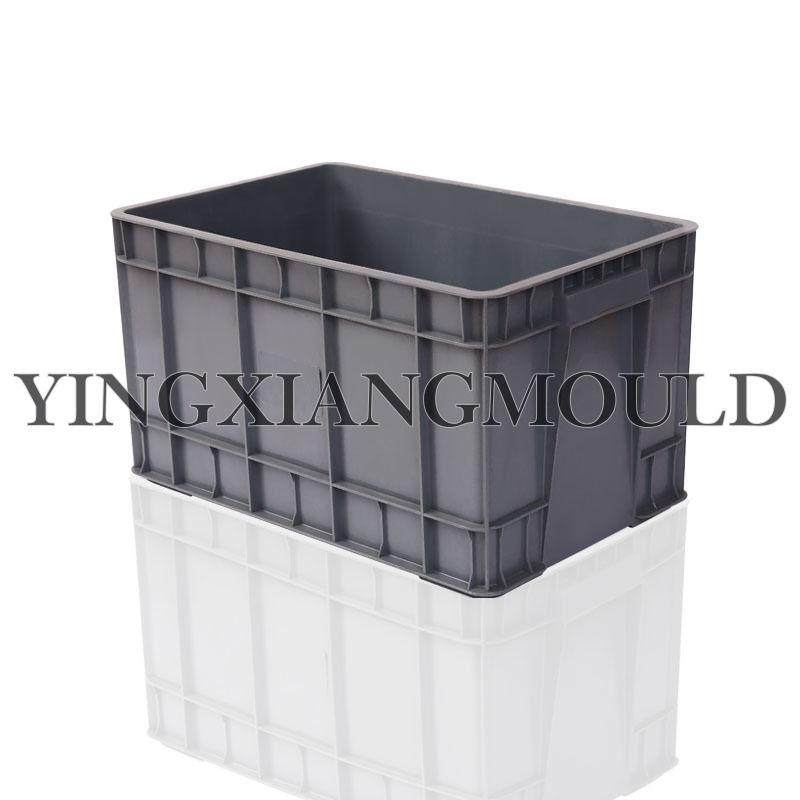
In a Plastic Trash Can Mould, uniform walls of 3 to 5 mm balance strength, weight, and cooling time. Reinforcing ribs add stiffness to the base and sides without thickening the whole wall. Nested stacking designs and forklift slots appear on larger industrial bins. Each rib in a Plastic Trash Can Mould is a thin deep groove in the cavity steel that has to release as well, which is one more reason ribs also carry their own draft.
The product range shows how many variations one Plastic Trash Can Mould family can cover. A round double-layer bin has an outer shell and an inner liner, formed in separate moulds. An openwork waste bin has holes through the wall, which need many small core pins or side slides, and weld lines can form between holes where flow splits and rejoins. A retaining ring is a separate small part that holds a liner bag. A large-scale split mould divides the heavy tooling into sections. Each design changes how the Plastic Trash Can Mould is built.
A Plastic Trash Can Mould runs HDPE for outdoor and industrial bins, where impact and weather are the main loads, and polypropylene for indoor bins. Tool steel is typically P20, 718H, or 2738 for the cavity, with NAK80 or H13 for the harder-working inserts, and a good tool of this kind reaches 300,000 to 500,000 cycles. Steel and tool life for each tool can be confirmed with the factory before ordering.
If you are interested in any of our products or services, please feel free to ask and we can talk about your ideas.
 QUICK LINKSMOBILE SITE
 FACTORY ADDRESS
 CONTACT INFORMATION



 English
 Español