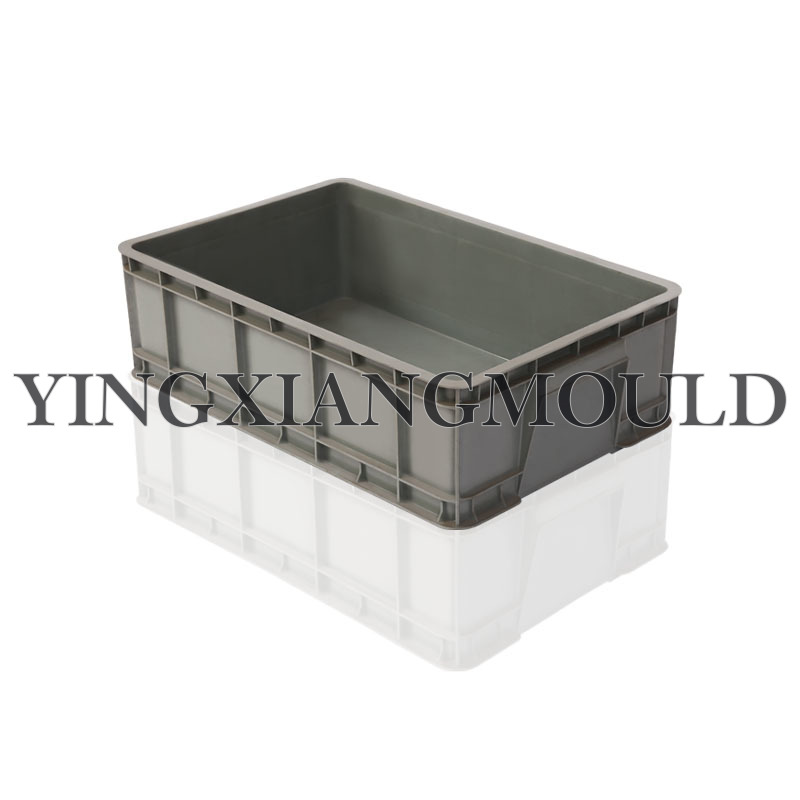
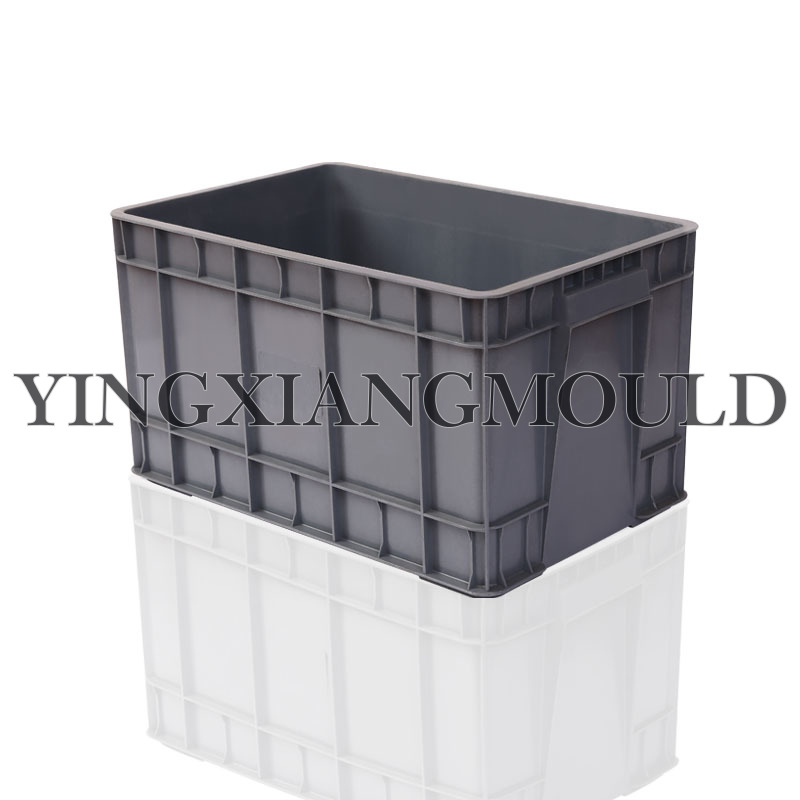
A Plastic Wash Basin Mould shapes a wide, shallow bowl, and a wide shallow bowl is the kind of part that warps. TaiZhou HuangYan YingXiang Plastic Mould Co., Ltd. in Huangyan, Taizhou, Zhejiang, makes basin moulds from single-cavity tools to multi-cavity tools, and much of the design effort goes into keeping the base flat and the rim round after the part cools. Everything that follows, from gate position to cooling layout, serves that goal.
Polypropylene shrinks about 1.5 to 2.0 percent as it cools, and high-density polyethylene shrinks about 1.5 to 3.0 percent. On a basin 40 cm across made in a Plastic Wash Basin Mould, a shrinkage of 1.8 percent removes about 7 mm from the diameter, so the cavity has to be cut larger than the finished size. The harder problem is that shrinkage is not even. Semi-crystalline plastics shrink more across the direction of flow than along it, and a bowl that fills radially from the center shrinks differently around the rim than across the base. A Plastic Wash Basin Mould has to be compensated for both, and the compensation for each resin and each shape can be confirmed with the factory before ordering.
A basin that rocks on a counter or a floor looks faulty even when it holds water perfectly. An acceptable flatness error on the bottom of a large basin is within 2 mm after cooling, and that tolerance is a design target for the tool, not something fixed afterward. Balanced cooling under the base keeps one side from shrinking before the other. A Plastic Wash Basin Mould that cools the center and the edge at the same rate produces a base that stays flat as it comes out. Cooling channel layout and the cycle time of each tool are not stated here and can be confirmed with the factory before ordering.
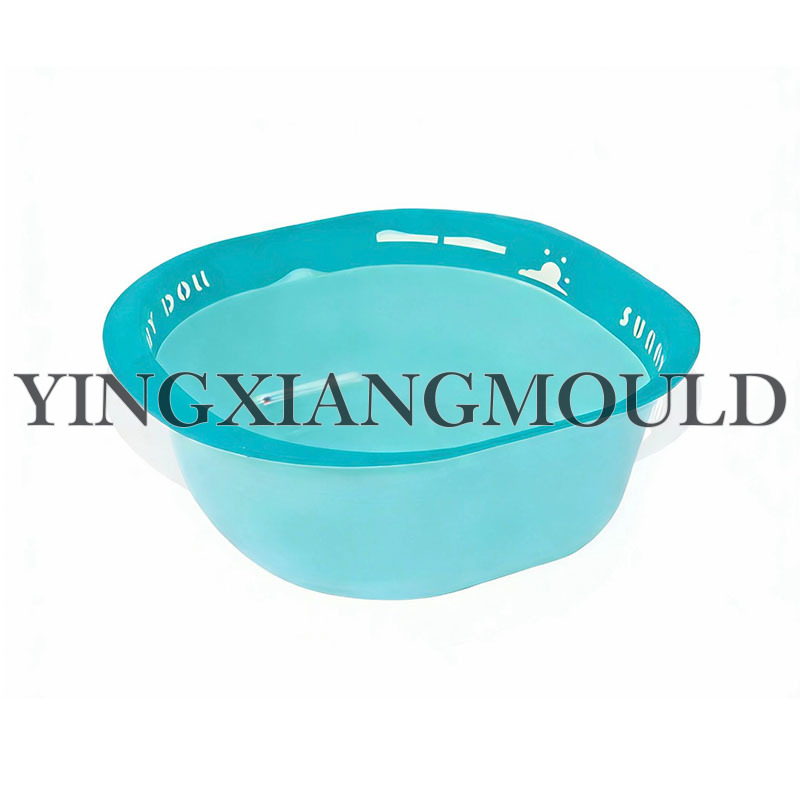
A bottom drainage slope of 1 to 3 degrees lets water run to one side or toward a drain hole. At 1 degree the base rises about 7 mm across 40 cm, and at 3 degrees about 21 mm. That small angle also stiffens the base, because a gently dished surface resists flexing better than a perfectly flat one. The slope is machined into the cavity, so the Plastic Wash Basin Mould sets the shape the user feels and the way water leaves.
Plastic must reach the rim of a wide bowl evenly. A hot runner gate placed at the center of the base sends melt outward in all directions, so the fill is balanced and the pressure is even. Optimized hot runner systems also help cut waste. Where handles interrupt the flow near the rim, melt fronts can meet and leave weld lines. Moldflow analysis before steel is cut shows where those lines fall and where warpage is likely, and it can be requested for a Plastic Wash Basin Mould before tooling begins.
A washbasin with dual handles carries two thick lugs on the rim, and a Plastic Wash Basin Mould for it has to manage them. Thick sections cool slowly, and they can shrink into sink marks or pull the nearby wall. Coring out the handle from behind, with a hollow section or a rib pattern, brings its wall closer to the rest of the basin and reduces the pull. The two-tone children's basin with dual handles adds a second challenge, because color separation lines must be sharp. How two-tone parts are formed in each tool can be confirmed with the factory before ordering.
A large, extra-thick basin takes much longer to cool than a thin one. As a rule of thumb, cooling time grows roughly with the square of wall thickness, so doubling the wall can quadruple the time spent cooling, and thicker walls also raise shrinkage at the base. A Plastic Wash Basin Mould for an extra-thick basin therefore needs generous cooling near the base and walls, or the cycle time makes the part uneconomic. Basin diameters of 42 cm and above count as large, while 36 cm and below are small or medium, and the machine size follows from those classes.
Non-food-contact basins can include recycled polypropylene at about 20 to 40 percent. Recycled content varies from batch to batch, so shrinkage varies with it, and a tool built for virgin resin may need a trial before it runs a blend. Colors to Pantone codes and logos by cavity engraving or inlay add further detail to a Plastic Wash Basin Mould , and recycled blends are tested before volume runs.
If you are interested in any of our products or services, please feel free to ask and we can talk about your ideas.
 QUICK LINKSMOBILE SITE
 FACTORY ADDRESS
 CONTACT INFORMATION


 English
 Español