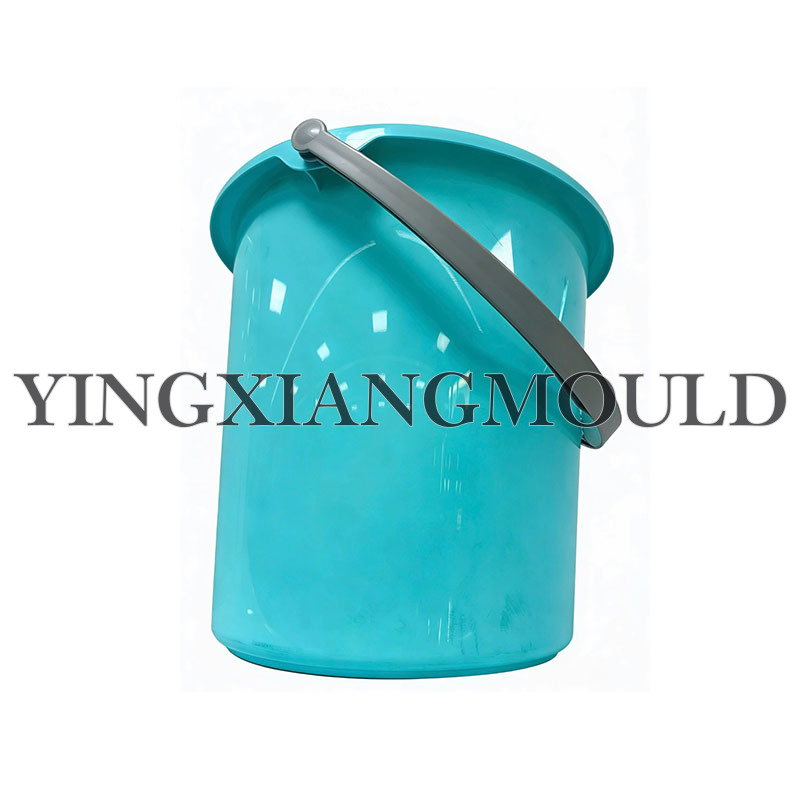
Agricultural Bucket Mould work begins from how a bucket is used outdoors: filled with water or feed, carried by its handle across uneven ground, left in sun and rain, then stacked in a shed. Each of those moments leaves a mark on the tooling. A handle that tears from its ear, a rim that goes oval, a surface that fades under sunlight and a stack that jams all trace back to how the cavity and core were laid out. TaiZhou HuangYan YingXiang Plastic Mould Co., Ltd. makes agricultural, household, foot-soaking and rectangular mop bucket moulds within its household product range in Huangyan, Taizhou, and these use conditions are worked into the mould before steel is cut.
A full bucket pulls on two small features. The ears that hold the bail or handle are moulded into the rim, and they carry the whole load each time the bucket is lifted. In an Agricultural Bucket Mould, each ear is shaped with a gradual thickening that blends into the rim wall, so stress spreads into the body instead of concentrating at one corner. Thick local zones tend to sink and cool slowly, so ears are cored out and ribbed rather than made solid.
For the same Agricultural Bucket Mould, the hole in each ear is formed by a side pin or slider, and the gate position is chosen so the melt front does not meet at the ear root. A weld line in that spot would turn into a crack line after repeated lifting, which is why flow analysis from the CAD/CAE/CAM system is run on the ear area before machining begins.
A thin round wall holds its shape poorly once the bucket is full and warm. A thickened or rolled rim stiffens the opening, keeps the bucket round for a lid or a stacking partner and gives the hand a firm edge. The rim cools differently from the wall below it, so water channels in the core and cavity follow the rim contour, which limits ovality as the part shrinks. For an Agricultural Bucket Mould, YingXiang checks the thickness transitions between rim, wall and base on the model so the rim does not become a stress line.
Outdoor buckets meet fertiliser solutions, feed, well water, cold mornings and strong sun. HDPE is widely used for its impact resistance at low temperature and its tolerance of many farm chemicals, while PP gives a stiffer wall that copes better with warm water. UV stabiliser and colour masterbatch are added at the moulding machine, and the cavity surface is finished to an even texture so colour reads uniformly from one batch to the next. Food-contact grades are used where a bucket holds drinking water or animal feed.
The household product moulds from YingXiang are compatible with PP, ABS, PS and PE, and options such as recycled material ratios or antibacterial masterbatch are accommodated in the same tool. That flexibility matters for an Agricultural Bucket Mould, because a farm customer and a retail customer often ask for different resin blends on one bucket shape.
Buckets are stored nested, and two nested buckets can seal against each other and refuse to separate. Stacking lugs or small standoff ribs on the inner wall keep a gap between neighbours so air can pass, and wall draft is set with nesting in mind. The base carries ribs for stiffness and a recessed gate mark. With a hot runner at the centre of the base, the gate vestige sits below the surface so the bucket stands flat and does not rock on a concrete floor.
Where a pouring lip or an embossed scale is needed, it is cut into the cavity as a replaceable insert, so one tool base can carry different markings for different customers. An Agricultural Bucket Mould built this way can change a scale or a logo without reworking the whole cavity.
Agricultural customers often order a bucket line in several capacities with a matching lid and handle. Family moulds for same-line sizes carry the ear, rim and handle geometry across the range, so each size behaves the same way when lifted and stacked. Where a customer works from a sample or a drawing, YingXiang develops the Agricultural Bucket Mould from that reference, and export OEM and ODM work can include finished products carrying REACH, RoHS or CA65 certification.
If you are interested in any of our products or services, please feel free to ask and we can talk about your ideas.
 QUICK LINKSMOBILE SITE
 FACTORY ADDRESS
 CONTACT INFORMATION



 English
 Español