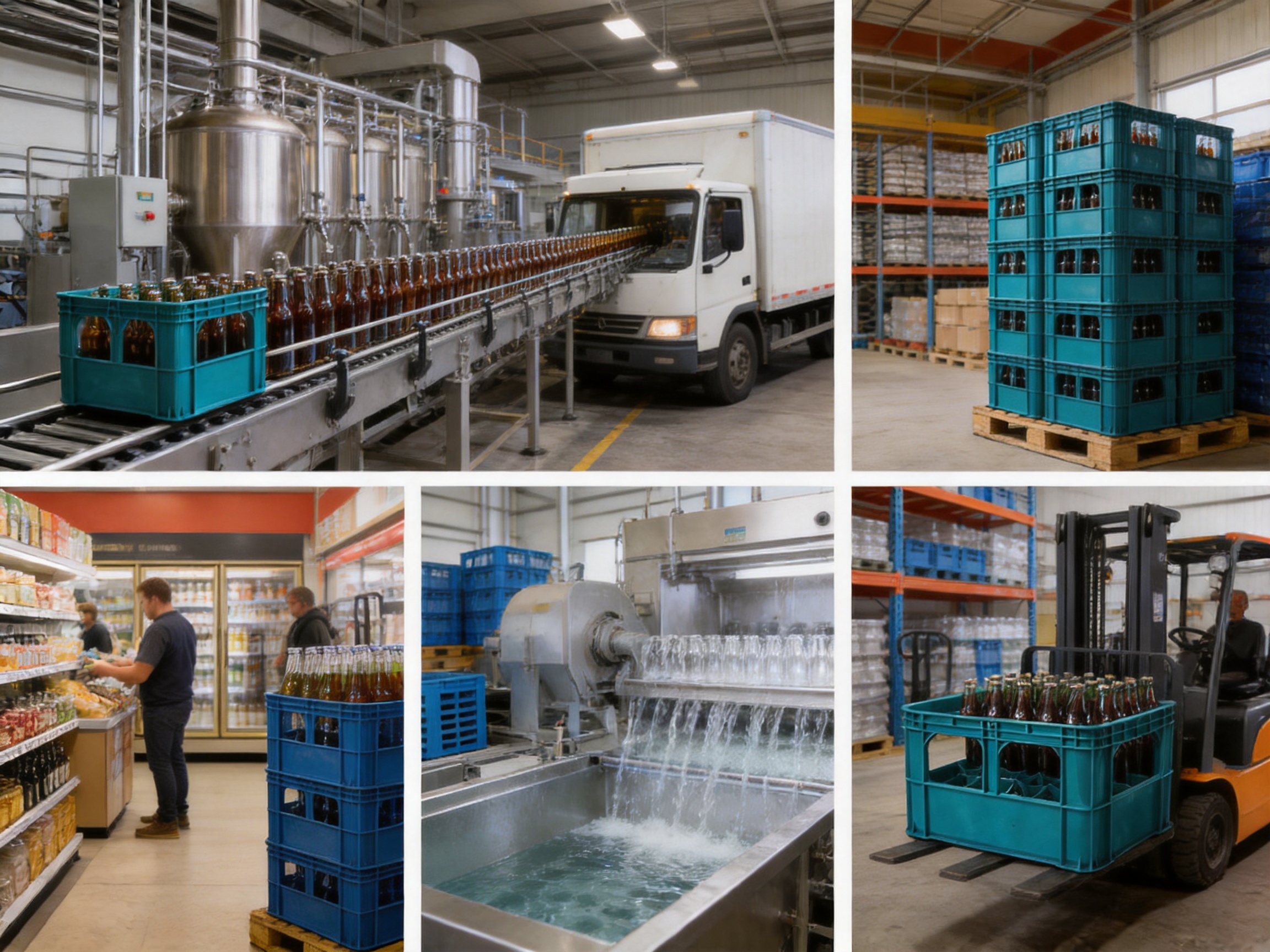
The 24-compartment beer crate is a reusable plastic beverage packaging solution designed to protect individual bottles during storage, transportation, retail handling, and return logistics. By separating bottles into dedicated compartments, the crate helps reduce contact between containers, limits movement during transit, and creates a practical format for breweries, beverage distributors, wholesalers, retailers, event operators, and hospitality businesses.
Unlike disposable corrugated cartons or loosely packed transport containers, a reusable beer crate can support repeated handling cycles while maintaining a consistent shape. Its rigid structure, integrated carrying areas, organized bottle layout, and stackable geometry make it suitable for supply chains in which empty packaging must be collected, returned, cleaned, refilled, and redistributed.
The 24-compartment format offers a useful balance between capacity and manual handling. It provides enough volume for efficient delivery while keeping the crate manageable for warehouse workers, drivers, shop employees, and consumers. The format can be adapted to different bottle diameters, heights, neck shapes, labeling requirements, and filling systems through professional mould design and injection moulding expertise.
For beverage manufacturers, the quality of the mould is as important as the quality of the finished crate. A well-engineered mould supports accurate compartment dimensions, stable wall thickness, reliable filling, clean ejection, consistent appearance, and long-term production efficiency. TaiZhou HuangYan YingXiang Plastic Mould Co., Ltd. develops customized plastic injection mould solutions for beverage boxes, logistics crates, folding boxes, pallets, storage products, and other industrial and household applications.
A 24-compartment beer crate is generally formed as a rigid, reusable container with an internal grid. The grid divides the main cavity into 24 individual spaces, allowing each bottle to stand in a controlled position. Depending on the end-use requirements, the crate may be designed for glass bottles, plastic bottles, returnable beverage bottles, or other standardized containers.
The crate normally includes a reinforced base, outer sidewalls, internal dividers, hand openings or integrated handles, and stacking features. These components work together to provide protection and logistical stability. The base must support the combined weight of the bottles and liquid, while the dividers need to resist impact and repeated contact during loading and unloading.
The outer profile may be designed with straight walls, tapered sides, interlocking ribs, or nesting features. Some designs prioritize maximum stacking stability, while others focus on empty-crate nesting to reduce return transport volume. The correct configuration depends on the distribution model, filling line arrangement, bottle dimensions, warehouse equipment, and preferred cleaning process.
A professional mould manufacturer does not treat the product as a simple open container. The crate must be developed as a complete system in which bottle protection, structural strength, production efficiency, ergonomics, stacking performance, and maintenance are considered together.
The most important function of a 24-compartment beer crate is to keep bottles separated. Without internal dividers, bottles may strike one another during lifting, vehicle movement, pallet handling, or stacking. Repeated impact can cause chips, cracks, label damage, or unstable loads.
Individual compartments create controlled spacing around each bottle. The dividers can be shaped to reduce contact with sensitive label areas and can include rounded transitions that help prevent sharp stress points. A correctly designed compartment also keeps the bottle upright, reducing the likelihood of tipping and liquid leakage.
For returnable glass bottles, this protection can extend packaging life and reduce product loss. For filled products moving through multiple distribution stages, it can also improve presentation at the point of sale. The crate becomes more than a transport box; it acts as a reusable protective framework for the entire beverage handling cycle.
Reusable plastic crates are designed for repeated circulation. They can move from a beverage plant to a distributor, from a distributor to a retailer, and from a retailer back to the filling operation. After inspection and cleaning, they can re-enter the distribution system.
Compared with disposable packaging, reusable crates can reduce the frequency of replacement and help companies establish a standardized packaging loop. Their service life depends on polymer selection, structural design, operating conditions, cleaning methods, loading practices, and mould quality. A strong mould creates a consistent product base, which is essential when thousands or millions of crates are produced.
The use of durable injection-moulded plastic also supports predictable dimensions over repeated handling. Consistent external dimensions help crates remain compatible with pallets, conveyors, warehouse shelving, vehicle loading systems, and automated filling equipment.
Twenty-four compartments provide an efficient transport unit for many beer distribution applications. The crate can carry a substantial number of bottles while maintaining a practical footprint. The layout can be optimized for the intended bottle diameter and loading pattern.
Efficient capacity is important because packaging influences transportation cost. A crate that carries more bottles per handling unit can reduce the number of individual units moved through a warehouse or delivery route. It can also simplify counting, stock control, and order preparation.
The product should not be evaluated only by the number of bottles it holds. The relationship between internal capacity, external dimensions, crate weight, stacking height, and manual handling requirements is equally important. A properly engineered 24-compartment design balances these factors rather than maximizing capacity at the expense of safety or usability.
Beer crates often need to be stacked during production, storage, transport, and retail display. Stacking features help prevent lateral movement and reduce the risk of unstable loads. Reinforced corners and accurately positioned contact surfaces can distribute weight more evenly across the crate.
Stacking geometry must be supported by precise mould construction. Small dimensional variations in the rim, base, or interlocking structures can affect stack alignment. If the fit is too loose, the stack may shift. If it is too tight, workers may have difficulty separating crates, and automated systems may experience interruptions.
Through careful design verification, the mould can support consistent stackability from one production batch to another. This is especially important for large beverage producers that depend on standardized packaging throughout multiple facilities or regional distribution centers.
A full beer crate can be heavy, so its handling features must be designed with ergonomics in mind. Integrated handles or hand openings should provide a secure grip while avoiding excessive pressure on the fingers and palms. The location of the handles should allow the weight to remain balanced during lifting.
Rounded edges can improve comfort and reduce the risk of cuts or abrasions. The external surface may also include ribs or textured areas that improve grip in wet warehouse, filling-room, or outdoor conditions. These details contribute to worker confidence and help reduce accidental dropping.
Handling performance is closely connected to the product’s mould design. Handle openings, reinforcing ribs, corner radii, and wall transitions must be formed accurately. Poorly designed or poorly machined features may create weak areas, flash, sharp edges, or difficult ejection conditions.
Beer crates are used in environments where liquid, dust, labels, broken glass, foam, and other residues may be present. The product should therefore be designed to support efficient washing and drainage. Smooth transitions, suitable drainage openings, and limited dirt traps can help cleaning equipment reach the internal and external surfaces.
The mould should avoid unnecessary recesses that collect residue. Where ribs or reinforcement are required, their geometry should be shaped to balance structural strength with cleanability. The internal compartments should allow water to flow through and should not create hidden pockets that remain wet after washing.
Cleaning requirements vary by customer, beverage type, washing temperature, detergent concentration, and equipment configuration. For this reason, the crate and mould should be customized according to the actual operating environment rather than copied from a generic design.
Standardized crates improve warehouse organization. Identical units can be stacked in predictable columns, counted more easily, and arranged according to delivery plans. The 24-compartment configuration also creates a consistent replenishment quantity for retailers and hospitality locations.
When empty crates can nest or stack efficiently, reverse logistics becomes more economical. The design may include a tapered profile or nesting support, provided that the geometry does not compromise full-load stacking stability. The ideal solution depends on whether the customer prioritizes loaded stability, empty return efficiency, or a combination of both.
Professional mould engineering helps ensure that these features operate consistently. The nesting depth, rim contact, and base alignment all depend on accurate machining and reliable process control.
Corrugated cartons are lightweight and suitable for one-way distribution, but they can lose strength when exposed to moisture, condensation, or repeated handling. They may also require additional internal partitions and replacement after use.
A reusable plastic beer crate offers greater resistance to water and repeated contact. Its internal dividers are integrated into the structure, eliminating the need for separate inserts in many applications. The crate can also be washed and reused, which supports closed-loop distribution models.
Cartons may remain appropriate for specialty products, export shipments, or direct-to-consumer packaging. However, for returnable bottle systems and high-frequency beverage distribution, rigid plastic crates can provide better long-term operational consistency.
Open bins offer general-purpose storage, but they do not provide individual bottle separation. Bottles can move, collide, and become difficult to count. A 24-compartment beer crate is specifically designed around bottle organization and protection.
The internal grid also helps maintain a stable loading pattern. Workers can see whether the crate is full, partially loaded, or incorrectly packed. This reduces handling errors and makes inventory checking more efficient.
Not all plastic crates provide the same performance. Low-quality products may have inconsistent wall thickness, weak divider connections, rough edges, poor stack alignment, or insufficient reinforcement. Such issues can increase breakage, cause handling difficulties, and shorten service life.
The quality of the injection mould is a major differentiator. A high-precision mould supports repeatable product dimensions and helps reduce defects such as warpage, sink marks, short shots, flash, weld-line weakness, and uneven surfaces. Mould design also influences cycle time and the cost of producing each crate.
A professional manufacturer can review the customer’s performance requirements before developing the mould. This approach is more reliable than selecting a generic crate and attempting to adapt it to an unsuitable bottle, machine, or distribution system.
| Evaluation Area | 24-Compartment Plastic Beer Crate | Disposable Carton | General Open Bin |
|---|---|---|---|
| Bottle separation | Dedicated compartments for each bottle | Possible with inserts, depending on design | Usually limited or unavailable |
| Resistance to moisture | High when suitable plastic is selected | Limited, especially during long exposure | Generally high |
| Reuse potential | Designed for repeated circulation | Normally limited | Possible, but product protection may be inadequate |
| Stacking consistency | Can include dedicated stacking features | Depends on carton strength and condition | Varies according to shape and load |
| Cleaning suitability | Can be designed for washing and drainage | Generally unsuitable for repeated washing | Depends on geometry and surface design |
| Logistics standardization | High when moulded to defined dimensions | Moderate to high | Varies widely |
The resin selected for a beer crate should match the expected mechanical, thermal, chemical, and environmental conditions. Common industrial crate materials may include polypropylene or other suitable engineering plastics, depending on the required stiffness, impact resistance, temperature range, weight, and regulatory expectations.
Material selection must be coordinated with mould design and injection parameters. Different plastics have different shrinkage rates, flow characteristics, cooling behavior, and sensitivity to processing conditions. A mould designed without considering these factors may produce dimensional instability or uneven performance.
For a 24-compartment crate, the internal divider network is especially important. Dividers must be strong enough to resist bottle impact but not so thick that they create unnecessary weight, extended cooling time, or difficult filling conditions. The connection between the divider system and the outer wall should be reinforced through suitable geometry rather than simply adding excessive material.
Corner areas deserve particular attention because they often receive impact during handling. Reinforced corners can improve durability, while carefully designed radii can reduce stress concentration. The base should also resist flexing when the crate is fully loaded and lifted from different positions.
Wall thickness should be balanced across the product. Excessively thin areas may lead to weakness or incomplete filling. Excessively thick areas can cause sink marks, longer cycles, increased material consumption, and uneven shrinkage. Simulation and mould-flow analysis can help identify these risks before steel machining begins.
The mould development process begins with a clear understanding of the customer’s requirements. Important information includes bottle dimensions, bottle material, filled weight, crate capacity, stacking height, washing conditions, operating temperature, expected service life, machine specifications, annual production volume, and target cycle time.
The manufacturer may also review whether the crate will be manually loaded or connected to an automated system. Conveyor compatibility, robotic gripping, label clearance, barcode areas, and pallet dimensions can influence the final geometry.
A well-defined requirement review prevents problems later in the project. It ensures that the mould is developed for the actual operating environment rather than for a theoretical product specification.
After the requirements are confirmed, engineers develop the three-dimensional product model. They assess compartment spacing, wall thickness, divider transitions, handle openings, stacking areas, drainage, draft angles, and ejection access.
CAD systems allow the design team to examine the product from multiple angles and evaluate possible interference between bottles, dividers, handles, and stacking surfaces. The design can be adjusted before mould construction, when changes are faster and less expensive.
Computer-aided engineering analysis can provide additional information about filling balance, cooling behavior, pressure distribution, shrinkage, and likely deformation. For a large crate, balanced filling is important because uneven flow may create warpage or inconsistent mechanical properties.
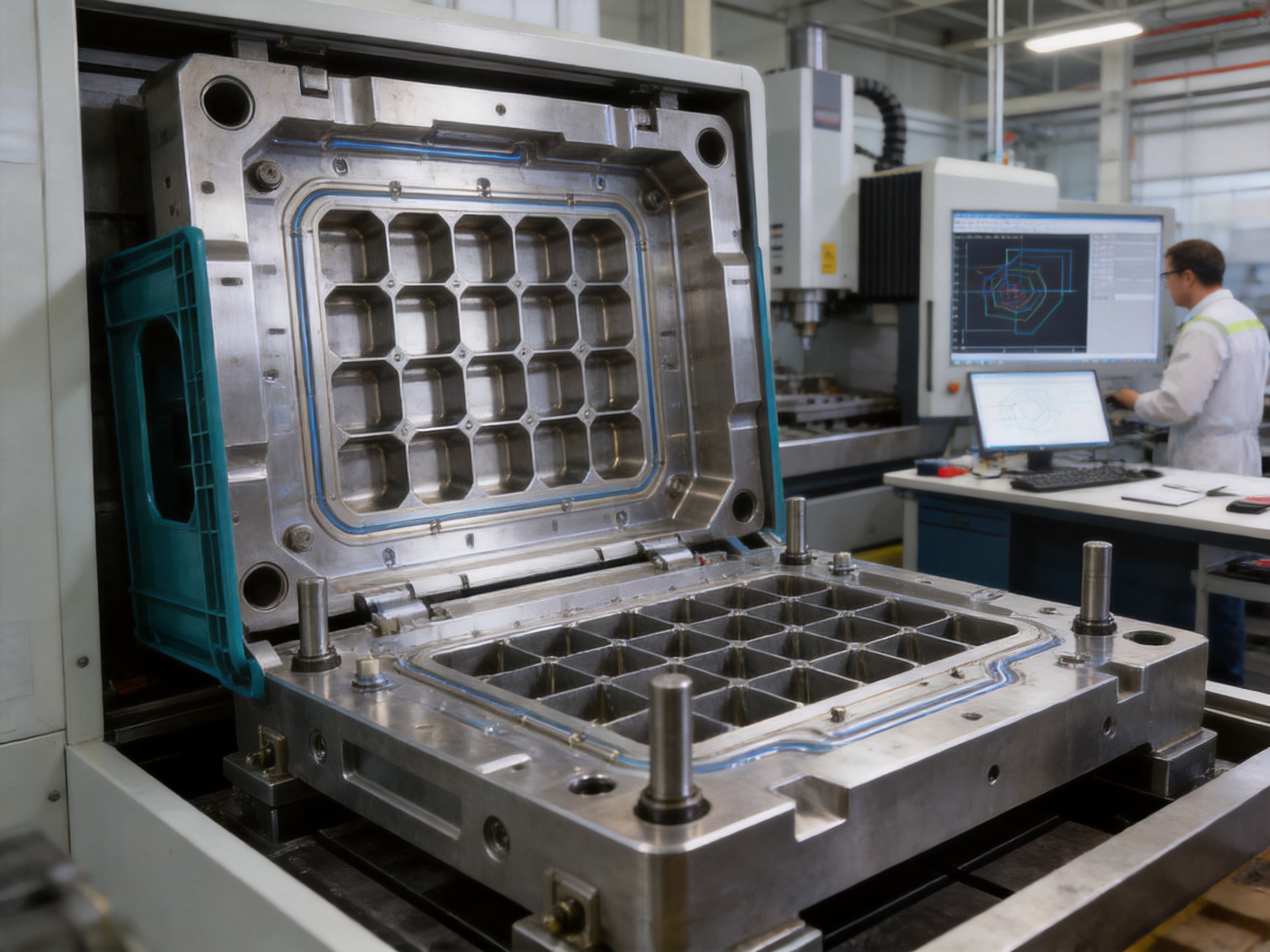
The mould structure is selected according to the crate’s size, complexity, production quantity, material, and injection machine. The design may include a fixed mould half, a moving mould half, core components, cavity components, ejection systems, cooling channels, guide systems, and replaceable wear parts.
Because the crate includes many internal compartments, the core side must be carefully planned. The divider geometry can create complex ejection requirements. Draft angles, core strength, ejector placement, and steel support must be coordinated to prevent sticking or deformation during demoulding.
The mould maker also considers maintenance. Replaceable inserts, accessible components, standardized fasteners, and clear cooling connections can make future servicing more efficient. A mould that is easy to maintain can provide better long-term value than one that is difficult to disassemble, even if both produce similar parts initially.
Precision machining is essential for features that control bottle spacing, stack alignment, and product appearance. Modern CAD, CAE, and CAM systems allow digital models to be transferred into machining operations with improved accuracy and repeatability.
High-quality cutting equipment can create complex surfaces, deep ribs, rounded transitions, and detailed cavity features. Electrical discharge machining may be used for areas that are difficult to produce through conventional cutting. Grinding and polishing can then be applied where surface quality and release performance require additional refinement.
Accurate machining reduces the risk of mismatch, flash, rough edges, dimensional variation, and visible defects. It also supports stable production across multiple moulding cycles.
Cooling has a direct influence on cycle time and product quality. A crate with uneven cooling may experience warpage, shrinkage differences, or dimensional distortion. These problems can affect bottle insertion, stacking, nesting, and conveyor performance.
The cooling channels should be positioned to support balanced heat removal from the cavity and core. Complex divider areas may require special attention because they can retain heat and cool more slowly than the outer walls.
Efficient cooling can reduce cycle time while maintaining consistent part quality. The result is improved production capacity and more predictable cost per crate.
The injection gate system controls how molten plastic enters the mould. Gate location, number, size, and type influence filling balance, weld-line position, pressure requirements, appearance, and mechanical performance.
For a large crate, the flow path must be evaluated across the entire footprint. If one region fills much earlier than another, the product may develop internal stress or uneven shrinkage. A suitable gate layout can improve filling balance and reduce the likelihood of weak weld lines in critical structural areas.
The best solution depends on the material, machine, product geometry, and customer expectations. Engineering analysis helps the manufacturer compare options before finalizing the mould.
After cooling, the finished crate must be released from the mould without distortion. Ejector pins, ejector plates, lifters, air assistance, or other mechanisms may be used depending on the product geometry.
Ejection forces should be distributed across strong areas of the product. Placing force in thin divider sections can cause marks or deformation. At the same time, insufficient ejection support may lead to sticking, longer cycles, or damage to the crate and mould.
Draft angles are also important. Proper draft allows the product to separate smoothly from the core while preserving the required internal dimensions. Draft must be balanced against bottle retention and structural requirements.
TaiZhou HuangYan YingXiang Plastic Mould Co., Ltd. is located in Huangyan, Taizhou, Zhejiang, China, an area widely associated with mould manufacturing. Established in 2012, the company operates a plant of approximately 7,000 square meters and has around 50 employees, including experienced technicians and engineering personnel.
The company uses CAD, CAE, and CAM systems to support product development, engineering analysis, machining, and mould production. These digital tools provide a connection between customer requirements, three-dimensional design, manufacturing data, and inspection procedures.
Yingxiang specializes in customized plastic mould solutions, including crate moulds, folding box moulds, pallet and tray moulds, beverage box moulds, logistics container moulds, storage box moulds, and moulds for household products. This range of experience is relevant to the 24-compartment beer crate because beverage packaging often shares engineering requirements with industrial logistics products.
The company’s production philosophy emphasizes lean manufacturing, long mould life, on-time delivery, competitive cost, premium quality, and comprehensive customer service. These priorities are important for customers who need more than a one-time prototype. They need a production mould that can support consistent output over an extended operating period.
A dedicated mould manufacturer can also coordinate product optimization and mould construction under one project. This reduces communication gaps between separate design and tooling suppliers. When design adjustments are necessary, engineering decisions can be evaluated against machining, injection, maintenance, and production considerations.
Quality control should begin before steel is cut. Product drawings, material assumptions, mould layouts, cooling plans, gate positions, ejection systems, and critical dimensions should be reviewed systematically.
During machining, the manufacturer can monitor component dimensions, surface finish, alignment, and the accuracy of interchangeable inserts. Proper inspection helps identify errors before assembly and reduces the possibility of expensive modifications after trial moulding.
Mould assembly requires attention to parting lines, guide systems, ejector movement, cooling connections, and cavity-to-core alignment. The completed mould should operate smoothly by hand before it is installed on the injection machine.
Trial moulding provides practical information about filling, cooling, ejection, warpage, flash, surface appearance, and dimensional stability. Samples should be checked against the approved product design. If adjustments are needed, the manufacturer can modify gates, vents, cooling, polishing, or local steel conditions.
For the finished crate, inspection may include external dimensions, compartment dimensions, wall thickness, handle strength, stack fit, bottle compatibility, surface quality, and visual consistency. Customers may also conduct their own loading, washing, drop, stacking, and transport trials.
Documentation is valuable throughout the project. Clear records of approved drawings, material specifications, trial results, inspection findings, and modifications help establish traceability and support future maintenance.
A beer crate must perform under conditions that are often more demanding than a controlled factory test. It may be exposed to sunlight, rain, condensation, dust, repeated impacts, wet floors, temperature changes, rough loading, and contact with forklifts or other crates.
The product should therefore be evaluated as part of the customer’s complete logistics cycle. A crate that performs well when empty may behave differently when fully loaded. A design that stacks correctly in a warehouse may require additional review when transported over uneven roads.
Testing can include loaded stacking, repeated lifting, impact exposure, bottle insertion and removal, washing cycles, conveyor movement, nesting checks, and dimensional verification after repeated use. The appropriate testing program depends on the application and customer standards.
Potential stress points include the handle openings, lower corners, base ribs, divider intersections, and stacking contact areas. These regions should be reviewed during product design and validated during trials.
The 24-compartment format can be adapted to different bottle families and operating requirements. Customization may include compartment diameter, bottle height, neck clearance, divider thickness, outer dimensions, handle position, stacking arrangement, drainage openings, surface texture, rib layout, and identification areas.
Color can be selected to support brand recognition, product category separation, asset management, or warehouse visibility. Surface markings, embossed symbols, recessed logos, serial areas, and barcode-ready zones may also be incorporated into the product or mould design, subject to the customer’s requirements.
Customers may choose between a design optimized for maximum loaded strength and one optimized for empty-crate nesting. Some operations may require a reinforced structure for heavy glass bottles, while others may prioritize low weight and high production speed.
Customization should always be evaluated against the complete injection process. A feature that appears simple in a product drawing may affect steel strength, cooling, ejection, filling balance, or mould maintenance. Professional consultation helps ensure that customization produces practical value rather than unnecessary complexity.
The purchase price of a mould is only one part of the total cost. Customers should also consider material consumption, cycle time, maintenance frequency, spare parts, production stability, rejected parts, energy use, labor requirements, and expected mould life.
A well-designed mould may require a higher initial investment than a basic alternative, but it can provide better long-term economics through reduced downtime, lower scrap, consistent production, and longer service life. For high-volume beverage packaging, these benefits can have a significant effect on the total cost per usable crate.
The crate itself should also be evaluated over its expected circulation period. Important questions include how many handling cycles it can support, how easily it can be repaired or cleaned, whether replacement parts are available, and whether its dimensions remain compatible with the distribution system.
Lean manufacturing principles can help reduce unnecessary processing and improve production efficiency. Careful planning of machining, assembly, trialing, and inspection can support competitive costs without sacrificing critical quality features.
Reusable beverage crates can support packaging reduction by replacing repeated use of disposable containers in suitable closed-loop systems. Their long service life allows the same packaging asset to circulate through multiple delivery cycles.
Plastic crates can also be designed for eventual recycling when they reach the end of their useful life, depending on the resin, additives, contamination level, and local recycling infrastructure. Clear material identification and responsible asset management can improve end-of-life handling.
Environmental performance should not be considered separately from operational efficiency. A crate that protects bottles effectively can reduce product breakage and associated waste. A crate that nests efficiently when empty can reduce reverse-logistics volume. A crate that lasts longer can reduce the demand for replacement packaging.
Customers should assess the entire life cycle, including raw material production, mould manufacturing, crate production, washing, transport, reuse, repair, and recycling. The most suitable design is one that performs reliably throughout this complete system.
A successful custom beer crate mould project benefits from a clearly organized workflow.
The customer should provide bottle drawings or samples, filled weight, bottle material, loading pattern, stacking requirements, washing conditions, production volume, and machine information. Photographs of existing packaging and distribution environments can also help engineers understand the application.
The mould manufacturer creates the initial product design, including compartment arrangement, external footprint, structural ribs, handles, stacking areas, and drainage. Alternative concepts may be compared according to strength, weight, nesting, and production feasibility.
CAD and CAE tools can be used to review draft, wall thickness, filling, cooling, shrinkage, ejection, and likely deformation. Design issues should be resolved before mould construction whenever possible.
The customer reviews the product drawings, mould layout, gate system, ejection plan, cooling arrangement, and expected trial schedule. Approval establishes a reference for manufacturing and inspection.
Tool components are machined, inspected, assembled, and tested. Trial moulding is then performed to evaluate real product behavior. Samples are provided for customer approval and application testing.
If adjustments are needed, the mould is modified and samples are produced again. Once the product meets the agreed requirements, the mould is prepared for delivery, installation, production support, and future maintenance.
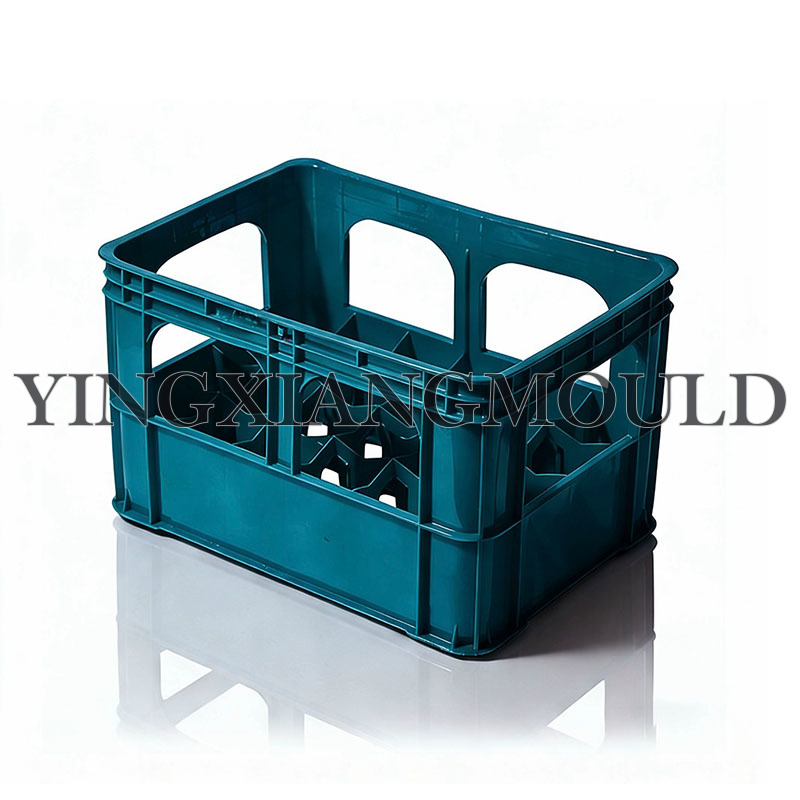
24-Compartment Beer Crate
Its main purpose is to transport, store, and organize 24 bottles while separating them from one another. The individual compartments help reduce bottle movement, collision, tipping, and handling damage.
Yes. Compartment diameter, height, neck clearance, divider geometry, and external dimensions can be adapted to the customer’s bottle specifications. The mould must be designed around the actual bottle and distribution requirements.
The suitable material depends on impact requirements, filled weight, temperature, cleaning chemicals, production conditions, and regulatory expectations. Polypropylene and other industrial plastics may be considered, but the final selection should be confirmed through engineering evaluation.
Mould precision affects compartment dimensions, bottle fit, stackability, wall consistency, surface quality, ejection, and production stability. A poorly made mould can create dimensional variation and defects that reduce the crate’s service life.
A reusable crate can be designed for repeated washing, provided that the material, geometry, drainage, and operating conditions are suitable. Washing temperature, detergent concentration, pressure, and drying practices should be considered during product development.
They can be designed with nesting features if reverse logistics efficiency is important. However, nesting geometry must be balanced against loaded stacking stability, bottle protection, and ease of separation.
The crate generally provides better resistance to moisture, repeated handling, and washing. It also offers integrated bottle separation and more consistent stacking. A carton may still be useful for one-way shipments or applications where returnable packaging is not practical.
Useful information includes bottle drawings or samples, desired capacity, filled weight, material preference, annual quantity, injection machine details, stacking requirements, washing conditions, preferred crate dimensions, color, marking requirements, and delivery expectations.
Regular cleaning, correct installation, suitable processing conditions, planned lubrication, inspection of wear components, and timely replacement of damaged parts can extend mould life. Proper cooling-water management and avoiding excessive injection pressure are also important.
Yes. The manufacturer also specializes in moulds for logistics crates, folding boxes, pallets, trays, storage containers, household products, chairs, stools, trash cans, floor mats, hand baskets, and related injection-moulded products.
TaiZhou HuangYan YingXiang Plastic Mould Co., Ltd. is located at No. 2 Chaoyuan Road, North City Street, Huangyan, Taizhou, Zhejiang, China.
Customers can contact the company by telephone or email to discuss bottle dimensions, crate performance, tooling requirements, production volume, and delivery expectations. The listed telephone numbers are +86 17858690885, +86 13566828762, and +86 19957608921. The listed email address is Chinayingxiang88@sina.com.
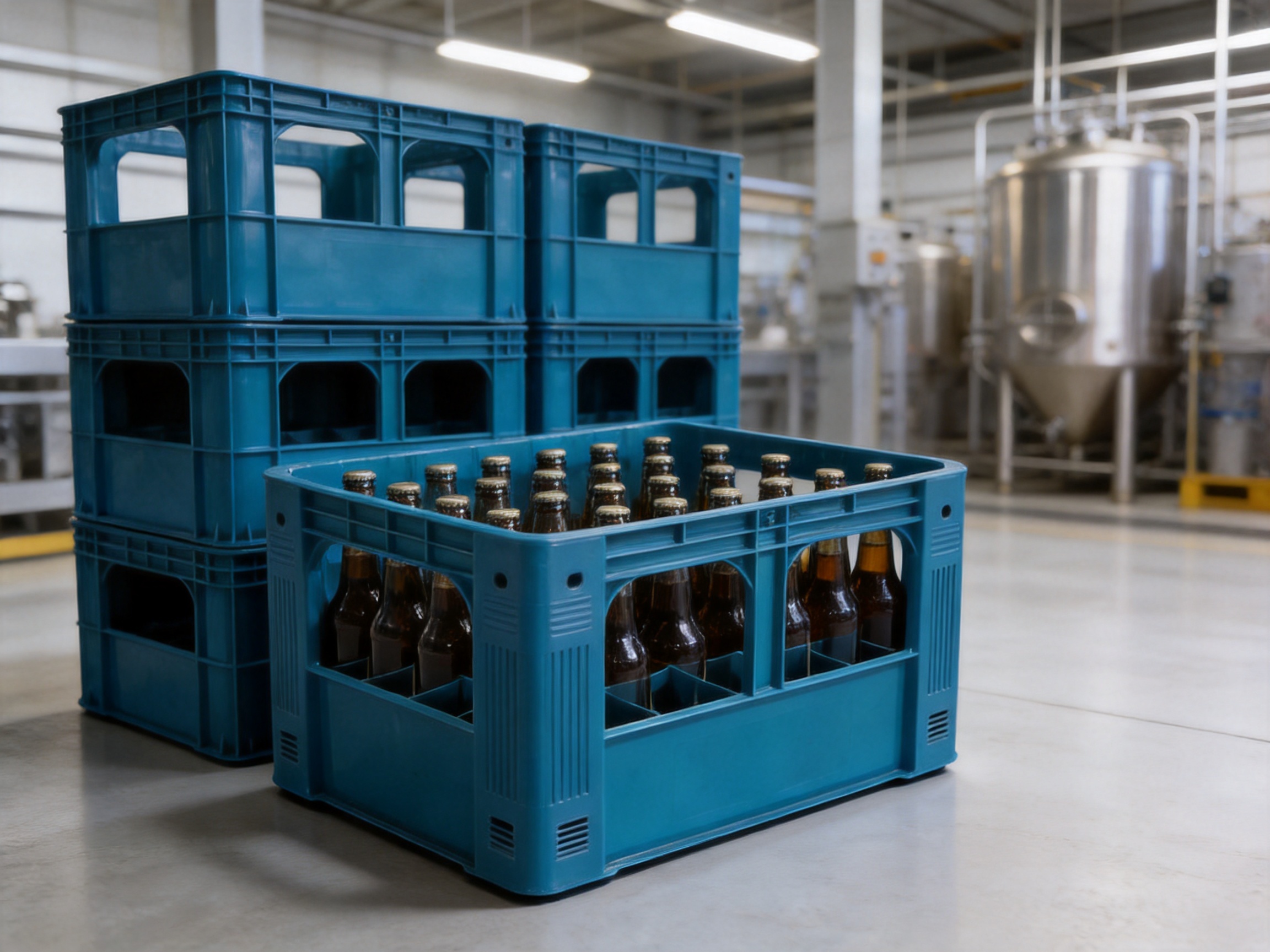
The finished beer crate is visible to the customer, but much of its performance is determined inside the mould. Internal cooling channels, steel support, gate balance, ejection design, parting-line control, venting, and machining accuracy may not be visible after production, yet they influence every crate manufactured.
Professional tooling also provides a foundation for future improvements. If the customer changes bottle dimensions, increases production volume, introduces automation, or requires a revised stacking pattern, a well-documented and carefully constructed mould is easier to evaluate and modify.
Experience with multiple plastic products can be particularly valuable. Crate moulds, pallet moulds, folding box moulds, and household product moulds share common challenges involving large surfaces, ribs, warpage, cooling, ejection, and high-volume production. Knowledge gained across these product categories can support more practical design decisions.
Yingxiang’s combination of engineering systems, manufacturing equipment, experienced technicians, and product-category experience positions it to support customized beverage crate projects from concept through mould delivery. Its focus on quality, delivery, service, and cost control aligns with the needs of customers seeking stable long-term production rather than a basic short-term tooling solution.
The 24-compartment beer crate is a practical reusable packaging solution for beverage manufacturers and distribution networks that require bottle protection, organized handling, stable stacking, and repeated circulation. Its dedicated compartments help reduce bottle contact, while its rigid plastic construction supports washing, warehouse use, and return logistics.
The product’s performance depends on more than its external appearance. Bottle compatibility, divider strength, wall thickness, handle design, drainage, stacking geometry, cooling, ejection, and mould precision must all be considered together. A properly developed mould can improve product consistency, production efficiency, service life, and total ownership value.
With a 7,000-square-meter plant, approximately 50 employees, CAD, CAE, and CAM capabilities, and experience in beverage, logistics, pallet, folding box, and household product moulds, TaiZhou HuangYan YingXiang Plastic Mould Co., Ltd. provides a professional basis for custom 24-compartment beer crate tooling.
For companies developing a new reusable beverage packaging system or upgrading an existing crate, cooperation with an experienced mould manufacturer can reduce design risk and create a more reliable path from concept to mass production. The right tooling partner can help transform bottle protection, distribution efficiency, and long-term packaging durability into measurable operational advantages.
1. General principles of reusable plastic transport packaging design and logistics container engineering.
2. Standard practices for injection mould design, mould-flow evaluation, cooling analysis, and ejection planning.
3. Industrial guidance on returnable beverage packaging, bottle separation, stackability, and reverse logistics.
4. Polymer processing principles concerning shrinkage, warpage, cooling balance, impact resistance, and repeated-use performance.
5. General quality-control practices for plastic injection mould manufacturing, trial moulding, dimensional inspection, and preventive maintenance.
6. Product and company information supplied for the 24-compartment beer crate and customized plastic mould manufacturing services.
If you are interested in any of our products or services, please feel free to ask and we can talk about your ideas.
 QUICK LINKSMOBILE SITE
 FACTORY ADDRESS
 CONTACT INFORMATION



 English
 Español