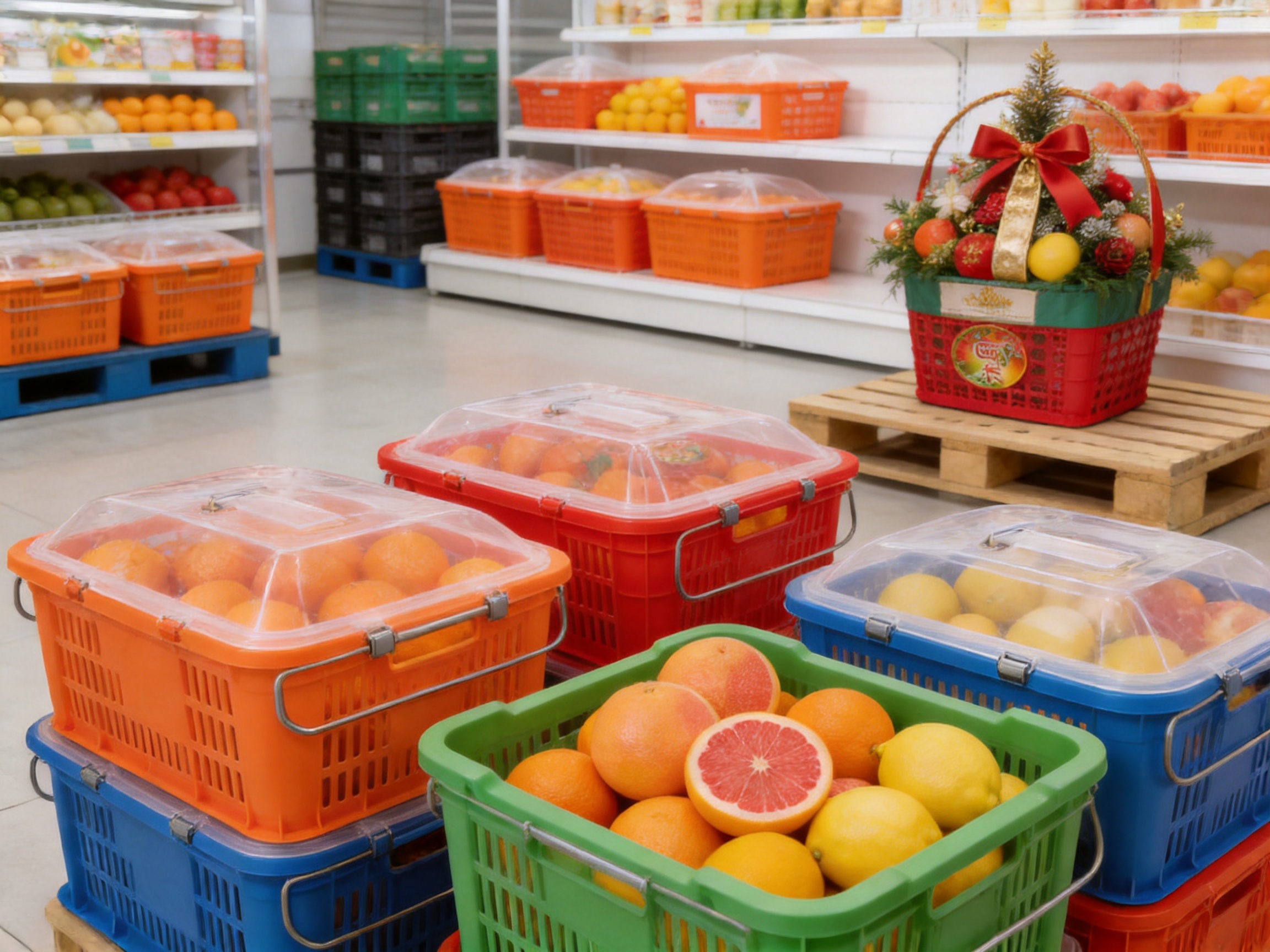
The covered orange basket is a practical packaging and storage solution developed for citrus fruits such as oranges, grapefruits, lemons, and similar produce. Its deep body, ventilated walls, reinforced carrying structure, and fitted lid provide a combination of protection, visibility, stacking stability, and convenient handling. Behind this finished product is a precision plastic injection mould capable of producing consistent baskets in large quantities and with repeatable quality.
For manufacturers, retailers, fruit distributors, household product suppliers, and gift-packaging companies, the mould is more than a tool for forming plastic. It is a production system that influences product appearance, cycle time, material consumption, assembly accuracy, service life, and long-term operating costs. A well-engineered mould helps a manufacturer produce baskets with uniform wall thickness, reliable ventilation openings, strong locking points, smooth edges, and stable dimensions from the first production batch to later repeat orders.
This article examines the covered orange basket mould in detail. It discusses the product concept, structural design, injection moulding requirements, material selection, manufacturing process, quality control, customization opportunities, and the advantages offered by a professional mould manufacturer. It also explains why this type of mould can be a competitive choice for modern fruit packaging and household storage applications.
The covered orange basket is designed as a reusable plastic container with a dedicated lid. Depending on the customer’s preferences and intended market, the basket may have a square, rectangular, or round profile. Its interior is deep enough to hold several kilograms of oranges or other citrus fruits, while its exterior is shaped for transportation, display, and storage.
The matching lid gives the basket a clear functional advantage over open fruit trays and conventional uncovered baskets. When closed, the lid helps reduce dust, contact contamination, accidental spillage, and direct handling of the fruit. At the same time, the ventilated basket body and carefully positioned openings allow air circulation, helping to reduce moisture accumulation during storage.
The lid may be produced in a transparent or semi-transparent plastic material. This allows users to inspect the fruit without opening the container. For retail environments, this visibility is valuable because customers can see the contents, color, and overall presentation. For household use, the transparent lid makes it easier to identify the stored fruit quickly.
The mould is intended for plastic injection moulding. It can be customized according to basket capacity, external dimensions, handle structure, lid design, locking method, branding requirements, and production equipment. The supplied specifications identify common mould steels such as 1CR13, 2CR13, 3CR13, 4CR13, S136, CR16, 2316, 718H, and P20, while suitable plastic materials may include PP, PC, PS, POM, PE, PU, PVC, ABS, and PMMA, depending on the component and performance requirements.
The product is therefore suitable for several markets. It can serve as a home storage basket, a display container for fruit and vegetables, a reusable transport package, or a component of a seasonal gift box. A single mould concept can also be adapted to produce related containers for apples, pears, tomatoes, potatoes, or mixed produce.

Orange basket with lid
The body of the basket is intentionally deep to accommodate a substantial quantity of citrus fruit. A generous internal volume allows the container to hold several kilograms of oranges without requiring excessive external length or width. This is useful for wholesale packaging, family-size storage, holiday gift sets, and retail displays.
A deep container must be designed carefully. If the side walls are too thin, they may flex under load. If they are too thick, the product may require excess plastic, resulting in higher material costs, longer cooling times, and possible sink marks. The mould design must balance wall thickness, rib placement, stiffness, and cooling efficiency so that the finished basket remains strong without becoming unnecessarily heavy.
Draft angles are also important. The internal and external surfaces need sufficient taper to allow smooth ejection from the mould. Correct draft reduces friction, prevents scratches, and helps maintain a clean surface finish. It also reduces the risk of deformation when the basket is removed from the cavity.
The perforated or mesh-style wall is one of the most important features of the design. Oranges and other citrus fruits can deteriorate more quickly when moisture is trapped around them. Ventilation openings promote air movement and help reduce the accumulation of condensation inside the container.
From a mould engineering perspective, mesh openings create several challenges. The openings must be dimensionally consistent, visually uniform, and strong enough to resist breakage during use. Thin webs between openings must fill properly during injection. If the flow path is poorly designed, the plastic may hesitate, weld lines may become visible, or some openings may be incompletely formed.
The cavity layout, gate position, runner design, and injection pressure must therefore be evaluated during mould development. Computer-aided analysis can help identify potential short shots, air traps, weld lines, and uneven filling. Venting must be placed strategically, especially around areas where the mesh pattern creates multiple flow fronts.
The lid provides protection while maintaining product visibility. A transparent lid can be produced using materials such as PC, PMMA, or certain grades of transparent PS, depending on the required impact resistance, clarity, chemical resistance, and cost target. A semi-transparent lid may be preferred when a softer visual effect or greater privacy is desired.
A lid must remain flat and dimensionally stable after moulding. Warpage can prevent proper closure, create uneven gaps, or affect the alignment of the locking points. The mould must provide balanced filling and uniform cooling. The cavity and core should be arranged so that the lid can be ejected without stress marks or distortion.
Surface quality is particularly important for a transparent component. Polishing standards, mould steel selection, cooling uniformity, and mould handling procedures all influence optical appearance. Scratches, cloudiness, flow marks, and weld lines may be more visible on a transparent lid than on an opaque basket body.
The lid includes locking points around the edge to create moderate closure. These locks should be secure enough to prevent the lid from opening accidentally during carrying or stacking, while still allowing users to open the container without excessive force.
Several locking structures are possible, including snap-fit tabs, flexible hooks, side clips, and interlocking rim profiles. The final solution depends on the intended usage, plastic material, lid thickness, product capacity, and expected number of opening and closing cycles.
When designing snap-fit features, the mould engineer must consider material flexibility, stress concentration, parting lines, ejection direction, and mould release. A poorly designed snap feature may break during assembly, become loose after repeated use, or require an uncomfortable amount of force. Proper radius transitions and controlled flexural length help improve durability.
Because the basket is intended to carry heavy fruit loads, the handle areas require reinforcement. A broad rim distributes lifting forces around the upper edge, while reinforced handles help prevent localized cracking or excessive deformation.
The handle may be integrated into the basket side wall or formed as a separate gripping section. In either case, the mould must provide adequate steel strength in areas subject to repeated stress. Ribs, fillets, and controlled transitions can improve the strength of the finished product without adding excessive material.
The handling area should also be comfortable. Sharp edges can cause discomfort, while an opening that is too narrow may not accommodate the user’s hand. The product design should therefore consider ergonomics alongside structural performance.
The bottom of the basket uses a flat base supported by ribs. This configuration helps the container remain stable on shelves, tables, transport platforms, and warehouse surfaces. The ribs can also increase stiffness and help distribute the weight of the fruit across the base.
Rib design must be coordinated with mould filling and cooling. Excessively thick rib intersections can lead to sink marks or internal voids. Proper rib-to-wall thickness ratios, smooth intersections, and adequate cooling channels help reduce these risks.
The ribbed base also supports stacking. When several baskets are placed together, the base and upper rim should transfer the load without crushing the fruit or deforming the container. Stable stacking can improve logistics efficiency by allowing more units to be transported or displayed in a limited area.
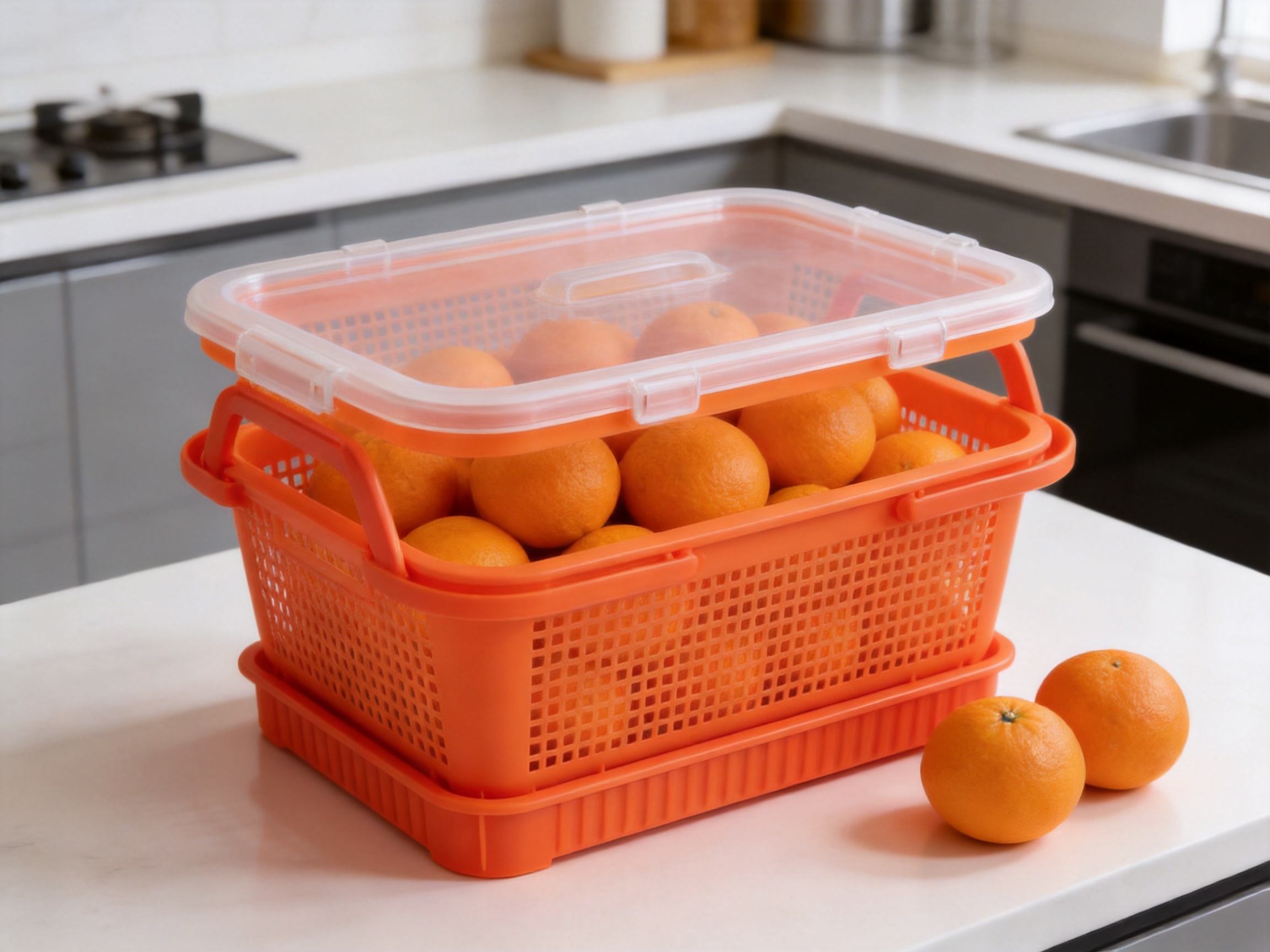
Open trays and uncovered baskets are easy to access, but they expose fruit to dust, accidental contact, and falling debris. The covered orange basket provides an additional protective barrier. The lid does not need to form an airtight seal; moderate closure is generally more suitable because citrus fruit benefits from ventilation.
This balance between protection and airflow is a major advantage. A completely open design may not provide enough cleanliness, while an airtight package may encourage moisture accumulation. The covered ventilated format addresses both concerns in a practical way.
Many storage boxes conceal their contents completely. Users must open the container to inspect the fruit, which can be inconvenient in a busy store or household kitchen. A transparent or semi-transparent lid allows quick visual checking.
Visibility also supports merchandising. Retailers can display attractive oranges or gift assortments while keeping the products protected. A well-designed lid can make the container look more organized and premium than a simple open sack or plain carton.
Loose fruit in bags can shift during transport, and cardboard cartons may become weak when exposed to moisture. A rigid plastic basket with reinforced handles gives users a more controlled carrying experience. Its shape helps keep the fruit organized, while the handle structure makes lifting more convenient.
Because the mould can be adapted to different capacities, manufacturers may offer small household versions and larger commercial versions. This product family approach creates opportunities for multiple sales channels without requiring a completely unrelated design concept.
When produced from an appropriate grade of PP or another durable plastic, the basket can be reused multiple times. Reusability is valuable for households, stores, fruit wholesalers, and seasonal gift businesses. It may also reduce dependence on single-use packaging for repeated storage operations.
The service life of the basket depends on material selection, wall thickness, handle design, locking structure, impact conditions, and cleaning practices. A professional mould helps maintain the dimensional consistency needed for reliable performance throughout the product’s useful life.
A stable flat bottom and reinforced rim can make the basket easier to stack. This is useful in warehouses and retail displays, where floor and shelf space are limited. Stackable containers can improve organization and help prevent products from being placed randomly or damaged by unstable piles.
Stacking features should be designed carefully so that the lower basket does not carry excessive pressure on the lid or fruit. A controlled nesting or stacking structure can improve safety and make the units easier to separate.
Citrus fruits are frequently sold as holiday gifts, seasonal packages, and premium produce assortments. The covered basket can serve as both a protective package and a presentational element. Color customization, transparent components, decorative labels, and optional surface textures can create a more distinctive appearance.
Compared with disposable packaging, a reusable basket may provide continuing value to the recipient. This can improve perceived product quality and help businesses differentiate their fruit packages from standard cartons or plastic bags.
Successful mould production begins with a detailed analysis of the basket and lid. Engineers review the three-dimensional product drawings, wall thickness, ribs, openings, handles, snap features, parting lines, ejection direction, and expected material behavior.
The analysis should determine whether the basket body and lid require separate moulds. In most cases, producing these components in separate tools provides better control over filling, cooling, surface finish, and cycle optimization. If a multi-cavity solution is desired, the number of cavities should be selected according to projected volume, machine capacity, product size, and investment budget.
Before steel cutting, the design should be checked for undercuts and difficult release areas. Side actions, lifters, collapsible cores, or other mechanisms may be required for certain locking and handle structures. Avoiding unnecessary complexity can reduce maintenance requirements and improve overall mould reliability.
The cavity forms the external surface of the basket, while the core forms the internal space. Their geometry must be arranged to provide consistent wall thickness and easy part removal. The parting line should be positioned where it has minimal effect on appearance and user comfort.
For a basket with extensive openings, the mould may contain many narrow steel features. These features must be strong enough to resist injection pressure and repeated thermal cycling. Proper steel treatment and careful machining are essential to prevent broken pins, damaged edges, or changes in opening geometry.
The lid may require a polished cavity for a clear surface, while the basket may use a textured or semi-matte finish to hide handling marks. Each area should be finished according to its functional and visual role.
The runner and gate system controls how molten plastic enters the mould. For a large basket, balanced filling is essential. An unbalanced flow path may produce uneven packing, warpage, visible weld lines, or inconsistent shrinkage.
Cold-runner systems are commonly used when investment cost, material flexibility, and simple maintenance are priorities. Hot-runner systems may reduce runner waste and improve cycle efficiency, especially in higher-volume production. The correct choice depends on the material, part size, expected output, machine configuration, and customer budget.
Gate locations should be selected to support uniform filling while minimizing visible marks in important areas. For a lid, the gate may need to be positioned to preserve appearance and reduce radial flow effects. For the basket, multiple gates may be considered when the component is large or has a complex mesh structure.
Venting allows trapped air and gas to escape as the cavity fills. This is particularly important for a basket with numerous openings, deep sections, and thin wall intersections. Inadequate venting can cause burn marks, short shots, gas traps, or poor surface replication.
Vent dimensions must be controlled. Vents that are too shallow may not release enough air, while vents that are too deep may allow flash. Venting can be positioned along the parting line, near the end of fill, around ribs, and at other areas identified through mould-flow analysis and trial results.
Cooling has a direct effect on cycle time, dimensional stability, and productivity. A basket mould contains broad surfaces, ribs, handles, and narrow mesh sections, so the cooling system must be designed for balanced heat removal.
Cooling channels should be placed close enough to the cavity surface to control temperature but far enough away to preserve mould strength. Areas around the base, upper rim, handle, and lid locking points may require particular attention because uneven cooling can cause warpage or dimensional mismatch.
Advanced mould manufacturing can incorporate baffles, bubblers, conformal cooling solutions, or independently controlled circuits where appropriate. The selection depends on tool size, required output, product geometry, and investment level.
The ejection system must remove the basket and lid without damaging thin webs, locking tabs, handles, or polished surfaces. Ejector pins, sleeves, stripper plates, and other mechanisms may be used according to the component geometry.
For a large container, ejection forces should be distributed evenly. Concentrated force can distort the basket or leave visible ejector marks. Ejector locations should generally be placed beneath stronger ribs or non-critical surfaces.
Automatic demoulding can be considered for high-volume production. A reliable automatic system may improve labor efficiency and reduce handling damage, although it requires careful coordination between the mould, injection machine, and downstream equipment.
PP is a common choice for the basket body because it offers a practical combination of impact resistance, flexibility, chemical resistance, low density, and cost efficiency. It can be processed efficiently and is available in many colors. PP also supports repeated handling and is suitable for many household and packaging applications.
Different PP grades can be selected according to stiffness, flowability, impact performance, and appearance. A grade with suitable melt flow may help fill the mesh walls and thin structural areas while maintaining acceptable strength.
PE can also be considered when greater flexibility and impact resistance are required. ABS may be used when a harder surface, stronger appearance, or improved dimensional rigidity is desired, although cost and chemical compatibility should be evaluated.
The lid material depends on the required transparency, impact strength, surface finish, and cost. Transparent PC offers high impact resistance and good clarity, although it may require careful drying and controlled processing. PMMA can provide excellent clarity and surface appearance but may be more sensitive to impact. Transparent PS may be suitable for certain low-impact applications where cost is a primary consideration.
A semi-transparent PP lid may be selected when matching the basket material, flexibility, and economical production are more important than optical clarity. The mould design should be adapted to the shrinkage and processing behavior of the selected plastic.
Mould steel selection influences tool life, polishability, corrosion resistance, machinability, and maintenance. P20 is widely used for general mould applications and may be suitable for components with moderate production requirements. 718H can provide improved hardness and performance in many production environments.
S136 and 2316 are often considered when corrosion resistance and high surface quality are important. This can be useful for transparent lid moulds or production environments where moisture and polished surfaces create special maintenance demands.
1CR13, 2CR13, 3CR13, and 4CR13 may be selected according to the required hardness, corrosion resistance, cost, and component function. The appropriate steel should be chosen after evaluating production quantity, plastic additives, surface finish, mould complexity, and maintenance expectations.
Steel selection should not be based solely on material name. Heat treatment, hardness control, machining precision, polishing quality, cooling design, and assembly accuracy all contribute to actual mould performance.
The manufacturing process begins with product data collection and engineering review. The customer’s drawings, samples, target capacity, plastic material, production machine, expected output, and market requirements are examined before the mould structure is finalized.
Three-dimensional CAD systems allow engineers to inspect wall thickness, identify undercuts, check assembly relationships, and prepare the mould layout. The basket body and lid can be studied together to ensure that their dimensions, locking features, and visual appearance are coordinated.
At this stage, engineers can also recommend design improvements. A small change to a rib, corner radius, handle transition, or snap-fit profile may improve manufacturability and reduce future mould maintenance. Early design review is generally less expensive than correcting a problem after steel machining or trial production.
Computer-aided engineering can be used to simulate filling, packing, cooling, and warpage. For a large ventilated basket, this analysis can help identify areas where molten plastic may hesitate or where weld lines may occur.
The analysis may compare alternative gate locations and runner layouts. It can also estimate pressure requirements, filling time, cooling behavior, and potential deformation. While simulation does not replace practical mould trials, it helps reduce avoidable design risks and supports more informed engineering decisions.
After the mould design is approved, CAM software converts the engineering data into machining instructions. CNC milling machines are used to create cavity and core surfaces, pockets, ribs, slides, inserts, and other precision features.
Complex basket openings and narrow structural areas demand accurate machining. Small dimensional deviations can influence assembly, ventilation, appearance, or part ejection. High-quality cutting tools, stable machine settings, and controlled workholding help maintain precision.
Deep cavity areas may require multiple machining stages, including roughing, semi-finishing, and finishing. Each stage removes material progressively while protecting the final geometry. For transparent lid moulds, finishing and polishing operations must be planned carefully to achieve the intended surface quality.
Electrical discharge machining is useful for producing intricate features that are difficult to create through conventional cutting. It can be used for sharp internal details, narrow slots, deep ribs, locking profiles, and other complex areas.
EDM parameters must be controlled to avoid excessive recast layers, dimensional variation, or surface damage. After EDM, the affected areas may require polishing, cleaning, or additional finishing according to the product requirement.
Wire-cut EDM can produce accurate inserts, contours, slots, and precision components. It is particularly valuable when the mould contains complex profiles that must fit together closely.
Accurate insert production makes it easier to repair or replace localized sections of the mould. This can reduce maintenance costs and extend the useful life of the complete tool.
Heat treatment can improve mould steel hardness and wear resistance. The correct treatment depends on the steel grade and the required service conditions. Improper treatment may cause distortion, cracking, or insufficient hardness, so the process must be controlled carefully.
Surface finishing ranges from standard milling textures to fine polishing and mirror polishing. The basket body may use a matte texture to reduce visible scratches, while the lid cavity may need a higher polish for transparent or semi-transparent appearance.
After machining and finishing, the mould components are assembled. Technicians check the fit of inserts, slides, ejector components, cooling connections, guide systems, and locking mechanisms.
Manual fitting remains important even when the mould has been produced with advanced equipment. Skilled technicians inspect contact surfaces, parting lines, shut-offs, moving components, and ejection behavior. Accurate fitting helps prevent flash, leakage, uneven wear, and premature component failure.
The first mould trial verifies whether the tool can produce acceptable parts. Engineers examine filling, ejection, dimensions, surface appearance, locking function, lid fit, wall consistency, and cycle behavior.
Trial results may lead to adjustments in injection speed, pressure, holding time, cooling time, mould temperature, or ejection settings. If necessary, the mould itself may be modified to improve venting, eliminate flash, correct shrinkage, or refine a surface detail.
Several trial stages may be used before final approval. A disciplined trial process helps ensure that the mould is suitable for stable production rather than merely producing a small number of acceptable samples.
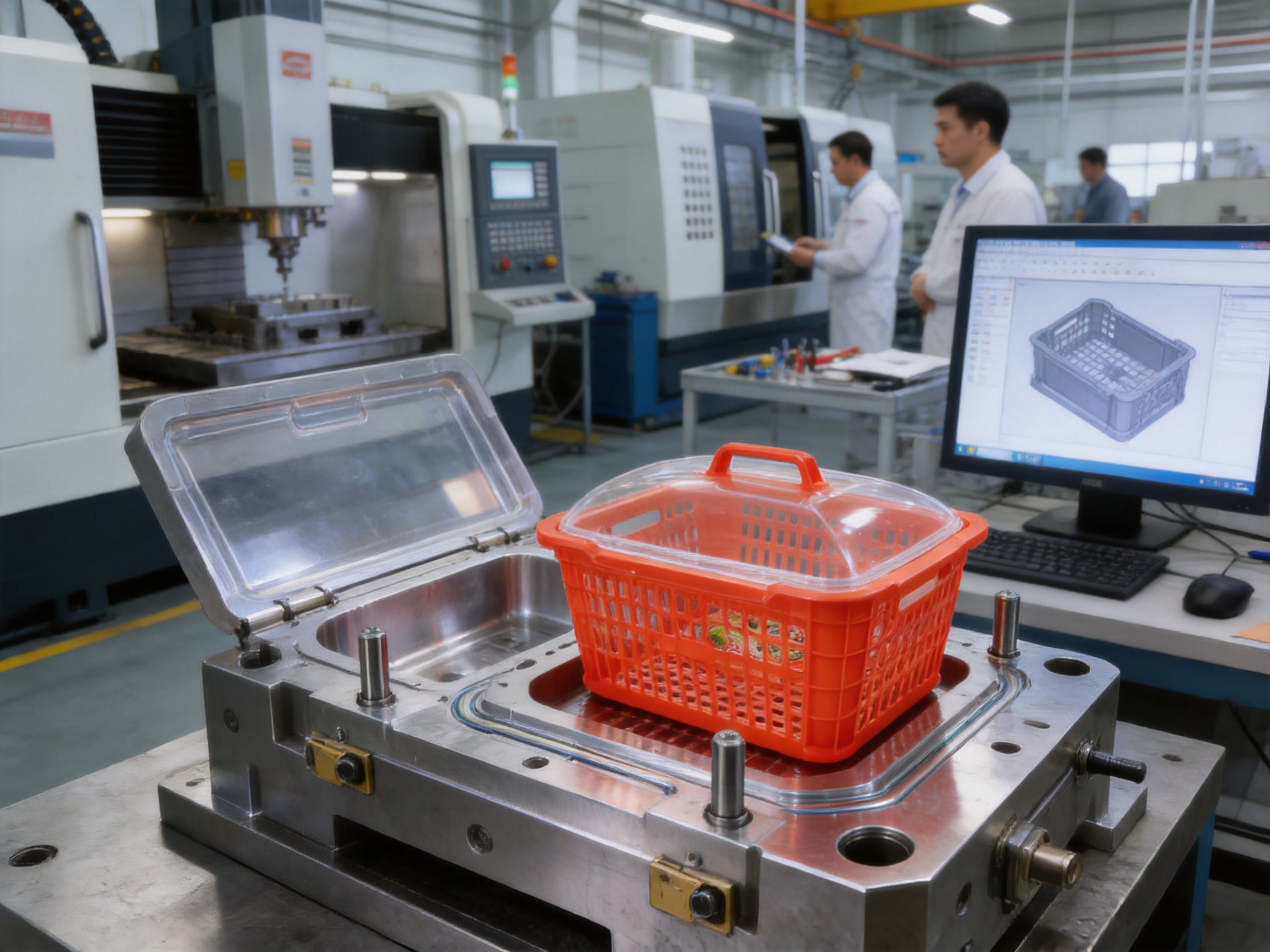
TaiZhou HuangYan YingXiang Plastic Mould Co., Ltd. is located in Huangyan, Taizhou, Zhejiang, China, a region widely associated with mould manufacturing. Established in 2012, the company operates a plant of approximately 7,000 square meters and has around 50 employees.
The company uses CAD, CAE, and CAM systems to support product development and mould production. These systems help connect design analysis, tool construction, machining, and trial evaluation. This integrated workflow can improve communication between engineering and production teams while reducing the risk of information loss during project transfer.
Yingxiang specializes in customized plastic mould solutions. Its product scope includes logistics crate moulds, folding box moulds, tray and pallet moulds, beverage box moulds, and moulds for daily household products. This range is relevant to the covered orange basket because the product combines the requirements of a household container, a logistics package, and a ventilated produce box.
Experience across multiple container categories can help engineers recognize recurring design challenges. These include large thin-wall filling, reinforced handles, stacking structures, snap-fit lids, ventilation openings, material shrinkage, and high-volume production requirements.
The company’s stated manufacturing priorities include lean production, long-life moulds, on-time delivery, premium quality, competitive costs, and comprehensive customer service. These priorities are important because a mould purchase is a long-term production decision. The customer needs not only a tool that works during initial sampling but also a tool that can support stable output, repeat orders, maintenance, and possible design updates.
The product specifications indicate that the model, color, size, and other characteristics can be customized. In practical terms, this means the mould can be developed around a customer’s target market rather than forcing the customer to accept one fixed basket design.
Customization may include basket dimensions, internal capacity, lid shape, handle opening, ventilation pattern, locking method, stacking structure, logo area, surface texture, and material selection. The customer can also define whether the finished product should be designed primarily for home use, retail display, commercial transport, or gift packaging.
OEM service supports customers that have their own brand, product drawings, distribution channels, or packaging strategy. An experienced mould supplier can help convert an initial concept or sample into a tool suitable for injection moulding.
The available mould material options allow the tool to be matched to expected production conditions. A lower-cost mould steel may be adequate for limited production, while corrosion-resistant or higher-performance steel may be preferred for larger output, demanding surface requirements, or frequent use.
The stated supply capacity of approximately 50 mould sets per month indicates the ability to support multiple projects across different product categories. Actual delivery time depends on the mould size, cavity number, complexity, steel selection, surface finish, design approval, and trial requirements.
Moulds are supplied in composite wooden boxes. Proper packaging is essential because moulds contain precision-fitted components that can be damaged by impact, moisture, or improper lifting during transport.
A suitable export package should protect the tool from movement, corrosion, and accidental contact with external surfaces. Moving components may require locking or support, while exposed steel surfaces may need rust-prevention treatment. Clear identification of the mould, component set, spare parts, and lifting points can also simplify installation at the customer’s factory.
Dimensional inspection confirms that the mould produces a basket and lid within the required tolerances. Important dimensions include overall length and width, height, internal volume, rim alignment, handle position, locking point location, opening size, and base flatness.
Dimensional checks should consider both mould steel and moulded samples. A cavity may be machined accurately, but plastic shrinkage and processing conditions can still affect the final component. The supplier and customer should therefore agree on critical dimensions and acceptable tolerances before production approval.
The lid must fit the basket consistently. The locking points should engage evenly, the lid should not rock excessively, and the opening force should remain reasonable. Compatibility tests should be carried out across multiple samples rather than on a single unit.
Temperature, material batch, and processing conditions can influence dimensions. A robust mould design provides enough control and repeatability to reduce variation during normal production.
Surface appearance affects customer perception, especially for gift packaging and retail applications. The basket should have consistent texture and minimal visible flow defects. The lid should meet the agreed level of transparency or translucency without unacceptable scratches, haze, burn marks, or weld-line weakness.
Surface inspection should also include parting lines, ejector marks, gate marks, flash, and areas around the ventilation openings. Finishing standards should be documented so that the supplier and buyer share the same expectations.
Functional testing may include handle loading, repeated lid opening and closing, stacking evaluation, drop testing, and inspection under realistic fruit loads. These tests help identify issues that may not be visible during dimensional inspection.
For example, a handle may appear correct but deform under several kilograms of fruit. A lid may fit during an initial test but loosen after repeated operation. A basket may remain stable when empty but become unstable when stacked under load. Practical testing provides valuable confirmation of the design’s real performance.
The mould should be inspected for cooling leaks, smooth movement, correct ejector return, guide-pillar alignment, slide operation, and secure fastening. Regular preventive maintenance can help preserve performance and reduce unexpected downtime.
Wear parts and spare components should be identified when the tool is delivered. Clear maintenance instructions can help the customer’s technical team perform cleaning, lubrication, inspection, and replacement work more efficiently.
| Customization Area | Available Direction | Primary Benefit |
|---|---|---|
| Basket shape | Square, rectangular, round, or other tailored profiles | Matches storage, display, and branding requirements |
| Capacity | Small household, medium retail, or larger commercial sizes | Supports different sales channels and fruit quantities |
| Lid material | Transparent, semi-transparent, or opaque plastic | Balances visibility, impact resistance, and cost |
| Ventilation pattern | Different opening sizes, shapes, and distribution | Improves airflow and creates a distinctive appearance |
| Locking system | Snap-fit tabs, clips, or interlocking rims | Controls security and ease of access |
| Handle design | Integrated, reinforced, or ergonomic grip structures | Improves carrying comfort and load performance |
| Surface treatment | Glossy, matte, textured, or polished finishes | Enhances appearance and hides handling marks |
| Branding | Embossed logos, recessed marks, or label areas | Supports product recognition and private-label sales |
| Plastic color | Custom colors for the basket and lid | Creates product differentiation and seasonal appeal |
Customization should be evaluated as part of the complete mould system rather than as isolated decoration. For example, changing the ventilation pattern may affect filling, cooling, ejection, and structural strength. Increasing basket capacity may require changes to the machine size, runner system, mould base, lifting arrangements, and cycle settings.
Customers should provide the target plastic material and production conditions as early as possible. The shrinkage rate, flow behavior, impact performance, transparency, and processing temperature of the plastic all influence mould dimensions and design decisions.
A single-cavity mould may be suitable for product development, moderate output, or a large basket with complex geometry. Multi-cavity moulds can increase productivity when demand is high, but they also require greater investment and more advanced balance control.
The correct choice should consider annual demand, target selling price, machine availability, labor cost, acceptable cycle time, and expected product variations. A lower-cavity mould may offer greater flexibility, while a higher-cavity tool may reduce unit cost at large volumes.
Cycle time includes mould closing, injection, holding, cooling, opening, and ejection. Cooling is often the longest stage for a thick or structurally reinforced container. Efficient cooling design can therefore produce significant commercial benefits.
Reducing cycle time must not compromise product quality. If the basket is ejected too early, it may deform. If packing is insufficient, the base or handle may lack strength. The best result comes from balancing speed, cooling, dimensional stability, and material usage.
Plastic cost is a major part of the total production cost. The basket should be strong enough for its intended load but should not contain unnecessary thickness. Correct rib design, wall transitions, and gate placement can reduce material consumption while maintaining performance.
Runner waste can also influence cost. Depending on the production volume and selected plastic, a hot-runner system may be considered to reduce discarded material. However, the additional system cost and maintenance requirements should be evaluated against expected savings.
Regular mould maintenance includes cleaning the cavity and core, removing residue, lubricating moving parts, checking cooling lines, inspecting ejector components, and applying rust prevention when the tool is stored.
Maintenance frequency depends on the plastic material, production environment, cycle count, surface finish, and mould construction. Abrasive additives, corrosive materials, and high-volume use may require more frequent inspection.
A mould built with replaceable inserts can be easier to repair. If a localized feature such as a locking tab, mesh section, or gate area becomes worn, the affected insert may be replaced without rebuilding the complete mould.
The primary application is the storage and presentation of oranges and other citrus fruits. The basket can be used in homes, fruit and vegetable shops, supermarkets, wholesale markets, farms, and distribution centers.
For household use, the container helps organize fruit in kitchens, dining areas, pantries, and refrigerators where suitable. The lid protects the contents while the transparent section permits quick inspection.
For retail display, the basket provides a tidy and reusable presentation format. Different colors or sizes can be assigned to different fruit categories, price levels, or promotional campaigns.
For commercial logistics, the reinforced body, ventilated walls, handles, and stackable base can help simplify movement between storage and display areas. The exact suitability for long-distance transport depends on the final basket design, load level, stacking method, and transport conditions.
For gift packaging, the basket can hold selected oranges, grapefruits, citrus products, or mixed food items. A customized lid, decorative color, logo, and label area can support seasonal and premium product programs.
The same mould development experience may also be applied to related produce containers. With design changes, the concept can be adapted for vegetables, baked goods, household supplies, or other products requiring ventilation and moderate protection.
A plastic product may appear simple on the outside, but the mould behind it can involve many interacting technical requirements. The basket must fill correctly despite its open mesh structure. The lid must remain flat and fit the rim. The handles must withstand load. The locking points must be durable. The base must remain stable. The mould must also operate reliably over many production cycles.
Professional mould engineering brings these requirements together. It combines product design, material knowledge, flow analysis, machining, steel selection, cooling, ejection, trial moulding, and quality control.
A supplier with experience in household products, crates, boxes, pallets, and trays is well positioned to understand the practical needs of a covered orange basket. These product categories frequently share challenges involving large dimensions, repetitive handling, stacking, reinforced structures, and cost-sensitive high-volume production.
Advanced equipment is valuable, but equipment alone does not guarantee a good mould. Experienced technicians are needed to interpret design data, recognize machining risks, adjust fitting surfaces, evaluate trial samples, and make practical improvements. The combination of modern CAD/CAE/CAM systems and experienced personnel supports a more complete manufacturing process.
Before requesting a quotation, customers should prepare the desired basket dimensions, internal capacity, target fruit weight, plastic material, color, lid transparency, locking method, handle style, expected annual output, and available injection machine information.
It is also helpful to provide product drawings, three-dimensional files, reference samples, or sketches. If the basket will be used for a specific retail or gift program, photographs and packaging references can help clarify appearance requirements.
Customers should identify critical performance requirements. These may include handle load, stacking height, drop resistance, repeated lid operation, temperature exposure, cleaning method, and acceptable surface marks.
Clear information at the beginning allows the mould supplier to recommend suitable steel, cavity quantity, cooling design, gate system, and ejection structure. It also makes the quotation and delivery schedule more realistic.
It is a plastic injection mould developed to produce a covered orange basket and its related components. The mould can be customized according to the customer’s product design, size, material, color, and production requirements.
The primary application is oranges and other citrus fruits such as grapefruits and lemons. Depending on the basket dimensions and ventilation design, it may also be suitable for apples, pears, tomatoes, potatoes, or mixed produce.
Ventilation openings allow air movement around the fruit and help reduce moisture accumulation. They can support better storage conditions while also reducing the risk of mold caused by trapped humidity. The final performance depends on fruit condition, temperature, humidity, and storage duration.
Yes. The lid can be designed with transparent or semi-transparent plastic, depending on the required clarity, impact resistance, cost, and appearance. Suitable materials may include PC, PMMA, transparent PS, or other approved plastic grades.
Yes. The model and size are customizable. The mould can be designed for household quantities, retail displays, larger commercial loads, or seasonal gift packages. Changing the size may require changes to the mould base, cooling system, injection machine, and structural design.
PP is a common choice because it offers a useful balance of impact resistance, flexibility, chemical resistance, low density, and cost. PE, ABS, and other plastics may also be considered when specific flexibility, rigidity, or appearance requirements apply.
Possible mould materials include 1CR13, 2CR13, 3CR13, 4CR13, S136, CR16, 2316, 718H, and P20. The best choice depends on production volume, corrosion resistance, surface finish, plastic type, mould complexity, and customer budget.
Yes. A logo can be incorporated as an embossed or recessed feature, or the basket can include a dedicated label area. The logo location should be selected carefully so that it does not weaken the basket, interfere with ejection, or create an undesirable flow mark.
The lid can use multiple locking points around the rim. Snap-fit tabs, clips, or interlocking profiles can provide moderate closure. The design should balance security with ease of opening and should be tested through repeated use.
Yes. The mould can be designed for high-volume injection moulding, subject to the selected cavity quantity, steel grade, cooling system, machine capacity, and maintenance plan. A multi-cavity tool may be considered when demand justifies the additional investment.
Professional mould engineering addresses filling balance, cooling, venting, ejection, shrinkage, surface finish, and dimensional control before mass production. Proper analysis and trial moulding can reduce short shots, flash, warpage, sink marks, locking problems, and premature tool wear.
The manufacturer provides customized plastic injection mould solutions, including product development support, mould design, material selection guidance, machining, assembly, trial moulding, quality inspection, and export packaging. OEM service is available for customers with their own designs or brand requirements.
The stated supply capacity is approximately 50 mould sets per month. Actual capacity and delivery time depend on the number of projects in production, tool complexity, cavity quantity, steel selection, finishing requirements, and customer approval schedules.
The mould should be cleaned regularly, lubricated according to the maintenance instructions, inspected for wear, and protected against corrosion during storage. Cooling channels, ejector components, slides, guide systems, and parting surfaces should be checked as part of preventive maintenance.
The supplier normally needs the product drawings or sample, basket and lid dimensions, target plastic materials, expected production volume, injection machine information, cavity preference, surface finish requirements, logo details, and delivery destination. More complete information allows for a more accurate technical and commercial proposal.
The covered orange basket mould combines practical product design with demanding injection moulding requirements. Its deep container, ventilated walls, transparent or semi-transparent lid, multiple locking points, reinforced handles, and ribbed base create a useful solution for citrus storage, retail presentation, commercial handling, and gift packaging.
Compared with open baskets, bags, and ordinary cartons, the covered design offers improved protection, visibility, carrying convenience, reusability, and stacking potential. These advantages can help businesses develop more attractive and functional fruit packaging for household and commercial markets.
The quality of the finished basket depends heavily on the mould. Balanced filling, accurate mesh openings, reliable cooling, smooth ejection, strong locking features, and precise lid compatibility must all be considered during design and manufacturing. Appropriate mould steel, advanced CAD/CAE/CAM systems, CNC machining, EDM, controlled heat treatment, skilled fitting, and systematic trial moulding contribute to dependable production.
TaiZhou HuangYan YingXiang Plastic Mould Co., Ltd. offers customized plastic injection mould solutions from its facility in Huangyan, Taizhou, Zhejiang, China. With experience in household products, logistics crates, folding boxes, trays, pallets, beverage boxes, and related containers, the company is equipped to support projects that require both attractive product design and durable tooling performance.
For customers seeking a reusable, ventilated, covered fruit container, this mould concept provides a flexible foundation. With the right customization, material selection, cavity configuration, and production process, it can support a broad range of orange basket products while maintaining practical manufacturing efficiency and long-term commercial value.
1. General principles of plastic injection mould design, including gate selection, venting, cooling, ejection, and draft-angle practice.
2. Technical guidance for polypropylene, polyethylene, polycarbonate, polystyrene, ABS, PMMA, and related injection moulding materials.
3. Industrial references on mould steel selection, corrosion resistance, heat treatment, polishing, and service-life planning.
4. Packaging engineering principles for reusable produce containers, ventilated storage systems, stacking structures, and retail presentation.
5. Engineering references covering computer-aided design, computer-aided engineering, computer-aided manufacturing, mould-flow evaluation, and CNC tool production.
6. Manufacturer-provided product specifications for the covered orange basket injection mould, including customization options, material choices, mould packaging, and supply capability.
If you are interested in any of our products or services, please feel free to ask and we can talk about your ideas.
 QUICK LINKSMOBILE SITE
 FACTORY ADDRESS
 CONTACT INFORMATION



 English
 Español