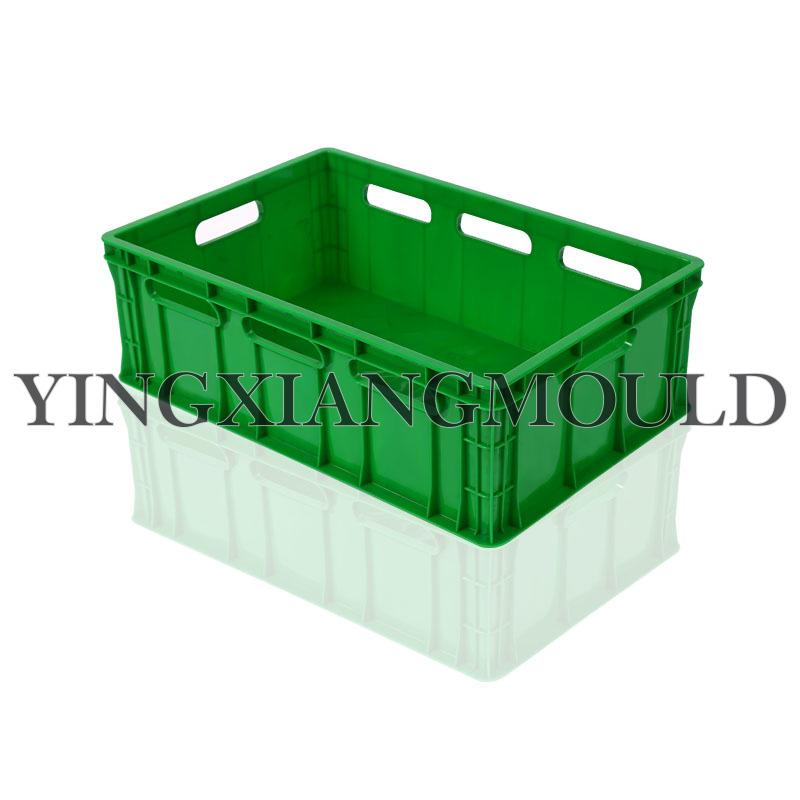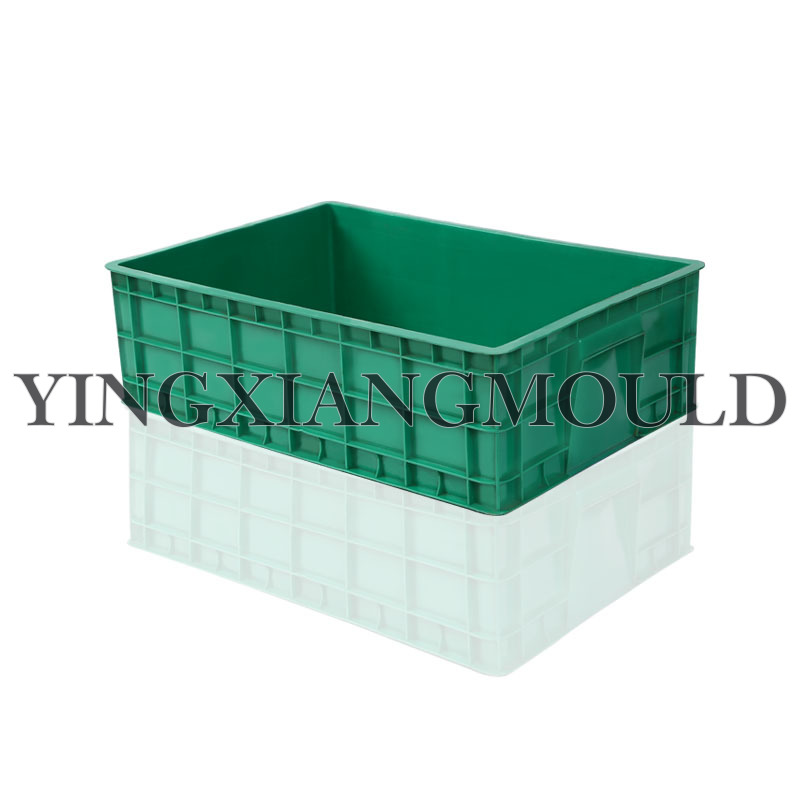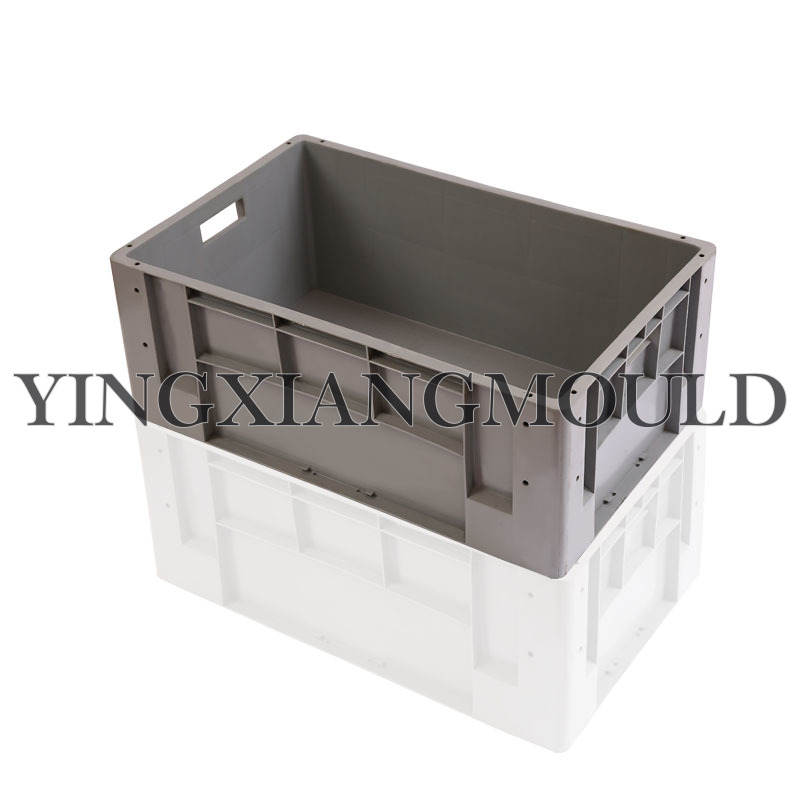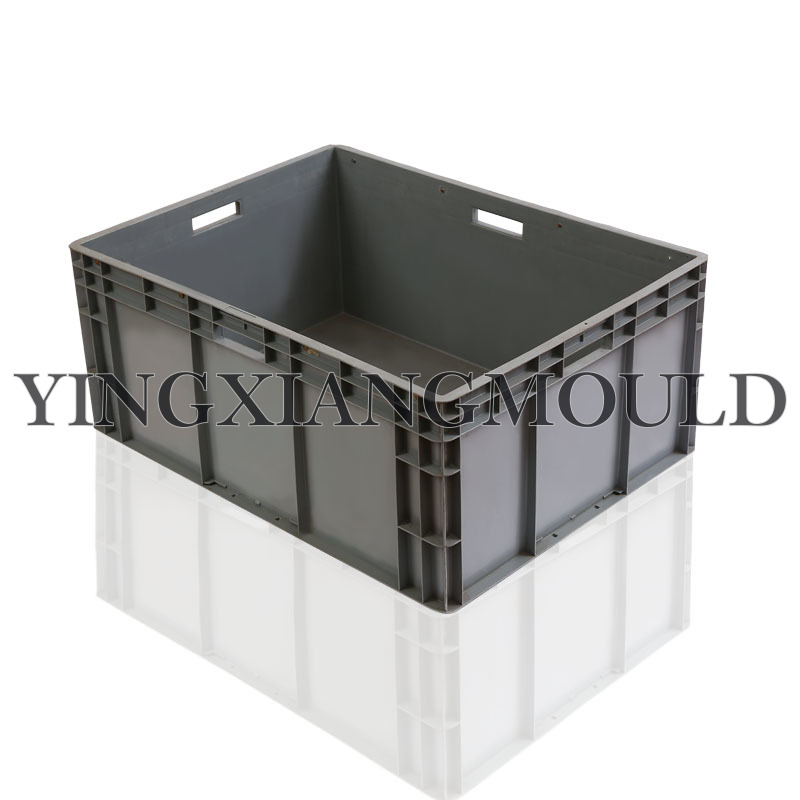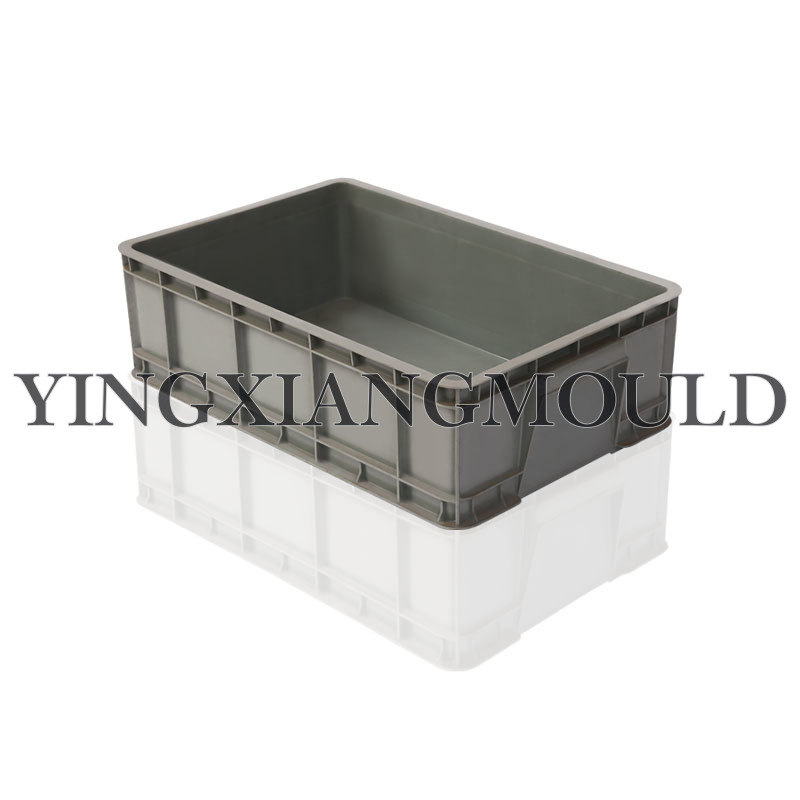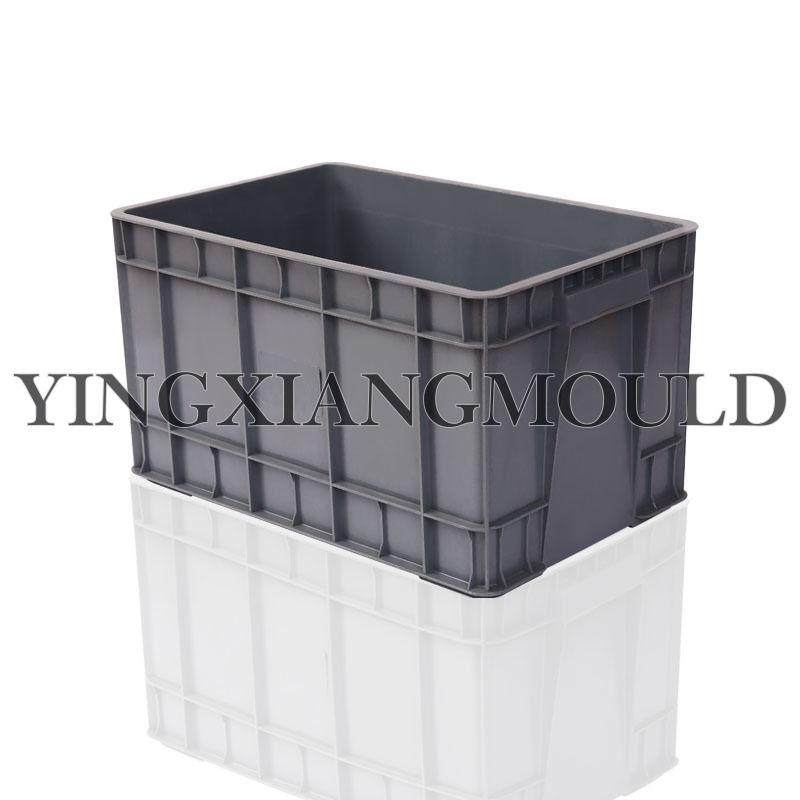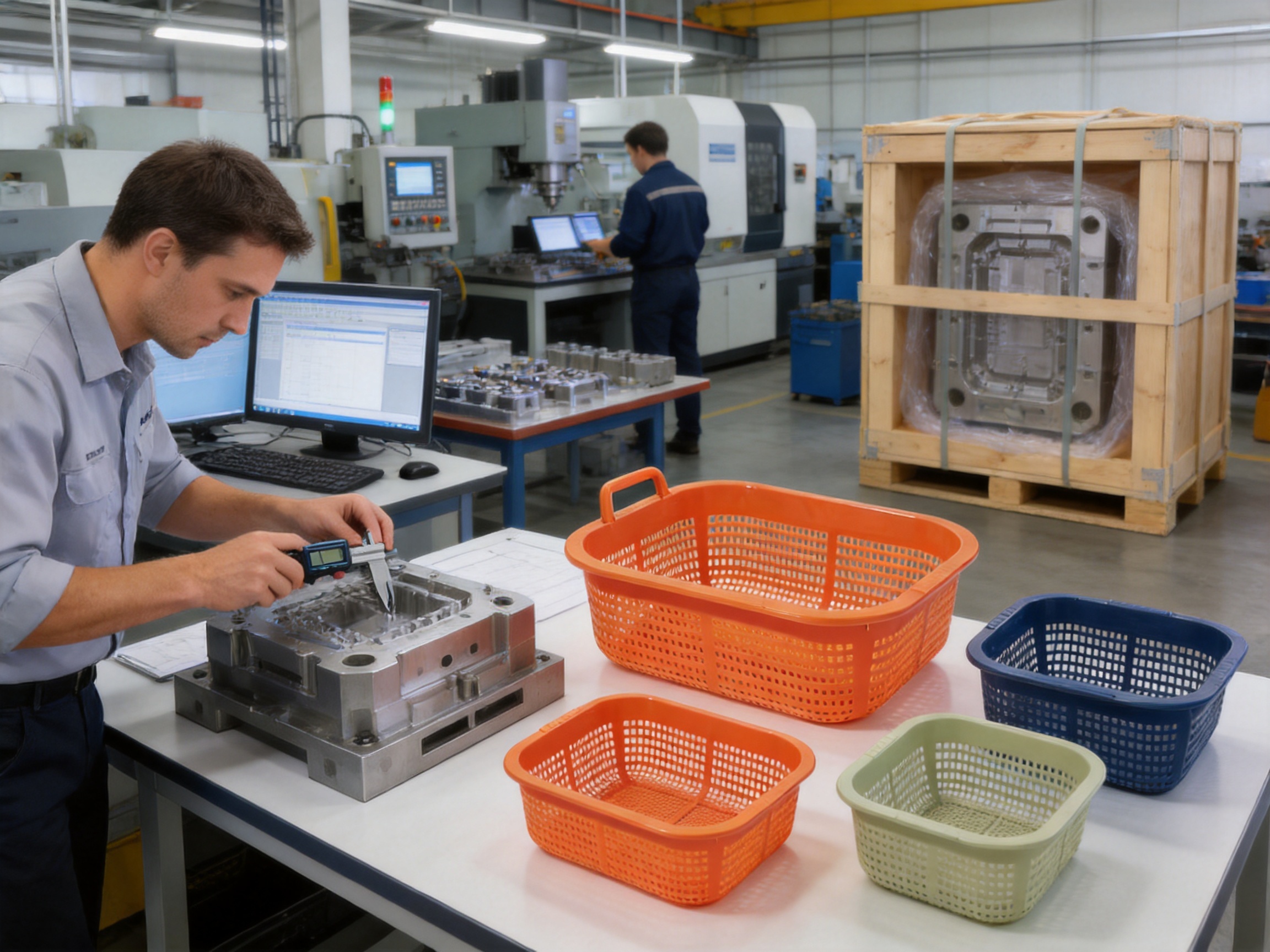
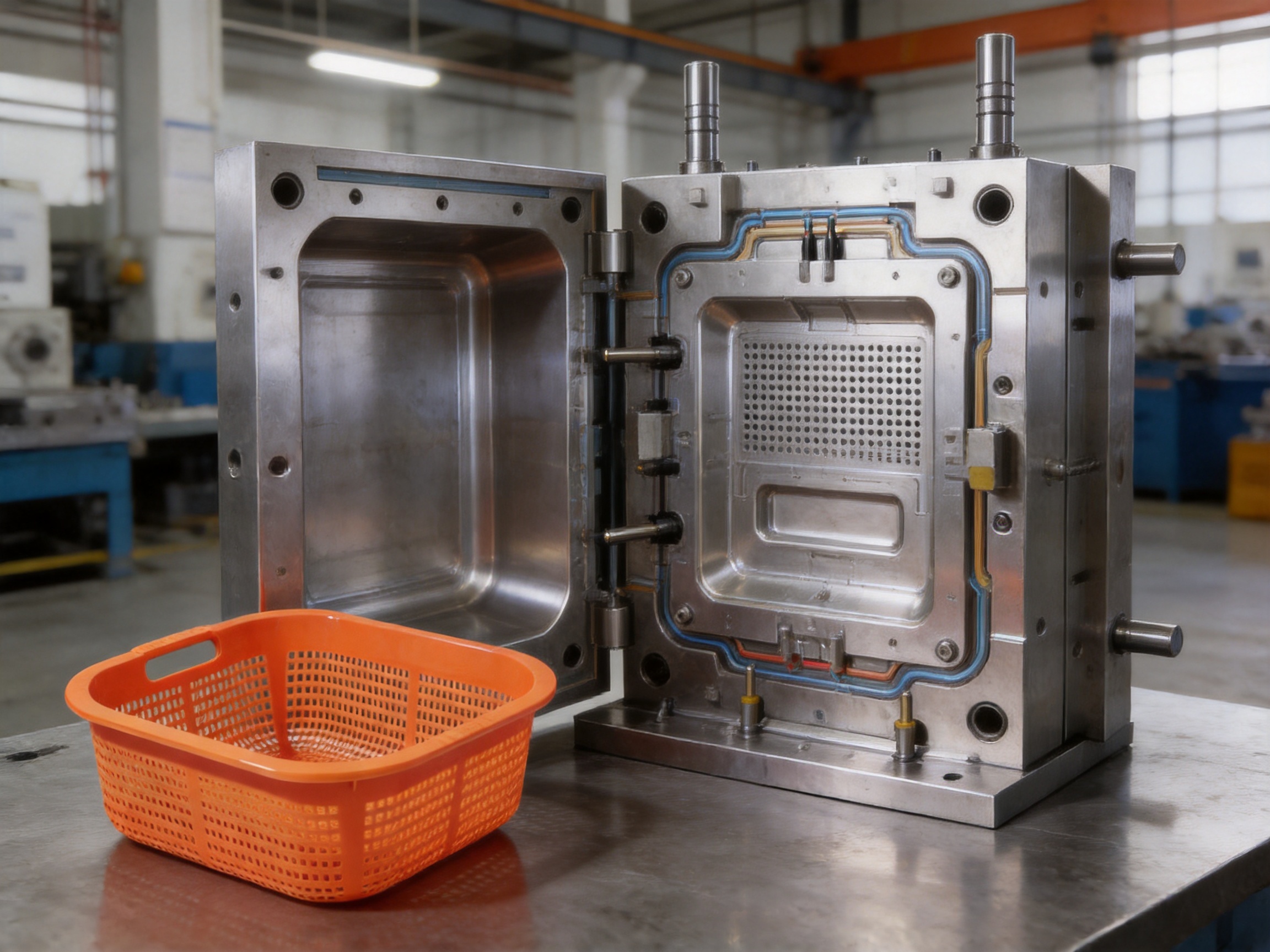
The square hollow plastic basket is a versatile storage product designed for homes, kitchens, bathrooms, children’s rooms, retail environments, and light commercial applications. Its perforated structure provides airflow, its square geometry makes efficient use of storage space, and its concealed handles support convenient carrying without adding unnecessary external volume. Behind this practical product is a carefully engineered plastic injection mould capable of producing consistent basket walls, clean perforations, smooth edges, and stable dimensions over repeated production cycles.
For manufacturers, distributors, and product developers, the mould is just as important as the finished basket. A well-designed mould affects appearance, production efficiency, part strength, demoulding performance, maintenance requirements, and the overall cost of ownership. The square hollow plastic basket mould supplied by TaiZhou HuangYan YingXiang Plastic Mould Co., Ltd. is developed as a customizable injection moulding solution for customers who require dependable performance, flexible material selection, and production-ready engineering support.
This article examines the product design, manufacturing value, technical characteristics, customization options, and company capabilities behind this type of basket mould. It also explains why a purpose-built perforated basket can offer important advantages over less specialized storage products and how a professional mould manufacturer can help transform an idea into a repeatable commercial product.
The square hollow plastic basket is formed as a lightweight, open-structure container with regularly distributed holes on the side walls and bottom. The perforations allow air to pass through the stored contents, helping reduce moisture accumulation and supporting better visibility. Unlike a fully enclosed storage box, the basket is designed for situations where ventilation, quick access, and visual identification are important.
The square shape is one of the product’s most practical features. Round baskets often create unused gaps when placed next to one another, while irregularly shaped containers may be difficult to arrange inside cabinets or on shelves. A square basket can be placed closely beside other baskets, against a wall, or inside a standard storage compartment. This makes the available space easier to organize and improves the appearance of a storage area.
The basket is suitable for many household uses. In kitchens, it can hold onions, potatoes, garlic, apples, packaged food, utensils, or cleaning accessories. In bathrooms, it can organize towels, toiletries, bottles, and personal care products. In children’s rooms, it can store building blocks, dolls, small vehicles, art supplies, and other toys. It may also be used in bedrooms, laundry areas, offices, workshops, dormitories, and retail displays.
The concealed handle design is another functional element. Instead of using large external handles that increase the overall footprint, the handle can be integrated into the upper structure of the basket. This creates a cleaner profile and makes the product easier to stack, place, or slide into storage furniture. A concealed handle can also reduce the risk of snagging when several baskets are arranged closely together.
The smooth plastic surface is easy to wipe and maintain. Because the basket is made through injection moulding, its exterior can be produced with a controlled surface finish selected according to the customer’s requirements. The product may be manufactured in different colours, sizes, and plastic materials, allowing it to serve different market segments and design styles.
Ventilation is a major advantage of the hollow basket structure. Fruits and vegetables can release moisture after harvesting or washing. If they are kept in a completely sealed container, condensation may form and accelerate deterioration. A perforated basket allows air to circulate around the contents, supporting a drier storage environment and making it easier for users to inspect the condition of the food.
The ventilation holes also contribute to product visibility. Users can identify the contents without removing the basket from a shelf. This is especially valuable in busy kitchens, supermarkets, storage rooms, and households where multiple baskets are used for different categories of goods. A visible storage system can reduce the time spent searching for items and encourage better organization.
Compared with fabric bags or cardboard containers, a plastic perforated basket offers better resistance to moisture and repeated handling. It does not absorb water as easily as paper-based packaging and can be cleaned more conveniently than many textile organizers. Compared with a fully solid plastic box, it offers improved airflow and often uses less material, helping reduce product weight.
The perforation pattern must be carefully designed. Holes that are too large may weaken the walls, allow small products to fall through, or create uncomfortable edges. Holes that are too small may restrict ventilation and increase mould complexity. The spacing, shape, corner radii, and distribution of the openings must therefore be balanced with the product’s intended use and the selected plastic material.
For a professional injection mould, the hole layout also affects filling, cooling, ejection, and mould strength. A basket mould is not simply a solid container mould with openings added afterward. The cavity, core, sliders, inserts, ejector system, and cooling arrangement must work together to produce a stable component without distortion or difficult demoulding.

Square Hollow Plastic Basket
The square hollow plastic basket provides a combination of ventilation, compact organization, cleanability, and durability that is not always available in alternative storage products. Each advantage results from a direct relationship between product geometry and everyday use.
Square products are naturally suitable for organized storage. Their straight sides allow several units to be arranged in rows with limited wasted space. When used in a cabinet, pantry, or modular shelving system, the baskets can be aligned neatly and labelled according to their contents. This is more efficient than relying on rounded containers that leave triangular gaps between units.
The regular shape also simplifies packaging, warehousing, and transportation. Square baskets can be nested or stacked according to the product design, helping distributors use cartons more efficiently. A more compact shipping arrangement may reduce handling complexity and improve the number of units that can be transported in each package.
The openings on the four sides and bottom create multiple airflow paths. This makes the basket particularly suitable for items that benefit from ventilation, including onions, garlic, potatoes, apples, and other fruits and vegetables. The same feature is useful for towels, washcloths, sports accessories, and toys that should not be kept in a completely sealed space.
Ventilation is also helpful after cleaning. If a basket is washed and placed in a humid environment, the open structure allows water to drain and air to circulate. This can make drying more convenient than with a deep solid container.
Injection-moulded plastic can provide a favourable balance between low weight and useful strength. The basket is easy to lift when filled with lightweight household goods, yet its designed wall structure can resist routine handling. Lightweight products are more comfortable for children, older users, and people who frequently reorganize storage areas.
Lower product weight can also support more economical distribution. However, lightness must not be achieved by reducing wall thickness beyond the practical limits of the material. Proper mould design and structural engineering help maintain sufficient stiffness around the rim, corners, handles, and base.
A smooth plastic surface is generally easier to wipe than unfinished wood, woven fabric, or porous cardboard. The open pattern reduces the chance that dust will remain hidden inside the basket, while the rounded edges can make cleaning more comfortable. Depending on the selected plastic and the customer’s intended market, the product can be designed for routine household cleaning with water and suitable detergents.
Colour is customizable, allowing the basket to be coordinated with kitchen furniture, bathroom accessories, children’s products, or retail displays. Manufacturers may offer neutral colours for home organization, bright colours for children’s storage, or brand-specific colours for commercial programs.
The surface finish can also influence the product’s perceived quality. A carefully selected texture may reduce the visibility of minor handling marks, improve grip, or create a more refined appearance. The mould manufacturer can discuss the relationship between texture, draft angle, polishing, and release performance before steel processing begins.
Many storage products are developed for one narrow use. The square hollow basket is more adaptable. Its dimensions, hole pattern, and handle design can be adjusted for different contents and environments. This allows one basic product concept to serve multiple applications while preserving a consistent manufacturing platform.
The mould is the foundation of production quality. A basket with thin walls, repeated openings, a concealed handle, and a regular square shape requires careful attention to parting lines, wall thickness, mould flow, cooling, and ejection.
The cavity forms the outer surface of the basket, while the core forms the internal space. The two sides must be designed to separate cleanly after injection. Because the basket contains numerous holes and recessed handle areas, the mould may require a combination of core features, inserts, lifters, or sliders depending on the final geometry.
The separation strategy should be considered at the beginning of the project, not after the product design has been completed. If the parting line passes through an important visual area, it may leave an unwanted witness mark. If the mould includes deep undercuts, the tooling may become more complicated and maintenance may increase. A skilled design team can often adjust the basket geometry slightly to improve mouldability without changing the product’s essential function.
The holes must be formed directly by mould steel whenever possible. Directly moulded openings provide consistent dimensions and avoid secondary drilling or cutting operations. This improves production efficiency and reduces the risk of rough edges, contamination, or inconsistent hole placement.
However, each hole-forming feature must be strong enough to withstand injection pressure and repeated mould cycles. Narrow steel projections may be vulnerable if they are unsupported or poorly cooled. The design team must evaluate the hole size, wall spacing, steel thickness, and flow direction to ensure reliable service life.
Uniform wall thickness is a central objective in injection moulding. Major differences in thickness can cause uneven cooling, sink marks, warpage, or internal stress. The basket’s side walls, base, rim, and handle areas should be balanced so the material fills the mould consistently and solidifies in a controlled manner.
Some areas may need local reinforcement, especially around handles, corners, stacking points, or the base. Reinforcement should be designed with gradual transitions rather than abrupt thick sections. Ribs may be used to increase stiffness while avoiding excessive material accumulation.
Draft angles help the finished basket release from the core and cavity. Without sufficient draft, the plastic may grip the mould surface, increasing ejection force and creating scuff marks or deformation. The required draft depends on the surface texture, material, depth, and geometry of the product.
Textured surfaces generally need more draft than polished surfaces. Deep internal walls may also require additional consideration because the part can shrink onto the core during cooling. A mould design that treats demoulding as a primary requirement can reduce cycle interruptions and improve the appearance of finished baskets.
The feeding system determines how molten plastic enters and travels through the basket mould. The gate location should support balanced filling while minimizing visible marks in important areas. For a basket with multiple openings, the flow path must be evaluated carefully because thin sections and changes in geometry can influence filling pressure and weld-line position.
Depending on the basket size, material, and production volume, the mould may be configured with a cold runner or a hot runner system. The most appropriate choice depends on the customer’s equipment, target cycle time, material selection, expected production quantity, and cost objectives. A professional manufacturer can compare these options during the engineering stage.
Cooling has a direct effect on cycle time and dimensional stability. The mould should remove heat evenly from the thicker areas, corners, rim, and base. Poorly balanced cooling can cause one side of the basket to shrink more than another, leading to warpage or difficulty fitting the product into storage furniture.
Cooling channels should be positioned with consideration for the basket’s geometry and the available mould steel. In complex regions, inserts or specialized channel arrangements may help improve temperature control. The goal is not simply to cool the part quickly, but to cool it evenly and repeatably.
The ejection system must remove the basket without leaving unacceptable marks or distorting the perforated walls. Ejector pins, ejector plates, sleeves, lifters, or other mechanisms may be selected according to the design. Ejection force should be distributed across strong areas of the product, such as the base or reinforced ribs.
If the ejection system pushes against thin sections or areas close to openings, the part may bend or show visible marks. A properly engineered system improves automatic production and reduces the risk of operator intervention.
The product information supports a wide selection of thermoplastics, including PP, PC, PS, POM, PE, PU, PVC, ABS, and PMMA, subject to the final application and moulding requirements. The most suitable material depends on impact needs, flexibility, chemical exposure, temperature, appearance, food-contact requirements, and cost.
Polypropylene is commonly considered for household storage products because it offers low density, useful toughness, and good chemical resistance. It can be suitable for lightweight baskets and is often selected when cost control and everyday durability are important. Its processing conditions and shrinkage must be accounted for during mould design.
Polyethylene can provide flexibility and impact resistance, depending on the grade. It may be considered when the basket needs to tolerate repeated handling or moderate deformation without cracking. The moulding process must take material shrinkage and surface requirements into account.
ABS may be chosen when a balance of rigidity, impact performance, and surface appearance is required. It can support a more substantial feel than some lightweight materials, although material cost and processing conditions may differ from those of polypropylene or polyethylene.
Polycarbonate and other engineering plastics may be suitable for specialized products requiring higher impact performance or particular optical and mechanical characteristics. They may not be necessary for every household basket, but they can be evaluated for demanding applications.
Material selection should be confirmed through a technical review. The customer’s product drawings, intended operating environment, colour requirements, moulding machine, annual output, and regulatory expectations should all be considered before final approval.
The supplied mould material options include 1CR13, 2CR13, 3CR13, 4CR13, S136, CR16, 2316, 718H, P20, and other grades selected according to project requirements. Steel choice affects corrosion resistance, polishability, hardness, toughness, wear resistance, maintenance, and expected production life.
For a household basket mould, the ideal steel grade depends on the material being processed, expected production volume, surface finish, cooling conditions, and customer budget. A mould intended for a moderate production program may have different steel requirements from a mould expected to run continuously in a high-volume factory.
Stainless mould steels can be considered when corrosion resistance and surface quality are important. Pre-hardened mould steels may offer practical machining and maintenance advantages for certain applications. Higher-performance materials may be specified in areas exposed to repeated wear or demanding processing conditions.
Steel selection should not be made solely by choosing the hardest or most expensive option. The correct approach is to match the steel to the product, production target, plastic material, and expected maintenance environment. A professional manufacturer can recommend a balanced configuration that protects both performance and investment.
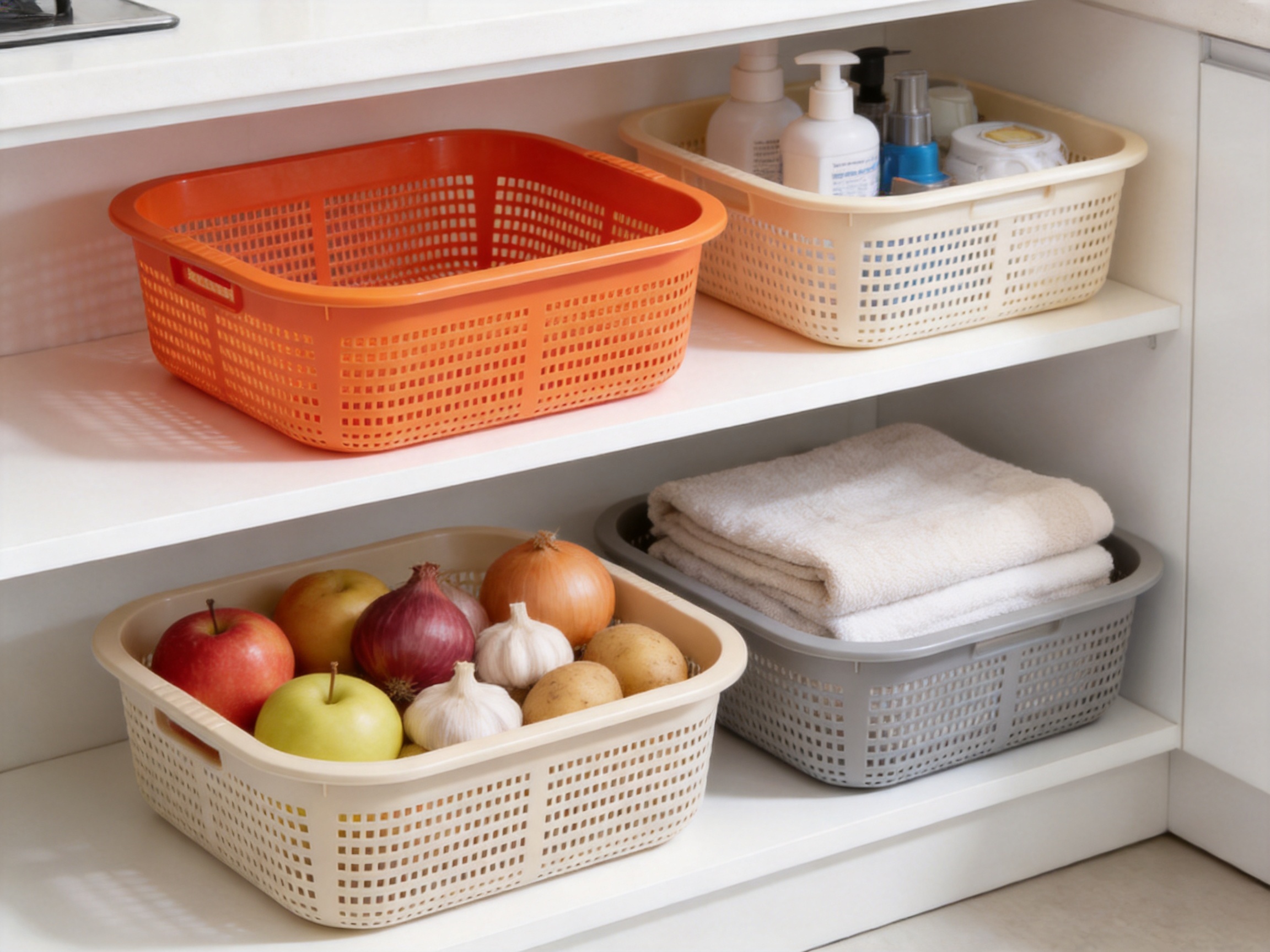
The basket mould is customizable in model, colour, size, plastic material, and product configuration. This flexibility allows customers to develop products for different sales channels rather than being limited to a fixed standard design.
Basket length, width, height, wall thickness, base structure, and handle position can be adjusted according to the intended storage application. A compact basket may be developed for drawers or small cabinets, while a larger model may be intended for pantry shelving, retail displays, or household laundry storage.
Dimension changes should be reviewed in relation to mould filling, shrinkage, cooling, ejection, and stacking. A small change in height can affect the mould’s depth and the required ejection stroke. A change in wall thickness may influence cycle time and material consumption. Early engineering communication helps prevent expensive revisions later.
The openings may be round, rectangular, square, elongated, or customized to support a particular design language. Their distribution can be adjusted for ventilation, visual appearance, structural strength, and manufacturing practicality.
Customers may also choose different perforation patterns for different product families. A kitchen basket might use a dense and regular pattern for small items, while a toy basket might use larger openings for stronger visual identification and faster cleaning.
The concealed handle may be adapted for one-handed carrying, two-handed lifting, or integration with a stacking arrangement. Handle edges should be rounded and comfortable, especially when the basket is expected to be used frequently or by children.
The handle region often requires special structural attention because it experiences concentrated loading. Reinforcing ribs, smooth transitions, and appropriate local wall thickness can improve performance without adding unnecessary bulk.
Plastic colour can be selected according to the customer’s catalogue, market positioning, or retail environment. A consistent colour system may help distinguish product sizes or usage categories. For example, different colours may be used for vegetables, cleaning products, toys, and bathroom accessories.
Surface texture and polish can also be customized. The selected finish should be compatible with the plastic material and the desired release performance. A high-gloss finish may emphasize colour and visual cleanliness, while a matte or textured finish may provide a practical appearance and help reduce the visibility of minor scratches.
Logos, symbols, recycling information, size marks, and product codes can be incorporated into the mould when required. Such details should be positioned in areas that do not compromise the basket’s appearance or handling comfort. The moulding method can create permanent identification without requiring a separate labelling operation.
TaiZhou HuangYan YingXiang Plastic Mould Co., Ltd. is located in Huangyan, Taizhou, Zhejiang, an area widely recognized for mould manufacturing. Established in 2012, the company operates a plant of approximately 7,000 square metres and has around 50 employees. Its business is focused on customized plastic mould solutions for household and industrial products.
The company uses CAD, CAE, and CAM systems to support the transition from product concept to mould production. These digital tools help engineers examine part geometry, plan mould structures, evaluate filling behaviour, prepare machining data, and reduce avoidable design risks before steel is processed.
CAD systems support accurate three-dimensional product and mould modelling. They make it possible to review wall thickness, draft, parting lines, inserts, ejection components, and assembly relationships. For a perforated basket, detailed three-dimensional review is particularly important because the hole pattern and handle structure can create many interconnected features.
CAE analysis can help evaluate filling, pressure, cooling, weld-line locations, air traps, and potential deformation. Simulation does not replace practical engineering experience, but it provides useful information for refining gate positions, wall thickness, cooling layouts, and material choices. These studies can reduce trial-and-error during mould testing.
CAM systems convert approved mould designs into machining instructions for high-precision equipment. Accurate data transfer between design and manufacturing helps maintain dimensional consistency and supports repeatable machining of cavities, cores, inserts, and mould components.
The company’s experienced technicians contribute practical knowledge to the project. Computer tools are valuable, but successful mould production also depends on understanding steel behaviour, machining limitations, injection moulding conditions, assembly tolerances, polishing, fitting, and maintenance. The combination of digital systems and hands-on experience supports a more complete manufacturing process.
The company specializes in a broad range of moulds, including integral box moulds, pallet moulds, fruit basket moulds, logistics crate moulds, folding box moulds, stool moulds, food storage container moulds, trash can moulds, beverage box moulds, hand basket moulds, household product moulds, floor mat moulds, and chair moulds.
This range is relevant to the square hollow plastic basket because it demonstrates experience with products that share common engineering challenges: large plastic surfaces, repeated ribs or openings, handles, stackability, dimensional stability, and high-cycle injection production.
Experience with logistics crates and pallets can contribute knowledge of load-bearing structures and reinforced bases. Experience with fruit baskets and hand baskets can support the design of ventilation openings, comfortable edges, and lightweight carrying features. Experience with household product moulds can help the team balance appearance, usability, and cost.
The stated supply capacity is approximately 50 mould sets per month. Actual delivery timing depends on product complexity, mould size, steel selection, surface requirements, hot runner configuration, testing schedule, and order quantity. Nevertheless, this capacity indicates an organized production base capable of supporting multiple customized projects.
A dependable mould supplier should communicate clearly about design approval, material procurement, machining, assembly, trial moulding, modifications, and final acceptance. Transparent project stages help customers coordinate their own product launches, injection machine planning, packaging development, and marketing schedules.
Quality control begins before mould manufacturing. Product drawings should define critical dimensions, functional requirements, appearance zones, tolerance expectations, material assumptions, and inspection standards. If these details are unclear, the mould may be technically complete but unsuitable for the customer’s production process.
During design review, engineers should identify potential risks such as insufficient draft, uneven walls, difficult undercuts, thin steel projections, poor gate placement, inadequate cooling, and ejection marks. Resolving these issues at the design stage is generally more efficient than correcting them after mould assembly.
Steel and component inspection are also important. Mould plates, inserts, guide components, ejector parts, cooling fittings, and standard components should meet the approved specifications. Proper fitting and alignment help prevent flash, mismatch, premature wear, and unstable operation.
After assembly, trial moulding allows the team to evaluate filling, part appearance, dimensions, demoulding, cycle stability, and mould operation. Trial samples should be compared with approved drawings and reference standards. If adjustments are required, they should be documented and verified in a subsequent trial.
For the square hollow basket, inspection should pay particular attention to the following areas:
1. Overall length, width, and height.
2. Squareness of the basket and alignment of the side walls.
3. Hole dimensions, spacing, and open-area consistency.
4. Wall thickness and base flatness.
5. Handle strength, comfort, and dimensional accuracy.
6. Surface finish, weld lines, flow marks, and visible ejector marks.
7. Warpage that could affect stacking or shelf placement.
8. Flash around the parting line and perforation features.
9. Smoothness of edges and corners.
10. Repeatability over multiple moulding cycles.
These checks help ensure that the mould is suitable not only for producing one acceptable sample, but for maintaining quality during continued manufacturing.
A mould should be evaluated by total value rather than by purchase price alone. A lower-cost mould may become expensive if it produces excessive waste, requires frequent repairs, causes long cycle times, or creates inconsistent parts. Conversely, an appropriately designed mould can support stable production and lower operating costs over its service life.
Material efficiency is one area of value. Balanced wall thickness and properly designed ribs can reduce unnecessary plastic consumption while maintaining stiffness. A lighter basket may require less material per unit and may also reduce transportation costs.
Cycle time is another consideration. Efficient cooling, reliable ejection, and a suitable feeding system can shorten the time required to produce each basket. Even a small reduction in cycle time can create meaningful savings when the mould runs continuously.
Automatic operation can further improve productivity. A well-designed ejection system reduces the need for manual removal and helps maintain consistent production rhythm. Automation compatibility should be discussed with reference to the customer’s injection moulding machine, robot, conveyor, and quality control system.
Maintenance planning also influences cost. Accessible cooling connections, replaceable wear parts, durable inserts, appropriate steel selection, and clear mould documentation can simplify maintenance. The customer should receive information about lubrication, cleaning, storage, inspection points, and recommended spare components.
| Evaluation Area | Key Consideration | Value to the Customer |
| Product geometry | Square structure, openings, handle, base, and stacking features | Improved usability and efficient storage |
| Mould filling | Gate position, runner balance, air evacuation, and wall thickness | Fewer defects and more stable production |
| Cooling | Balanced temperature control around walls, corners, rim, and base | Shorter cycles and reduced warpage |
| Ejection | Distributed force and reliable release from the core | Better appearance and automatic operation |
| Steel selection | Hardness, corrosion resistance, polishability, and wear resistance | Suitable service life and maintenance cost |
| Customization | Size, colour, material, hole pattern, and branding details | Products adapted to specific markets |
| Engineering support | CAD, CAE, CAM, trial moulding, and technical communication | Lower design risk and smoother project development |
| Production capacity | Organized manufacturing and approximately 50 mould sets per month | Support for commercial project schedules |
Choosing an experienced mould manufacturer provides benefits that go beyond machining capability. A professional supplier can contribute to product refinement, production planning, material decisions, defect prevention, and long-term service.
One advantage is the ability to identify design problems early. A customer may focus on the appearance and function of the basket, while the mould engineer evaluates whether the same geometry can be filled, cooled, ejected, and maintained efficiently. This practical review can prevent costly changes after tooling begins.
Another advantage is cross-category experience. A manufacturer that builds crates, pallets, baskets, containers, chairs, stools, and other household products is familiar with a wide range of plastic behaviours and structural requirements. Lessons learned from one product category can often improve another, provided the final design is evaluated on its own technical merits.
Communication is also important. Custom moulds involve many decisions, including product drawings, steel grades, hot or cold runner systems, mould bases, cooling connections, surface texture, packaging, spare parts, and trial sample approval. A supplier that provides clear technical explanations can help international customers make informed choices.
Yingxiang provides OEM service and supports customized product requirements. The company’s location in Huangyan gives it access to an established mould-making supply chain, skilled technicians, machining resources, and supporting services. Its focus on lean manufacturing, long mould life, on-time delivery, competitive cost, and customer service aligns with the needs of buyers seeking repeatable mould production rather than one-time experimental tooling.
Completed moulds are packaged in composite wooden boxes for transport. Proper packaging is essential because moulds contain precision surfaces, moving components, cooling connections, and alignment systems that must be protected during handling and shipment.
Before packaging, the mould should be cleaned, preserved against corrosion where appropriate, and checked for loose components or exposed vulnerable surfaces. Technical documents, mould drawings, spare parts, water connection information, operating notes, and trial records should be organized for the customer’s production team.
Delivery planning should include more than the shipping date. Customers should also consider installation, injection machine compatibility, mould weight, lifting requirements, cooling connections, electrical requirements for hot runner systems, and the availability of qualified operators. Early coordination reduces the risk of delay when the mould arrives at the production facility.
After the mould enters production, support may be required for process optimization. Injection speed, holding pressure, cooling time, mould temperature, ejection timing, and material drying conditions can all influence the final basket. Although the mould supplier does not control every aspect of the customer’s injection process, a clear technical handover can help the customer establish a stable starting point.
The first step is to identify how the basket will be used, what it will contain, where it will be placed, and how it will be sold. The customer should define target dimensions, load expectations, required ventilation, stacking or nesting needs, colour, surface appearance, and estimated annual quantity.
Three-dimensional files, two-dimensional drawings, sketches, physical samples, or reference photographs can be used to communicate the intended design. The more complete the information, the more accurately the mould supplier can assess feasibility and cost.
The product should be reviewed for draft, wall thickness, parting lines, holes, ribs, handles, ejection, cooling, and mould structure. Any changes should be approved before detailed mould construction begins.
The customer should select the intended plastic grade or provide the required performance criteria. The mould steel, surface finish, and wear protection can then be matched to the application and production plan.
A final mould design should identify cavity and core arrangements, runner and gate systems, cooling circuits, ejection components, sliders or lifters, mould base, standard parts, and connection positions. Approval at this stage creates a clear reference for manufacturing.
The mould is machined, assembled, tested, and adjusted. Trial baskets are inspected for dimensions, appearance, filling, demoulding, and functional performance. Any required corrections should be recorded and completed before final acceptance.
Before the mould is shipped or placed into regular production, the customer should confirm the injection machine, material supply, colour masterbatch, packaging, inspection method, and operating parameters. A production-ready approach helps convert the mould investment into stable commercial output.
A reusable plastic basket can replace some disposable packaging and temporary storage materials. When designed for repeated use and maintained properly, it may provide value over a long service period. The square structure can also support efficient nesting or stacking, which may reduce storage volume when the baskets are empty.
Material selection should consider the intended service life, recyclability requirements, colour additives, and local regulations. Customers supplying food-related markets should independently confirm whether the selected plastic grade, colourant, and production process meet applicable food-contact requirements. The mould manufacturer can assist with material compatibility, but regulatory approval remains dependent on the complete product and supply chain.
Designing for durability is also an environmental consideration. A basket that cracks easily may require frequent replacement, while a well-balanced product can remain useful for longer. Reinforcing high-stress areas, avoiding sharp transitions, and selecting a suitable material can improve practical service life.
Manufacturers should also consider whether the final basket can be separated from labels, metal parts, or other materials at the end of its life. A simple all-plastic design may be easier to sort and recycle, depending on the material and local recycling infrastructure.
The basket is designed for ventilated household and light commercial storage. It can hold fruits, vegetables, toiletries, towels, toys, building blocks, cleaning items, and many other products that benefit from airflow and easy visibility.
A square shape fits efficiently into cabinets, shelves, drawers, and storage systems. Several square baskets can be arranged closely together with less unused space than rounded containers typically create.
Yes. The model, dimensions, colour, plastic material, hole pattern, surface finish, handle structure, and other product details can be customized according to the customer’s requirements and manufacturing conditions.
Potential materials include PP, PC, PS, POM, PE, PU, PVC, ABS, and PMMA. The final choice depends on impact resistance, flexibility, appearance, chemical exposure, temperature, cost, and the intended application.
The concealed handle makes the basket easier to carry while maintaining a compact external profile. It can reduce interference when baskets are placed beside one another or inside cabinets and shelving units.
The holes allow air to circulate around fruits and vegetables, helping reduce trapped moisture and making the contents easier to see. Users should still follow appropriate food storage and hygiene practices for the specific product.
Yes. Colour is customizable, allowing the product to match a customer’s brand identity, interior design programme, product category, or retail strategy.
Possible steel options include 1CR13, 2CR13, 3CR13, 4CR13, S136, CR16, 2316, 718H, P20, and other grades. The appropriate selection depends on production volume, plastic material, surface finish, corrosion resistance, wear, and budget.
CAE analysis can assist in evaluating filling behaviour, pressure, weld-line locations, cooling, air traps, and possible warpage. It helps engineers refine the mould design before machining and can reduce avoidable trial-and-error.
TaiZhou HuangYan YingXiang Plastic Mould Co., Ltd. has operated since 2012 and has an approximately 7,000-square-metre plant, around 50 employees, CAD/CAE/CAM systems, experienced technicians, and a stated supply capacity of about 50 mould sets per month. Its product experience includes baskets, crates, boxes, pallets, containers, chairs, stools, and other plastic household or industrial products.
The mould is packaged in a composite wooden box. The customer should also confirm shipping dimensions, mould weight, lifting points, technical documents, and any special handling requirements before dispatch.
A buyer should provide product drawings or samples, target dimensions, plastic material, colour, expected production volume, injection machine information, surface requirements, delivery expectations, and any requirements for hot runners, automation, packaging, inspection, or spare parts.
Yes. OEM service is available. The product can be developed according to the customer’s design, brand requirements, dimensions, material, colour, and intended market application.
Trial samples should be checked for dimensions, squareness, hole consistency, wall thickness, handle strength, base flatness, surface defects, flash, warpage, ejection marks, and repeatability across multiple cycles.
The square hollow plastic basket combines practical storage geometry with ventilation, visibility, light weight, easy cleaning, and flexible application. Its square shape makes efficient use of shelves and cabinets, while the perforated walls and bottom support airflow for fruits, vegetables, household items, and children’s products. The concealed handle provides convenient carrying without unnecessarily increasing the product footprint.
Producing this basket consistently requires more than a basic cavity and core. The mould must manage perforations, wall thickness, corner strength, concealed handles, cooling, ejection, shrinkage, and surface appearance. Steel selection, injection system design, CAE analysis, precision machining, and trial moulding all contribute to the final result.
TaiZhou HuangYan YingXiang Plastic Mould Co., Ltd. offers a customized mould manufacturing platform supported by CAD, CAE, and CAM systems, experienced technicians, a 7,000-square-metre plant, and experience across household and industrial plastic products. Its capabilities in basket, crate, box, pallet, container, chair, stool, and related mould categories provide a useful foundation for customers developing new storage products.
For buyers seeking an injection mould that can support reliable production, customized appearance, and long-term commercial value, the square hollow plastic basket represents a practical product opportunity. With the correct design review, material selection, steel specification, mould construction, and quality control process, it can become a durable and adaptable storage solution for multiple markets.
1. General principles of thermoplastic injection mould design, including draft, wall thickness, cooling, gating, ejection, and mould maintenance.
2. Technical guidance for polypropylene, polyethylene, ABS, polycarbonate, polystyrene, PVC, POM, PU, and PMMA processing.
3. Industrial practices for CAD, CAE, and CAM integration in precision plastic mould manufacturing.
4. Manufacturing considerations for perforated containers, ventilated baskets, logistics crates, and reusable household storage products.
5. Standard quality-control practices for injection mould inspection, trial production, dimensional verification, and finished-part evaluation.
6. Company information and product specifications supplied for the square hollow plastic basket mould project.
If you are interested in any of our products or services, please feel free to ask and we can talk about your ideas.
 QUICK LINKSMOBILE SITE
 FACTORY ADDRESS
 CONTACT INFORMATION



 English
 Español