The curved-square low stool is a practical household product that combines a compact footprint, rounded comfort, stable support, and efficient use of plastic material. Although its overall shape appears simple, producing a high-quality low stool requires careful engineering at every stage. The mould must reproduce smooth curves, balanced proportions, consistent wall thickness, durable structural features, clean surfaces, and reliable part ejection. For this reason, the performance of the stool depends not only on the product design but also on the precision, durability, and manufacturing quality of the injection mould.
A well-designed curved-square low stool can serve multiple markets. It may be used as a children’s seat, bathroom stool, dressing stool, garden seat, temporary step, waiting-room accessory, household seat, or commercial utility product. Its square-inspired profile allows efficient storage and packaging, while its curved edges improve safety and visual appeal. The design can also be adapted to different heights, colors, textures, load requirements, and branding needs.
The Curved-Square Low Stool mould is developed for manufacturers seeking dependable mass production of attractive and functional plastic stools. It is suitable for injection moulding operations that require repeatability, efficient cycle performance, and a consistent finished appearance. The mould can support customization according to the customer’s product drawings, target market, selected resin, machine conditions, and expected production volume.
TaiZhou HuangYan YingXiang Plastic Mould Co., Ltd. brings specialized experience in plastic mould manufacturing for household products, logistics crates, folding boxes, pallets, beverage boxes, storage containers, chairs, floor mats, baskets, and other injection-moulded products. Established in 2012 in Huangyan, Taizhou, Zhejiang, China, the company operates a mould manufacturing facility of approximately 7,000 square meters with around 50 employees. Its technical capabilities include CAD, CAE, and CAM-based development, precision machining, experienced mould assembly, trial production, and customer-focused project support.
This article explains the product concept, the functional advantages of the curved-square low stool, the engineering requirements of its mould, the manufacturing process, quality-control considerations, customization opportunities, and the strengths that help the mould compete in international markets.

Curved-Square Low Stool
The curved-square low stool is defined by a low seating height and a body that blends square or rectangular geometry with rounded corners and softened transitions. This combination creates a recognizable appearance that is more distinctive than a completely round stool while remaining more comfortable and safer than a sharp-edged square design.
The product can be manufactured in a range of dimensions. A compact version may be used in bathrooms, bedrooms, children’s rooms, kitchens, or small apartments. A broader version may function as a general-purpose household seat. Depending on the customer’s requirements, the top surface may be flat, gently contoured, lightly textured, or designed with an integrated grip area. The legs may be straight, slightly tapered, outward-angled, or connected with reinforcing ribs.
Plastic injection moulding is particularly suitable for this product because it allows the complete stool body to be produced with high repeatability. The process can integrate structural ribs, leg supports, anti-slip features, drainage openings, stacking elements, and decorative details into a single moulded component. This reduces the need for secondary assembly and helps control production costs.
The low stool format also offers logistical advantages. Compared with taller chairs or complex furniture products, a low stool can be more compact during transport and easier for retailers to display. If the design includes nesting or stacking features, multiple units can be stored in a smaller volume, improving warehouse utilization and reducing handling effort.
For distributors and product brands, the mould creates a foundation for a versatile product family. One basic platform may be adapted into several versions, including different colors, surface textures, heights, load ratings, decorative patterns, and packaging configurations. A carefully planned mould-development strategy can therefore support both a standard product and future variations.
The curved-square silhouette gives the stool a strong visual identity. Round stools are familiar and easy to manufacture, but they may appear generic. Fully square stools can provide a contemporary appearance, but sharp corners may reduce comfort and create safety concerns. The curved-square design occupies a useful middle position. It communicates stability and modernity while maintaining a softer household-friendly appearance.
The broad surfaces and rounded transitions are suitable for both minimalist and colorful product styling. The stool may be produced in neutral colors for bathrooms, kitchens, hotels, and offices, or in brighter colors for children’s products, retail collections, and promotional campaigns. A matte texture can create a practical, understated appearance, while a finer surface finish can support a more premium visual effect.
Rounded corners reduce pressure points when users sit on the stool or move it by hand. The softened profile is also more comfortable when the product is used for short periods in a bathroom, dressing area, or kitchen. A gently curved seat edge can improve the feeling of comfort without requiring additional cushions or assembled components.
Comfort is influenced by more than the top surface. The transition between the seat and legs, the leg angle, the position of reinforcing ribs, and the overall height all contribute to the user experience. During product development, these details can be adjusted according to the intended user group and application environment.
Rounded corners can reduce the risk of sharp-edge contact in homes, schools, childcare areas, and public spaces. Smooth transitions are especially valuable when the stool is intended for children or older users. Although no plastic product can eliminate every risk, thoughtful geometry can reduce unnecessary hazards and improve product acceptance.
The mould design must preserve these rounded features accurately. Uneven polishing, inconsistent machining, or poor parting-line control can create visible steps or unwanted sharpness. Precision machining and careful mould fitting are therefore essential to the safety and appearance of the finished stool.
The square-related shape can use floor space efficiently. A square or softly rectangular stool can be positioned close to walls, cabinets, and other furniture with less unused space than some round alternatives. This is helpful in compact homes, retail displays, bathrooms, and commercial environments.
If the underside and side walls are designed for nesting, finished stools can be stacked during storage and distribution. Nesting capability should be considered at the beginning of mould development because it affects wall geometry, leg placement, draft angles, and the interaction between upper and lower units.
The product can be adapted for several end uses:
• Household seating for kitchens, bedrooms, bathrooms, balconies, and living areas.
• Children’s seating for homes, classrooms, playrooms, and activity centers.
• Utility seating for workshops, gardens, retail stores, and service areas.
• Temporary step use where the design and load rating are appropriate.
• Hospitality and commercial applications requiring easy-to-clean plastic furniture.
• Promotional or private-label products with customized colors, surface patterns, and packaging.
This flexibility gives mould buyers more opportunities to serve different customer groups without changing the entire production concept.
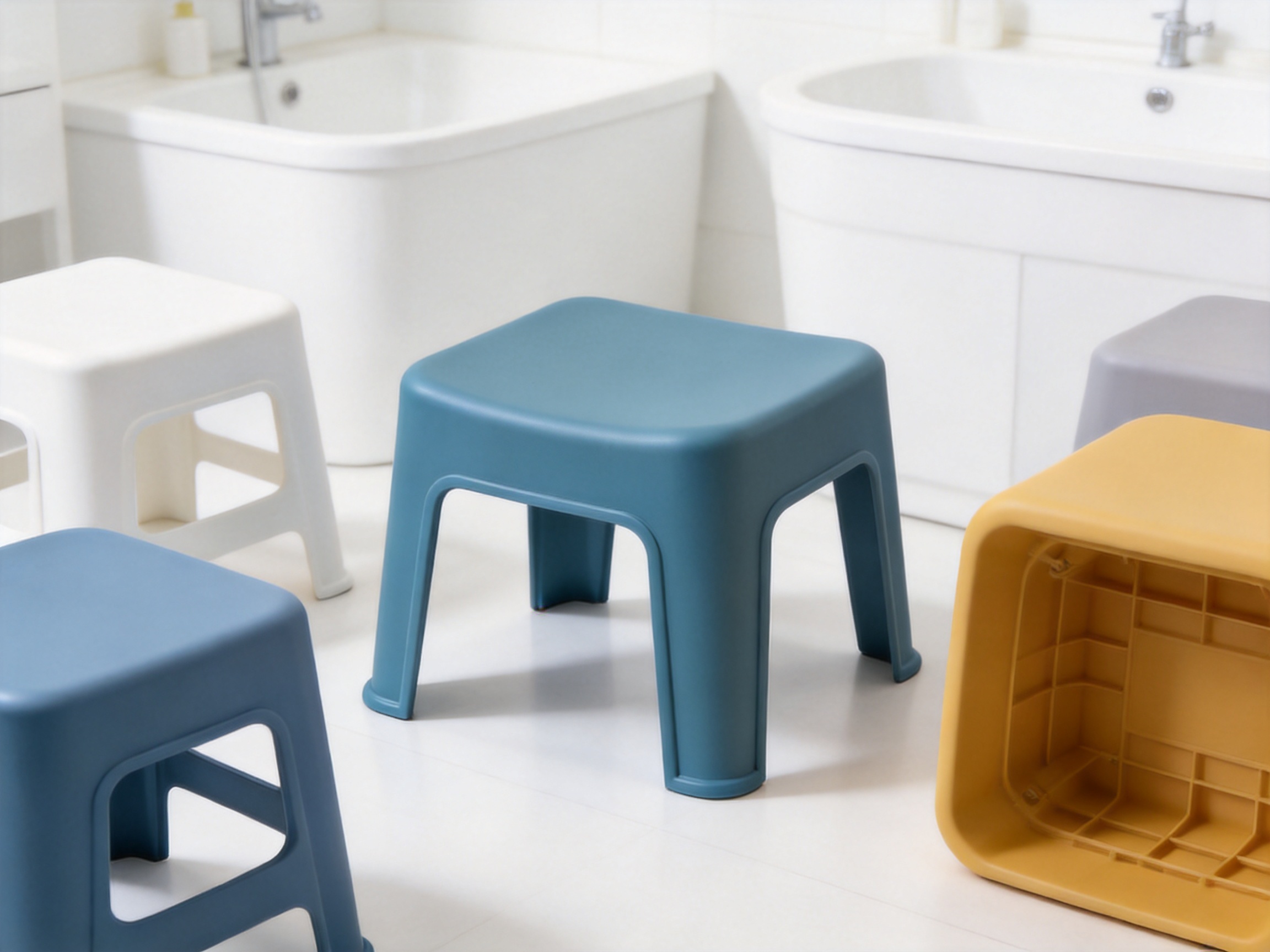
Injection-moulded furniture must balance strength, weight, material usage, cooling behavior, and mouldability. Excessively thick sections may cause sink marks, voids, extended cooling time, and unnecessary material consumption. Excessively thin sections may reduce stiffness and create filling difficulties. The product design should therefore use suitable wall thicknesses and transitions based on the selected plastic material and intended load.
Curved-square forms require particular attention at the corners. Material flow can behave differently in broad straight sections and rounded transitions. If the wall design is not balanced, the finished stool may show variation in shrinkage, warpage, or surface gloss. Computer-aided analysis can help identify potential filling and cooling problems before steel cutting begins.
Ribs can increase stiffness without making the entire stool unnecessarily heavy. They may be placed beneath the seat, around the leg connections, or along the inner side walls. A successful rib design must provide strength while avoiding excessive thickness and difficult material flow.
Reinforcement around the legs is especially important because the legs transfer the user’s weight to the floor. Stress may concentrate where each leg joins the seat. Proper radii, balanced transitions, and sufficiently supported geometry can reduce the chance of cracking or fatigue during repeated use.
The mould must reproduce these structural details cleanly. Narrow or deep ribs may require carefully positioned gates, vents, and ejection components. Their placement should also support easy demoulding and minimize visible marks on important external surfaces.
Draft angles allow the moulded stool to separate from the core and cavity without excessive friction or surface damage. The correct amount depends on the material, surface texture, depth of the feature, and required appearance. Textured surfaces generally need more draft than polished surfaces.
Insufficient draft can cause scuffing, deformation, sticking, or difficult production cycles. Excessive draft may alter the intended appearance or affect stacking performance. The design team must balance demoulding reliability with product dimensions and function.
For a low stool, the core may contain multiple leg projections and internal details. Ejection must be distributed so that the part leaves the mould evenly. Concentrating ejector force in a small area could deform the underside or leave undesirable marks.
The gate system influences filling balance, weld-line location, pressure requirements, cycle efficiency, and the visual quality of the finished product. A stool with a broad seat and several legs may require a carefully selected gate position or a balanced multi-gate arrangement.
The best configuration depends on the product structure, resin, machine, and customer’s production requirements. A gate placed on a non-visible underside may protect the appearance of the seat. However, the location must still allow the cavity to fill properly and avoid excessive pressure loss.
For larger or more complex versions, a hot runner system may be considered to reduce runner waste and improve process consistency. A conventional cold runner may be suitable for other designs, especially where the moulding system, material selection, and production volume favor a simpler configuration. The mould manufacturer can evaluate these options during technical review.
Air trapped inside the cavity can produce burns, short shots, weld lines, surface defects, and inconsistent filling. Venting is particularly important at the ends of flow paths, near deep ribs, around leg details, and in areas where multiple melt fronts meet.
Vents must be designed carefully. They should release air while preventing excessive flash. Their depth, location, and maintenance condition all affect production results. A mould that includes practical venting provisions is easier to stabilize during production and less likely to require repeated corrective work.
Cooling represents a major part of the injection cycle. Uneven cooling can lead to warpage, dimensional variation, residual stress, and inconsistent stacking behavior. The seat area, corners, legs, and reinforcing structures may cool at different rates, so the cooling-channel layout must be considered during mould design rather than added as an afterthought.
Efficient cooling can improve output by shortening cycle time, but speed must not compromise dimensional stability. The objective is a controlled and balanced thermal process. Computer-aided analysis, practical channel planning, and mould trials can help identify areas that need adjustment.
For mould buyers, better cooling design can create long-term value. A stable cycle improves productivity, reduces rejected parts, supports consistent quality across shifts, and may lower energy consumption per unit.
The manufacturing process begins with a review of the product concept or customer-supplied drawing. The mould team examines the product’s dimensions, material, appearance requirements, load expectations, production quantity, machine capacity, ejection method, and packaging needs.
At this stage, potential issues such as undercuts, thin walls, sharp transitions, difficult parting lines, uneven shrinkage, and insufficient draft should be identified. Early communication can prevent expensive modifications after machining has started.
The company uses CAD, CAE, and CAM technologies to support this process. Three-dimensional modelling helps verify component relationships, mould opening direction, cooling access, ejection movement, and assembly conditions. Analysis tools can assist with filling, cooling, warpage, and gate-location decisions.
After the product design is confirmed, the mould structure is developed. This includes the cavity, core, parting surface, runner system, gates, cooling channels, ejector system, guide components, inserts, support plates, and standard mould-base elements.
For the curved-square low stool, the mould structure must protect the external appearance while providing enough support for the seat and legs. The parting line should be positioned to minimize visible witness marks and simplify trimming. Where appropriate, replaceable inserts may be used in areas subject to wear or likely to require future design changes.
A well-planned structure also simplifies maintenance. Cooling fittings, ejector components, inserts, and wear surfaces should be accessible for inspection and replacement. Maintenance-friendly construction supports longer service life and reduces downtime during production.
Once the design is approved, mould components are machined using suitable equipment and controlled machining procedures. CNC machining creates the primary cavity and core forms, while additional operations may be used for deep features, narrow ribs, holes, inserts, and complex transitions.
Machining accuracy is important for maintaining dimensional consistency and ensuring that the mould closes correctly. The rounded corners of the stool require smooth tool paths and careful control of surface continuity. Poorly connected tool paths may leave visible marks or uneven curvature on the finished product.
Electrical discharge machining may be used for areas that are difficult to produce by conventional cutting. It can assist with deep corners, fine details, narrow slots, and complex geometries. The process must be controlled to minimize recast layers and preserve the required surface condition.
Different mould areas may require different machining methods. The objective is not to use one process for every feature, but to select a suitable combination that delivers accuracy, efficiency, and maintainability.
After machining, critical surfaces may be ground, polished, textured, or otherwise finished according to the product requirements. The visible external surfaces of the stool need consistent treatment to avoid gloss variation and unwanted tool marks.
A polished surface can create a clean, reflective appearance, while an etched or textured finish can improve visual depth and reduce the visibility of minor handling marks. Texture may also provide a more practical grip or a softer visual character. The selected finish should be applied consistently across the cavity and core so that the finished products match from batch to batch.
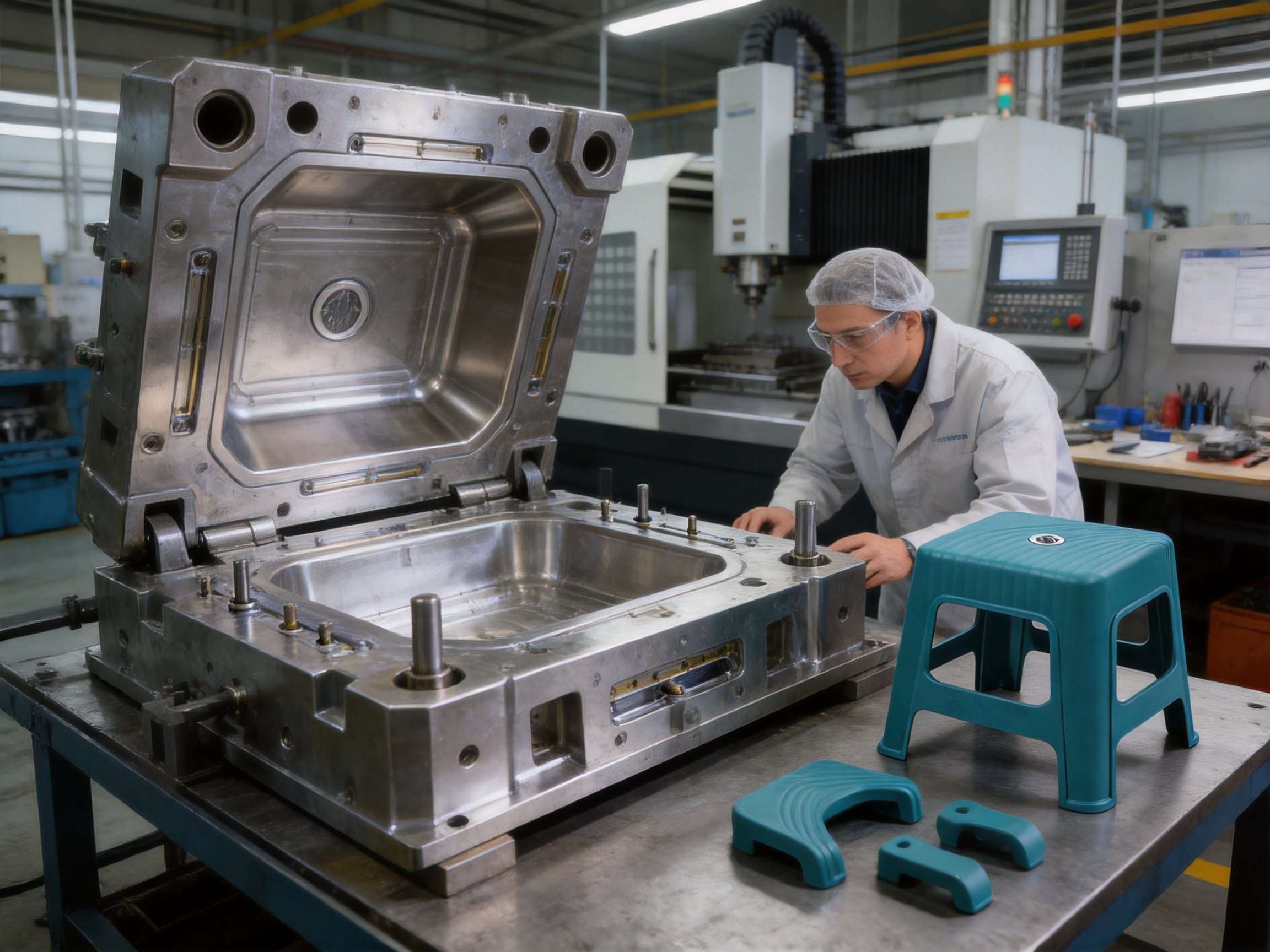
Dimensional inspection verifies that the mould components and trial parts meet the agreed requirements. Important dimensions may include overall length, width, height, seat size, leg spacing, wall thickness, stacking clearance, and connection details.
Inspection should consider not only individual dimensions but also relationships between them. For example, the legs must be aligned with the seat, the stool must stand level on a flat surface, and nested products must separate smoothly without excessive interference.
Flash can appear when the mould surfaces do not close correctly, when clamping force is insufficient, or when the parting surface is damaged or poorly fitted. On a household stool, flash around the seat edge or legs can affect comfort, appearance, and safety.
Accurate fitting, suitable mould steel, proper support, and careful trial adjustment help control flash. The mould should be inspected under production conditions rather than assessed only when it is static and clean.
Trial moulding is used to evaluate the interaction between the mould and the injection machine. The trial process may examine filling behavior, pressure, cooling time, ejection, cycle stability, part appearance, warpage, weld lines, gate vestige, and dimensional consistency.
Trial results should be documented and reviewed systematically. If an adjustment is required, the cause should be identified before changes are made. Random modifications may solve one symptom while creating another problem elsewhere.
For the curved-square low stool, special attention should be paid to whether the seat remains flat, whether the legs are balanced, whether the corners show consistent appearance, and whether the product can stand without rocking. These simple functional checks are important indicators of mould and process quality.
The mould may be designed for commonly used injection-moulding materials according to the customer’s product requirements. Possible material choices can include polypropylene, high-density polyethylene, acrylonitrile butadiene styrene, or other suitable thermoplastics. The final selection depends on impact resistance, stiffness, chemical resistance, color, surface appearance, temperature exposure, cost, and intended use.
Different materials shrink and flow differently. A mould that performs well with one resin may require process adjustments when another resin is introduced. Material selection should therefore be confirmed before final mould design, especially when the stool must meet specific load or environmental requirements.
A low-cost mould may focus only on producing a recognizable shape. A professionally engineered mould considers the complete product life cycle, including assembly-free production, user comfort, repeat loading, surface appearance, maintenance, packaging, and future production stability.
This broader approach helps prevent problems that may not appear during the first trial. Examples include progressive leg cracking, repeated ejection marks, uneven stacking, difficult cleaning, unstable standing, or unacceptable variation between moulding cycles.
Household products are often sold in sets or displayed together. Differences in color, gloss, dimensions, or leg alignment can be immediately noticeable. Precision mould construction and controlled processing help ensure that every stool has a consistent appearance.
Consistency is also important for private-label products. Retailers and brand owners need confidence that future orders will match earlier shipments. Stable mould design, documented technical information, and replaceable wear components can support repeat production over an extended period.
When the mould integrates structural details and produces clean surfaces, less secondary trimming, drilling, assembly, or manual correction may be needed. This can reduce labor requirements and improve production efficiency.
A product that leaves the mould close to its final form is easier to package and inspect. Reduced secondary work also lowers the risk of human variation, which is valuable for high-volume orders.
The initial mould price is only one part of the total cost. Maintenance, rejected parts, downtime, cycle time, energy consumption, spare parts, and service response all influence the long-term investment value.
A durable mould with accessible components and practical cooling and ejection systems can provide better economics over its working life. This is especially important for stools that may be produced in large quantities or across several seasons.
Some suppliers may offer customization only by modifying an existing design without fully reviewing mouldability. A specialized mould manufacturer can evaluate whether a proposed change will affect draft, filling, strength, cooling, ejection, or cycle performance.
This means customers can request meaningful differentiation while retaining a manufacturable product. Possible changes include brand marks, embossed patterns, drainage holes, anti-slip features, modified heights, altered leg shapes, new textures, and different seat contours.
TaiZhou HuangYan YingXiang Plastic Mould Co., Ltd. is located in Huangyan, Taizhou, Zhejiang, a region widely recognized for mould manufacturing expertise. The company has developed its business around customized plastic mould solutions for household products and industrial applications.
Its approximately 7,000-square-meter facility provides space for design, machining, mould assembly, testing, inspection, and project coordination. A workforce of around 50 employees combines technical personnel, experienced machinists, mould assemblers, quality staff, and customer-service support.
The company’s product experience covers a broad range of plastic mould categories. These include integral boxes, pallets, fruit baskets, logistics crates, folding boxes, stools, food storage containers, trash cans, beverage boxes, hand baskets, household products, floor mats, and chairs.
This product diversity is valuable because many mould-engineering principles are transferable across product categories. Experience with crates and pallets strengthens knowledge of load-bearing structures, rib design, shrinkage, and large-area moulding. Experience with household products supports attention to appearance, safety, ergonomics, and consumer expectations.
CAD, CAE, and CAM systems support the transition from product concept to mould manufacture. Digital tools improve design communication, help evaluate potential risks, and allow machining data to be prepared accurately. They also make it easier to review design changes with customers before physical work begins.
The company emphasizes lean manufacturing, long-life moulds, on-time delivery, competitive costs, premium quality, and comprehensive customer service. These objectives are important for international customers who may require clear project communication, predictable schedules, technical documentation, and support after delivery.
| Buyer Requirement | How the Stool Mould Can Support It | Potential Business Benefit |
|---|---|---|
| Attractive household design | Curved corners, balanced proportions, and controlled surface finishing | Stronger retail appeal and broader consumer acceptance |
| Efficient mass production | Injection-moulded one-piece construction with planned filling, cooling, and ejection | Repeatable output and reduced manual assembly |
| Product differentiation | Options for textures, colors, dimensions, logos, and structural details | Support for private-label and customized product lines |
| Stable product quality | Precision mould construction, inspection, and trial moulding | Lower rejection rates and improved customer confidence |
| Long service life | Maintainable mould structure and suitable component selection | Better long-term return on the mould investment |
| Compact logistics | Low stool geometry and possible stacking or nesting features | Improved storage, transport, and retail display efficiency |
| Multiple applications | Adaptable design for household, commercial, and utility markets | More opportunities to expand sales channels |
| Technical project support | CAD, CAE, CAM, engineering review, and customer communication | Reduced development risk and clearer project execution |
Customers may require different stool heights or seat dimensions depending on the target market. A children’s stool, bathroom stool, and workshop stool may all use the same general design language while requiring different proportions.
Changing dimensions can affect mould strength, shrinkage, cooling, machine capacity, and material consumption. Every dimensional revision should therefore be reviewed as an engineering change rather than treated as a simple scale adjustment.
Surface texture can strengthen the product’s visual identity and influence its practical use. A fine texture may help reduce the visibility of fingerprints and minor scratches. A deeper texture may provide a more distinctive appearance or increase surface grip.
Texture must be coordinated with draft angles and ejection. Deep textures can increase demoulding resistance, while inconsistent texture depth can create visible differences between product areas. Proper mould finishing is essential for a uniform result.
Plastic color can be changed through material pigmentation or masterbatch selection. Neutral colors may suit mature household markets, while bright colors may appeal to children and seasonal collections. Dark colors can create a premium appearance, but they may also make surface defects more visible.
Material and color decisions should be made together with product requirements. A material selected for rigidity may have different impact performance from a more flexible resin. A product designed for outdoor use may require better resistance to sunlight, moisture, or temperature variation.
Embossed or debossed branding can be integrated into the mould. This approach avoids separate labels and can provide a permanent product identity. Logos should be designed with suitable line thickness, depth, draft, and orientation to ensure clean reproduction.
Brand marks may be positioned on the seat, side wall, underside, or leg area according to the desired visual effect. The location should also be considered in relation to parting lines, gates, ejectors, and user contact areas.
Additional features may include anti-slip feet, drainage openings, carrying grips, stacking guides, strengthening ribs, ventilation areas, or storage hooks. Each feature must be evaluated for its effect on mould filling, demoulding, cleaning, structural strength, and production cost.
Functional additions can make the stool more competitive, but unnecessary complexity should be avoided. The best design is usually one that solves a clear user problem without creating disproportionate manufacturing difficulty.
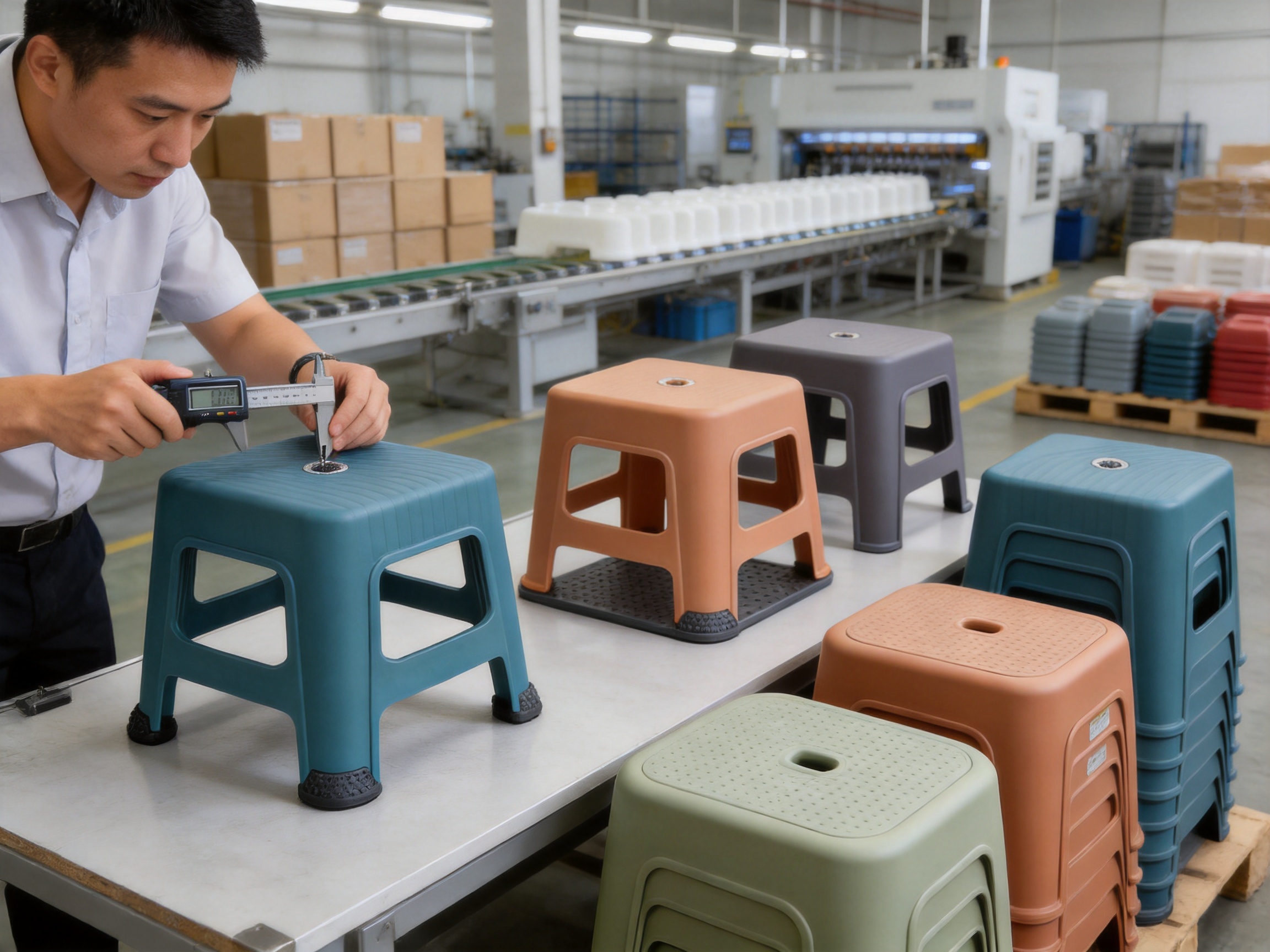
Regular mould maintenance is essential for stable production. Maintenance activities may include cleaning the cavity and core, checking vents, lubricating moving components, inspecting ejector pins, examining guide systems, checking cooling channels, and protecting steel surfaces against corrosion.
The production environment influences maintenance frequency. Materials containing glass fiber or other abrasive additives may increase wear. High production volumes may require more frequent inspection of gates, slides, ejectors, and parting surfaces. Water quality can affect cooling channels and should be managed appropriately.
A maintenance record can help identify recurring issues. Tracking cycle counts, repair history, dimensional changes, and replacement parts allows the owner to plan preventive maintenance instead of waiting for an unexpected failure.
Replaceable inserts and accessible components can reduce repair time. If a small area of the cavity becomes damaged, an insert-based solution may avoid replacing or rebuilding a larger mould section. This approach can protect production continuity and reduce long-term service costs.
The most direct market for the curved-square low stool is household retail. Consumers often value products that are easy to clean, easy to move, and suitable for several rooms. A compact plastic stool can provide a convenient seating or support solution without the maintenance required by upholstered furniture.
Retail success depends on appearance, perceived strength, packaging, color selection, and price positioning. A reliable mould enables manufacturers to offer a consistent product that can be sold through physical stores, home-goods distributors, and online channels.
The softened geometry and low height may be suitable for children’s applications when the product is designed, tested, and labeled according to applicable safety requirements. For this market, rounded edges, stable legs, suitable dimensions, smooth surfaces, and non-toxic material selection are especially important.
Bright colors, friendly textures, and simple branding can increase appeal. However, children’s products require careful consideration of foreseeable misuse, tipping behavior, pinch points, and load conditions.
Plastic stools are commonly used in bathrooms and utility areas because they can be wiped clean and are less vulnerable to moisture than many wooden or upholstered alternatives. Drainage features, non-slip considerations, and appropriate material selection may be valuable for these applications.
The stool should not be marketed as a step product unless its design, testing, and instructions support that intended use. Clear product communication helps protect consumers and reduces misuse-related risks.
Hotels, restaurants, service areas, salons, waiting spaces, and temporary event facilities may require lightweight stools that are easy to move and maintain. A consistent design with a professional color palette can suit commercial environments.
For commercial buyers, durability, cleanability, stackability, replacement availability, and delivery reliability may be more important than decorative complexity. The mould should therefore support a product that can withstand repeated handling and frequent cleaning.
A good mould cannot compensate for every production problem. Injection parameters, material drying, machine condition, clamping force, cooling-water temperature, cycle time, operator training, and inspection methods all influence the finished stool.
However, a well-engineered mould gives the production team a stronger foundation. Balanced filling, accessible cooling, effective venting, reliable ejection, and accurate parting surfaces make the process easier to control.
Process documentation should include recommended starting conditions, material information, mould-opening requirements, ejection guidance, cooling connections, inspection points, and maintenance instructions. These documents help different operators achieve more consistent results.
When a customer plans to use multiple machines, the mould may need to be reviewed for compatibility with the available equipment. Machine nozzle position, tie-bar spacing, mould thickness, injection capacity, and ejection stroke can affect installation and operation.
A typical project begins with the customer sharing product drawings, samples, three-dimensional data, target material, annual demand, preferred machine, and appearance requirements. The mould manufacturer reviews the information and identifies questions or possible improvements.
The next stage is design confirmation. The customer and engineering team agree on the product structure, parting line, gate concept, ejection method, mould layout, steel selection, cooling approach, and expected delivery plan.
After approval, mould components are manufactured and assembled. The first trial identifies whether the product fills, cools, ejects, and meets appearance expectations. Trial parts are inspected, and any necessary corrections are completed.
Before shipment, the mould may undergo final testing, cleaning, rust prevention, documentation, and packaging. Clear identification of cooling lines, ejector connections, lifting points, and spare components can simplify installation at the customer’s factory.
After delivery, technical communication remains valuable. Production feedback can reveal opportunities to optimize cycle time, improve appearance, or adjust maintenance procedures. A supplier that offers responsive service can help customers achieve a faster and more stable production start.
It is an injection mould designed to produce a low plastic stool with a square-inspired profile and rounded corners. The mould forms the seat, legs, structural details, surface features, and other integrated elements required by the product design.
The design combines efficient space use with softened corners, modern appearance, user comfort, and broad application potential. It can be adapted for household, children’s, utility, commercial, and private-label markets.
Yes. Height, seat size, leg geometry, wall structure, stacking clearance, and other dimensions can be developed according to the customer’s product requirements. Dimensional changes should be reviewed for mouldability, strength, shrinkage, cooling, and ejection.
Yes. Embossed or debossed logos can often be integrated into the mould. The logo’s location, depth, draft, line thickness, and relationship with the parting line should be considered during design.
The suitable material depends on the required strength, flexibility, impact resistance, surface appearance, chemical resistance, environmental exposure, and cost. Common thermoplastics may be considered, but the final resin should be confirmed before mould completion.
A well-designed injection mould can produce a repeatable part with integrated structural features, reducing manual assembly and secondary processing. Balanced filling, efficient cooling, reliable ejection, and reduced rejection rates can also improve operating efficiency.
Stacking or nesting requires suitable seat, side-wall, and leg geometry. The design must provide enough clearance for units to separate easily while preventing excessive movement during storage. Draft angles, shrinkage, and packaging dimensions should be evaluated together.
Quality may be checked through component inspection, mould-fitting verification, dimensional measurement, surface inspection, trial moulding, ejection testing, and evaluation of the finished stool. Functional checks may include stability, standing level, stacking behavior, and appearance consistency.
Service life depends on mould steel, product material, production volume, processing conditions, maintenance, and design complexity. Proper maintenance and timely replacement of wear components can help extend useful life.
Yes. The company specializes in customized plastic mould solutions and can support projects from product review and three-dimensional design through mould manufacturing, trial production, inspection, delivery, and technical communication.
Useful information includes product drawings or samples, three-dimensional files, target material, estimated annual quantity, preferred machine, color and surface requirements, expected load, packaging concept, delivery destination, and any applicable quality or safety standards.
The curved-square low stool is a versatile plastic product that offers a valuable combination of comfort, safety-oriented geometry, efficient space utilization, attractive appearance, and broad market potential. Its simple visual form hides a number of important engineering challenges. The mould must control filling, cooling, shrinkage, ejection, structural reinforcement, surface finishing, and dimensional stability to produce a dependable commercial product.
A professionally developed stool mould provides more than a cavity in which plastic is formed. It creates a repeatable manufacturing system. The quality of the mould affects production speed, rejection rates, maintenance requirements, product consistency, and the customer’s ability to develop future variations.
TaiZhou HuangYan YingXiang Plastic Mould Co., Ltd. combines regional mould-making experience, a substantial manufacturing facility, skilled personnel, CAD, CAE and CAM capabilities, and experience across household and industrial plastic products. Its focus on lean manufacturing, long-life mould construction, reliable delivery, competitive cost, premium quality, and customer service makes it a suitable partner for customized stool mould development.
For buyers seeking a practical and marketable plastic stool, the curved-square design can serve as a strong product platform. With appropriate material selection, structural engineering, surface treatment, and mould manufacturing control, it can be developed for multiple customer groups and production environments. The result is a product that is visually distinctive, easy to manufacture, convenient to distribute, and adaptable to changing market requirements.
1. Society of Plastics Engineers, Injection Molding Fundamentals and Processing Practices.
2. International Organization for Standardization, Plastics—Injection Moulding and Product Quality Considerations.
3. Rosato, D. V., Rosato, M. G., and Rosato, D. V., Injection Molding Handbook.
4. Beaumont, J. P., Runner and Gating Design Handbook: Tools for Successful Injection Molding.
5. Malloy, R. A., Plastic Part Design for Injection Molding.
6. General technical principles for CAD, CAE, CAM, mould cooling, ejection, venting, and plastic product development.
If you are interested in any of our products or services, please feel free to ask and we can talk about your ideas.
 QUICK LINKSMOBILE SITE
 FACTORY ADDRESS
 CONTACT INFORMATION



 English
 Español