Modern homes, offices, commercial kitchens, hotels, hospitals, public facilities, and industrial workplaces all require waste containers that are hygienic, practical, durable, and visually compatible with their surroundings. The dual-lid step-on waste bin is designed to meet these needs through hands-free operation, separated access, efficient space utilization, and a clean contemporary appearance. Behind the finished bin is a carefully engineered plastic injection mould that determines its dimensions, surface quality, strength, assembly accuracy, production efficiency, and long-term commercial value.
A waste bin may appear to be a relatively simple household product, but its mould involves many technical considerations. The body must be strong enough to resist repeated loading and impact. The lids must open smoothly and close accurately. The pedal mechanism must operate reliably over many cycles. The container must maintain dimensional stability after cooling, while the outer surfaces must meet the appearance requirements of household and commercial markets. These requirements make mould design, steel selection, cooling, ejection, machining, testing, and production control especially important.
The dual-lid step-on waste bin mould is developed for manufacturers seeking a dependable solution for producing high-quality plastic waste bins at scale. Its design can support efficient injection moulding, stable part quality, smooth assembly, and cost-effective mass production. With suitable customization, the mould can be adapted to different capacities, lid arrangements, surface textures, color requirements, structural details, and market specifications.

Dual-Lid Step-On Waste Bin
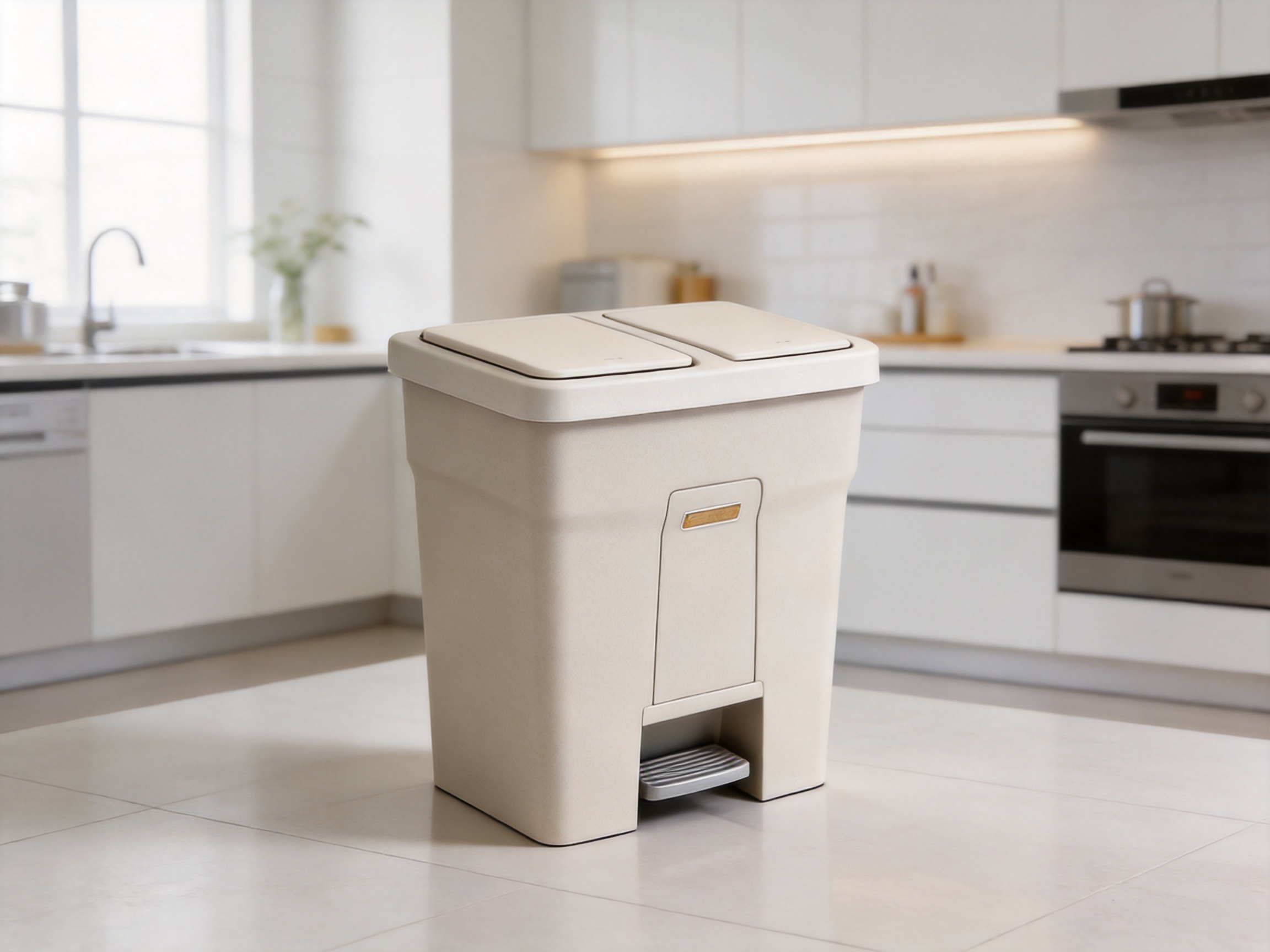
A dual-lid step-on waste bin generally consists of a main container body, two independent lids or lid sections, a foot pedal or pedals, hinge components, connecting hardware, and supporting internal or external structures. The dual-lid configuration provides flexible access and can improve the user experience in environments where cleanliness, odor control, or waste separation is important.
Unlike an open-top waste container, a step-on model allows users to open the lid without touching the bin with their hands. This feature is particularly valuable in kitchens, washrooms, healthcare facilities, food preparation areas, hotels, offices, and other locations where hygiene is a priority. The hands-free operating principle reduces direct contact with potentially contaminated surfaces and helps maintain a cleaner appearance.
The two-lid arrangement can provide a balanced visual design and allow manufacturers to create different product configurations. For example, the internal space may be divided for waste sorting, or the two lids may work as coordinated panels covering a single large compartment. Depending on the intended market, the product may include removable liners, bag-retaining rings, soft-closing systems, odor-control accessories, or color-coded components.
From a mould manufacturing perspective, the product is not limited to one single tool. A complete development program may include a body mould, lid moulds, pedal mould, liner mould, hinge component moulds, and other accessory moulds. The exact mould structure depends on the product design, expected output, available injection equipment, resin selection, and customer requirements.
The most important advantage of a step-on waste bin is hands-free operation. The user applies pressure to a foot pedal, which activates the opening mechanism. This avoids the need to lift a lid manually or touch a potentially dirty surface. In households, the feature is convenient during cooking or cleaning. In commercial environments, it contributes to better hygiene management and more efficient daily operation.
The mould must support accurate production of the pedal area, hinge supports, reinforcement ribs, and connecting interfaces. If these areas are poorly formed, the pedal may become loose, the lid may open unevenly, or the operating force may vary between products. A well-engineered mould helps maintain the tolerances needed for smooth mechanical performance.
Two lids can provide greater flexibility than a single large lid. They may reduce the lifting radius required during operation, create a balanced appearance, and support internal separation. Smaller lid panels can also reduce the visual impact of opening and closing. For homes and public spaces where the waste bin is visible, this contributes to a more refined product presentation.
Independent lid sections require accurate matching around the center line, side edges, and hinge positions. The mould design must control shrinkage and warpage so that the panels close evenly without excessive gaps. Proper alignment is also important for maintaining a clean appearance and minimizing odor leakage.
A closed waste bin helps contain odors and prevents waste from remaining exposed. While the effectiveness of odor control depends on the lid design, seal arrangement, liner system, and usage conditions, the mould provides the foundation for consistent fit and surface quality. Smooth internal corners and properly designed openings can make the container easier to clean.
The product may be manufactured from plastic materials with suitable chemical resistance and impact performance. Material selection should consider exposure to food residue, cleaning agents, moisture, temperature changes, and repeated mechanical use. The mould must be compatible with the selected resin and processing conditions to achieve stable filling and cooling.
The vertical form commonly associated with step-on waste bins allows useful capacity without requiring a large floor area. This is valuable in kitchens, narrow corridors, office corners, washrooms, and service areas. A well-designed bin can provide practical internal volume while maintaining a compact external footprint.
When developing the mould, the product designer and mould engineer should evaluate wall thickness, draft angles, stacking or nesting possibilities, lid clearance, pedal projection, and packaging dimensions. These factors influence not only mould performance but also warehousing, transportation, and final retail presentation.
The dual-lid step-on waste bin can serve multiple market segments. Household users may value appearance, quiet operation, and easy cleaning. Hotels and restaurants may require durability and fast maintenance. Offices may prioritize a professional appearance and compact dimensions. Healthcare and institutional facilities may focus on hygiene, reliable operation, and easy disinfection.
This broad application range gives manufacturers an opportunity to create several models from a common product platform. By changing the capacity, color, surface texture, lid configuration, or accessory system, a manufacturer can address different customer groups while retaining a similar core mould development strategy.
The quality of a plastic waste bin is directly influenced by the mould used to manufacture it. A high-quality mould controls the geometry of the product and supports repeatable production over a long service life. A poorly designed mould may produce flash, sink marks, short shots, uneven wall thickness, visible weld lines, warpage, difficult ejection, and inconsistent assembly.
For a dual-lid step-on waste bin, appearance and function are closely connected. The exterior surface is usually visible from all sides, so cosmetic defects can affect the perceived value of the finished product. At the same time, the hinge mounts, pedal supports, lid edges, and internal reinforcement areas must have sufficient strength and dimensional accuracy.
The mould development process should begin with a detailed review of the product design. Engineers examine the parting line, draft angles, wall thickness, ribs, bosses, holes, undercuts, ejection areas, gate positions, cooling channels, and expected shrinkage. Any potential manufacturing difficulty should be identified before steel cutting begins.
Good mouldability begins with a product design that supports balanced filling and predictable cooling. Uniform wall thickness is generally preferred because large variations can cause uneven shrinkage. Where thick structural areas are required, engineers may use ribs, curved sections, or hollow reinforcement features rather than simply increasing the overall wall thickness.
Draft angles help the moulded part release from the core and cavity. The appropriate draft depends on the material, surface texture, depth of the feature, and product geometry. Textured surfaces normally require more draft than polished surfaces. Insufficient draft can cause drag marks, deformation, or excessive ejection force.
Ribs and bosses should be positioned carefully to provide strength without creating excessive sink marks on the visible surface. The mould designer must also consider whether these features can be machined accurately, cooled effectively, and ejected without damaging the component.
The parting line is the location where the mould separates to release the product. For a large waste bin body, parting line placement affects the visibility of the mould line, the complexity of the tooling, the number of slides or lifters required, and the ease of trimming any flash.
A well-positioned parting line can reduce cosmetic impact and simplify mould construction. It should also avoid interfering with important sealing surfaces, hinge areas, pedal interfaces, or lid alignment features. For the lids, parting line planning is particularly important because the outer surface may contain curves, recesses, decorative details, or integrated handles.
The gate introduces molten plastic into the cavity. Its position and type influence filling balance, weld-line location, pressure requirements, appearance, and post-moulding finishing. Large or irregularly shaped components may require a gate arrangement that distributes material evenly and reduces hesitation during filling.
For the body of a waste bin, the gate system should support uniform filling from the bottom, side, or another carefully selected location, depending on the product geometry and injection machine. For visible lids, engineers may prioritize a gate position that minimizes cosmetic marks. The final choice should be verified through mould-flow analysis and practical trial production.
Runner design also affects material waste and cycle efficiency. A hot runner system may reduce cold runner waste and support automatic production, while a cold runner system may offer a simpler and more economical solution for certain product volumes. The appropriate configuration depends on the product, material, production quantity, customer preference, and maintenance plan.
Cooling is one of the most important factors in injection moulding. Molten plastic must cool sufficiently before the part can be ejected, and uneven cooling can cause warpage or dimensional variation. A carefully arranged cooling system helps maintain stable cycle times and consistent product quality.
The body of a waste bin may contain broad surfaces and different structural thicknesses. Cooling channels should be positioned as close as practical to the moulding surfaces while maintaining adequate steel strength. Special attention may be required around corners, deep sections, ribs, bosses, hinge mounts, and pedal support areas.
Efficient cooling can improve productivity by shortening cycle times, but cooling speed must be balanced against part quality. Excessive or uneven cooling may create internal stress, while insufficient cooling may cause deformation during ejection or handling. Simulation and mould trials help establish suitable process conditions.
The ejection system removes the cooled product from the mould. For a large plastic container, ejection must be strong enough to release the part while distributing force to avoid distortion. Ejector pins, sleeves, stripper plates, air assistance, or other mechanisms may be considered depending on the design.
Ejector marks should be located on non-critical surfaces whenever possible. The position and size of ejector components must be selected carefully so that they do not damage thin walls, visible surfaces, or functional interfaces. A balanced ejection arrangement can reduce stress and improve automatic production reliability.
A professional mould manufacturer requires more than machining equipment. Successful tooling depends on the integration of product analysis, engineering, material control, precision machining, assembly, testing, and customer communication. The manufacturing process for a dual-lid step-on waste bin mould should be organized around accuracy, repeatability, service life, and production efficiency.
The process begins with the review of product drawings, three-dimensional data, technical requirements, resin information, target output, and injection machine parameters. Engineers check whether the product can be demoulded, whether the wall thickness is suitable, whether the proposed gate arrangement is practical, and whether the mould can meet the expected life cycle.
Computer-aided design systems are used to build the mould structure and simulate the relationship between the product, core, cavity, inserts, slides, cooling channels, and ejection components. This digital stage allows potential problems to be corrected before machining. It also supports communication between the customer, product designer, mould engineer, and production team.
Computer-aided engineering can be used to evaluate filling patterns, pressure distribution, cooling behavior, weld lines, air traps, and potential warpage. While simulation does not replace physical testing, it can reduce development risk and guide decisions about gate location, runner arrangement, cooling layout, and material selection.
Mould steel must be selected according to expected production volume, plastic material, surface requirements, corrosion exposure, mechanical loading, and maintenance expectations. Different mould components may use different steel grades to balance hardness, toughness, polishability, machinability, and cost.
For high-output production, wear resistance and dimensional stability are particularly important. The cavity and core surfaces must retain their geometry during repeated thermal cycles and mechanical operation. Hinge, slide, and ejection components may also require suitable treatment or hardened materials to maintain reliability.
Steel preparation should include inspection of dimensions, flatness, hardness condition, and material documentation. Proper steel control helps reduce the risk of premature wear, cracking, deformation, or unexpected changes during heat treatment and machining.
Computer numerical control machining creates the main cavity, core, inserts, slides, and other mould components. High-quality machining equipment can produce complex curved surfaces, deep features, sharp transitions, and detailed structures with consistent accuracy.
Large mould components require careful setup because even small alignment errors can affect parting lines, wall thickness, lid fit, and assembly performance. Machining strategies should consider tool access, cutter deflection, material removal, surface finish, and the sequence of roughing, semi-finishing, and finishing operations.
For visible parts such as lid panels, surface quality is especially important. Fine finishing, polishing, or controlled texturing may be required to achieve the customer’s intended appearance. The mould surface directly influences the plastic product, so surface treatment must be completed with attention to uniformity and defect prevention.
Electrical discharge machining can be used for deep narrow features, complex corners, ribs, slots, and other areas that are difficult to produce through conventional cutting. It is particularly useful when the mould includes intricate details or hardened components.
After electrical discharge machining, affected areas may require cleaning, polishing, and inspection. The finished surface should be consistent with the product specification. Special care is needed around cosmetic areas, because uneven EDM texture or excessive polishing can create visible differences on the finished bin.
Heat treatment can improve the hardness, wear resistance, and dimensional stability of selected mould components. The treatment must be controlled carefully because excessive distortion can affect mould assembly and product accuracy. Components should be inspected after treatment and, where necessary, returned to precision machining or grinding.
Surface protection may also be considered for areas exposed to moisture, abrasive materials, or corrosive plastic additives. The appropriate treatment depends on the resin, production environment, maintenance plan, and expected mould life.
During assembly, the core, cavity, inserts, guide systems, ejector system, cooling components, slides, and other mechanisms are fitted together. The assembly team checks movement, alignment, clearances, clamping surfaces, water connections, and mechanical interaction.
For a dual-lid product, assembly accuracy affects the relationship between the left and right lid components, the hinge supports, and the operating mechanism. The mould must allow the product to be produced consistently so that the finished parts can be assembled without excessive adjustment.
Trial moulding is essential for verifying the performance of the tooling. The initial trial evaluates filling, appearance, dimensions, ejection, cooling, cycle time, and part assembly. Engineers inspect the body, lids, pedal components, and other parts for short shots, flash, sink marks, weld lines, warpage, burn marks, and surface inconsistency.
Process parameters such as injection speed, pressure, holding pressure, melt temperature, mould temperature, cooling time, and ejection timing may be adjusted during testing. If the issue is related to the mould itself, modifications may include gate refinement, vent improvement, polishing, steel correction, cooling adjustment, or ejection changes.
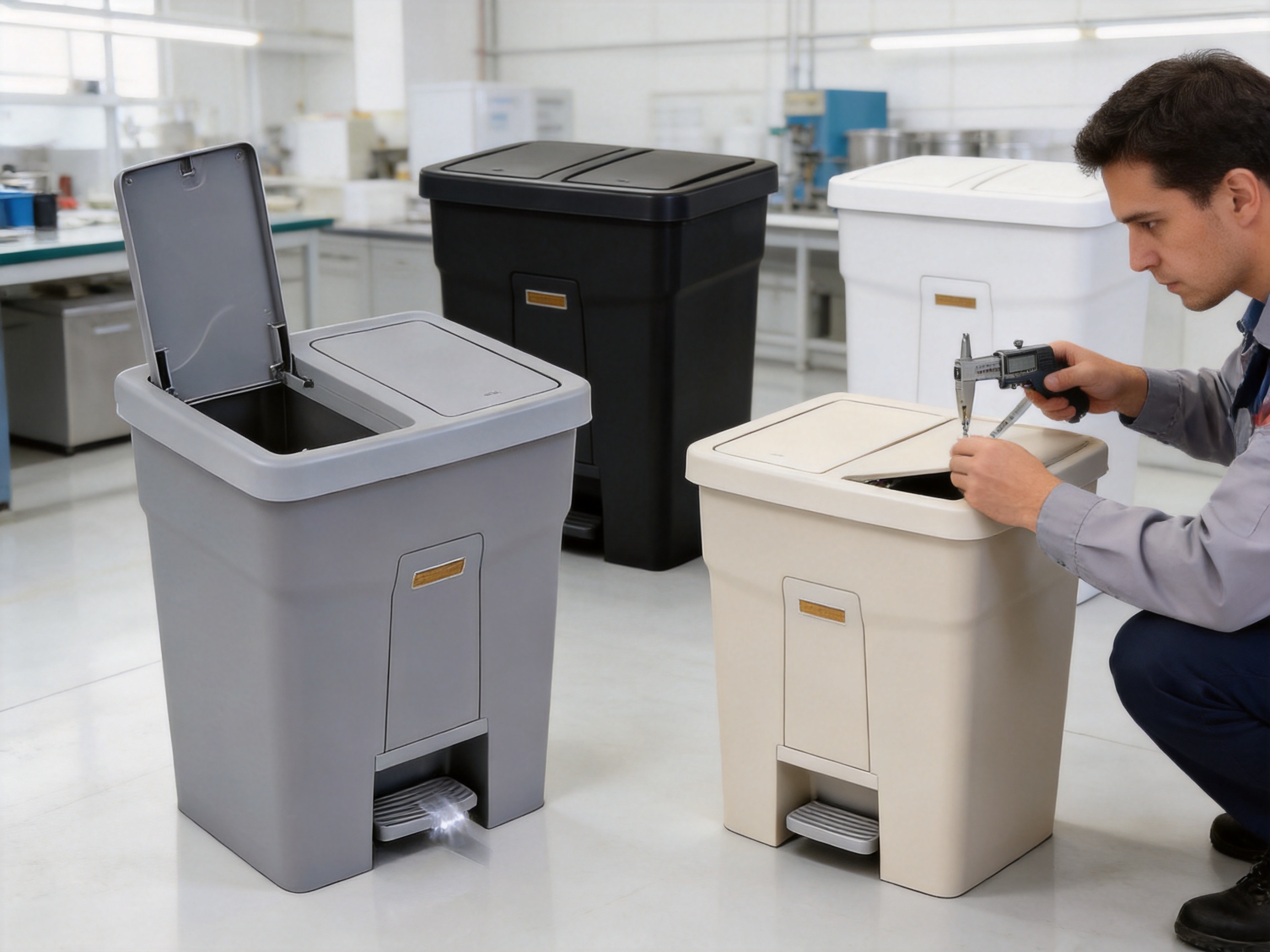
A responsible manufacturer should not consider the mould complete merely because it produces a recognizable part. The tooling should be tested against the customer’s functional and appearance requirements. Where appropriate, trial samples should be checked for lid alignment, pedal operation, hinge strength, dimensional accuracy, and assembly repeatability.
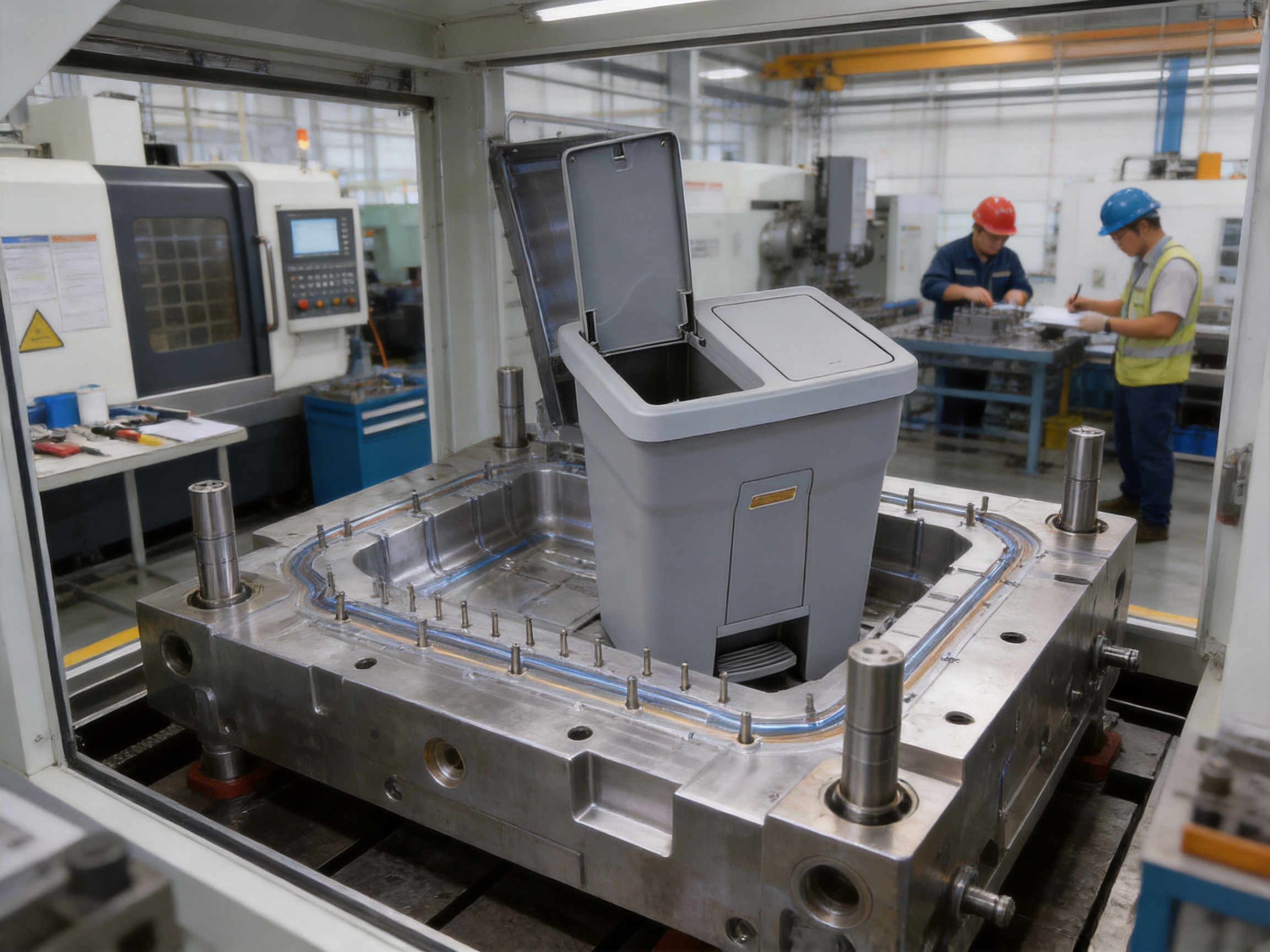
A specialized plastic mould manufacturer can provide advantages beyond the delivery of a basic tool. Experience with household products, logistics containers, storage boxes, pallets, chairs, trays, and other injection-moulded products gives engineers a practical understanding of large plastic components, structural design, cycle-time control, and mass-production requirements.
The manufacturer described in the supplied company information operates in Huangyan, Taizhou, Zhejiang, a region widely recognized for mould manufacturing. Established in 2012, the company has developed experience in customized plastic mould solutions and maintains a plant of approximately 7,000 square meters with around 50 employees.
The company uses CAD, computer-aided engineering, and computer-aided manufacturing systems to support product development and tooling production. This combination helps connect digital design with practical machining and mould assembly. It also enables the engineering team to study potential problems before production and communicate technical details more clearly with customers.
Advanced equipment and experienced technicians are important for large and visually sensitive products such as waste bins. The body mould may require large machining capacity, accurate alignment, efficient cooling, and reliable ejection. The lid moulds may require polished or textured surfaces and precise hinge interfaces. Experienced technicians help ensure that digital designs are translated into workable tools.
The company’s product range includes crate and folding box moulds, tray and pallet moulds, beverage box moulds, and moulds for daily household products. This background is relevant to waste bin mould production because these products often share requirements related to structural strength, repeated handling, clean surfaces, dimensional stability, and cost-effective large-volume manufacturing.
Lean manufacturing aims to reduce unnecessary work, material waste, waiting time, rework, and avoidable production variation. In mould manufacturing, lean principles can be applied to production planning, material preparation, machining sequences, inspection, assembly, and trial management.
For the customer, a lean approach can contribute to clearer delivery planning, fewer unexpected modifications, better use of steel and machining capacity, and more reliable project communication. It also supports the goal of producing a mould that performs consistently rather than requiring repeated corrective work after delivery.
Mould life depends on steel, structure, processing conditions, maintenance, production volume, and the type of resin used. A long-life mould should be designed with suitable wear resistance, replaceable components where practical, accessible cooling connections, reliable guide systems, and maintainable ejection mechanisms.
Replaceable inserts can be useful in areas that experience higher wear or may require future modification. Standardized components can simplify maintenance and reduce downtime. The mould should also be designed so that routine cleaning, lubrication, inspection, and water-channel maintenance can be completed efficiently.
Delivery depends on effective coordination between design, procurement, machining, heat treatment, assembly, testing, and modification. A detailed project schedule helps identify critical operations and reduce delays. Regular communication with the customer is also important when decisions are needed about surface finish, material, color, product tolerances, or sample approval.
On-time delivery is especially important for manufacturers launching a new household product or preparing for a seasonal sales program. Delays in mould completion can affect injection production, packaging, marketing, and distribution. A disciplined tooling process helps reduce these commercial risks.
Tooling cost should be evaluated together with mould life, cycle time, maintenance, scrap rate, and product quality. A very low initial price may not provide the best overall value if it results in frequent repairs, poor cooling, high reject rates, or limited production capacity.
A professional mould manufacturer can help balance cost and performance by selecting an appropriate mould structure, steel grade, runner system, number of cavities, surface treatment, and standard components. The best solution depends on expected annual output and the customer’s long-term business plan.
The dual-lid step-on waste bin can be customized for different markets and product strategies. The mould design should be based on approved product data so that changes are identified before production begins.
| Customization Area | Possible Considerations | Effect on Mould Development |
|---|---|---|
| Capacity | Small household, medium office, or larger commercial volume | Changes body dimensions, cooling layout, ejection force, and machine requirements |
| Lid Configuration | Two independent lids, coordinated panels, or separated compartments | Requires accurate hinge, center-line, and closing-surface design |
| Operating System | Single pedal, dual pedal, or linked mechanism | Influences pedal moulds, support structures, and assembly interfaces |
| Surface Finish | Polished, matte, textured, or decorative exterior | Determines steel finishing, draft requirements, and appearance control |
| Material | Selected according to impact, chemical, temperature, and appearance needs | Affects shrinkage, processing conditions, cooling, and mould wear |
| Color | Single color, multiple colors, or color-coded waste separation | May require product segmentation, inserts, or separate production planning |
| Accessories | Removable liner, bag holder, soft-closing parts, or odor-control components | May require additional moulds, inserts, or precision interfaces |
| Branding | Embossed, debossed, printed, or label-ready areas | Requires approved logo geometry and consideration of parting and filling |
Customization should be controlled carefully because even a small product change can affect the mould. Changing the lid thickness may require a new cooling layout. Adding a logo may alter the surface finish and draft requirements. Increasing capacity may require larger machine capacity and a different ejection system. Early engineering review helps identify these consequences before the project enters production.
Quality control should take place throughout the mould manufacturing process rather than only at final assembly. Incoming steel inspection, machining checks, dimensional verification, heat-treatment control, component inspection, assembly testing, and trial moulding all contribute to the final result.
Critical dimensions include cavity and core geometry, lid mating areas, hinge positions, pedal interfaces, guide components, ejector locations, cooling connections, and mould base alignment. Inspection equipment may include coordinate measuring systems, precision gauges, height gauges, and other suitable instruments.
Inspection results should be compared with the approved drawings and three-dimensional data. Any deviation that could affect product function, assembly, appearance, or mould life should be reviewed before the tool is released.
Visible surfaces should be checked for polishing consistency, texture uniformity, machining marks, EDM differences, scratches, dents, and other defects. The mould should reproduce the intended surface finish across the entire visible product area.
During trial production, the plastic parts should be inspected under suitable lighting. Cosmetic standards should be agreed in advance because acceptable limits may differ between household, commercial, and premium product markets.
The finished mould should be evaluated for opening and closing behavior, ejection stability, water circulation, insert fit, slide movement, and repeatable production. For the bin components, the lids should align correctly, the pedal should connect properly, and the assembled product should operate without excessive friction or looseness.
Where the final product includes a soft-closing or linked mechanism, the moulded parts should be checked for consistency because small dimensional differences can affect the mechanical behavior. A stable moulding process supports more reliable assembly.
Maintenance information should identify lubrication points, cooling connections, wear components, recommended cleaning procedures, and inspection intervals. Clear documentation helps the customer protect the mould after delivery and reduce unnecessary downtime.
The customer should also receive information about suitable processing conditions, approved materials, spare parts, and any special instructions related to slides, lifters, ejectors, or hot runner components. Good technical documentation extends the practical value of the mould.
Plastic injection moulding can support efficient mass production because a single mould can produce a large number of repeatable parts. Efficient mould design can reduce cycle time, material waste, energy consumption, and reject rates. These benefits are especially important for household products sold in competitive markets.
Material selection should consider durability and the expected service life of the finished waste bin. A durable product may remain in use longer and reduce the frequency of replacement. Where appropriate, recycled or recyclable resin options can be evaluated, provided that they meet the required mechanical, appearance, hygiene, and processing standards.
Design for disassembly may also be considered. If the lid, pedal, liner holder, and body can be separated efficiently at the end of the product’s service life, material recovery may become easier. The product designer should balance this goal with the need for secure assembly and reliable everyday operation.
Mould cooling efficiency can reduce energy use during production. Proper water-channel design helps maintain stable mould temperatures and can shorten the cooling stage. In addition, a well-balanced filling system may reduce injection pressure and improve machine efficiency.
Waste reduction begins with mould accuracy. Flash, short shots, warpage, and dimensional failures create scrap and consume additional energy. Better engineering, simulation, testing, and process control can reduce these problems and improve the overall environmental performance of the product.
When comparing a professionally developed dual-lid step-on waste bin mould with a basic alternative, buyers should examine more than the initial quotation. Important comparison points include mould life, cycle time, product consistency, ease of maintenance, surface quality, assembly accuracy, and technical support.
A poorly balanced mould may require high injection pressure, produce uneven filling, or generate visible weld lines in important areas. Inconsistent cooling can lead to warpage and uneven lid gaps. Weak ejection arrangements can deform the body or leave excessive marks. Inadequate venting may create burn marks or incomplete filling. These problems can increase scrap and reduce customer satisfaction.
A professional mould design addresses these risks during engineering. The parting line is planned around appearance and function. Gates and runners are evaluated for balanced filling. Cooling channels are designed for the product geometry. Ejection is distributed to protect the component. Steel and surface treatment are selected according to expected production conditions.
The advantage is not only a better first sample. A stable mould can provide more consistent parts throughout the production run. This improves assembly, reduces adjustment, supports predictable packaging, and helps manufacturers maintain a uniform product image in the market.
A clear development workflow can improve both product quality and project efficiency. The first step is to confirm the product brief, including capacity, overall dimensions, material, color, lid arrangement, pedal system, surface finish, expected output, and target machine.
The next step is to review the three-dimensional product data and identify mouldability issues. The engineering team should check draft, wall thickness, ribs, bosses, undercuts, parting lines, gate locations, cooling possibilities, and ejection requirements. Any necessary product changes should be agreed before mould design approval.
After the design review, the mould structure is developed in CAD. CAE analysis may be used to evaluate filling, cooling, pressure, weld lines, and warpage. The customer should review the mould design before steel is ordered or machining begins.
Once the mould structure is approved, steel preparation, rough machining, heat treatment, precision machining, EDM, grinding, polishing, component production, and assembly follow according to the project schedule. Inspection should be completed at important stages to prevent errors from moving into later operations.
Trial moulding then verifies the tool under practical conditions. The trial report should record machine information, resin, process parameters, sample observations, dimensional results, and required corrections. After modifications, another trial may be conducted until the samples meet the agreed requirements.
Before delivery, the mould should be cleaned, protected, checked for smooth operation, and accompanied by the necessary documentation. The customer may then move into production validation, during which the bin is assembled, tested, packaged, and evaluated in the intended manufacturing environment.
The dual-lid step-on waste bin is suitable for residential kitchens, dining areas, utility rooms, offices, hotel rooms, guest facilities, restaurants, clinics, hospitals, schools, retail spaces, and other locations that require covered waste storage.
In kitchens, hands-free operation allows users to dispose of waste while cooking. In offices, the clean exterior can fit professional interiors. In hotels, the product can support room hygiene and housekeeping routines. In restaurants and food service areas, the covered design can help contain waste and support organized work practices.
For healthcare or institutional applications, product specifications should be reviewed carefully to ensure compatibility with cleaning chemicals, disinfection procedures, and applicable hygiene requirements. The mould manufacturer can support the production of a suitable plastic component, but final compliance depends on the complete product design, material, assembly, and application environment.
In waste separation programs, two lids may be combined with separate internal compartments or color-coded components. This can help users distinguish different waste streams. The precise configuration should be developed according to local collection systems and customer expectations.
A dual-lid step-on waste bin mould is an injection tooling system used to manufacture the plastic components of a waste bin with two lid sections and a foot-operated opening mechanism. Depending on the product structure, the complete project may include separate moulds for the body, lids, pedal, liner, and accessories.
A step-on mechanism allows the user to open the lid without touching the waste bin by hand. This improves convenience and can support better hygiene in kitchens, offices, hospitality facilities, healthcare environments, and other areas where frequent waste disposal is required.
Two lids can create a balanced appearance, reduce the size of each moving panel, support internal waste separation, and provide flexible product configurations. They also require accurate alignment and hinge design to ensure smooth operation and a clean closed position.
Yes. The mould can be developed around the customer’s approved capacity, dimensions, wall thickness, lid configuration, and operating mechanism. A change in capacity may affect the mould size, cooling layout, ejection system, machine requirements, and material usage.
The material should be selected according to impact resistance, chemical exposure, temperature, appearance, stiffness, cost, and recycling objectives. The final resin choice affects shrinkage, filling, cooling, mould wear, and processing conditions, so it should be confirmed before detailed tooling design.
Mould-flow analysis can help predict filling behavior, pressure distribution, weld-line locations, air traps, cooling performance, and possible warpage. It does not replace physical trials, but it can guide gate selection, runner design, cooling layout, and product modifications before machining.
Steel selection should consider expected production volume, resin characteristics, surface finish, wear, corrosion, dimensional stability, maintenance, and budget. Higher-output projects may require stronger wear resistance and carefully treated mould surfaces.
A good appearance depends on product design, steel finishing, polishing or texturing, gate placement, venting, cooling balance, processing conditions, and inspection. The mould surface should be prepared according to the agreed cosmetic standard.
Cooling affects cycle time, dimensional stability, warpage, residual stress, and product release. A balanced cooling system is important because the bin body and lids may contain broad surfaces, curved areas, ribs, and different wall thicknesses.
Important checks include mould dimensional inspection, component fit, parting-line condition, cooling-channel performance, ejection movement, slide operation, surface finish, trial sample appearance, product dimensions, lid alignment, pedal assembly, and overall mould function.
One mould can generally produce parts in different colors when the material and process are suitable. Color changes require proper purging and production control. If the product requires separate color zones or integrated multi-material features, the mould structure may need additional inserts or a specialized design.
The buyer should provide product drawings or three-dimensional data, target dimensions, estimated annual output, material preference, surface finish, color requirements, injection machine information, delivery expectations, packaging considerations, and any functional requirements for the pedal and lids.
Household products often require a combination of attractive appearance, reliable function, easy assembly, competitive cost, and high-volume production. Experience with household moulds helps the supplier understand these requirements and apply practical solutions to body structure, surface finish, cooling, ejection, and maintenance.
A competitive mould combines accurate product reproduction, efficient filling, stable cooling, reliable ejection, durable components, maintainable construction, consistent surface quality, and technical support. The goal is to reduce total production cost and quality risk throughout the mould’s useful life.
The dual-lid step-on waste bin is a practical product for modern hygiene-conscious environments. Its hands-free operation, covered storage, flexible lid arrangement, compact use of space, and broad application potential make it suitable for household and commercial markets. However, the performance of the finished bin depends heavily on the quality of the injection mould used to produce it.
A successful mould requires careful product analysis, suitable draft and wall-thickness design, balanced gates and runners, effective cooling, reliable ejection, accurate hinge and pedal interfaces, appropriate steel, precision machining, controlled surface finishing, and thorough trial moulding. These elements work together to determine the product’s appearance, strength, assembly, operating feel, cycle time, and production consistency.
The manufacturing capabilities described for the Huangyan-based mould company support this type of project through customized plastic mould development, CAD, CAE, CAM, modern equipment, experienced technicians, a substantial production facility, and experience with household and industrial plastic products. Its focus on lean manufacturing, long-life mould construction, delivery control, competitive cost, and customer service provides a suitable foundation for developing a reliable waste bin mould.
For manufacturers planning to launch or improve a dual-lid step-on waste bin, the best results come from involving the mould supplier early. A thorough engineering review can prevent avoidable design problems, reduce modification costs, improve production efficiency, and create a tool capable of supporting stable long-term manufacturing.
1. Injection Moulding Handbook, practical principles of plastic part design, mould construction, process control, and troubleshooting.
2. Plastics Engineering Fundamentals, guidance on polymer behavior, shrinkage, cooling, warpage, and material selection.
3. Design for Manufacturability in Plastic Injection Moulding, principles of draft, wall thickness, ribs, bosses, parting lines, and ejection.
4. Mold Engineering and Manufacturing Practice, methods for steel selection, CNC machining, EDM, polishing, assembly, and mould testing.
5. Polymer Processing and Injection Moulding Technology, discussion of filling, packing, cooling, cycle-time optimization, and quality control.
6. Industrial Product Development Methods, approaches to product review, CAD and CAE integration, prototype validation, and production approval.
7. Household Plastic Product Design Guidelines, considerations for hygiene, usability, appearance, durability, maintenance, and recycling.
If you are interested in any of our products or services, please feel free to ask and we can talk about your ideas.
 QUICK LINKSMOBILE SITE
 FACTORY ADDRESS
 CONTACT INFORMATION



 English
 Español