The stackable round low stool is a practical household product designed for modern living, commercial spaces, children’s areas, waiting rooms, cafés, workshops, and temporary seating environments. Its compact profile, stable structure, and stackable format make it easy to store, transport, and use in different locations. Behind the performance of this apparently simple product is a carefully engineered plastic injection mould capable of producing consistent, durable, and attractive stool components in high volumes.
For manufacturers, the quality of the mould directly influences almost every aspect of the finished stool. It affects dimensional accuracy, surface appearance, cycle time, material consumption, assembly compatibility, structural strength, and long-term production cost. A well-designed mould can support stable mass production, while a poorly engineered tool may create flash, sink marks, short shots, deformation, uneven walls, difficult demoulding, and frequent maintenance interruptions.
The stackable round low stool mould developed by TaiZhou HuangYan YingXiang Plastic Mould Co., Ltd. is intended for customers seeking a dependable solution for plastic household product manufacturing. Based in Huangyan, Taizhou, Zhejiang, China, the company has specialized in customized plastic mould solutions since 2012. Its capabilities cover stool moulds, household product moulds, logistics crate moulds, folding box moulds, pallet moulds, tray moulds, beverage box moulds, and other injection moulds for daily-use products.
This article examines the product concept, mould engineering, manufacturing process, performance advantages, customization options, quality considerations, and purchasing value of a stackable round low stool mould. It also explains how an experienced mould manufacturer can help improve production efficiency and product consistency from the first design review through long-term technical support.

Stackable Round Low Stool
A low stool is one of the most versatile plastic household products. Unlike a conventional chair with a high backrest, a low stool can be used as a seat, footrest, temporary support, children’s seat, dressing-room accessory, garden item, or utility product. Its uncomplicated structure makes it suitable for efficient injection moulding, while its small footprint allows several units to be stacked together when not in use.
The round design provides a soft, approachable visual appearance. It can be developed with a circular seat, rounded outer edges, a cylindrical or slightly tapered body, and integrated legs or support ribs. The exact geometry can be adjusted according to the intended market, user group, loading requirement, colour scheme, and manufacturing method.
Stackability is one of the most important product advantages. A stackable stool should allow multiple units to nest or align securely without excessive friction. This helps retailers reduce warehouse space, enables users to store several stools in a compact corner, and lowers transportation volume compared with non-stackable seating products. The mould must therefore maintain accurate relationships between the stool’s upper and lower surfaces, support ribs, legs, and nesting areas.
A successful product design balances several requirements:
First, the stool needs sufficient load-bearing strength for normal use. The seat and supporting structure must resist bending, cracking, and permanent deformation under repeated loading.
Second, the product needs adequate stability. The base should provide a reliable contact area with the floor, and the centre of gravity should remain suitable for the intended height and diameter.
Third, the stool should be comfortable enough for short- and medium-duration sitting. Rounded edges and a smooth seat surface can improve user experience and reduce pressure points.
Fourth, the stool should be easy to clean. A relatively smooth plastic surface is suitable for homes, commercial venues, childcare facilities, and other areas where frequent wiping is required.
Fifth, the design should support efficient moulding. Uniform wall thickness, appropriate draft angles, carefully positioned gates, and correctly designed ribs help reduce production problems while preserving the required strength.
Plastic injection moulding is a repeatable manufacturing process, but repeatability depends on the quality of the mould and the accuracy of the process conditions. The mould determines the external appearance and internal geometry of every product cycle. It also controls how molten plastic flows, cools, shrinks, and separates from the cavity.
For a stackable low stool, the mould must manage several technical challenges at the same time. The product may have a large circular seat surface, deep side walls, internal strengthening ribs, hollow legs, nesting features, and a visible exterior surface. If the cavity is not balanced, the plastic may fill unevenly, leading to warpage or inconsistent dimensions.
The mould must also accommodate shrinkage. Plastic contracts as it cools, and the amount of contraction varies according to the material, wall thickness, flow direction, cooling rate, and reinforcement content. Mould designers compensate for expected shrinkage through accurate steel design and simulation-informed adjustments.
Demoulding is another important consideration. A stool mould with deep features or insufficient draft may cause the product to stick to the cavity or core. This can result in scratches, deformation, broken ribs, or longer cycle times. Proper draft angles, polished surfaces, ejector placement, and mould opening strategy help the product leave the mould smoothly.
The mould also needs a cooling system capable of controlling temperature across the entire part. The round seat and supporting body may cool at different rates. Uneven cooling can create warpage, ovality, dimensional variation, or stress. Well-positioned cooling channels improve cycle consistency and help reduce production time.
These requirements demonstrate why a stool mould should not be judged only by its initial purchase price. A lower-cost tool may appear attractive at the quotation stage, but unstable production, high scrap rates, repeated repairs, and short service life can make it more expensive over time. A well-engineered mould can deliver greater value through reliable output and lower total ownership cost.
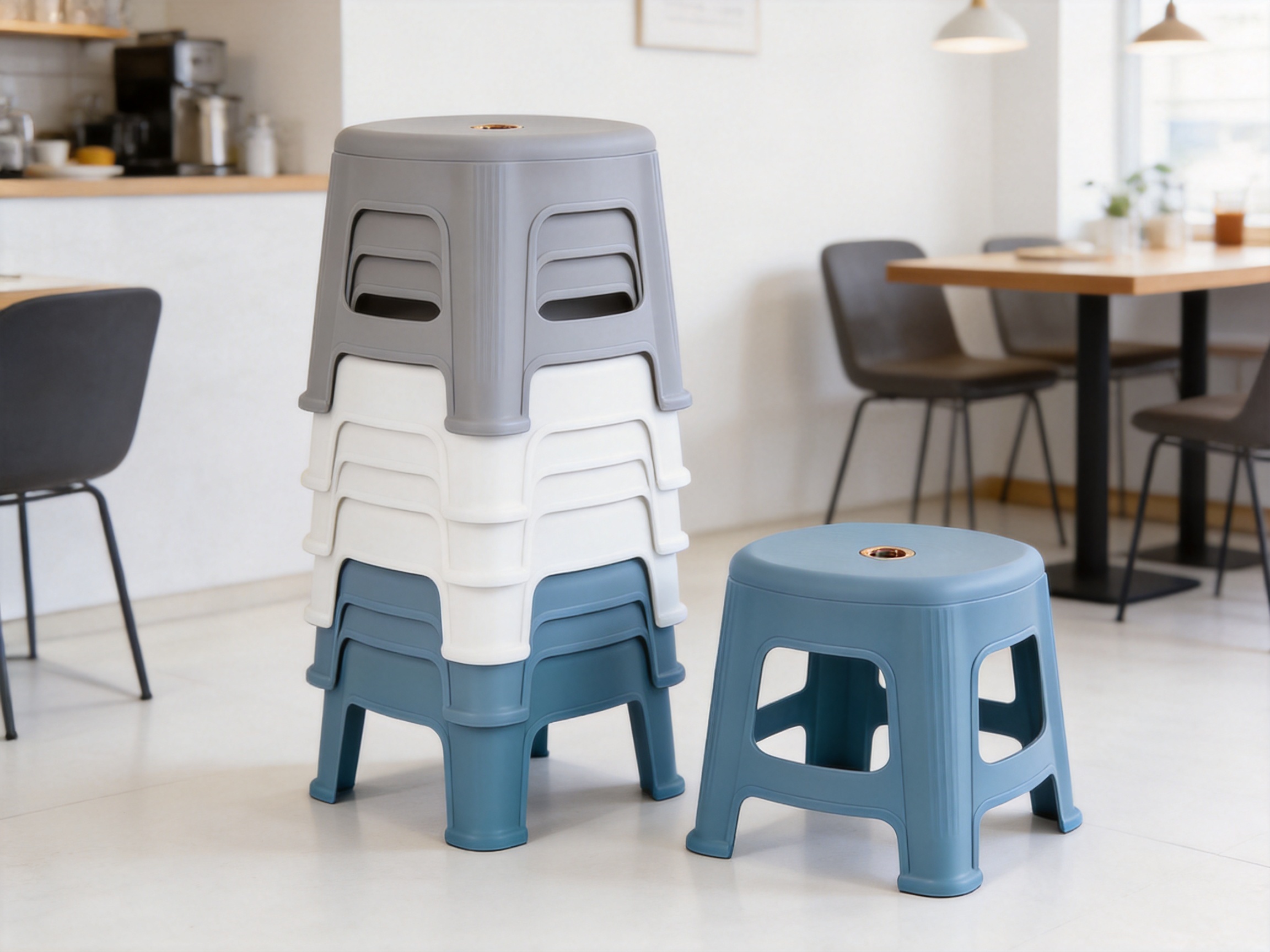
The primary advantage of the product is its ability to stack vertically. When several stools are not being used, they can be placed one above another instead of occupying separate floor positions. This feature is valuable for households with limited storage, restaurants that rearrange seating frequently, event organizers, schools, shops, and commercial facilities.
For distributors, stackability also improves container utilization. More units can be loaded into the same shipping volume, potentially reducing freight cost per stool. Retailers can display multiple colours or product variations while using less backroom space. These logistical benefits make stackability a commercial advantage as well as a user convenience.
A round low stool can suit a wide range of interior styles. Its simple form can be produced in neutral colours for household use, bright colours for children’s environments, or stronger industrial colours for workshops and service areas. The design can be adapted with textured surfaces, contrasting details, printed decoration, or brand-specific colour matching.
Compared with more complex seating products, a round stool generally has fewer components and a simpler assembly structure. This can reduce assembly labour and simplify inventory management. Depending on the final product design, the stool may be moulded as one main part or combined with a small number of additional components such as anti-slip feet, decorative plugs, or reinforcement elements.
Plastic surfaces are easy to wipe and can be designed without fabric, exposed fasteners, or complicated joints. This is especially useful in kitchens, cafés, classrooms, bathrooms, workshops, and other environments where dust, spills, or frequent handling may occur.
A smooth mould surface can help create a clean-looking product. At the same time, controlled texturing may be used to reduce the visibility of minor marks or improve grip. The appropriate finish depends on the target market and the customer’s product specification.
Product strength does not depend only on using more plastic. Excessively thick walls can increase material cost, extend cooling time, and create sink marks or internal stress. A better approach is to combine suitable wall thickness with ribs, curved transitions, support columns, and load-distributing geometry.
The mould can be designed to reproduce these features accurately. Internal ribs can reinforce the seat and body while keeping the product relatively lightweight. Rounded transitions reduce sharp stress concentrations. A properly designed base can distribute load across the floor and reduce the chance of localized deformation.
A low stool should be easy for users to move. A well-balanced injection-moulded structure can provide satisfactory strength without becoming unnecessarily heavy. Lower weight can make the product more comfortable to carry, reduce material consumption, and improve transportation efficiency.
Weight reduction must be managed carefully. Removing too much material can reduce stability or create weak points. The mould design process should therefore consider product analysis, anticipated loading, material behaviour, and practical manufacturing experience rather than relying on appearance alone.
The stackable round low stool mould can be engineered around the customer’s product drawings, 3D data, sample, or performance requirements. At the beginning of a project, the mould manufacturer reviews the product structure to identify potential manufacturing risks before steel cutting begins.
Design for manufacturability is the process of adjusting product geometry so it can be moulded efficiently and consistently. For a low stool, this review may include wall thickness, draft angle, rib thickness, corner radii, parting-line position, gate location, ejector arrangement, cooling requirements, and surface finish.
A manufacturability review can identify areas where the product design may cause filling difficulty, trapped air, visible weld lines, sink marks, warpage, or ejection resistance. Early correction is generally easier and less expensive than modifying the mould after machining has started.
The mould team can also review how the stool will be stacked. If the nesting clearance is too tight, units may become difficult to separate. If it is too loose, stacks may lean or become unstable. Accurate product tolerances and smooth transitions are essential for reliable stacking.
The cavity forms the external surface of the stool, while the core forms internal areas and support geometry. Both sides must be manufactured with high dimensional accuracy so that the completed product meets the customer’s requirements.
For visible household products, the cavity surface may require polishing, texturing, or a combination of different finishes. The choice of mould steel and surface treatment depends on the expected production volume, plastic material, product appearance, and maintenance requirements.
Replaceable inserts may be used in areas that are likely to wear or require future modification. This approach can make maintenance more practical and can allow selected product details to be changed without rebuilding the complete mould.
The gate is the point through which molten plastic enters the cavity. Its position affects filling balance, weld-line location, surface appearance, packing pressure, and the ease of removing the runner or gate mark.
A round stool may require a gate arrangement that supports balanced flow across the seat and body. The best configuration depends on the product’s shape, material, wall thickness, injection machine, and customer expectations for gate visibility. The mould manufacturer evaluates these factors during the design stage.
A properly planned runner system can reduce pressure loss and material waste. It can also support consistent filling from one cycle to the next. In projects where production efficiency is especially important, the gate and runner design should be considered together with cycle time, automation, and downstream trimming requirements.
Air trapped inside a mould cavity can cause burn marks, short shots, gas marks, hesitation, and other defects. Venting allows displaced air and gases to escape as the plastic fills the cavity.
Vents must be positioned carefully. They need to provide effective air release without creating unwanted flash or visible marks on critical surfaces. The mould manufacturer considers the filling path, parting line, deep ribs, corners, and likely last-fill areas when planning the venting system.
Cooling has a direct effect on productivity and product quality. If the plastic remains hot for too long, the cycle becomes slow. If cooling is uneven, the product may warp or shrink inconsistently. A balanced cooling system helps the stool solidify more uniformly.
Cooling channels should be placed at suitable distances from the mould surface and arranged to cover areas with different thermal demands. Thick sections, ribs, central seat regions, and side walls may require special attention. The final channel configuration depends on the mould structure and available machining methods.
The ejection system removes the stool after mould opening. It may use ejector pins, sleeves, stripper arrangements, or other mechanisms depending on the product shape. Ejection force should be distributed across suitable areas to avoid deformation or visible marks.
For a stackable stool, ejection must be strong enough to release the product but gentle enough to protect the seat, legs, ribs, and nesting surfaces. A carefully planned system supports faster cycles and reduces the risk of product damage.
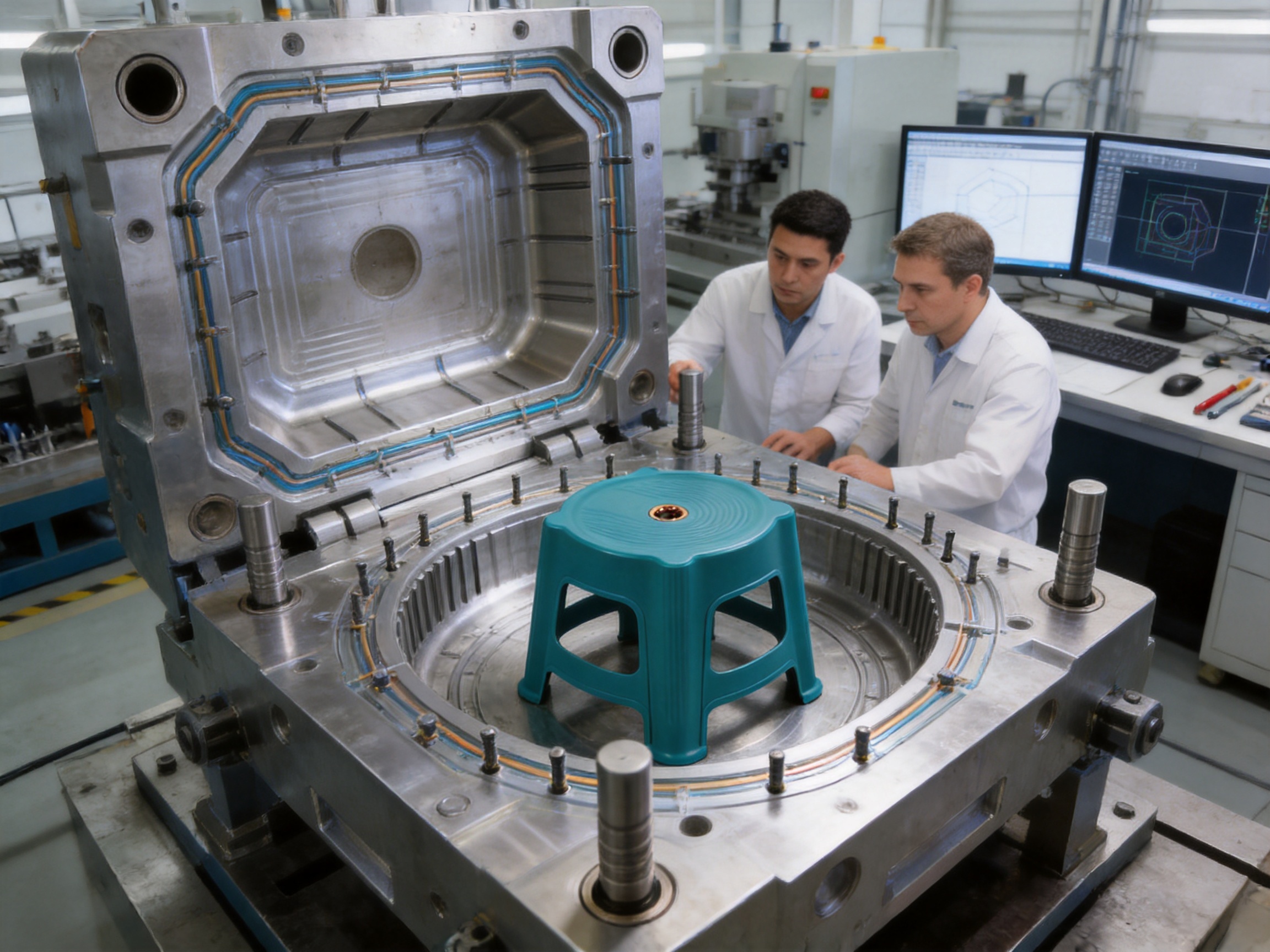
The strength of a mould supplier is reflected not only in its design ideas but also in its ability to turn those ideas into precise, durable steel. TaiZhou HuangYan YingXiang Plastic Mould Co., Ltd. operates in Huangyan, Taizhou, a region widely recognized for mould manufacturing. The company was established in 2012 and has developed experience in customized plastic injection moulds for household and industrial applications.
The company has a plant of approximately 7,000 square metres and a team of around 50 employees. Its production resources include CAD, CAE, and CAM systems, high-tech equipment, and experienced technical personnel. These capabilities support a controlled workflow from initial product review to final mould testing.
The project normally begins with product data, technical drawings, reference samples, or a customer design brief. Engineers study the product requirements and prepare the mould structure using computer-aided design tools.
CAD systems help the team check dimensions, parting lines, draft angles, inserts, ejector positions, cooling layouts, and assembly relationships. Digital design makes it easier to identify interference and make revisions before manufacturing.
The engineering stage also provides an opportunity to consider the customer’s injection machine. Mould size, clamping requirements, injection volume, ejection stroke, nozzle position, and production automation all influence the final mould design.
Computer-aided engineering can support the evaluation of plastic flow, filling balance, pressure demand, cooling behaviour, weld-line position, air traps, and predicted warpage. Analysis does not replace practical mould-making experience, but it can help engineers compare design alternatives and identify potential risks earlier.
For a round stool, flow analysis may be useful when reviewing the seat, curved side walls, ribs, or multiple flow paths. The aim is to improve filling consistency and reduce the likelihood of defects that could otherwise require later modifications.
Once the mould structure is approved, CAM systems can convert design information into machining strategies. Computer-controlled machining helps produce cavity and core components according to the required geometry.
Precision machining is particularly important for the stackability of the stool. Small dimensional errors in nesting surfaces, side walls, or support areas can affect how smoothly the products fit together. Accurate machining also supports consistent assembly and reduces the time required for manual correction.
Complex ribs, narrow grooves, deep corners, and fine details may require electrical discharge machining or other specialized processes. These methods allow the mould maker to create geometries that may be difficult to produce through conventional cutting alone.
After machining, mould components are fitted, aligned, polished, textured, and inspected. Skilled bench work remains essential because precision moulding requires careful adjustment of parting surfaces, slides, inserts, ejector systems, and moving elements.
After the main components are completed, the mould is assembled and checked for movement, alignment, cooling circulation, ejection, and safety. The first trial moulding process allows the team to examine actual product performance under injection conditions.
Trial parts are reviewed for short shots, flash, sink marks, warpage, weld lines, surface defects, dimensional variation, ejection marks, and gate appearance. If improvements are required, the mould may be adjusted through polishing, venting correction, local steel modification, processing changes, or other technical measures.
Several trial stages may be used when the product has demanding performance or appearance requirements. A structured trial process helps ensure that the mould is ready for customer production rather than simply looking complete on the workbench.
Before delivery, the mould should be checked for opening and closing movement, cooling flow, ejection function, component identification, spare parts, and documentation. The customer may also review sample products and confirm critical dimensions or appearance requirements.
Clear documentation supports installation and future maintenance. It may include mould specifications, recommended processing conditions, cooling information, lubrication points, spare component details, and notes about product inspection.
The appropriate plastic material depends on the intended use, required appearance, loading level, impact resistance, colour, cost target, and environmental conditions. Common injection-moulding materials for household stools may include polypropylene, high-density polyethylene, ABS, or other suitable thermoplastics.
Polypropylene is often considered for lightweight products because of its flow characteristics, impact performance, chemical resistance, and practical cost. Other materials may be selected when the product requires a different surface appearance, stiffness, temperature performance, or structural behaviour.
Material selection should be made together with mould design. Different plastics have different shrinkage rates, flow behaviour, processing temperatures, cooling requirements, and sensitivity to moisture or processing conditions. A mould that performs well with one resin may require adjustments when used with another.
Colour additives and masterbatch can also influence processing. Dark or bright colours may reveal flow marks, weld lines, or surface inconsistencies more easily than neutral colours. If the stool will be sold in several colours, the customer should consider whether a shared mould can support all colour options without creating unacceptable appearance variation.
For higher-strength applications, reinforced materials may be considered, but they can increase mould wear and affect shrinkage. In such cases, mould steel, gate design, cooling, and maintenance planning should reflect the characteristics of the selected material.
A specialized stool mould is designed around the actual geometry and performance requirements of the product. This is preferable to adapting a generic mould concept that may not properly control nesting, support structure, or surface appearance.
Consistent dimensions help multiple stools stack correctly and support reliable assembly if additional components are used. They also reduce variation between production batches, which is important for distributors and brands that need a uniform appearance across large orders.
Experienced mould engineers understand that strength comes from geometry, material distribution, and processing control rather than simply increasing wall thickness. Through ribs, curved transitions, and carefully located support features, a stool can achieve a practical strength-to-weight ratio.
This can give the product an advantage over designs that are either unnecessarily heavy or too thin to withstand repeated use. Lower material consumption may also improve production economics when multiplied across thousands of units.
Cooling and filling design have a major effect on cycle time. A mould with properly arranged cooling channels, balanced flow, and efficient ejection can support shorter and more stable cycles than a mould designed without sufficient thermal or flow analysis.
Shorter cycles do not automatically guarantee better production, but stable cycle performance can increase output and reduce cost per unit. It also helps the manufacturer plan labour, machine use, and delivery schedules more accurately.
Appropriate steel selection, reliable components, accurate fitting, and attention to wear areas can extend mould service life. This is especially important for products intended for mass production, where small maintenance delays can affect the entire manufacturing schedule.
Replaceable inserts and standard mould components can make future servicing more practical. The exact maintenance strategy depends on production volume, resin type, cycle conditions, and the customer’s operating environment.
A professional mould supplier can help customers adapt the stool for different markets. Possible variations include seat diameter, stool height, base geometry, rib configuration, surface texture, logo area, colour range, anti-slip features, and packaging format.
Customization is most successful when considered at the beginning of the project. Late changes may require steel modification, insert replacement, or even a new mould section. Early communication allows the engineering team to protect future flexibility wherever practical.
Manufacturers often require support beyond the mould quotation. They may need guidance on machine selection, injection settings, cooling connections, sample evaluation, product inspection, or mould maintenance. A supplier with experience in household and industrial products can provide more useful communication during these stages.
TaiZhou HuangYan YingXiang Plastic Mould Co., Ltd. emphasizes customized solutions, lean manufacturing, long-life moulds, on-time delivery, competitive cost, and comprehensive customer service. These priorities are particularly relevant to customers who need a complete project solution rather than a basic steel tool.
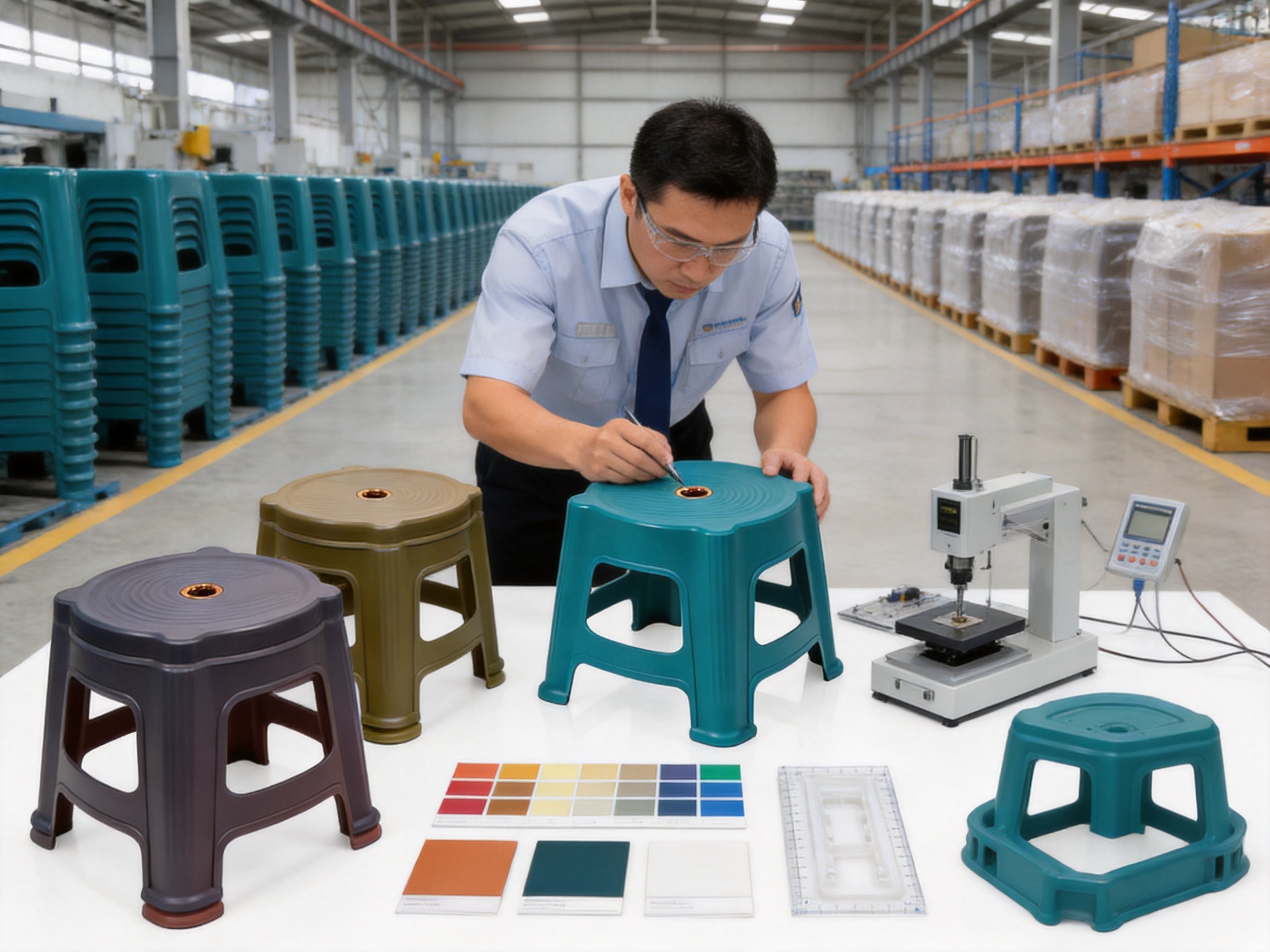
Quality control should be conducted throughout the mould project rather than only at the final inspection. Each stage contributes to the reliability of the finished tool.
The design review checks product data, mould structure, material assumptions, machine compatibility, cooling strategy, ejection plan, and potential manufacturing risks. It is also the correct stage to confirm critical dimensions and appearance zones.
Mould steel and standard components should be selected according to the expected production conditions. Verification may include checking material certificates, hardness requirements, component dimensions, and compatibility between moving parts.
Machining inspections help confirm that cavity and core dimensions meet the approved design. Critical areas may include stackable interfaces, parting surfaces, mounting positions, ejector holes, cooling channels, and alignment features.
During assembly, the mould maker checks whether slides, inserts, ejectors, guide systems, and other moving elements operate smoothly. The mould should open and close without abnormal resistance, interference, or excessive wear.
Sample products should be reviewed for appearance, weight, dimensions, stacking performance, stability, ejection marks, gate marks, and visible defects. If required, functional tests can be carried out to evaluate load performance or repeated stacking.
The exact inspection criteria should be agreed with the customer. A household stool designed for light domestic use may have different requirements from one designed for commercial facilities or frequent public use.
Although the basic product is a round low stool, the mould can be adapted to suit different commercial strategies. Customers may wish to develop several variations from a common design platform or create a completely distinctive product.
Seat diameter and stool height can be adjusted for children, adults, compact living areas, retail displays, or commercial environments. Dimensional changes must be evaluated for stability, stacking clearance, wall thickness, and mould size.
Glossy, matte, fine-textured, or patterned surfaces can create different visual and tactile effects. Texturing may also help reduce the visibility of minor scratches during daily use. The selected finish should be confirmed before final cavity processing.
The stool may be produced in a single standard colour, several seasonal colours, or customized shades. Branding may be incorporated through a recessed or raised logo, an identification area, or an applied label. Logo features should be positioned where they do not interfere with stacking or cleaning.
Depending on the product design, anti-slip pads or feet may be added as separate components. Alternatively, the base geometry may be designed to improve floor contact. The selected solution should consider floor type, noise, cleaning, replacement requirements, and assembly cost.
Because the stools are stackable, packaging can often be planned around nested sets. Protective materials may be used around visible surfaces, while carton dimensions can be optimized for warehouse and container loading. A mould supplier can consider stacking height and product nesting during the design stage to support the customer’s logistics plan.
Even a high-quality mould requires proper use and maintenance. Customers should operate the mould according to suitable injection parameters and avoid unnecessary pressure, excessive temperature, or uncontrolled cycle changes.
Before production, cooling lines should be checked for flow and leakage. The mould should be installed securely, and the machine settings should be confirmed against the mould and material requirements. The first production cycles should be monitored until filling, packing, cooling, and ejection are stable.
Routine maintenance may include cleaning the cavity and core, removing plastic residue, checking ejector movement, lubricating appropriate moving parts, inspecting cooling connections, and examining parting surfaces for damage. Maintenance frequency depends on production volume and material.
When using reinforced or abrasive plastics, wear may occur more quickly in gates, runners, slides, and other high-contact areas. The customer should maintain production records so that changes in cycle time, ejection force, product dimensions, or surface appearance can be identified early.
If a product defect appears, the cause should be investigated systematically. Possible causes include material moisture, incorrect temperature, insufficient venting, blocked cooling channels, excessive injection speed, inadequate packing, mould wear, or product design limitations. Adjusting processing conditions without checking the mould and material may not solve the underlying problem.
For importers and product brands, a mould project is an investment in future production capacity. The value of the stackable round low stool mould should therefore be evaluated through the complete commercial lifecycle.
A reliable mould can help create a stable supply of products with consistent appearance. This supports customer satisfaction and reduces the risk of complaints caused by uneven dimensions, poor stacking, visible flash, or premature product failure.
The product’s stackability can improve warehousing and distribution efficiency. More products may fit into a given storage area or shipment, and retailers can handle inventory more easily. When the mould is designed for efficient cycle time and reasonable material use, the unit cost may also become more competitive.
Customization gives brands an opportunity to differentiate themselves. A simple stool can be developed with a distinctive colour system, a recognizable surface treatment, a specialized size, or a branded detail. The mould becomes a tool for creating a consistent product identity rather than merely reproducing a generic item.
Supplier location and communication are also important. The company’s position in Huangyan, Taizhou, a major mould-manufacturing region, provides access to an established industrial network and experienced mould-making personnel. Yingxiang’s focus on custom injection mould solutions allows customers to discuss product-specific requirements during design and manufacturing.
The company’s product range includes logistics crate moulds, folding box moulds, pallet and tray moulds, beverage box moulds, household product moulds, chair moulds, floor mat moulds, trash can moulds, hand basket moulds, and food storage container moulds. This broad experience in plastic products can be useful when a customer requires several related moulds or plans to expand a household product series.
A clear project workflow helps reduce misunderstandings and keeps technical decisions organized.
The first step is requirement collection. The customer provides product drawings, 3D files, sample references, target material, expected production quantity, injection machine information, surface requirements, and delivery expectations.
The second step is technical evaluation. Engineers examine the product and identify potential concerns related to filling, cooling, ejection, stacking, wall thickness, parting lines, and appearance.
The third step is quotation and project confirmation. The quotation should reflect mould structure, material assumptions, expected production conditions, trial arrangements, packaging, and delivery terms.
The fourth step is mould design. The approved product data is converted into a complete mould structure using CAD and, where appropriate, CAE analysis.
The fifth step is manufacturing. CAM programming, machining, electrical discharge machining, polishing, texturing, fitting, and assembly are carried out according to the approved design.
The sixth step is trial moulding. Sample products are produced and evaluated. Any necessary corrections are completed before final approval.
The seventh step is delivery and production support. The mould is prepared with relevant documentation and shipped to the customer. Technical communication may continue during installation, initial production, and later maintenance.
This structured workflow helps customers understand where decisions are made and where approval is required. It also gives the mould supplier opportunities to prevent avoidable problems before they become expensive changes.
The main advantage is efficient storage. Multiple stools can be nested vertically, reducing the floor space required in homes, shops, warehouses, restaurants, schools, and event venues. The round shape also provides broad market appeal and supports a simple, easy-to-clean product structure.
Yes. Customers can discuss dimensions, wall structure, colours, surface finish, logo details, support ribs, anti-slip features, packaging, and other requirements. The practical range of customization depends on the approved product design and mould structure.
Material selection depends on the required strength, impact resistance, weight, appearance, cost, temperature conditions, and intended use. Polypropylene and other suitable thermoplastics may be considered, but the final material should be confirmed with the moulding processor and mould engineer.
Cooling affects cycle time, shrinkage, dimensional consistency, and warpage. A balanced cooling layout helps the stool solidify uniformly and can support more stable mass production.
The mould controls the dimensions and position of the stool’s nesting surfaces, side walls, legs, and internal supports. Accurate machining and suitable product tolerances help the finished stools stack smoothly without excessive looseness or friction.
In many cases, the same mould can produce different colours by changing the plastic colourant or masterbatch. However, the customer should evaluate colour-change procedures, cleaning requirements, surface appearance, and possible colour contamination before production.
Useful information includes product drawings or 3D files, sample images, approximate dimensions, target material, expected annual or monthly quantity, injection machine details, surface finish, colour requirements, branding needs, and delivery destination.
No. Initial price is only one part of total cost. Cycle time, scrap, repair frequency, mould life, material consumption, maintenance, and production stability can have a greater effect over the complete project lifecycle.
Regular cleaning, lubrication of suitable moving parts, cooling-line inspection, careful handling of parting surfaces, and timely replacement of worn components can help preserve mould performance. Maintenance should be adapted to production volume and plastic material.
A suitable supplier should have experience in plastic injection mould design, precision machining, trial moulding, household product development, and customer-specific engineering. It should also be able to communicate about product design, injection conditions, maintenance, and delivery.
A physical sample may be used as a design reference, although accurate 3D data and technical drawings are preferable. If reverse engineering is required, the customer and mould supplier should confirm the expected dimensional accuracy and any intellectual property considerations.
Yes, a properly engineered injection mould can support high-volume production. The suitable cavity arrangement, steel selection, cooling, ejection, and maintenance plan depend on the required output and the customer’s production equipment.
The development of a stackable round low stool may appear straightforward, but successful mass production requires coordination between product design, mould structure, plastic material, machine settings, quality control, and logistics. An experienced manufacturer can connect these areas and help the customer avoid decisions that create problems later.
TaiZhou HuangYan YingXiang Plastic Mould Co., Ltd. has operated since 2012 and combines engineering resources, manufacturing equipment, experienced technicians, and a broad product background. Its approximately 7,000-square-metre plant and team of around 50 employees support the production of customized plastic moulds for both household and industrial applications.
The company’s experience with crates, folding boxes, pallets, trays, beverage boxes, chairs, stools, food containers, trash cans, hand baskets, floor mats, and other plastic products demonstrates its ability to work with different geometries, surface requirements, structural features, and production objectives.
Its use of CAD, CAE, and CAM systems supports a modern design-to-manufacturing workflow. Combined with practical fitting, trial moulding, and technical experience, these resources can help improve mould accuracy and reduce avoidable production risks.
For customers purchasing a stool mould, the most important benefit is not simply receiving a mould that fits into an injection machine. The real goal is obtaining a tool that can produce consistent products, support efficient cycles, maintain appearance quality, allow practical maintenance, and contribute to long-term commercial success.
The stackable round low stool is a compact and commercially versatile plastic product. Its low profile, rounded form, easy-clean surface, lightweight handling, and vertical storage capability make it suitable for many household, retail, hospitality, educational, and industrial environments.
Its performance depends strongly on the quality of the injection mould. Accurate cavity and core construction, balanced filling, effective venting, controlled cooling, reliable ejection, appropriate draft, and durable mould components are essential for stable production. The mould must also preserve the dimensional relationships that allow the stools to stack smoothly.
A specialized and carefully manufactured stool mould can offer advantages over less developed alternatives through improved consistency, reduced scrap, better cycle-time potential, more reliable service life, and greater customization flexibility. These benefits can lower total production cost and strengthen the customer’s position in competitive markets.
TaiZhou HuangYan YingXiang Plastic Mould Co., Ltd. provides customized plastic injection mould solutions from its facility in Huangyan, Taizhou, Zhejiang, China. Established in 2012, the company combines CAD, CAE, and CAM systems with modern equipment, experienced technicians, and a broad portfolio of household and industrial moulds. Its focus on lean manufacturing, long-life moulds, on-time delivery, competitive costs, and customer service makes it a suitable partner for stackable stool mould projects and related plastic product development.
For a quotation or technical discussion, customers can contact the company by telephone at +86 17858690885, +86 13566828762, or +86 19957608921, or by email at Chinayingxiang88@sina.com. The company is located at No. 2 Chaoyuan Road, North City Street, Huangyan, Taizhou, Zhejiang, China 318020.
1. Injection Molding Handbook, technical principles of plastic flow, cooling, mould construction, and production control.
2. Plastics Engineering Fundamentals, material selection, shrinkage, warpage, and structural design considerations for injection-moulded products.
3. Design for Manufacturing and Assembly, product geometry, draft angles, ribs, wall thickness, and cost-effective production principles.
4. International Mouldmaking Practice, mould steel selection, cavity and core machining, polishing, fitting, and maintenance procedures.
5. Polymer Processing Reference Materials, thermoplastic processing behaviour, cooling requirements, shrinkage, and injection-moulding quality factors.
6. Industrial Product Quality Management Guidelines, inspection planning, trial mould evaluation, dimensional control, and production consistency.
If you are interested in any of our products or services, please feel free to ask and we can talk about your ideas.
 QUICK LINKSMOBILE SITE
 FACTORY ADDRESS
 CONTACT INFORMATION



 English
 Español