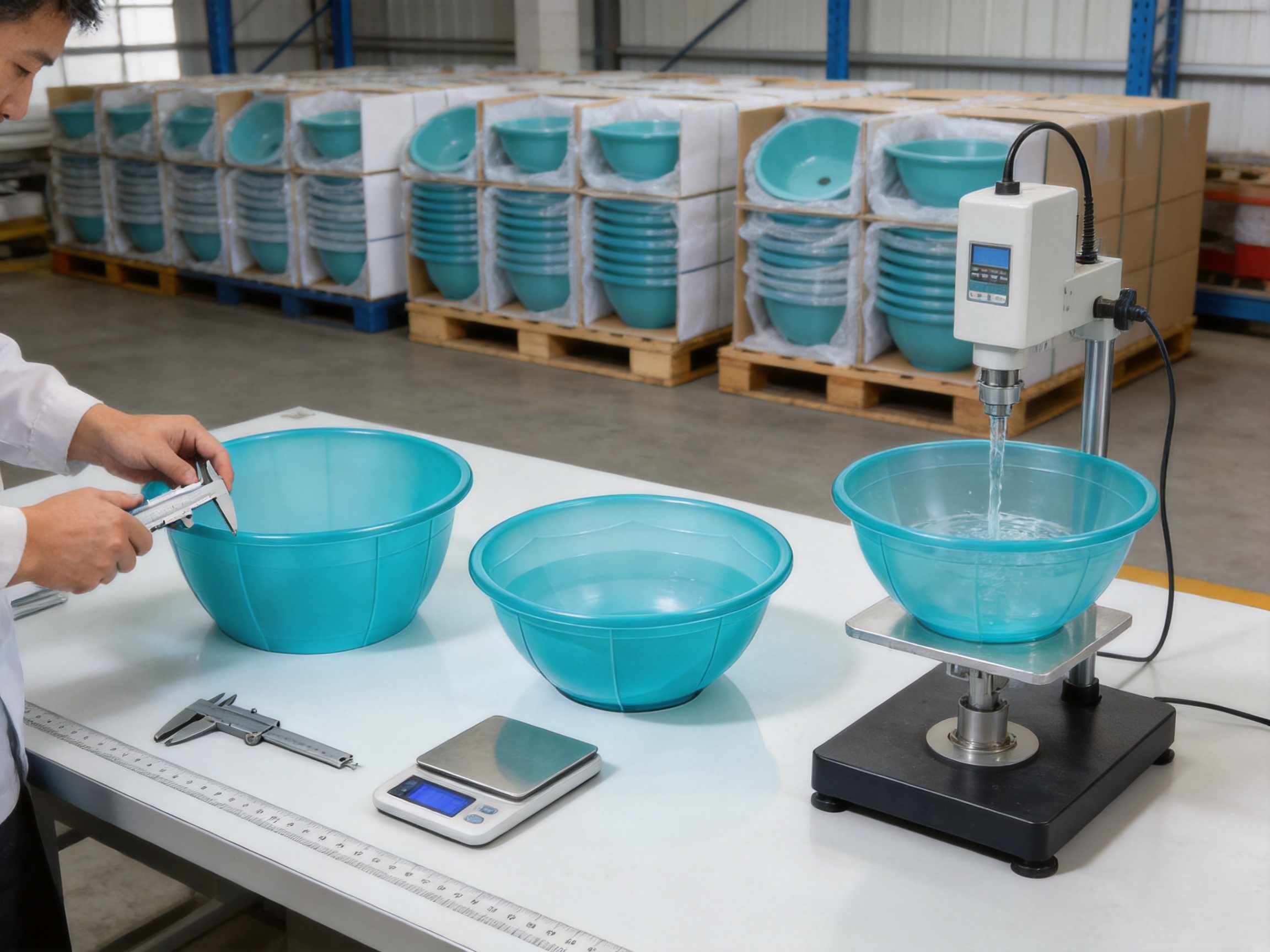
A deepened washbasin set is a practical household product designed for washing, soaking, sorting, carrying, and organizing items in kitchens, bathrooms, utility rooms, balconies, laundry areas, and other domestic spaces. Compared with a shallow basin, a deepened washbasin normally provides greater working capacity, improved splash control, better support for larger items, and more comfortable handling during everyday tasks. When manufactured through a carefully engineered plastic injection mould, it can combine lightweight construction with dependable strength, smooth surfaces, consistent dimensions, and an attractive appearance.
The quality of a deepened washbasin set depends on much more than the visible shape of the finished product. The design of the mould, the selection of plastic material, the filling balance of the cavity, the cooling system, the ejection method, the surface finish, and the inspection procedure all influence the final result. A well-designed mould helps the producer maintain stable wall thickness, reduce deformation, control shrinkage, avoid visible flow marks, and achieve repeatable production over a long service life.
TaiZhou HuangYan YingXiang Plastic Mould Co., Ltd. provides customized plastic mould solutions for household products and related injection-moulded containers. Located in Huangyan, Taizhou, Zhejiang, China, the company works in one of the world’s recognized mould manufacturing regions. Since its establishment in 2012, it has developed experience in household product moulds, storage containers, logistics crates, folding boxes, pallets, beverage boxes, trays, chairs, stools, and other plastic products requiring practical design and repeatable industrial production.
For a deepened washbasin set, the combination of product usability and mould engineering is particularly important. The basin must be comfortable to hold, stable when placed on a flat surface, resistant to ordinary household impacts, and easy to clean. At the same time, it must be economical to manufacture and suitable for the customer’s selected injection-moulding machine, material, production volume, and market requirements. These objectives require a systematic process from early product design through final mould testing.
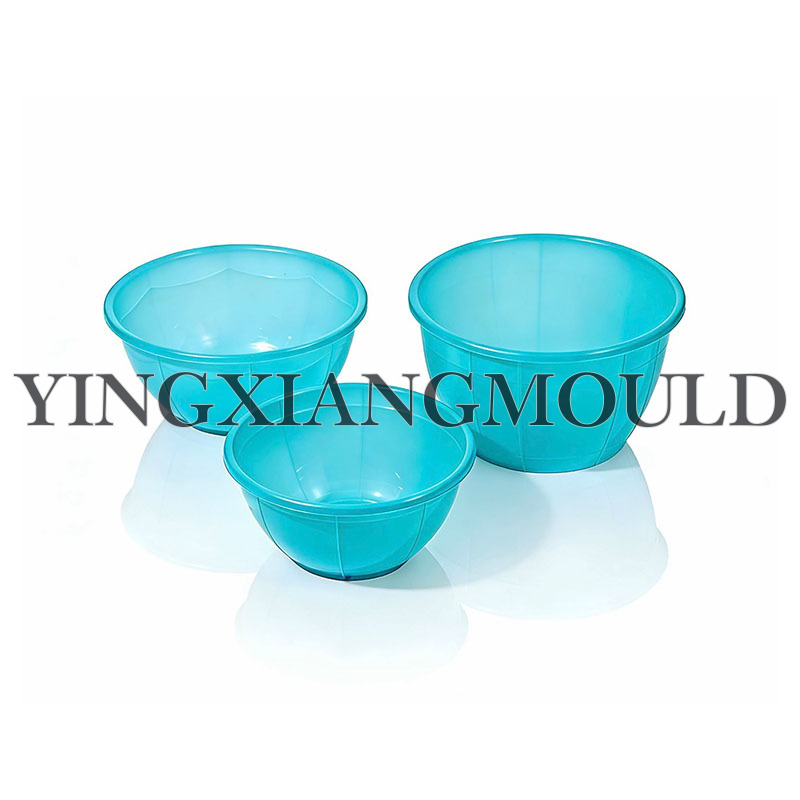
Deepened Washbasin Set
A washbasin set may contain one or more coordinated basins or accessories intended for household washing and storage tasks. The deepened design increases the internal usable volume without necessarily requiring a proportionally larger footprint. This makes the product suitable for customers who want additional capacity while preserving convenient placement in a sink, on a countertop, on a floor, or in a storage cabinet.
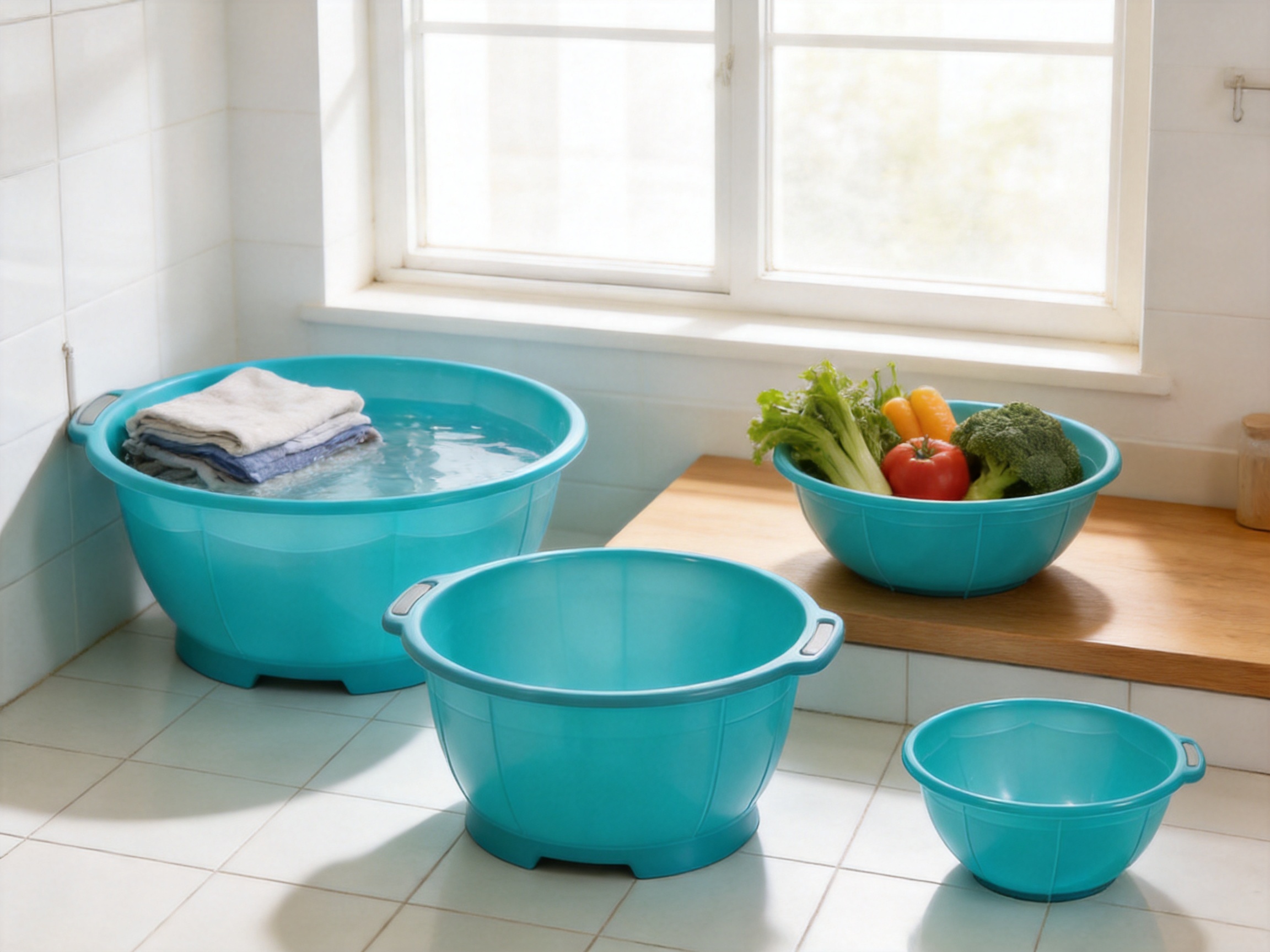
The product can be designed for a wide range of applications. In a kitchen, it may be used for washing vegetables, soaking dishes, separating food preparation items, or transporting water. In a bathroom or laundry area, it may support hand washing, clothing soaking, cleaning, or general household work. In a balcony or utility room, the basin may be used for plant care, cleaning tools, pet-related tasks, or temporary storage.
A set format can also create additional commercial value. Several coordinated sizes allow customers to select the most suitable capacity for different tasks. Nestable basins can save retail and warehouse space. Matching colors and surface textures can create a unified product family. A set may also include complementary components such as a draining insert, handled container, cover, or storage accessory, depending on the customer’s design brief.
The primary characteristic is increased depth. A deeper basin can hold more water or materials and can reduce overflow during normal use. Its vertical walls should be designed with sufficient draft so that the product can be released smoothly from the mould. The internal corners should be rounded rather than sharply intersecting, helping to improve cleaning performance and reduce stress concentration.
A practical washbasin should have a stable base. If the base is too narrow, the product may tip when loaded. If it is too broad without adequate structural support, the product may become unnecessarily heavy or difficult to store. The best configuration balances footprint, capacity, wall height, center of gravity, and handling comfort.
The rim is another important feature. A rolled, reinforced, or smoothly rounded rim can improve user comfort and help the basin retain its shape. It may also provide a convenient gripping area when the product is full. Excessive sharpness, flash, or uneven thickness at the rim can create discomfort and reduce the perceived quality of the finished product.
A coordinated washbasin set can serve different customer segments without requiring a completely separate visual identity for each size. Retailers can offer small, medium, and large capacities under one product family. Distributors can combine sets for household, hospitality, institutional, and cleaning applications. The same basic mould concept can also be adjusted for different colors, textures, handles, and packaging formats.
From a production perspective, a set can create opportunities for standardized manufacturing. Shared design principles may simplify material selection, quality control, and packaging development. If the moulds are planned as a product series, the manufacturer can maintain consistent wall appearance, corner geometry, and branding areas across multiple sizes.
The deepened washbasin set can offer several advantages over ordinary shallow basins, poorly reinforced products, and inconsistent low-cost alternatives. These advantages do not come from depth alone. They result from the relationship between the product structure, mould accuracy, material behavior, and production control.
A deeper basin can hold more water, clothing, food ingredients, cleaning items, or other household materials. This reduces the need to refill or transfer contents repeatedly. For users who perform soaking or washing tasks, additional depth may improve efficiency and reduce splashing when the basin is moved carefully.
Higher sidewalls provide a greater containment margin than shallow trays. This is useful when the basin is filled with water or when wet items are moved from one location to another. The upper rim and internal wall angle can be optimized to provide sufficient capacity while preserving easy access for the user.
A properly engineered deep basin can be stronger and more stable than a thin, shallow product with an irregular base. Reinforced ribs, a designed base profile, rounded transitions, and controlled wall thickness help distribute load. These features can reduce excessive flexing when the product is lifted or placed on a surface.
Handling comfort depends on the rim, sidewall angle, grip position, product weight, and center of gravity. A professional mould design can incorporate practical hand positions or smooth gripping zones. The aim is to make the basin easier to lift without adding unnecessary material or creating difficult-to-clean recesses.
Consumers often judge household products by their surface quality. A basin with uniform color, clean edges, a smooth interior, and consistent gloss can appear more durable and hygienic. An accurate mould cavity and suitable polishing or texturing process help maintain a repeatable appearance across production batches.
Many deepened basin sets can be designed for nesting. One basin fits into another while leaving sufficient clearance to prevent sticking. This reduces shipping volume, warehouse requirements, and retail display space. Nesting must be considered during the product design stage because excessive interference can cause scratches, difficult separation, or packaging problems.
Smooth internal surfaces and rounded corners help users remove residue. The mould should avoid unnecessary deep pockets, sharp internal intersections, and difficult-to-reach recesses. Drainage behavior can also be considered if the design includes a spout, pouring area, or perforated insert.
Before mould construction begins, the product design should be reviewed for function, appearance, manufacturability, and expected service conditions. A strong design brief should identify the intended capacity, overall dimensions, material, color, texture, packaging method, target market, expected production volume, and available injection machine.
Wall thickness has a direct influence on strength, weight, cycle time, shrinkage, and appearance. Very thin walls may reduce material consumption but can lead to weak corners, visible deformation, short shots, or excessive flexibility. Very thick walls may increase cost, prolong cooling, create sink marks, and intensify warpage.
For a deepened washbasin, the wall thickness should be as uniform as practical. Changes in thickness should be gradual rather than abrupt. Where reinforcement is needed, ribs or local structural features are normally more efficient than simply making the entire wall thicker. These details must be designed with suitable rib thickness and draft to prevent moulding defects.
Draft allows the moulded basin to separate from the cavity and core. Insufficient draft may cause drag marks, whitening, deformation, or difficult ejection. The correct angle depends on the material, surface texture, depth, and direction of ejection. Textured surfaces generally require more draft than polished surfaces because the texture increases resistance during release.
Draft should be reviewed on the inner walls, outer walls, ribs, handles, stacking features, and any lettering or decorative areas. Early draft analysis can prevent costly modifications after mould steel has been machined.
Rounded corners help material flow through the cavity and reduce stress concentration in the finished product. They also make the basin easier to clean. A smooth transition between the sidewall and base can reduce the likelihood of sharp moulding lines, cracks, and visible flow disturbances.
The base should support the expected load without rocking. A carefully designed base may include a peripheral support ring, reinforcing ribs, or a slightly raised central area. The design must also account for mould shrinkage and cooling behavior. A theoretically flat base can become uneven if the cooling system is not balanced or if the geometry contains significant thickness variation.
The rim should provide adequate stiffness and a smooth contact surface. If the basin includes handles, the connection between the handle and body must be reinforced without creating excessive thickness that produces sink marks. Handle openings must have sufficient radius, draft, and clearance for ejection and cleaning.
Nesting clearance should be tested with real production samples rather than relying only on computer models. The design should allow basins to separate easily while preventing excessive movement during transport. If the set contains several sizes, the nesting sequence and packaging arrangement should be defined before the mould is finalized.
The injection mould is the central production tool that converts the customer’s product design into repeatable physical products. For a deepened washbasin, the mould must handle a relatively large surface area, a deep cavity, possible thin-wall sections, and demanding appearance requirements.
The core forms the inside of the basin, while the cavity forms the outside. Their alignment must be precise so that wall thickness remains consistent around the entire product. A mismatch can create one-sided walls, uneven shrinkage, or visible parting-line steps. The mould base, guide pillars, guide bushes, inserts, and locking surfaces all contribute to alignment accuracy.
Depending on product size and design complexity, the mould may use a monolithic cavity, replaceable inserts, or a combination of machined and assembled components. Replaceable inserts can be useful when the design includes interchangeable logos, handles, texture areas, or size-specific elements. The best structure depends on the customer’s production plan and anticipated future modifications.
The gate introduces molten plastic into the mould cavity. Its location influences filling balance, weld-line position, pressure requirements, packing behavior, and visible appearance. A gate placed in an unsuitable area may produce hesitation, air traps, flow marks, or an obvious gate vestige.
For a large basin, the flow path should be analyzed carefully. A central gate, edge gate, hot runner arrangement, or multiple-gate solution may be considered based on the material, product geometry, machine capability, and appearance requirements. The selected solution should fill the cavity consistently while limiting excessive pressure and unnecessary post-processing.
Air trapped inside the cavity must escape as molten plastic advances. Inadequate venting can cause burn marks, short shots, silver streaks, weld-line weakness, and unstable filling. Vents should be placed in suitable end-of-fill locations and designed with dimensions appropriate for the selected material.
Venting is especially important around deep corners, ribs, handles, and areas where multiple melt fronts meet. The mould manufacturer can use flow simulation and trial moulding to identify locations requiring additional venting or vent improvements.
Cooling is one of the most important factors in cycle time and dimensional stability. A deepened basin has broad surfaces and may contain thicker zones near the base, rim, handle, or reinforcement features. If these areas cool at different rates, warpage and deformation may occur.
A balanced cooling layout should bring coolant close enough to critical surfaces while preserving mould strength. Channels may be arranged around the cavity, core, base, and rim. Baffles, bubblers, conformal cooling inserts, or local cooling solutions may be considered where conventional straight channels cannot provide sufficient temperature control.
Good cooling design offers several benefits: shorter cycle times, more uniform shrinkage, improved surface quality, and greater dimensional repeatability. It can also reduce energy consumption per part because the mould does not need to remain in the machine longer than necessary.
The ejection system must remove the basin without distortion, whitening, drag marks, or damage to the rim and internal surfaces. Ejector pins, stripper plates, sleeve ejectors, air assistance, or combined systems may be selected according to the product geometry.
For a deep basin, a stripper plate can sometimes distribute ejection force more evenly than a limited number of ejector pins. However, the final choice depends on mould size, available space, part geometry, and cost. Ejectors should be positioned under structurally strong areas whenever possible. Their marks should be located where they are acceptable for the target market.
The mould surface can be polished, matte-finished, chemically textured, or mechanically textured. A smooth inner surface is often preferred for cleaning and hygiene. The outside may use a fine texture to improve grip, hide minor handling marks, or create a distinctive appearance.
Texture depth affects draft requirements and ejection force. It also influences how colors appear under different lighting conditions. The texture specification should therefore be agreed upon before mould finishing begins.
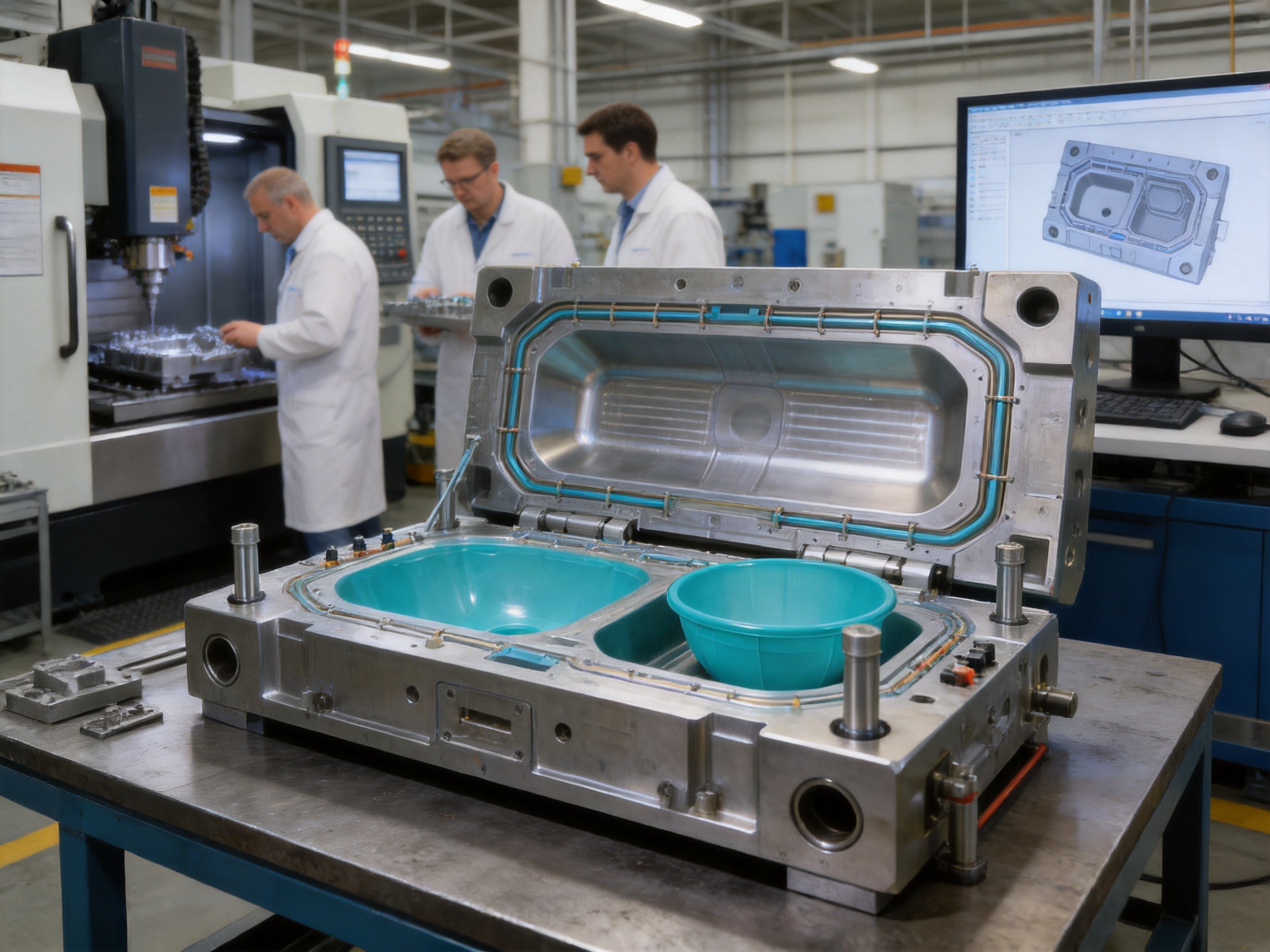
The manufacturing process for a reliable washbasin mould begins with engineering review rather than immediate cutting. Yingxiang Plastic Mould uses CAD, CAE, and CAM systems to support product analysis, mould design, machining, and production preparation. These systems help connect the customer’s concept with the physical requirements of injection moulding.
The first stage is a feasibility review of the product drawings or three-dimensional data. Engineers examine wall thickness, draft, parting line, undercuts, handles, ribs, nesting clearances, gate locations, ejection surfaces, and potential deformation areas.
At this stage, the customer can make changes at relatively low cost. A small modification to a corner radius or wall transition may significantly improve filling and cooling. Similarly, moving a handle, adjusting the rim, or adding a reinforcing rib may improve both user experience and mould life.
Computer-aided engineering can be used to evaluate filling behavior, pressure distribution, weld-line locations, air traps, cooling trends, shrinkage, and warpage. Simulation does not replace physical trials, but it helps the engineering team identify risk areas before steel is machined.
For a deepened washbasin, the analysis may compare different gate positions and cooling strategies. It can also help determine whether the selected machine has enough injection volume, pressure, and clamping force. The result is a more informed mould design and fewer avoidable modifications during testing.
After product feasibility is confirmed, the mould structure is developed. The design includes the mould base, core, cavity, slides or lifters if required, cooling circuits, runner system, gates, vents, ejectors, guide components, support plates, and safety elements.
The structure should be strong enough for the expected production cycle and suitable for maintenance. Wear components should be accessible for inspection and replacement. Cooling connections, lifting points, identification plates, and spare-part requirements should also be considered.
Mould steel selection depends on the expected production volume, plastic material, surface requirements, corrosion exposure, and maintenance plan. Common mould steels may be selected for general household production, while hardened or corrosion-resistant grades can be considered for higher production demand or more demanding conditions.
The selection should balance hardness, toughness, machinability, polishing performance, thermal conductivity, and cost. A mould intended for a long production life should not be designed only around the lowest initial price. The cost of maintenance, downtime, replacement parts, and production interruptions must also be considered.
Computer-controlled machining produces the cavity, core, inserts, pockets, cooling features, and other mould components. Precision milling, drilling, grinding, electrical discharge machining, and polishing may all be used according to the geometry and surface requirements.
Large basin surfaces require careful control of tool paths and transitions. Visible surface areas should be machined and finished consistently to avoid variations in gloss or texture. Deep areas and narrow features may require specialized electrodes or extended-reach tooling.
After machining, components are measured, fitted, and assembled. The alignment of the core and cavity is checked, and moving components are tested for smooth operation. The engineering team reviews parting-line contact, insert positioning, ejector movement, slide travel, cooling connections, and safety clearances.
Accurate fitting is essential because even a small mismatch can affect product appearance and mould longevity. Proper assembly also helps prevent premature wear caused by uneven contact, insufficient support, or misaligned moving components.
The surface treatment is completed according to the agreed product finish. Polishing may be applied to the internal basin surface, while a controlled texture may be used on the exterior. The transition between different finishes should be clear and consistent.
The mould surface is inspected for scratches, machining marks, pits, sharp edges, and inconsistent texture. This stage directly influences the appearance of every basin produced during the mould’s service life.
The first mould trial provides physical evidence of filling, ejection, cooling, dimensions, and appearance. Samples are inspected for short shots, flash, weld lines, sink marks, warpage, gate marks, burn marks, and other defects.
If correction is required, the mould may be adjusted through polishing, vent improvement, gate modification, cooling refinement, dimensional correction, or process parameter changes. Several trial stages may be appropriate for complex or high-volume projects. The objective is not merely to produce one acceptable sample, but to establish a stable production window.
The selected plastic material must match the intended use of the washbasin. Polypropylene is widely considered for household containers because it offers low density, useful chemical resistance, and good flexibility. High-density polyethylene may be selected where toughness and impact resistance are important. Other materials can be evaluated when the customer requires specific stiffness, appearance, temperature resistance, or regulatory properties.
Material selection should consider contact with water, detergents, food-related items, cleaning chemicals, sunlight, and temperature changes. If the basin is intended for food preparation or food-contact use, the customer should specify the applicable regulatory requirements and obtain suitable material documentation from the resin supplier.
Color consistency is important for household products sold as coordinated sets. The masterbatch should be compatible with the selected resin and processed according to supplier recommendations. Excessive pigment concentration, poor dispersion, or unsuitable processing temperature can affect surface appearance and mechanical properties.
Color samples should be approved under defined lighting conditions. A product can appear different under retail lighting, daylight, and indoor lighting. Clear approval standards help prevent disagreement between mould trials and mass production.
Injection speed, melt temperature, mould temperature, holding pressure, holding time, cooling time, and back pressure all influence the finished basin. These settings must be optimized for the selected machine, material, mould, and product design.
Faster filling may reduce premature freezing but can increase shear heating or visible flow marks. Higher holding pressure may improve packing but can also increase stress and make ejection more difficult. Longer cooling may improve stability but reduce output. Process optimization therefore requires a balance between quality, cycle time, and production cost.
Quality control should cover both the mould and the finished washbasin. A mould can be visually attractive yet still produce unstable parts if cooling, ejection, or filling is not properly controlled. Conversely, a good process cannot compensate for serious mould alignment or dimensional problems.
Mould inspection may include dimensional measurement of critical components, checking of parting-line contact, verification of cooling-channel passage, testing of ejector movement, examination of surface finish, and confirmation of component identification. Moving parts should operate smoothly without abnormal resistance or excessive clearance.
Finished samples should be evaluated for overall dimensions, weight, wall appearance, base stability, nesting performance, rim quality, handle strength, surface finish, flash, gate vestige, weld lines, sink marks, warpage, and ejection marks.
Functional tests may include filling the basin with water, lifting it under a defined load, checking for rocking, stacking multiple units, and observing separation after nesting. The test method should reflect the intended use rather than relying only on visual inspection.
Measurements should be taken after the moulded parts have cooled and stabilized under controlled conditions. Important dimensions may include overall length, width, height, internal depth, rim opening, base footprint, handle opening, and nesting clearance.
Measurement records help identify trends. If dimensions gradually change during production, the cause may be mould temperature variation, cooling blockage, material batch differences, machine instability, or wear. Early detection helps prevent large quantities of nonconforming products.
Long-term reliability depends on suitable steel, proper heat treatment where applicable, balanced mould construction, effective cooling, correct lubrication, and regular maintenance. Wear areas should be inspected according to shot count or production schedule. Vent cleaning is especially important because deposits can reduce air evacuation and create burn marks.
Maintenance documentation should identify spare components, lubrication points, cooling connections, recommended cleaning methods, and inspection intervals. This information helps the customer maintain consistent production after the mould has been delivered.
TaiZhou HuangYan YingXiang Plastic Mould Co., Ltd. operates from a 7,000-square-meter plant and has around 50 employees, including experienced technicians and manufacturing personnel. The company’s location in Huangyan, Taizhou, provides access to a mature mould-making supply chain, experienced technical labor, machining resources, and supporting industrial services.
The company’s capabilities cover both household product moulds and industrial plastic mould applications. Its product experience includes logistics crates, folding boxes, trays, pallets, beverage boxes, stools, chairs, storage containers, trash cans, baskets, floor mats, and other injection-moulded products. This broad range is valuable because it exposes the engineering team to different structural requirements, material behaviors, mould sizes, and production challenges.
Experience with crates and pallets contributes knowledge of impact resistance, reinforcement, large mould structures, cooling balance, and repeated industrial use. Experience with household products contributes knowledge of surface appearance, ergonomics, cleanability, nesting, color, and retail presentation. A washbasin set benefits from both types of experience.
The use of CAD, CAE, and CAM systems supports an integrated workflow from design review to machining. CAD helps create and verify mould geometry. CAE helps predict filling, cooling, shrinkage, and deformation. CAM converts approved geometry into machining strategies for CNC equipment and other processing systems.
This integration reduces communication gaps between design and production. It also makes it easier to revise a gate, adjust a cooling channel, change an insert, or refine a surface before physical manufacturing reaches an advanced stage.
Different markets may require different basin sizes, colors, handles, textures, capacities, and packaging arrangements. A standardized catalogue product may not meet every customer’s needs. Customized mould development allows the product to be adapted to local consumer habits, target price, available machine, material preference, and distribution requirements.
Customization can also include logo areas, interchangeable inserts, family-size mould planning, alternative gate solutions, or design features that improve stacking and transport. The objective is to create a product that is commercially useful as well as technically manufacturable.
Lean manufacturing focuses on reducing unnecessary activities, controlling process variation, improving workflow, and using resources efficiently. In mould manufacturing, this may involve clearer production planning, standardized inspection procedures, better tool management, efficient machining sequences, and early identification of design risks.
Lean thinking supports predictable delivery and helps reduce the cost of avoidable rework. It also encourages cooperation between design, machining, assembly, trial moulding, inspection, and customer service teams.
A mould project involves technical communication throughout its life cycle. The supplier must understand the customer’s product requirements, confirm design changes, report trial results, and provide guidance for mould installation and production.
Delivery is not complete when the mould leaves the factory. The customer also needs suitable drawings, operating information, spare-part recommendations, and maintenance guidance. Clear documentation helps reduce installation errors and supports a faster transition to stable production.
| Evaluation Area | Deepened Washbasin Set with Engineered Mould | Basic Shallow Basin or Low-Control Alternative |
|---|---|---|
| Capacity | Greater working depth and useful volume for washing, soaking, and carrying | Lower capacity and increased risk of overflow during many tasks |
| Structure | Designed rim, base, corners, and reinforcement for balanced strength | May flex excessively or deform if wall thickness and reinforcement are inconsistent |
| Handling | Can include comfortable rim geometry, stable balance, and practical gripping areas | May be difficult to lift or uncomfortable when filled |
| Cleaning | Smooth surfaces and rounded transitions can reduce residue collection | Sharp corners or rough surfaces may make cleaning more difficult |
| Nesting | Planned clearance can reduce packaging and warehouse volume | Uncontrolled nesting may cause sticking, scratches, or wasted space |
| Appearance | Controlled surface finish, color consistency, and reduced moulding defects | Greater possibility of flash, uneven gloss, flow marks, or inconsistent color |
| Production stability | Balanced filling, cooling, venting, and ejection support repeatable output | Unbalanced mould design may cause warpage, short shots, and unstable dimensions |
| Service life | Planned steel, maintenance access, and replaceable wear components can support long use | Lower initial cost may lead to more frequent repairs or earlier replacement |
The product design should be considered together with packaging and logistics. A washbasin set that nests efficiently can reduce the number of cartons required for a given quantity. This may lower transportation cost and reduce warehouse space. However, nesting pressure must be controlled so that products do not become stuck or damaged.
Packaging should protect the rim, handles, surface texture, and visible areas. If the products are stacked in large quantities, separators or controlled orientation may be necessary. Carton dimensions should be coordinated with the nesting height and the customer’s shipping method.
Color and product identification can also influence commercial performance. Different colors may distinguish capacities or target customer groups. Product labels, instruction cards, barcode areas, and retail packaging can be incorporated into the launch plan without changing the fundamental mould structure.
For export markets, customers should review applicable packaging, labeling, material, and product safety requirements. Requirements may vary according to whether the basin is marketed for general household use, food preparation, childcare, hospitality, institutional cleaning, or another application.
Plastic household products can be designed to use material efficiently while preserving required strength. Uniform walls, optimized ribs, suitable processing parameters, and balanced cooling can reduce unnecessary material consumption. A durable product may also have a lower environmental impact over its service life because it does not need to be replaced as frequently.
Material selection should consider recyclability and local waste-management conditions. Where appropriate, the customer may evaluate recyclable thermoplastics, controlled use of regrind, or packaging materials with reduced environmental impact. Any use of recycled content must be validated for color, odor, mechanical performance, cleanliness, and regulatory suitability.
Energy efficiency can be improved through shorter moulding cycles, effective cooling, properly maintained equipment, and efficient production planning. A well-designed mould supports these objectives by reducing unnecessary cooling time and decreasing the quantity of rejected parts.
Sustainability must not be treated as a separate feature added after the design is completed. It is more effective when considered during product geometry, mould structure, material selection, packaging, and maintenance planning.
A successful washbasin mould project benefits from a clear sequence of communication and approval.
The customer should provide target dimensions, capacity, application, material preference, color, surface finish, expected production volume, packaging concept, and available injection machine information. Photographs, sketches, samples, or reference products may help communicate the intended appearance.
The mould engineering team reviews draft, wall thickness, parting line, gate, cooling, ejection, nesting, and potential deformation. Design changes are discussed before detailed mould construction.
The customer reviews the three-dimensional mould design, product data, key dimensions, and visible surface areas. Approval should cover all important details, including logo placement, texture, handle shape, parting-line expectations, and ejector-mark locations.
Steel and components are processed through machining, heat treatment where applicable, grinding, electrical discharge machining, polishing, assembly, and inspection. The mould is checked before trial production.
Samples are produced using suitable material and machine conditions. The samples are evaluated for filling, dimensions, appearance, stability, nesting, and function. Corrections are recorded and completed systematically.
The customer and mould manufacturer establish practical processing parameters and inspection standards. A stable production window is preferred over a single setting that works only under ideal conditions.
Documentation should include mould drawings, product drawings, inspection information, maintenance guidance, spare-part recommendations, and any agreed processing notes. These materials support future production and troubleshooting.
A deepened washbasin has increased vertical depth compared with a conventional shallow basin. The deeper profile provides greater internal capacity and improved containment. The final depth should be balanced with stability, handling comfort, material use, ejection requirements, and storage clearance.
Yes. The product can be customized in dimensions, capacity, color, texture, handle configuration, rim shape, base structure, nesting clearance, logo area, and accessory combination. Customization should be evaluated early so that the mould design reflects the intended production method.
Polypropylene and high-density polyethylene are common options for household basins, but the best material depends on the required stiffness, impact resistance, flexibility, chemical resistance, appearance, temperature performance, and applicable regulations. The customer should confirm the final application before selecting the resin.
Cooling affects cycle time, shrinkage, warpage, surface appearance, and dimensional stability. A balanced cooling system helps the basin cool more uniformly, reducing distortion and supporting more consistent production.
Flow analysis can predict filling behavior, pressure requirements, weld-line positions, air traps, cooling trends, and warpage risks. It allows engineers to compare design options before machining, which can reduce rework and improve the chance of achieving a stable first trial.
Yes. Multiple sizes can be designed as a coordinated product family. Shared design principles can maintain a consistent appearance while allowing different capacities. The customer should decide whether each size requires a separate mould, interchangeable inserts, or another mould structure.
Nesting clearance is controlled through the dimensions, draft angles, wall profile, rim geometry, and bottom shape. It should be validated with physical samples because plastic shrinkage, surface texture, and actual production conditions can affect separation.
Typical checks include short shots, flash, sink marks, warpage, weld lines, burn marks, flow marks, silver streaks, uneven color, gate marks, ejector marks, dimensional variation, rocking, and difficult nesting. Functional tests should also confirm that the basin handles expected loads and remains stable.
Maintenance normally includes cleaning the cavity and core, removing deposits from vents, checking cooling channels, lubricating moving components, inspecting ejectors and guide systems, protecting steel surfaces, and recording production shots. A maintenance schedule should be adapted to the material, production volume, environment, and mould construction.
The customer should provide product drawings or samples, expected dimensions, material preference, annual or monthly volume, machine information, color and texture requirements, packaging concept, target market, and delivery expectations. More complete information allows a more accurate technical and commercial assessment.
An experienced manufacturer can identify design risks earlier, recommend practical mould structures, balance filling and cooling, select suitable processing methods, and support trial correction. Experience with both household and industrial products is useful because it combines appearance and ergonomics with structural strength and production durability.
The deepened washbasin set is a practical household product with strong potential in kitchen, bathroom, laundry, cleaning, and general storage applications. Its advantages include greater capacity, improved containment, comfortable handling, stable placement, easy cleaning, efficient nesting, and a coordinated appearance across multiple sizes.
These advantages are achieved most effectively when product design and mould engineering are developed together. Wall thickness, draft, corner radii, base structure, rim geometry, gate position, venting, cooling, ejection, surface finish, and nesting clearance all influence the final result. A mould that is designed only for initial production may create avoidable problems in appearance, stability, cycle time, and maintenance. A mould designed for long-term performance can support more reliable output and better total production economics.
TaiZhou HuangYan YingXiang Plastic Mould Co., Ltd. combines household product experience with industrial plastic mould capability. Its 7,000-square-meter plant, approximately 50-person team, CAD/CAE/CAM systems, technical personnel, and experience in crates, folding boxes, pallets, trays, beverage boxes, chairs, stools, storage containers, and other products provide a foundation for customized washbasin mould development.
For customers seeking a dependable deepened washbasin set, the most valuable approach is to define the product clearly, review manufacturability early, use simulation where appropriate, build the mould with balanced cooling and ejection, conduct systematic trials, and establish documented production and maintenance standards. This process can transform a simple household basin concept into a consistent, durable, and commercially competitive injection-moulded product.
1. Society of Plastics Engineers, Injection Molding Fundamentals and Process Control.
2. Rosato, D. V., Rosato, M. G., and Rosato, D. V., Injection Molding Handbook.
3. American Society of Mechanical Engineers, General Principles of Engineering Drawing and Dimensional Specification.
4. International Organization for Standardization, Plastics — Injection Moulding and Product Quality Considerations.
5. International Organization for Standardization, Quality Management Systems — Requirements and Process-Based Quality Control.
6. Society of Plastics Industry, Guidelines for Plastic Product Design and Mould Construction.
7. Modern Plastics Encyclopedia, Thermoplastic Material Selection and Processing Principles.
8. Technical information supplied for the Deepened Washbasin Set and customized plastic mould manufacturing capabilities.
9. Technical information concerning the facilities, equipment, personnel, product categories, and manufacturing experience of TaiZhou HuangYan YingXiang Plastic Mould Co., Ltd.
10. General industry practices for plastic injection mould design, cooling analysis, ejection engineering, surface finishing, inspection, and mould maintenance.
If you are interested in any of our products or services, please feel free to ask and we can talk about your ideas.
 QUICK LINKSMOBILE SITE
 FACTORY ADDRESS
 CONTACT INFORMATION



 English
 Español