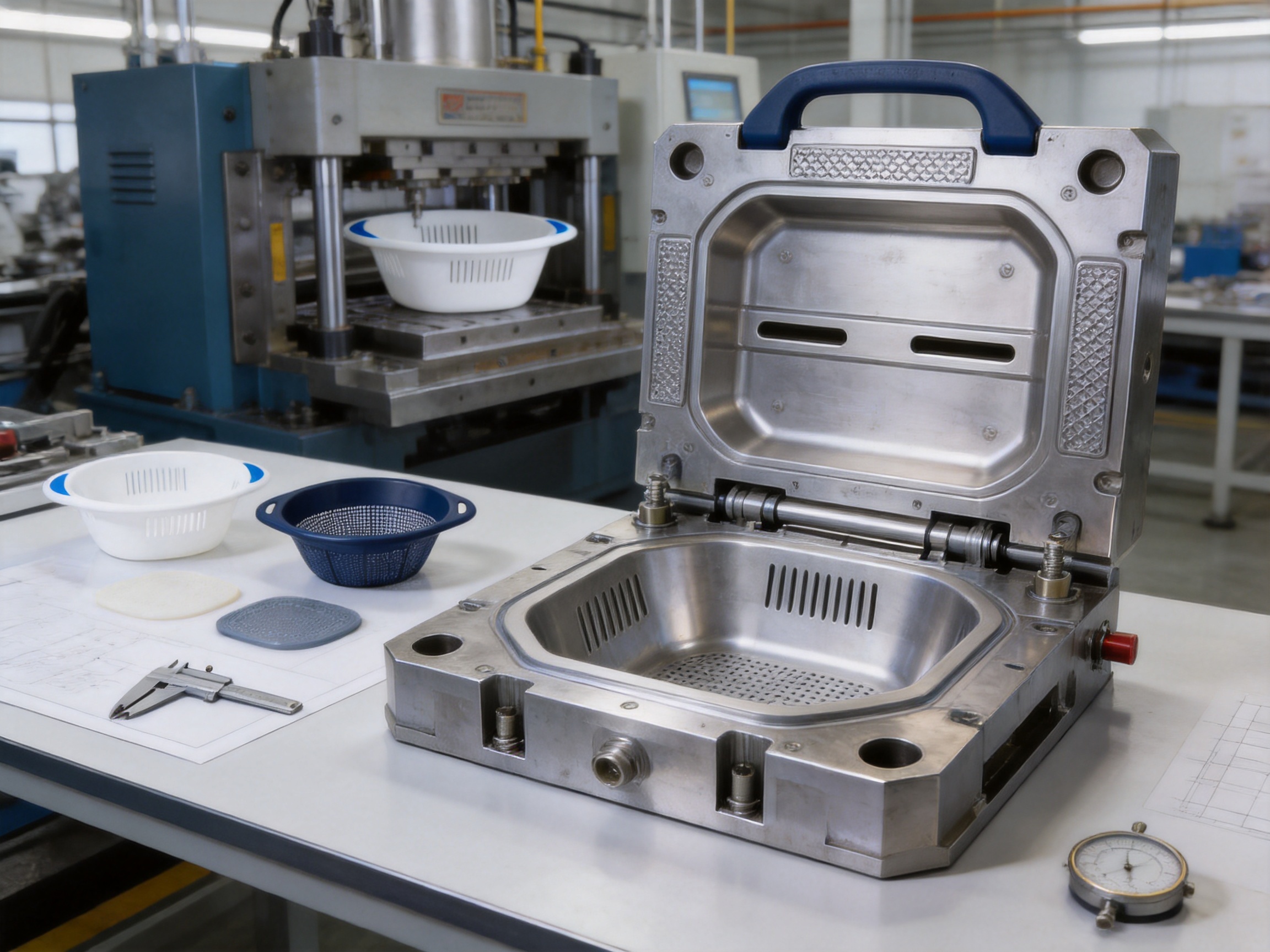
The non-slip double-handled drain basket is a practical kitchen storage and food-preparation product designed for fast drainage, stable handling, convenient cleaning, and repeated daily use. It combines a single-layer basket structure, densely distributed elongated drainage holes, extended side handles, reinforced edges, and non-slip support pads into one functional household item. Although simple in appearance, this type of product requires careful product design and a high-quality plastic injection mould to achieve consistent wall thickness, reliable drainage performance, accurate handle geometry, clean surface finishing, and long-term dimensional stability.
For importers, kitchenware distributors, supermarket suppliers, restaurant equipment companies, and household product brands, the drain basket is more than an ordinary plastic container. Its performance depends on the relationship between the final product and the mould used to manufacture it. A well-designed mould reduces production defects, improves cycle consistency, supports efficient mass production, and allows the product to maintain the same appearance and dimensions from one production batch to another.
This article examines the design features of the non-slip double-handled drain basket, its advantages compared with ordinary draining bowls and low-cost competing baskets, its suitable applications, and the manufacturing strengths behind a customized plastic injection mould. It also explains how material selection, mould steel, cooling design, ejection, surface treatment, quality control, and engineering support influence the final result.

Non-Slip Double-Handled Drain Basket
The non-slip double-handled drain basket is a household draining tool made from durable plastic, generally using polypropylene, or PP, as the primary product material. It is intended for draining water from fruits, vegetables, fresh meat, dishes, baby items, and other washable household goods. The basket uses a single-layer open structure rather than a solid container, allowing water to pass quickly through openings in the bottom while the raised side walls help contain food and reduce splashing.
Two extended handles are positioned on opposite sides of the basket. These handles make it easier to lift, carry, pour, rinse, or transfer the contents. Their textured surfaces are designed to provide a more secure grip when the user’s hands are wet. This feature is particularly important in kitchens, where water, cooking oil, food residue, and cleaning agents can make smooth plastic surfaces slippery.
The product also includes non-slip pads or support areas at the four corners of the bottom. These contact points help prevent unnecessary movement when the basket is placed on a countertop, sink, table, floor, or other working surface. The combination of raised edges and bottom support improves stability during draining and makes the basket more comfortable to use during food preparation.
From a manufacturing perspective, the product requires a mould capable of forming a relatively broad basket body, multiple drainage holes, reinforced folded edges, integrated handles, textured grip areas, and bottom anti-slip features. These details must be manufactured accurately without creating excessive flash, deformation, sink marks, incomplete filling, or difficult demoulding conditions.
The basket uses a single-layer draining structure with many elongated holes distributed across the bottom. This arrangement allows water to escape rapidly after washing food or household items. Compared with products that use only a few large circular openings, elongated holes can offer a greater effective drainage area while preserving an orderly and attractive appearance.
A dense hole pattern also helps reduce the accumulation of water and food residue. When a draining basket retains less water, fruits and vegetables can dry more efficiently, and the risk of standing water around the food is reduced. For restaurants, catering operations, and busy household kitchens, fast drainage can improve preparation efficiency and reduce the time required for rinsing and drying.
The hole dimensions and distribution must be balanced carefully. Openings that are too large may allow smaller food pieces to fall through, while openings that are too narrow may restrict drainage and become more difficult to clean. A professional mould design considers the intended use, the selected plastic material, the required product strength, and the expected manufacturing process when defining the hole geometry.
The double-handle design provides a natural lifting position on both sides of the basket. Users can hold the product with two hands, distribute the load more evenly, and move wet or heavy contents with greater control. This is useful when the basket contains washed vegetables, meat, plates, cooking utensils, or baby products.
The handles are extended from the side walls and include textured surfaces. The texture is not merely decorative. It can improve tactile feedback and reduce the chance of slipping during lifting. A textured handle can be particularly valuable when users are working near a sink or handling the basket with wet hands.
Handle design also affects mould construction. The handle must be thick enough to withstand repeated loading but not so thick that it creates excessive cooling time or visible sink marks. The transition between the handle and basket wall must be reinforced without producing an uncomfortable ridge or an unattractive heavy section. Proper gating, venting, cooling, and ejection are important for obtaining a clean and durable handle.
The basket walls are slightly higher than the lowest drainage area. This helps contain food and other items during washing, lifting, and transportation. The wall height also assists in reducing water splashing when the basket is rinsed or moved.
Higher walls must be designed with appropriate draft angles so the finished basket can be removed from the mould without scratches, distortion, or excessive ejection force. If the walls are too vertical, the product may stick inside the cavity. If the walls taper too aggressively, the usable internal capacity may be reduced. A balanced wall angle provides both practical volume and reliable demoulding.
The upper edges of the basket are thickened or folded to improve rigidity. These reinforced edges help the product maintain its shape when it is lifted, filled, stacked, or exposed to repeated washing. They also improve the user’s experience by creating a more comfortable rim for handling.
Without adequate edge reinforcement, a large plastic basket may flex excessively, especially when it contains wet food or dishes. Excessive flexing can cause a lower-quality impression and may eventually lead to fatigue around the side walls or handles. A well-designed rim supports both appearance and functional durability.
The non-slip pads or support areas at the four bottom corners provide a stable contact arrangement. Rather than allowing the entire bottom surface to slide directly on a wet countertop, these contact points help separate the main basket base from the working surface and reduce unwanted movement.
The support structure must be moulded consistently so that all four points contact the surface as intended. Uneven shrinkage, warpage, or inconsistent wall thickness can cause one corner to lift or make the basket rock. For this reason, mould balance, cooling uniformity, and product geometry are essential to the final stability of the basket.
Many ordinary drain baskets use short, narrow, or completely smooth side grips. These designs may be sufficient for light loads, but they can become uncomfortable or slippery when the basket is wet. The double-handled drain basket uses extended handles with textured grip surfaces, providing a more secure and controlled lifting experience.
The two-sided grip also distributes force more evenly than a single central handle. This can reduce tilting while the basket is being carried and helps keep contents inside the basket. The design is therefore suitable for users who frequently transfer washed food from a sink to a preparation table or storage area.
The elongated drainage holes are arranged densely across the lower section. Compared with a basket that has only a few widely spaced openings, this structure can support quicker water release over a larger portion of the base. The result is a more efficient draining process for vegetables, fruit, dishes, and other washable items.
The opening pattern also gives the basket a visually organized appearance. For private-label product buyers, this can help create a more recognizable product identity without requiring complicated secondary processing. The pattern, rim, handles, and support pads can be customized through mould and product design while retaining the basic functional concept.
Low-cost baskets often have a flat or narrow base that can slide easily when exposed to water. The four-corner non-slip support design helps the basket stay in position. This is especially useful when the user is washing food directly inside the basket or placing it beside a sink for draining.
Improved stability also reduces the chance of accidental tipping. When a basket is filled with wet produce, even a small movement can cause contents to fall onto the floor or into a dirty sink. A stable base provides a more controlled working area and improves the overall perception of product quality.
The smooth plastic surface can be rinsed quickly. The open basket form allows water to reach the interior and exterior surfaces without the narrow enclosed areas found in some complicated kitchen containers. A simple structure also reduces the number of locations where food residue can remain trapped.
The drainage holes should be designed with rounded or sufficiently smooth edges where practical. This supports comfortable cleaning and reduces the chance of residue accumulating around sharp transitions. Mould polishing and surface finishing are important because the quality of the mould cavity directly influences the smoothness of the finished product.
The use of tough PP plastic, reinforced edges, and a balanced basket structure gives the product suitable strength for regular household and commercial use. PP offers a useful combination of low density, chemical resistance, toughness, and processability. It is commonly used in household storage products and kitchen accessories because it can be injection moulded efficiently into functional shapes.
The product can also be specified in other thermoplastics when a customer’s application requires different performance characteristics. Potential options include PC, PS, POM, PE, PU, PVC, ABS, and PMMA, subject to the product design, temperature requirements, chemical exposure, impact expectations, and regulatory needs of the target market.
After washing and drying, the baskets can be stacked directly. Stackable geometry is valuable for households with limited cabinet space and for commercial kitchens that need to store multiple units. It also reduces packaging volume during transport when the product design permits nesting or controlled stacking.
Stacking performance depends on accurate control of the basket wall angle, handle position, rim shape, and bottom support geometry. A mould made with appropriate dimensional tolerances helps ensure that multiple units stack smoothly without excessive friction or unstable contact.
In the home, the drain basket can be used to rinse leafy vegetables, fruits, grains, meat, seafood, cooking utensils, and dishes. The handles make it easy to move the basket from the sink to the countertop, while the raised walls help prevent food from spilling during transfer.
The basket can also serve as a temporary drying container for reusable bottles, children’s dishes, or small kitchen accessories. Its open structure allows air and water to move freely around the contents, supporting faster drying than a closed container.
Commercial kitchens require products that can withstand frequent washing and repeated handling. The double-handled design is useful when staff need to transfer ingredients quickly between washing stations, preparation counters, and cooking areas. The basket’s simple structure can also make visual inspection easier during cleaning procedures.
For commercial buyers, durability, consistent supply, color availability, and easy replacement are important. A professional injection mould manufacturer can support these requirements by offering repeatable production, customizable colors, and a mould construction appropriate for the expected production volume.
The product may be offered as a standalone kitchen accessory or as part of a broader household storage product range. Retailers can position it as a fruit and vegetable washing basket, a multi-purpose draining container, or a kitchen organization item.
Because the model, color, size, and product specifications can be customized, the same basic mould development approach can support different market segments. A buyer may request a larger capacity for commercial use, a smaller version for apartments, or a special color range for a private-label retail program.
The basket may also be used for rinsing baby items, small toys, reusable feeding accessories, or household tools. For these uses, the surface should remain easy to clean, and the product should be manufactured from a material appropriate for the intended application. If the product is marketed for food contact or baby-related use, the buyer must confirm applicable material and compliance requirements for the destination market.
The non-slip double-handled drain basket is suitable for OEM and customized production. Customization can be completed at several levels, including product dimensions, shape, drainage pattern, handle texture, color, logo treatment, packaging, and material selection.
| Customization Area | Possible Options | Key Considerations |
|---|---|---|
| Product size | Small, medium, large, or customer-defined dimensions | Capacity, storage space, mould size, and injection machine requirements |
| Basket shape | Rectangular, rounded rectangular, oval, or other customized profiles | Stacking, drainage, ergonomics, and mould complexity |
| Drainage openings | Elongated holes, round holes, slots, or mixed patterns | Drainage speed, food retention, cleaning, and product strength |
| Handle design | Textured, smooth, wider, longer, or branded handles | Grip comfort, load strength, draft, and ejection |
| Color | Standard or customer-specified colors | Pigment consistency, resin compatibility, and brand identity |
| Material | PP, PC, PS, POM, PE, PU, PVC, ABS, PMMA, or other suitable plastics | Impact strength, rigidity, chemical resistance, cost, and application |
| Branding | Raised logo, recessed logo, textured identification, or packaging branding | Artwork quality, mould insert design, and visual positioning |
| Packaging | Individual packaging, bulk packing, or composite wooden box for mould shipment | Protection, logistics efficiency, and customer requirements |
Customization should begin with a clear product specification. Important information includes the target dimensions, expected capacity, intended plastic material, annual volume, surface finish, color, tolerance requirements, packaging method, and destination-market regulations. Early clarification helps the engineering team select a suitable mould structure and avoid late-stage changes that could increase development cost.
The mould can be manufactured using different steel grades according to production volume, plastic material, surface requirements, and customer expectations. Available choices may include 1CR13, 2CR13, 3CR13, 4CR13, S136, CR16, 2316, 718H, P20, and other suitable mould steels.
For standard production, P20 and related pre-hardened steels may provide a practical balance of machinability, strength, cost, and service life. For applications requiring improved corrosion resistance, polished surfaces, or frequent use with moisture-sensitive production conditions, stainless mould steels such as S136 or selected 4CR13 grades may be considered.
The correct steel selection depends on more than the name of the material. Hardness, heat treatment, polishing quality, corrosion resistance, wear resistance, and the compatibility of the steel with the intended plastic all influence mould performance. A professional manufacturer evaluates the complete production situation rather than selecting steel only on the basis of initial price.
The parting line should be located to balance appearance, mould simplicity, product strength, and demoulding reliability. For a basket with a continuous rim and integrated handles, the parting line requires careful planning around the upper edge, side walls, handle transitions, and bottom support features.
An unsuitable parting line may create visible marks in high-contact areas, complicate ejection, or increase the risk of flash. A well-planned parting line keeps cosmetic marks away from the most visible surfaces where possible and supports stable mould opening and closing.
Draft angles allow the product to release from the cavity and core. The correct angle depends on the material, surface texture, wall height, depth, and polishing condition. Textured handle areas may require additional draft compared with smooth surfaces because the texture can increase resistance during ejection.
Insufficient draft may cause scratches, whitening, deformation, or excessive force on the ejector system. Excessive draft can affect the usable internal dimensions and stacking relationship. Engineering analysis is therefore required to identify the smallest practical draft that still provides reliable production.
Uniform wall thickness is important for controlling shrinkage and reducing warpage. The basket walls, rim, handles, bottom support points, and connecting areas should be designed with balanced sections. Thick areas can cool slowly and may produce sink marks, while thin areas may fill prematurely or lack strength.
Reinforcing ribs can improve stiffness without adding excessive material, but ribs must be placed and sized carefully. If ribs are too thick, they may create visible sink marks on the opposite surface. If they are too tall or poorly drafted, they may make ejection more difficult. A balanced design provides structural support while maintaining a clean appearance.
The gate and runner system must deliver molten plastic evenly into the basket cavity. Because the product has a broad body and many openings, unbalanced filling can create weld lines, flow hesitation, air traps, or different shrinkage levels across the product.
Gate location affects both appearance and function. Gates should be placed where flow can spread efficiently while minimizing visible marks on handles, the upper rim, or interior food-contact surfaces. Depending on the product size, expected production volume, and machine configuration, the mould may use a cold runner or hot runner system.
A suitable runner design reduces pressure loss and helps control filling time. It also supports repeatable production when the basket is manufactured in large quantities. The final selection should consider mould cost, cycle time, material behavior, maintenance requirements, and the customer’s target output.
Air trapped inside the cavity can cause short shots, burn marks, surface defects, and inconsistent filling. The basket’s elongated drainage holes and corner areas may create locations where air needs to escape efficiently. Venting channels must be designed without creating unacceptable flash or weakening the mould.
Accurate venting is especially important around the ends of thin features, the farthest filling points, and the transitions between the basket wall and handles. Regular mould maintenance is also necessary because residue or wear can reduce venting effectiveness over time.
Cooling is one of the most important factors affecting cycle time, product deformation, and dimensional consistency. The mould should include cooling channels positioned to remove heat evenly from the basket walls, rim, handles, and bottom structure.
Uneven cooling can cause the basket to warp, rock on its four support points, or become difficult to stack. Areas around the handles and reinforced rim may require particular attention because their geometry and material thickness differ from the main wall. A well-designed cooling system improves productivity and reduces the need for post-moulding correction.
The ejection system must remove the basket without damaging the product. Ejector pins, stripper structures, or other suitable mechanisms may be used depending on the basket’s geometry and the available non-cosmetic areas.
Ejection force should be distributed evenly. Concentrating force in a small number of locations can deform the bottom or leave visible marks. The product design should include appropriate ejector contact zones, and the mould should be tested to confirm that the basket releases cleanly at the intended cycle conditions.
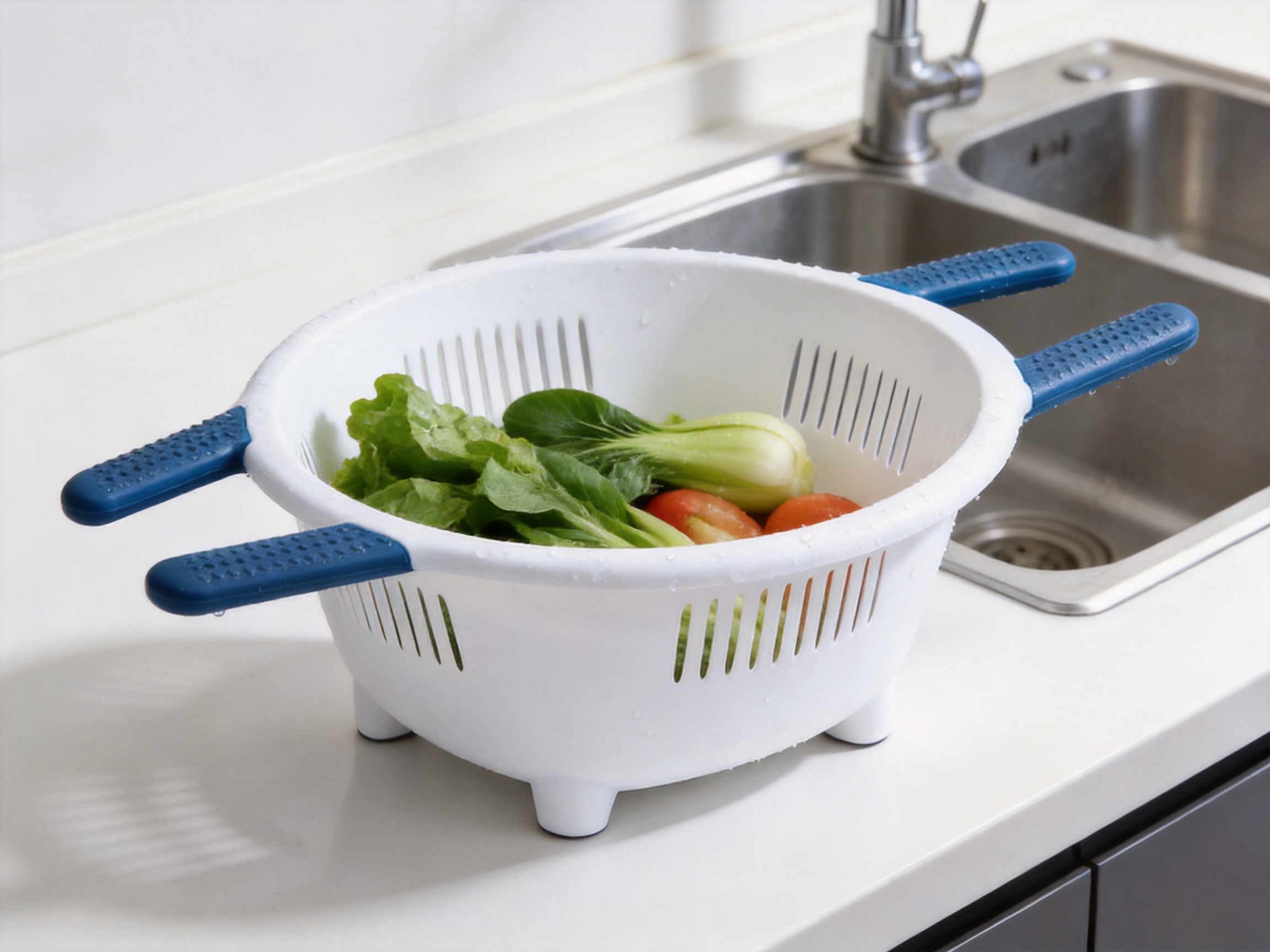
Manufacturing begins with a review of the product concept, drawings, three-dimensional files, material requirements, and expected production volume. The engineering team evaluates the basket’s dimensions, wall thickness, drainage openings, handles, bottom supports, stacking features, and surface requirements.
CAD, CAE, and CAM systems support this process. Computer-aided design is used to create and refine the mould and product geometry. Computer-aided engineering can assist with filling, cooling, shrinkage, and deformation analysis. Computer-aided manufacturing converts approved designs into machining instructions for high-precision equipment.
Early analysis can identify problems before steel is cut. Potential issues may include incomplete filling, excessive injection pressure, unsuitable gate positions, unbalanced cooling, difficult ejection, insufficient draft, or distortion around the handles. Resolving these issues during design is generally more efficient than correcting them after mould assembly.
After design approval, mould components are processed using suitable machining equipment. Milling, drilling, grinding, electrical discharge machining, wire cutting, and other processes may be selected according to the geometry and steel grade.
Drainage holes, handle textures, corner features, and narrow transitions require careful machining. The accuracy of these details affects not only the appearance of the mould but also the consistency of the finished plastic basket. Precision machining reduces variation between cavities and supports reliable assembly.
Some mould components may require heat treatment to improve hardness, wear resistance, or dimensional stability. The appropriate process depends on the selected steel and mould construction. After heat treatment, components may require additional grinding or finishing to achieve the required dimensions.
Cavity surfaces can be polished, textured, or otherwise finished according to the customer’s requirements. A polished surface may support easy cleaning and a smooth product appearance, while a controlled texture can improve grip areas or provide a distinctive visual effect. Surface treatment should be selected with demoulding and product application in mind.
During assembly, core, cavity, inserts, sliders where required, ejector components, cooling channels, and other parts are fitted together. Accurate alignment is essential to avoid mismatch, flash, uneven parting lines, and premature wear.
The assembly team checks moving components for smooth operation and confirms that the mould opens, closes, ejects, and resets correctly. Water circuits are inspected for leakage and flow continuity. Ejection components are checked for synchronization so that the basket is released evenly.
Trial moulding is used to evaluate the performance of the new mould under actual injection conditions. The trial process may examine filling, pressure, temperature, cooling time, ejection, product appearance, and dimensional stability.
Sample baskets are inspected for short shots, flash, sink marks, weld lines, burn marks, warpage, scratches, uneven color, and other defects. The handles are tested for visual quality and basic load performance, while the basket is checked for stability on a flat surface. The drainage holes are inspected for complete formation and clean edges.
If adjustments are required, the mould may be modified through polishing, venting improvement, gate correction, cooling adjustment, dimensional correction, or other controlled engineering work. A structured trial process helps ensure that the mould is ready for repeatable production rather than merely producing one acceptable sample.
Before delivery, the mould can be checked for dimensions, surface condition, opening and closing performance, ejector movement, water leakage, component identification, and packaging security. The mould is normally protected for transportation, and composite wooden box packaging can be used to reduce the risk of damage during handling and shipment.
Documentation may include mould drawings, spare-part information, trial records, maintenance guidance, and production recommendations, depending on the customer’s requirements. Clear documentation supports installation and maintenance at the customer’s injection moulding facility.
The supplier is TaiZhou HuangYan YingXiang Plastic Mould Co., Ltd., located in Huangyan, Taizhou, Zhejiang, China, a region widely associated with mould manufacturing and plastic processing. Established in 2012, the company operates a plant of approximately 7,000 square metres and has around 50 employees.
The company focuses on customized plastic mould solutions for household and industrial products. Its product range includes crate and folding box moulds, logistics container moulds, tray and pallet moulds, beverage box moulds, and moulds for daily household items. This experience is relevant to the non-slip drain basket because both storage products and kitchen products require accurate large-surface moulding, practical part design, reliable ejection, and stable mass production.
The company uses CAD, CAE, and CAM systems to support engineering and manufacturing. These systems help connect product design, mould analysis, machining, and production preparation. The integration of digital design and manufacturing can improve communication between the customer and the mould team while reducing avoidable design errors.
Advanced equipment and experienced technicians support the production of mould components, assembly, trial moulding, and quality inspection. The company’s stated focus includes lean manufacturing, long-life moulds, on-time delivery, competitive cost, premium quality, and comprehensive customer service.
For customers purchasing a customized basket mould, the ability to work with one supplier from product review through mould completion can simplify project management. It can also reduce communication gaps between the product design and mould manufacturing stages. This is particularly helpful when the product includes integrated features such as textured handles, anti-slip supports, drainage openings, and reinforced edges.
The reported supply capacity is approximately 50 mould sets per month. Actual capacity for any specific project depends on mould size, complexity, steel selection, number of cavities, finishing requirements, testing schedule, and the current production plan. Customers should confirm detailed lead times and technical conditions before placing an order.
Key dimensions include overall basket length, width, height, wall thickness, handle position, drainage hole size, rim profile, and support-pad height. Measuring these areas helps confirm that the mould is manufactured according to the approved drawings.
Dimensional control is important for stacking and stability. Small differences in the bottom support points or side-wall geometry can cause the basket to rock, sit unevenly, or become difficult to nest. Consistent control also improves interchangeability when a customer orders replacement mould components or additional moulds.
The product should be inspected for flash, weld lines, sink marks, scratches, drag marks, flow marks, burn marks, and uneven texture. Cosmetic requirements depend on the customer’s target market, but visible defects around the handles, upper rim, and outer walls are generally more noticeable to end users.
Mould polishing and proper processing conditions work together to produce the desired surface. A high-quality mould cannot compensate for unsuitable injection settings, and excellent processing cannot fully correct poor cavity finishing. Both mould construction and production control are necessary.
The drainage function can be checked by placing the basket under a controlled flow of water and observing whether water passes through the openings without significant blockage. The product should also be checked after drying to confirm that residue does not collect excessively around the holes or corners.
Handle performance can be evaluated through repeated lifting and controlled load testing appropriate to the intended application. The bottom support points should be checked on a flat surface to confirm stability. Stackability can be assessed by placing multiple units together and observing whether they nest or stack consistently.
When PP or another specified plastic is used, the production team should maintain consistent material grades and processing conditions. Recycled content, additives, pigments, and regrind policies should be agreed with the buyer in advance, especially when appearance, food contact, or regulatory compliance is important.
Color consistency is also relevant for private-label products. The same color reference, pigment supplier, resin grade, and processing method should be used as consistently as possible to reduce variation between batches.
The initial price of a mould is only one part of the total cost of ownership. A lower-priced mould may require more maintenance, produce more rejected baskets, run with longer cycle times, or have a shorter service life. These factors can increase the cost per acceptable product over time.
A well-designed mould can reduce material waste by supporting balanced wall thickness and stable filling. It can reduce labor requirements by minimizing manual trimming and correction. It can also improve machine utilization when the mould opens, ejects, and cools reliably during long production runs.
For a basket with many drainage holes and integrated handles, mould quality is especially important. A small defect in a hole-forming insert may be repeated across every unit. An alignment problem in the handle area can create flash or a visible mismatch in the entire production batch. Investing in appropriate design and inspection helps protect the buyer’s product quality and brand reputation.
The basket’s durable PP construction can support repeated use rather than short-term disposal. A reusable draining product may reduce the need for single-use alternatives in household and commercial preparation environments. The product’s simple form also avoids unnecessary components and reduces assembly requirements.
Efficient mould design can contribute to material savings by controlling wall thickness and reducing excessive runners where suitable. Shorter cycle times can lower energy use per unit, although actual environmental performance depends on the injection machine, process settings, production volume, material source, and recycling practices.
At the end of the product’s service life, the plastic should be handled according to local waste-management systems and the material identification used by the manufacturer. Buyers seeking specific recycled content, recyclability, or environmental certifications should define these requirements before mould design and material approval.
Buyers should provide a complete project brief before requesting a quotation. The brief should state the target product dimensions, expected annual quantity, intended market, plastic material, color, logo requirements, surface finish, packaging method, and acceptable tolerance range.
It is also useful to clarify whether the supplier is responsible only for the mould or for both mould manufacturing and injection production. If the mould will be shipped to another factory, the customer should request information about injection machine requirements, mould weight, cooling connections, ejection settings, recommended processing conditions, and spare parts.
Sample approval should be based on agreed criteria rather than appearance alone. The buyer may need to approve dimensions, drainage performance, stability, handle strength, stacking behavior, surface quality, color, and packaging. A written approval standard reduces misunderstandings during mass production.
Customers should also confirm ownership and protection of mould drawings, product files, inserts, and other tooling information. Clear commercial and technical agreements help protect both sides and support future modification or replacement requirements.
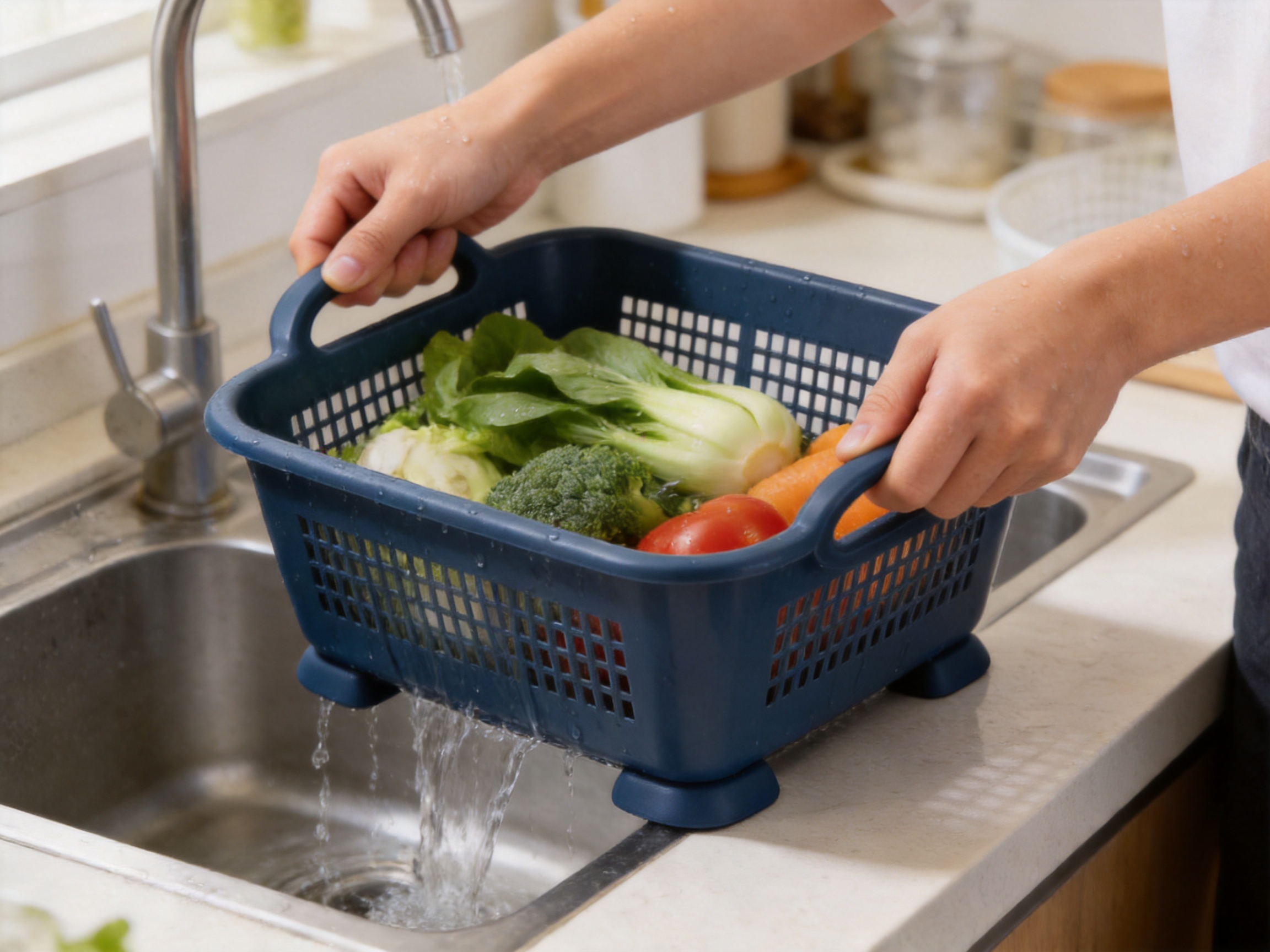
The basket is mainly used to wash and drain fruits, vegetables, fresh meat, dishes, baby items, and other household goods. It can be used in home kitchens, restaurant kitchens, catering operations, and general food-preparation areas.
PP is a practical primary choice because it offers toughness, low density, chemical resistance, and efficient injection moulding performance. Other plastics, including PC, PS, POM, PE, PU, PVC, ABS, and PMMA, may be considered when the application requires different mechanical, visual, or chemical characteristics.
Yes. The model, size, color, product structure, handle design, drainage pattern, and branding details can be customized subject to engineering review. Any dimensional change may affect mould size, machine requirements, cooling, ejection, and project cost.
The textured handle surfaces are intended to improve grip when the user’s hands are wet. They also provide a more distinctive tactile appearance than completely smooth handles. Texture depth and pattern must be designed with appropriate draft to support reliable demoulding.
The four supports help stabilize the basket on countertops, tables, floors, and other surfaces. They reduce unwanted sliding and help the basket remain level while water drains from the contents.
Yes. The product is designed to be placed and stacked after drying. Actual stacking performance depends on the final dimensions, wall angle, handle configuration, rim design, and product tolerances.
Possible mould steel options include 1CR13, 2CR13, 3CR13, 4CR13, S136, CR16, 2316, 718H, P20, and other suitable grades. The best choice depends on production volume, surface requirements, plastic type, corrosion exposure, wear expectations, and budget.
Warpage is addressed through balanced product geometry, appropriate wall thickness, suitable gate locations, uniform cooling, correct processing conditions, and controlled ejection. CAE analysis and trial moulding can help identify potential deformation before mass production.
The design is suitable for food-preparation applications, but food-contact compliance depends on the selected resin, additives, pigments, manufacturing process, and destination-market regulations. Buyers should specify food-contact requirements and request the appropriate material documentation before production.
Yes. OEM service is available. The supplier can support customized product and mould projects involving household products, logistics crates, folding boxes, pallets, trays, beverage boxes, and other injection-moulded plastic items.
Useful information includes three-dimensional product files or drawings, product dimensions, material, expected annual output, number of cavities, color, surface finish, logo requirements, injection machine details, mould life expectations, delivery location, and packaging requirements.
Composite wooden box packaging can be used to protect the mould during transportation. The packaging method should be confirmed according to mould size, shipping route, handling conditions, and customer requirements.
The non-slip double-handled drain basket combines practical drainage, secure handling, countertop stability, easy cleaning, reinforced construction, and convenient storage. Its densely distributed elongated holes help release water efficiently, while the extended textured handles improve control during lifting and transfer. Raised walls help contain contents, reinforced edges improve rigidity, and four bottom support points reduce sliding during use.
Compared with ordinary baskets that may have smooth handles, unstable bases, limited drainage openings, or weak rims, this design offers a more complete user experience. It is suitable for households, restaurant kitchens, catering operations, food preparation, and a wide range of general cleaning tasks.
The quality of the final product depends strongly on the injection mould. Steel selection, parting-line planning, draft, wall-thickness balance, gate design, venting, cooling, ejection, machining, surface finishing, and trial moulding must all be managed carefully. A supplier with experience in household moulds, logistics crates, folding boxes, pallets, trays, beverage containers, and other large plastic products can provide useful engineering knowledge for this type of customized project.
With its Huangyan manufacturing base, approximately 7,000-square-metre facility, experienced technical team, CAD/CAE/CAM capabilities, and focus on customized plastic mould solutions, the supplier is positioned to support OEM customers seeking reliable household product moulds. The company’s approach emphasizes long-life tooling, practical engineering, stable quality, delivery coordination, and ongoing customer service.
For buyers planning a new draining basket product, the best results come from treating product design and mould design as one integrated project. Clear specifications, early engineering analysis, appropriate materials, controlled mould manufacturing, and systematic sample approval can help create a basket that is attractive, stable, durable, easy to use, and suitable for efficient mass production.
1. General principles of plastic injection mould design, including draft angles, wall-thickness control, gating, venting, cooling, and ejection.
2. Technical guidance for polypropylene injection moulding and household plastic product development.
3. Standard engineering practices for mould steel selection, heat treatment, polishing, and corrosion-resistant tooling.
4. General quality-control procedures for dimensional inspection, cosmetic inspection, functional testing, and trial mould evaluation.
5. Product and company information supplied for the non-slip double-handled drain basket and customized plastic injection mould manufacturing services.
If you are interested in any of our products or services, please feel free to ask and we can talk about your ideas.
 QUICK LINKSMOBILE SITE
 FACTORY ADDRESS
 CONTACT INFORMATION



 English
 Español