Tomatoes and potatoes require careful handling from harvesting and sorting to storage, distribution, and retail display. Although both products are widely consumed, they present different logistics challenges. Tomatoes are soft, sensitive to impact, and vulnerable to deformation when stacked incorrectly. Potatoes are more resistant to pressure, but they are heavy in bulk and require strong ventilation, stable stacking, and dependable protection against abrasion. A well-designed turnover crate must therefore combine strength, airflow, hygiene, handling convenience, and production efficiency.
The tomato and potato turnover crate is developed for reusable agricultural logistics. It is intended to support repeated circulation between farms, collection stations, wholesalers, food processors, supermarkets, and other distribution points. Compared with disposable cartons, thin bags, or poorly designed reusable containers, a purpose-built plastic crate can offer improved durability, easier cleaning, better load stability, and more consistent protection for fresh produce.
The quality of a turnover crate depends on more than its external appearance. Its performance is closely related to the mould structure, material distribution, cooling design, parting-line planning, ejection system, ventilation layout, and dimensional control. A high-quality injection mould allows the finished crate to achieve reliable wall thickness, clean openings, accurate stacking features, smooth handling surfaces, and a long service life.
TaiZhou HuangYan YingXiang Plastic Mould Co., Ltd. specializes in plastic injection mould manufacturing for logistics crates, folding boxes, pallets, trays, beverage boxes, and household products. Based in Huangyan, Taizhou, Zhejiang, China, the company provides customized mould solutions supported by CAD, CAE, and CAM systems, modern processing equipment, and experienced technicians. Its product range and engineering capabilities make it suitable for customers seeking a dedicated mould for tomato and potato turnover crates.

Tomato & Potato Turnover Crate
A turnover crate is a reusable container designed to circulate through a supply chain. Unlike a one-way package, it is collected, returned, washed, inspected, and used again. This circulation model is particularly useful for agricultural products because fresh produce moves through multiple handling stages before reaching the final consumer.
At the farm, the crate can receive produce during harvesting or initial sorting. At a collection point, workers can examine quality, remove damaged items, and consolidate shipments. During transport, the crates can be stacked on pallets or placed directly in delivery vehicles. At wholesale markets and retail facilities, the open structure allows quick inspection and convenient product presentation. After use, the empty crates can be nested, stacked, or returned for the next logistics cycle, depending on their design.
For tomatoes, the crate should reduce excessive compression and impact. The internal dimensions should provide enough usable space without encouraging unstable overfilling. Smooth internal surfaces can help limit cuts and bruises, while rounded corners can reduce concentrated pressure on individual fruits. Adequate ventilation is also important because airflow can help control heat and moisture during short-term transportation.
For potatoes, load-bearing capacity and ventilation are especially important. A filled crate can become heavy, so the base, side walls, corner posts, and stacking points must work together. Ventilation openings can promote air circulation and assist with temperature management. At the same time, the openings must be designed so that the crate retains sufficient structural strength and does not create sharp edges that could damage the produce.
A dual-purpose tomato and potato turnover crate must balance these requirements rather than optimize only one characteristic. Excessively large openings may weaken the side wall or permit product loss. Very small openings may limit airflow and increase weight. A rigid structure may stack well but become unnecessarily heavy. A lightweight structure may lower material use but fail under repeated loading. Good mould engineering helps manufacturers find the correct balance for the intended application.
The most important advantage of a reusable logistics crate is its ability to withstand repeated handling. Agricultural containers are often exposed to loading impacts, vibration, moisture, dust, washing, temperature changes, and rough contact with warehouse floors. The crate must retain its shape and function through many cycles instead of becoming unusable after a single journey.
Injection-moulded plastic provides a consistent structure when the mould is properly designed and processed. Compared with makeshift containers or low-quality thin-wall packaging, a well-engineered crate can provide more predictable load performance. The corner areas, base ribs, handles, and stacking features can be integrated into one continuous moulded product, reducing the need for separate components or assembly operations.
For a tomato and potato crate, durability should not mean unnecessary bulk. A strong design distributes stress through ribs, reinforced corners, and properly supported walls. This approach can help achieve a practical relationship between material consumption and service life. The final result is a crate that is durable enough for repeated circulation while remaining manageable for workers.
Fresh produce continues to exchange heat and moisture after harvesting. If air is trapped around the products, condensation and localized heat may develop. A ventilated crate helps air move through the load, especially when the crates are arranged with aligned openings during storage or transport.
The opening pattern must be considered together with the crate’s structural design. Ventilation holes should be positioned to preserve adequate wall strength and avoid creating weak areas around handles or stacking points. Their edges should be smooth and properly radiused. The size and arrangement of openings can also influence mould filling, cooling behavior, demoulding, cleaning, and the appearance of the finished crate.
For tomatoes, airflow can help reduce the accumulation of heat during short-distance transport. For potatoes, ventilation can support more stable storage conditions and reduce the risk of damp areas when the crate is handled in humid environments. The exact performance depends on the produce condition, transportation time, temperature, loading density, and warehouse system, so the crate should be developed according to the customer’s actual application.
Crates in agricultural logistics are often stacked to save floor space and maximize vehicle capacity. A reliable stacking interface helps prevent sliding, leaning, and accidental collapse. It also protects the lower layers from uneven pressure.
Stacking feet, locating rims, reinforced top edges, and correctly matched base profiles are common design features for this purpose. The upper crate should settle into a predictable position on the lower crate. The contact areas must be strong enough to carry the intended load, while the overall profile should not unnecessarily reduce usable internal volume.
Accurate mould dimensions are essential for stable stacking. Even small deviations in critical areas can cause uneven contact, rocking, or difficulty during automated handling. The mould must therefore maintain dimensional consistency from cavity to cavity and from one production cycle to another. Proper steel selection, machining accuracy, mould assembly, and trial verification all contribute to this result.
Workers may carry a full crate manually, slide it across a platform, or move it with a pallet truck or conveyor. Handles should provide a secure grip without sharp edges or excessive pressure points. The handle size and position should be considered in relation to the crate’s loaded weight, worker posture, and the ability to see the hand opening during fast handling.
Rounded external edges can make the crate more comfortable to hold and reduce the chance of catching on clothing or adjacent containers. Internal corners should also avoid unnecessary recesses where dirt or moisture could collect. These details may appear small, but they have a direct effect on the daily usability of the crate.
Reusable produce containers must be easy to clean. Soil, plant residue, moisture, and organic material may remain on the crate after use. A hygienic design should minimize deep pockets, narrow dead zones, and inaccessible cavities. Smooth surfaces and effective drainage can support washing and drying operations.
The mould design has a direct influence on these characteristics. A clean parting-line layout, suitable draft angles, controlled transitions, and properly formed ribs can reduce areas where residue accumulates. Ejector marks should be placed carefully so they do not create unnecessary recesses on critical food-contact surfaces.
The selected plastic resin and cleaning process must also be appropriate for the intended use. Resin selection is the responsibility of the product manufacturer and should be based on food-contact requirements, impact performance, temperature exposure, chemical resistance, and applicable regulations in the target market.
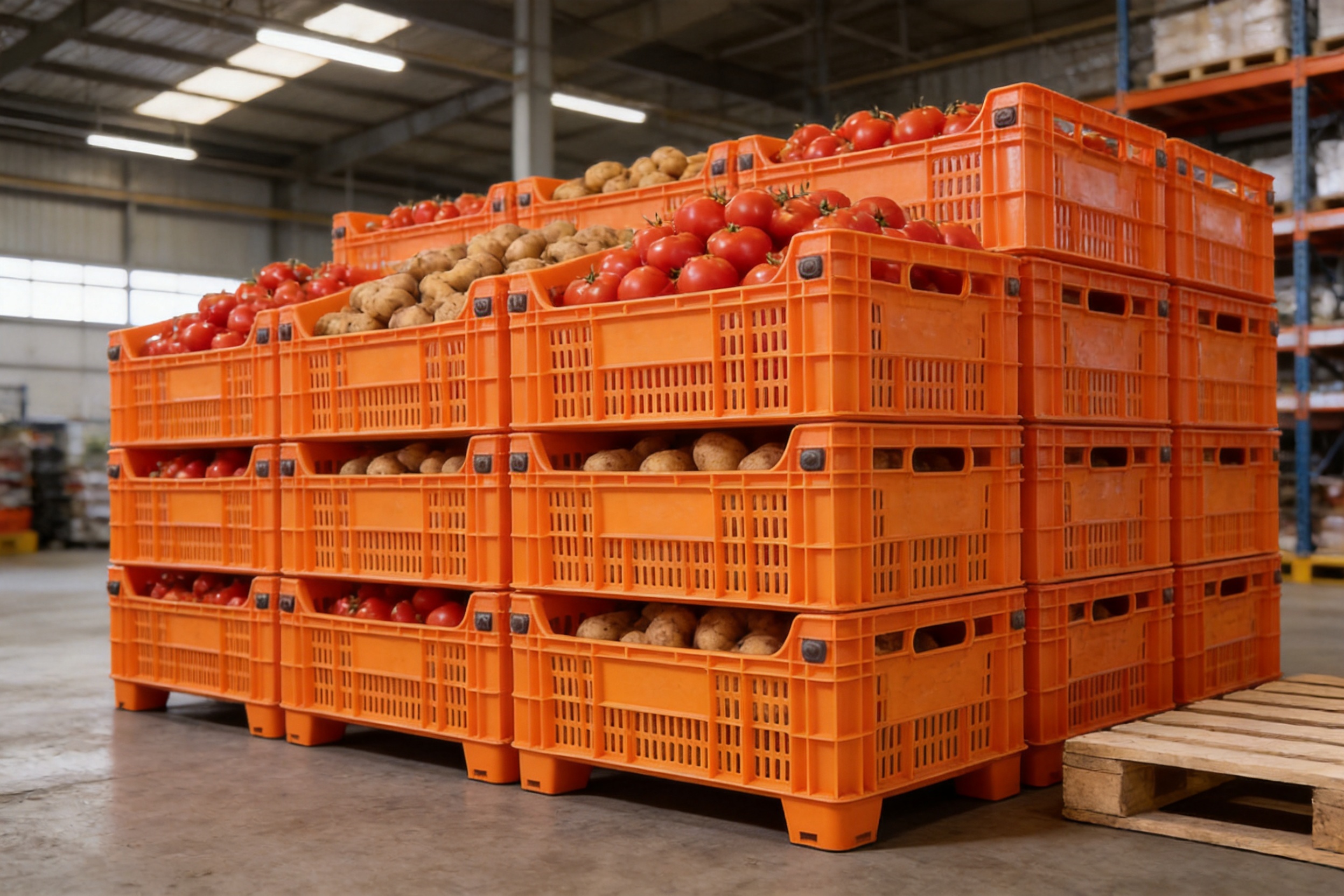
Corrugated cartons are useful for many distribution applications, but they can lose strength when exposed to water, condensation, or repeated handling. Fresh produce may also release moisture, especially when moved from a cool environment to a warmer one. A plastic turnover crate is more suitable for repeated washing and circulation, and it is less dependent on keeping the packaging dry.
A reusable crate can also provide more dependable stacking performance over multiple journeys. Cartons may deform after compression or become weakened at corners. By contrast, a moulded crate can incorporate reinforced edges and stable locating features. It can be returned, cleaned, and reused instead of being discarded after one shipment.
Cartons still have advantages in low-cost one-way shipping, printing, and temporary retail packaging. However, for supply chains that regularly move fresh tomatoes and potatoes between fixed partners, a reusable plastic crate may offer better long-term value and operational consistency.
Woven sacks are flexible and relatively easy to store when empty, but they provide limited protection against crushing and impact. Produce at the bottom of a large sack may carry a significant portion of the load. Sacks can also be less convenient for organized stacking and visual inspection.
A rigid turnover crate distributes weight through its base and side structure. It gives the produce a defined space and provides more stable geometry during transport. The open design allows workers to inspect the contents without emptying the entire package. Handles and stacking features can also make the crate easier to move through a standardized logistics system.
Not every plastic box provides the same performance. An inexpensive bin may have uneven walls, weak handles, poor stacking geometry, sharp openings, or inadequate ventilation. Such weaknesses can increase product damage and reduce the number of usable cycles.
The principal advantage of a professionally developed mould is consistency. The mould determines the basic geometry of every crate. When its steel structure, cooling system, ejection layout, and machining accuracy are properly controlled, the resulting parts are more likely to meet the intended design from the first production run through later replacement cycles.
Single-use packaging may appear economical when only the initial purchase price is considered. A turnover crate should be evaluated over its complete operating life. The total assessment can include the number of uses, washing requirements, return logistics, repair or replacement rates, labor savings, and product protection.
When a crate circulates efficiently, the cost per use may decrease over time. Standardized reusable containers can also make handling more predictable and simplify storage, palletization, and inventory planning. The environmental benefits depend on the number of reuse cycles, transport distances, cleaning energy, material selection, and end-of-life recycling, but a long-lived crate can support a more resource-efficient distribution model than repeated disposal.
The mould is the foundation of the finished crate. Its design must take into account the product geometry, resin behavior, injection machine capacity, expected production volume, ejection direction, cooling requirements, and maintenance plan. A crate mould is not simply a hollow negative shape. It is a coordinated system of steel components that must fill, cool, release, and repeat reliably.
Before mould construction, engineers review the crate’s external dimensions, internal volume, wall thickness, rib layout, handle openings, ventilation holes, stacking points, and surface requirements. They also analyze how the crate will be used and which areas are likely to receive the highest loads.
For a tomato and potato application, the team may pay particular attention to the base, lower corners, upper rim, handles, and contact areas between stacked crates. If the customer needs different versions for different produce volumes, the design can be evaluated for family moulding, interchangeable inserts, or separate tooling, depending on the expected production plan.
Draft analysis is another important stage. Vertical surfaces need sufficient draft to release from the mould without scuffing or deformation. Openings, ribs, and handle walls must be reviewed individually because a suitable draft angle for one area may not be adequate for another. Early analysis reduces the risk of costly design changes after steel machining has begun.
Large crates often have broad walls and complex openings. The molten plastic must travel through the mould and fill these areas evenly. If flow is poorly balanced, the part may show short shots, weld lines in weak locations, excessive packing, sink marks, or visible flow marks.
Computer-aided engineering can help predict filling behavior, pressure requirements, cooling conditions, and likely deformation. The analysis is not a substitute for practical mould experience, but it provides valuable information before manufacturing. Gate locations, runner dimensions, injection sequence, and vent positions can be considered with greater confidence.
For a reusable crate, weld-line placement deserves particular attention. A weld line near a handle, stacking foot, or heavily loaded corner may reduce local strength. The mould engineer can seek a gate arrangement and flow path that place weld lines in less critical areas or improve their quality through temperature and pressure control.
Cooling has a major effect on cycle time, dimensional stability, and production cost. A crate mould contains wide surfaces, ribs, corners, and openings that may cool at different rates. If the cooling system is unbalanced, the finished part may warp, shrink unevenly, or become difficult to stack.
Cooling channels should be planned to remove heat efficiently from both thick and thin sections. Areas around the base, handles, and reinforced corners may require special attention because they can retain heat longer than open wall sections. The design should also allow practical drilling, sealing, inspection, and maintenance.
Uniform cooling helps the manufacturer achieve more consistent dimensions from cycle to cycle. It can also reduce the time required before ejection, which supports higher productivity. The ideal system depends on the crate size, resin, wall thickness, machine conditions, and expected cycle time.
A large crate must be ejected without distortion. The ejector system should distribute force across suitable structural areas rather than concentrating pressure on thin walls or visible surfaces. Ejector pins, sleeves, blades, lifters, or other mechanisms may be selected according to the product geometry.
Demoulding is particularly important around handle openings, deep ribs, nested sections, and stacking profiles. If a section tends to grip the core, the mould may require improved draft, polished surfaces, lifters, or other release solutions. A carefully planned ejection system helps protect both the mould and the finished crate.
Air trapped in the cavity can cause burn marks, incomplete filling, silver streaks, or poor surface appearance. Venting must therefore be considered around the perimeter, at the ends of flow paths, and near features where air may become trapped.
The external appearance of a logistics crate may not require a high-gloss finish, but the surfaces should still be clean, uniform, and free from defects that interfere with handling or washing. Texture can be used where additional grip or a practical visual finish is needed. The choice of texture should not create unnecessary dirt-trapping areas.
TaiZhou HuangYan YingXiang Plastic Mould Co., Ltd. was established in 2012 and operates a mould manufacturing facility of approximately 7,000 square meters with around 50 employees. The company uses CAD, CAE, and CAM systems together with high-tech equipment and experienced technicians. These resources support the development of moulds for logistics crates and other large plastic products.
The manufacturing process begins with communication and technical evaluation. Customer drawings, product samples, usage requirements, resin information, injection machine details, and expected production volume are reviewed. This stage helps define the mould concept and identifies risks before formal design approval.
CAD systems are used to develop the mould assembly and individual components. Engineers can examine the cavity, core, sliders, lifters, ejector system, cooling circuits, guide elements, and mould base as an integrated structure. The three-dimensional model helps detect interference and confirms whether the product can be released in the intended direction.
Structural planning also includes the selection of steel sections, support plates, guide systems, and replaceable wear components. For a crate mould intended for long production runs, the design should allow practical maintenance. Components that may experience wear or damage should be accessible and replaceable without requiring unnecessary disassembly of the entire tool.
CAE tools can be used to study filling, packing, cooling, warpage, and stress distribution. For large injection-moulded crates, these simulations can support decisions about gate locations, flow balance, cooling-channel positions, and likely deformation.
Simulation results should be interpreted by experienced engineers. Material data, machine parameters, mold temperature, injection speed, and actual production conditions all affect the result. The value of CAE lies in reducing uncertainty and allowing the team to compare design options before committing to machining.
After design approval, CAM systems convert machining information into practical manufacturing operations. CNC milling, high-speed machining, drilling, electrical discharge machining, grinding, and other processes may be used according to the component requirements.
Large mould components require stable machining conditions and careful reference management. The accuracy of cavity and core alignment affects wall thickness, fit, parting-line quality, and the performance of the stacking structure. Small errors in a critical feature can become visible across thousands of finished crates, so inspection is required during and after machining.
Mould assembly brings together the machined plates, inserts, guide components, cooling connections, ejector parts, and other systems. Skilled technicians check the fit of moving components and verify that the mould opens, closes, and ejects smoothly.
Fitting is especially important for complex crate moulds with numerous openings and reinforced structures. Parting lines should close properly, slides should move without interference, and the ejector system should return reliably. Careful assembly helps prevent flash, leakage, uneven wear, and damage during production.
A mould trial provides practical evidence of how the tool performs. The trial team checks filling, ejection, cooling, surface appearance, dimensions, warpage, parting lines, handle strength, and stacking fit. Samples may be measured and compared with the approved product design.
If adjustments are required, the technical team identifies their causes before making corrections. Changes may involve polishing, venting, gate modification, cooling improvement, dimensional correction, or process parameter optimization. A controlled trial and correction procedure increases the likelihood that the mould will enter production smoothly.
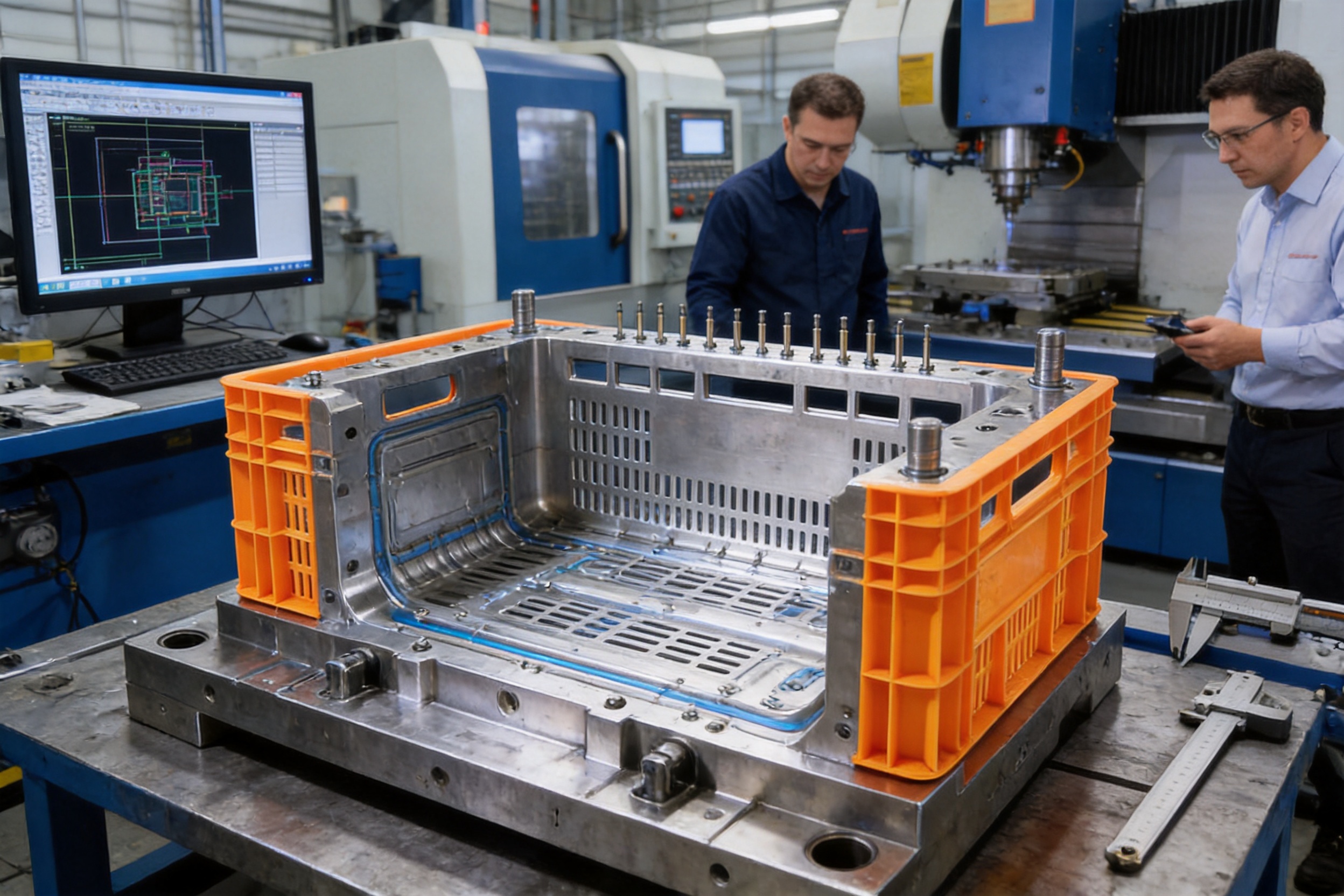
The plastic selected for a tomato and potato turnover crate should match the required impact strength, rigidity, temperature range, cleaning conditions, appearance, and regulatory requirements. Common logistics-crate materials may include polypropylene or other suitable thermoplastics, but the final choice must be confirmed by the product manufacturer and its material supplier.
Material behavior affects mould design. Shrinkage values influence cavity dimensions, rib geometry, stacking accuracy, and expected warpage. Flow characteristics affect gate selection and filling pressure. The resin’s sensitivity to temperature and shear influences processing conditions. A mould maker should receive accurate material information early in the design process.
Color can be used for product identification, logistics separation, brand recognition, or produce-category management. Pigment addition may affect processing and appearance, so the customer should define color requirements before finalizing the product and mould specifications. Surface texture, gloss level, and marking areas should also be agreed in advance.
Recycled content may be considered for suitable non-food-contact applications or where regulations permit. However, recycled resin can vary in contamination level, flow behavior, color, and mechanical performance. The product manufacturer should validate the chosen material and ensure that it meets the intended safety and performance requirements.
| Design factor | Importance for the crate | Mould engineering response |
| Wall thickness | Influences strength, weight, filling, cooling, and shrinkage | Balance material distribution and avoid abrupt thickness changes |
| Ventilation openings | Support airflow and visual inspection | Position openings while preserving wall strength and clean release |
| Stacking interface | Controls stability during storage and transport | Maintain accurate dimensions and reinforced contact areas |
| Handles | Influence worker comfort and lifting safety | Provide smooth edges, suitable draft, and adequate local strength |
| Base structure | Carries product load and supports stacking | Use ribs and cooling layout to reduce deformation |
| Cleaning access | Supports hygiene and repeated circulation | Avoid deep dead zones and design smooth, drainable surfaces |
| Resin shrinkage | Affects final dimensions and assembly compatibility | Apply accurate material data during tool design and trial correction |
Quality control should begin before steel is ordered. A clear technical specification reduces misunderstandings about product dimensions, tolerances, resin, surface treatment, cycle expectations, and inspection standards. Engineering drawings, three-dimensional files, and mould-flow results can be reviewed with the customer before production.
During machining, critical dimensions should be checked against the approved design. Inspection may include coordinate measurement, gauge verification, surface checks, and visual confirmation of cooling and ejection components. The objective is not only to confirm individual dimensions but also to ensure that the complete mould works as a coordinated system.
During trial production, sample crates should be evaluated for actual use. Empty-crate dimensions are important, but loaded behavior is equally relevant. The customer may need to test stacking, lifting, conveyor movement, washing, nesting, pallet fit, and transportation vibration. For tomatoes and potatoes, produce protection should be assessed under realistic loading conditions.
Parting-line flash should be minimized because it can affect worker comfort, cleaning, product contact, and stacking. Ejector marks should be controlled. Openings should be free of sharp edges. The base should sit evenly on a flat surface. Handles should be comfortable and sufficiently robust for the intended load.
A complete quality approach also includes documentation. Mould drawings, component lists, trial records, sample measurements, correction notes, and maintenance recommendations can help the customer manage future production. Clear documentation is especially valuable when the mould is used for many years or transferred between production sites.
YingXiang Plastic Mould is located in Huangyan, Taizhou, a region widely associated with mould manufacturing. Its approximately 7,000-square-meter plant, team of around 50 employees, advanced design and manufacturing systems, and experienced technicians provide a foundation for handling customized plastic mould projects.
The company’s specialization includes crate moulds, folding box moulds, tray and pallet moulds, beverage box moulds, and moulds for daily household products. This range is relevant to the development of a tomato and potato turnover crate because many of the required engineering principles are shared across large reusable containers: structural reinforcement, ventilation, stacking, high-cycle durability, dimensional accuracy, and efficient production.
Experience across related products can help engineers identify common risks. For example, a beverage box may require strong handles and accurate stacking, while a pallet mould may require careful control of large flat areas and load-bearing ribs. A folding box may involve moving mechanisms and precise nesting. Knowledge from these product categories can be applied when designing a new agricultural crate.
The company emphasizes lean manufacturing, long-life mould construction, on-time delivery, competitive costs, and comprehensive customer service. These priorities are important for customers who are not simply buying a metal tool but developing a complete container program. The mould must support stable mass production, and the supplier must remain available for technical communication, modifications, maintenance, and future improvements.
A tomato and potato turnover crate can be customized for different supply-chain conditions. The customer may specify external dimensions based on pallet size, truck utilization, shelf dimensions, or existing warehouse equipment. Internal volume can be selected according to the typical weight and quantity of produce per crate.
Ventilation can be adjusted according to produce type, climate, transport duration, and washing requirements. A design intended for short-distance tomato distribution may use a different opening pattern from a crate intended for longer potato storage. If the same crate must serve both products, the design should be tested for the more demanding conditions.
Color, logo placement, embossed markings, and identification areas can support asset management. A logistics operator may use different colors for different farms, regions, product grades, or ownership systems. Permanent moulded markings can be useful where labels may peel or become unreadable during washing.
Customers may also request nesting capability when the crates are empty. Nested crates reduce return-transport volume and storage space. The nesting design must be balanced with the need for product capacity, stacking stability, wall strength, and easy separation by workers.
For automated facilities, the crate can be reviewed for conveyor compatibility, robotic gripping, barcode placement, RFID integration, and palletizing requirements. These details should be incorporated into the product design before mould construction because later changes to critical interfaces may require substantial tooling modification.
The initial mould investment is only one part of the total project cost. A professional evaluation should include the expected production quantity, number of reusable cycles, resin consumption, cycle time, maintenance cost, repair requirements, product loss, labor efficiency, and return logistics.
A mould with a lower initial price may not provide the best value if it requires frequent repair, produces inconsistent crates, or limits the production rate. Conversely, a well-engineered mould may provide a higher return through stable operation and longer service life. The correct balance depends on the customer’s annual volume and business model.
Material savings should be considered carefully. Reducing wall thickness may lower the unit cost, but an overly light crate may suffer from deformation or premature failure. The better approach is to optimize the structure through ribs, corner reinforcement, flow analysis, cooling design, and accurate processing conditions.
Cycle time also affects unit economics. Efficient cooling and reliable ejection can allow more parts to be produced during a given period. If the mould can run consistently with limited downtime, the manufacturer may achieve better delivery performance and lower production overhead.
Maintenance planning protects lifecycle value. The customer should receive information about cleaning, lubrication, cooling-channel care, rust prevention, storage, and inspection intervals. Proper maintenance can reduce unplanned downtime and help preserve the mould’s accuracy over many production cycles.
The project normally begins with a requirement discussion. The customer provides information about the produce, target markets, expected load, crate dimensions, stacking method, washing process, resin, injection machine, annual volume, and preferred delivery schedule. Product drawings or samples are helpful but not always essential at the earliest stage.
The engineering team then reviews the product concept and proposes a mould structure. At this point, questions about handles, openings, nesting, marking, parting lines, ejection, and cooling should be resolved. The customer approves the product design and mould layout before detailed manufacturing begins.
After the mould is machined and assembled, trial samples are produced. The customer may inspect the samples physically or review measurement records and photographs. Practical testing is recommended because a crate that appears correct on a drawing must still perform under real loading and handling conditions.
Once corrections are completed and the mould is accepted, the tool can be prepared for shipment or production use. Technical support may include injection parameter guidance, sample evaluation, maintenance instructions, and recommendations for future modifications.
This structured workflow reduces risk because decisions are made in stages. It also creates a clear record of design intent, which is useful if the customer later orders a second mould, a replacement tool, or a related crate size.
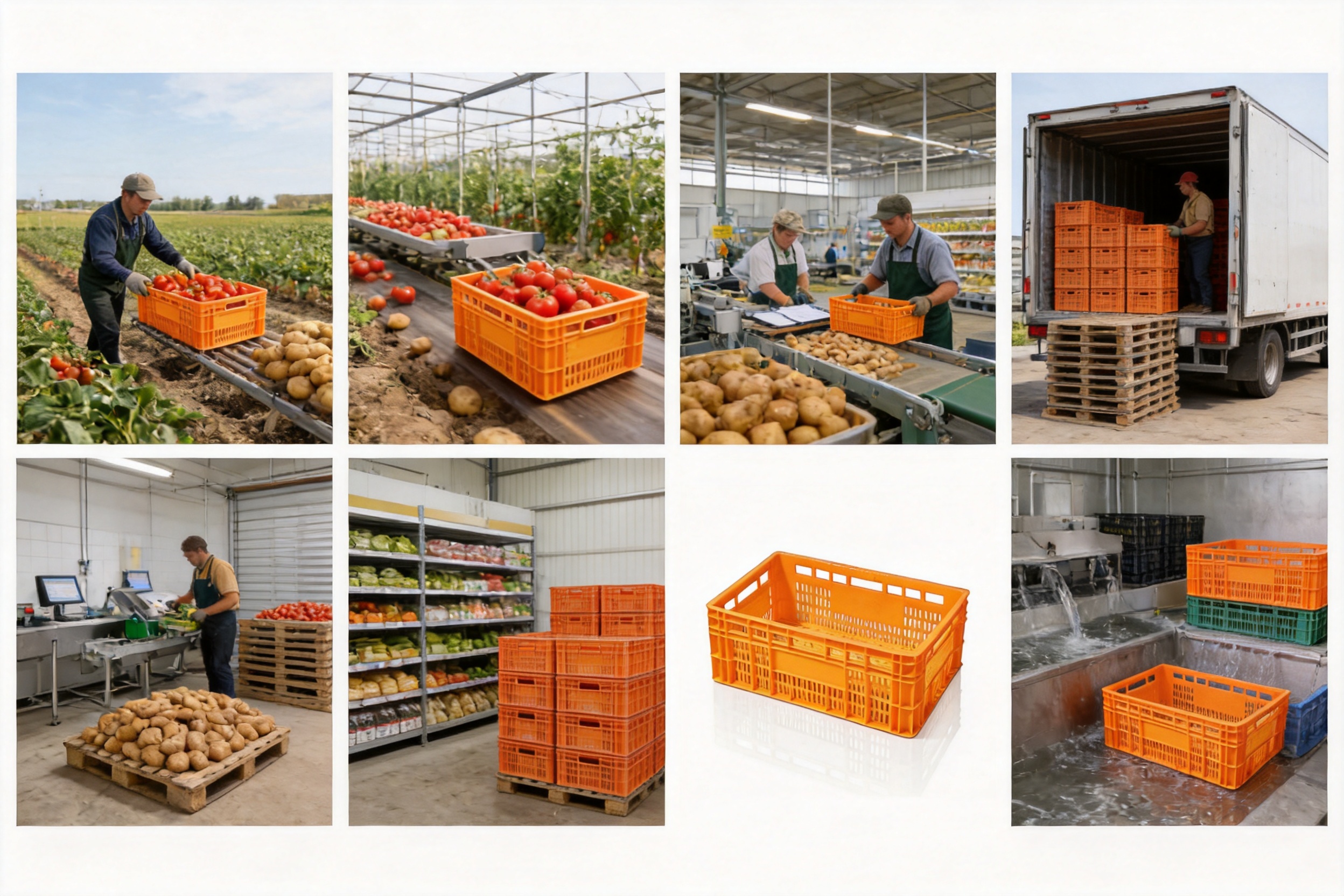
At the farm, a rigid crate can be positioned close to the harvesting area and filled progressively. Workers can see the contents and avoid excessive overfilling. Handles support movement from the field to a collection point, while the open design allows air circulation during temporary holding.
For tomatoes, careful placement can reduce the pressure associated with deep piles. For potatoes, the reinforced base and side structure can support heavier loads than many flexible packaging formats. The actual load should always be determined through product testing and safe handling procedures.
At a sorting facility, standardized crate dimensions help organize workstations, conveyors, and pallet positions. The crate can be loaded with graded products and transferred without repacking into another package. This may reduce handling steps and lower the risk of additional bruising.
Uniform external dimensions also help facilities create repeatable stacking patterns. When the stacking interface is accurately moulded, workers and machines can position crates more efficiently. This predictability can support higher throughput during peak harvest periods.
Wholesale markets often require rapid unloading, inspection, and redistribution. A ventilated crate can display the product while protecting it from direct contact with the floor. Retail operators may use the crate for back-room storage or move smaller quantities to the sales area.
Because the container is reusable, it can be returned through an established collection system. This requires coordination between suppliers, distributors, retailers, and cleaning facilities, but it may reduce reliance on continuously purchasing one-way packaging.
After use, the crates can be collected for inspection and washing. Their open structure and smooth surfaces support more efficient cleaning than containers with numerous inaccessible recesses. Drainage and drying should be considered in the facility design so that clean crates are not returned to service while still holding excessive moisture.
Inspection teams can separate damaged or heavily worn crates. Standardized repair and replacement policies help maintain the quality of the circulating fleet. The mould supplier can support this system by providing replacement-tool information and advising on the durability of specific components.
A crate should be used within its intended load and stacking limits. The manufacturer of the finished crate is responsible for validating these limits through testing. Users should not exceed the recommended load, stack unstable products above the approved height, or use damaged crates in demanding applications.
Crates with cracked handles, broken feet, severe deformation, or sharp damaged edges should be removed from circulation. Regular inspection is especially important in systems where containers are moved by forklifts, conveyors, or automated equipment.
Workers should receive training in safe lifting and stacking. Even a well-designed handle cannot eliminate the risks associated with excessive weight or awkward posture. The crate design should support safe work, while operating procedures determine how it is actually used.
If the crate is intended for direct contact with food or fresh produce, the resin, colorant, additives, cleaning chemicals, and production environment should be verified according to the regulations of the destination market. Tooling quality supports product consistency, but regulatory compliance requires a complete material and manufacturing control system.
The finished crate is visible to the customer, but many of its most important performance characteristics are established inside the mould. A poorly balanced cooling system can create warpage that is not obvious in the original design. An unsuitable ejection layout can leave marks or distort the base. A weak parting-line plan can lead to flash. Inadequate venting can produce filling defects. These problems may become expensive after mass production begins.
Professional mould development addresses these risks through early analysis, appropriate equipment, skilled fitting, controlled trials, and continuous communication. The objective is not merely to make one acceptable sample but to create a reliable production tool capable of delivering consistent parts over a long period.
For the tomato and potato turnover crate, the mould must support both product protection and logistics efficiency. It must produce a structure that is strong yet practical, ventilated yet stable, easy to clean yet economical to manufacture, and suitable for repeated handling. This combination requires coordinated product design and tool engineering.
A tomato and potato turnover crate is a reusable plastic logistics container designed for handling, transporting, storing, and distributing fresh tomatoes and potatoes. It normally includes ventilation openings, reinforced walls, handles, and stacking features. The exact dimensions and structure can be customized according to the customer’s supply chain.
Injection moulding can produce a repeatable crate geometry with integrated handles, ribs, openings, stacking points, and smooth surfaces. It is suitable for medium- and high-volume production and can provide consistent dimensions when the mould, material, machine, and process are properly controlled.
It can be designed for both products if the internal volume, ventilation, strength, and protection requirements are compatible. However, the final design should be tested with the actual tomato and potato varieties, loading weights, transportation conditions, and handling methods.
A reusable plastic crate is generally more resistant to moisture, repeated handling, washing, and long-term stacking. It can be returned and circulated through the supply chain. Cardboard may still be preferable for certain one-way shipments, printed packaging applications, or situations where reverse logistics are not practical.
Useful information includes the desired external and internal dimensions, load capacity, produce type, resin, injection machine details, annual quantity, stacking method, pallet compatibility, washing process, ventilation requirements, color, markings, nesting needs, and target delivery schedule.
CAE analysis can help predict filling behavior, pressure distribution, cooling performance, shrinkage, and warpage. It allows engineers to compare design options before machining and may reduce the risk of defects related to gate position, flow balance, cooling, and dimensional stability.
The product can use smooth surfaces, suitable corner radii, open drainage paths, and a ventilation layout that avoids deep inaccessible pockets. The mould should be designed to minimize unwanted recesses, rough transitions, and difficult-to-clean areas.
Yes, nesting can be included in the product design if reduced return volume and storage efficiency are important. The nesting structure must be balanced with internal capacity, wall strength, stacking stability, and easy separation by workers.
Important factors include suitable mould steel, accurate machining, reliable cooling, balanced ejection, strong guide systems, proper venting, replaceable wear components, stable assembly, and a practical maintenance plan. The mould should also be matched to the intended production volume and resin.
The supplied information identifies the company as a plastic mould manufacturer specializing in customized mould solutions. The customer should confirm whether finished-crate production, injection molding, sampling, or additional production services are included in a specific project.
Testing may include dimensional inspection, empty-crate stacking, loaded stacking, handle evaluation, impact testing, washing trials, nesting checks, conveyor compatibility, and transport simulation. The test plan should reflect the actual supply-chain conditions and the customer’s safety requirements.
Support may include product design review, mould-flow analysis, tooling design, machining, assembly, trial moulding, sample correction, technical documentation, and maintenance recommendations. The exact scope should be agreed in the quotation and technical contract.
The tomato and potato turnover crate is a practical reusable packaging solution for fresh produce supply chains that require protection, ventilation, stable stacking, convenient handling, and repeated circulation. Its advantages are strongest when the crate is designed as part of a complete logistics system rather than treated as a simple plastic box.
Its performance depends on the relationship between product geometry, material selection, injection processing, and mould construction. A professional mould can help produce consistent walls, smooth handles, accurate stacking features, balanced ventilation, and a durable base. Careful cooling, ejection, venting, and flow planning further improve production stability and finished-part quality.
TaiZhou HuangYan YingXiang Plastic Mould Co., Ltd. offers customized plastic mould development supported by a 7,000-square-meter facility, experienced technicians, CAD, CAE, CAM systems, and manufacturing experience across logistics crates, folding boxes, pallets, trays, beverage boxes, and household products. Its focus on lean manufacturing, long-life tooling, delivery performance, cost control, and customer service makes it a suitable partner for customers developing a tomato and potato turnover crate.
For the best result, customers should define their produce, loading, washing, stacking, transportation, and production requirements at the beginning of the project. When product design and mould engineering are developed together, the final crate can deliver stronger performance, more dependable circulation, and better lifecycle value than many alternative packaging formats.
1. General principles of reusable plastic packaging design for agricultural logistics.
2. Technical guidance on injection mould design, cooling, ejection, venting, and dimensional control.
3. General practices for fresh produce handling, ventilation, stacking, and post-harvest transportation.
4. Engineering references for thermoplastic material behavior, mould shrinkage, warpage, and processing conditions.
5. Industry guidance concerning reusable container cleaning, inspection, maintenance, and circulation systems.
6. Company information and product categories supplied for TaiZhou HuangYan YingXiang Plastic Mould Co., Ltd.
If you are interested in any of our products or services, please feel free to ask and we can talk about your ideas.
 QUICK LINKSMOBILE SITE
 FACTORY ADDRESS
 CONTACT INFORMATION



 English
 Español