Extra large thick storage boxes are increasingly important in homes, warehouses, moving services, vehicles, retail environments, and commercial storage operations. As people accumulate more clothing, bedding, toys, sports equipment, tools, and seasonal goods, demand has grown for storage products that provide more than simple volume. Users expect a large box to remain stable under heavy loads, resist deformation, stack securely, open and close conveniently, and remain practical during repeated handling.
The mould used to produce this type of container determines many of its most important characteristics. A well-designed injection mould supports consistent wall thickness, accurate dimensions, smooth surfaces, strong handles, reliable lid engagement, and efficient mass production. By contrast, an underdeveloped mould can produce uneven walls, sink marks, warpage, weak corners, poor fitting lids, flashing, short shots, or excessive cycle times.
The extra large thick storage box mould is developed for the production of spacious, reinforced polypropylene storage containers. The corresponding box design uses thickened walls and a reinforced base to support large or heavy contents. It can be used for comforters, down jackets, pillows, children's toys, large plush toys, sports equipment, household goods, moving supplies, and temporary vehicle storage.
This article examines the product concept, mould structure, material options, manufacturing process, customization services, quality advantages, and application value of this injection mould solution. It also explains how an experienced mould manufacturer combines engineering design, precision machining, mould steel selection, testing, and customer support to deliver dependable tooling for household and industrial plastic products.

Extra large thick storage box
The extra large thick storage box is a high-capacity plastic container manufactured through injection moulding. Its main design feature is reinforcement. Compared with a lightweight general-purpose storage bin, this product has substantially thickened walls and bottom sections. The added material improves rigidity and allows the container to carry larger or heavier contents without easily bending.
The box is primarily intended for home use, but its spacious internal volume makes it suitable for numerous other environments. In a household, it can organize seasonal clothing, bedding, children's products, and household accessories. During a move, it can replace several smaller cartons and provide a more durable reusable alternative. In a vehicle, it can temporarily contain tools, outdoor supplies, sports equipment, or emergency items.
The container includes a reinforced lid that helps reduce deformation when the box is closed or when another light item is placed above it. Symmetrical handles on both sides allow one person to move the box when the weight is manageable or two people to lift it together when the contents are heavier. Anti-slip stripes on the bottom help increase ground stability and reduce unwanted movement on smooth floors.
From a moulding perspective, the product presents several engineering challenges. The large projected area requires careful clamping-force calculations. The thick sections require controlled filling and cooling to minimize sink marks and internal stress. The lid and box body must maintain dimensional compatibility. Handles must be strong enough for lifting but also easy to release from the mould. The bottom anti-slip pattern must be formed clearly without creating difficult demoulding conditions.
| Characteristic | Product Value | Moulding Consideration |
|---|---|---|
| Extra-large capacity | Suitable for bulky household and commercial items | Large mould dimensions, balanced filling, and adequate injection capacity |
| Thickened PP construction | Improves rigidity and load-bearing performance | Cooling design and shrinkage control are especially important |
| Reinforced lid | Helps resist deformation and protects stored contents | Accurate fit, stiffening ribs, and reliable ejection are required |
| Side handles | Supports one-person or two-person lifting | Handle geometry must balance strength, ergonomics, and demoulding |
| Anti-slip bottom stripes | Improves stability on the floor | Texture depth and draft angle must be correctly designed |
| Customizable dimensions | Allows adaptation to different markets and uses | Engineering changes must be incorporated into the complete mould system |
The combination of a large internal volume, thickened structure, reinforced lid, and convenient handling features gives this storage box a practical advantage over thin containers that are designed mainly for light articles. It is not simply a larger version of a standard bin. Its mould must be engineered around strength, dimensional stability, manufacturability, and repeated use.
Many storage containers compete primarily on low material consumption and low initial cost. While lightweight products may be suitable for short-term use, they can suffer from flexing, lid deformation, cracked handles, and unstable stacking when used with heavier contents. The extra large thick storage box concept addresses these weaknesses by placing greater emphasis on structural reliability and usable capacity.
Thickened PP walls distribute the weight of stored items across a more rigid structure. The bottom is also reinforced to reduce excessive deflection when the box is filled. This is valuable for bedding, books, toys, clothing, equipment, and other contents that may create a substantial concentrated load.
Load-bearing performance depends on more than nominal wall thickness. The mould design must also consider corner radii, rib placement, transitions between the sidewalls and base, handle integration, and the support surface created by the bottom geometry. A well-designed mould allows these features to work together rather than relying only on additional plastic material.
Large plastic surfaces are vulnerable to warpage because they cool unevenly. If one portion contracts more quickly than another, the finished part may twist or develop a lid-fitting problem. The thicker construction of this storage box is supported by mould engineering that balances cooling channels, filling paths, ejection forces, and part geometry.
The reinforced lid is another important advantage. A lid with carefully positioned stiffening features can retain its shape more effectively than a flat, thin cover. Correct mould tolerances ensure that the lid closes smoothly while maintaining sufficient retention during handling.
Large capacity can become inconvenient if the container is difficult to lift. Symmetrical handles on both sides improve handling flexibility. Two people can lift the box from opposite sides, while one person can move it when the total weight is appropriate. Handle placement can also help users maintain balance during transport.
For mould production, the handle area requires special attention. Internal openings, undercuts, and thick transitions can create ejection difficulties. The mould must use suitable parting lines, sliders, lifters, or other mechanisms when required. The goal is to produce a clean handle with sufficient strength while avoiding unnecessary complexity that could reduce mould life or increase maintenance requirements.
Anti-slip stripes on the bottom provide additional contact points and help reduce sliding. This feature is useful on smooth household floors, vehicle surfaces, storage shelves, and other areas where a large empty or partially filled box could shift.
The bottom pattern must be designed with suitable texture depth, draft, and spacing. If the pattern is too deep or has unsuitable angles, the part may resist ejection. If it is too shallow, the anti-slip effect may be limited. The mould manufacturer must therefore balance product performance with reliable production.
A rigid injection-moulded container can be reused many times, making it suitable for seasonal organization, relocation, warehouse handling, and temporary transport. Unlike disposable packaging, it can remain in service after the original storage task is completed.
The mould can also be customized for different dimensions, colors, lid styles, handle configurations, and surface treatments. This allows buyers to develop a storage box for a specific market segment instead of selecting a standard product that may not match their requirements.

The quality of a large storage box is closely connected to the quality of its mould design. Before steel is cut, engineers must analyze the product model, material behavior, injection position, cooling requirements, ejection strategy, and expected production volume. Computer-aided design and engineering analysis are essential for identifying potential problems before machining begins.
The first stage is a detailed review of the box and lid geometry. Engineers examine the overall length, width, height, wall transitions, corner radii, handle openings, lid engagement areas, ribs, bottom stripes, and any stacking or nesting features. Each feature influences mould construction and production performance.
Thick sections are particularly important. Excessively thick areas may produce sink marks, voids, or extended cooling times. Abrupt changes in thickness may create visible flow lines or warpage. A well-prepared design may use internal ribs or carefully distributed reinforcement rather than adding material everywhere.
The moulding team also checks draft angles. Vertical walls must generally include sufficient draft to release from the core and cavity without scratching or distorting the product. Textured surfaces may require additional draft. Handle openings and lid locking features must be reviewed for possible undercuts.
Large containers require a filling system that distributes molten plastic evenly. An unbalanced runner or gate arrangement may cause one side to fill before the other, leading to weld lines, air traps, uneven packing, or dimensional variation. Flow analysis can help determine the most suitable gate locations and runner configuration.
For PP storage boxes, the gate design must support efficient filling while preserving the visible quality of the finished surface. Depending on the product structure and production requirements, the mould may use one or more gates, hot runner technology, or a conventional cold runner system. The final selection depends on part size, expected cycle time, appearance requirements, maintenance preferences, and customer production equipment.
Injection pressure and packing pressure must also be considered. A large box may require a high-capacity injection machine, especially when the product includes thick walls and a reinforced base. Mould and machine specifications should be matched during the engineering stage to reduce production risk.
Cooling is one of the most important aspects of a large thick-wall mould. Plastic must solidify sufficiently before ejection, but the cooling process must also be balanced across the entire part. If the cavity side cools differently from the core side, or if corners remain hotter than flat walls, the product may warp.
Cooling channels should be positioned as close as practical to the moulding surfaces while maintaining adequate steel strength. The design may include separate circuits for the cavity, core, lid, handle regions, and reinforced base. Proper water flow, circuit identification, and accessibility support stable production and easier maintenance.
Good cooling design can reduce cycle time, improve dimensional consistency, and lower energy consumption. It also helps prevent the operator from ejecting a part before it has sufficient rigidity. For a large storage box, a small improvement in cooling balance can create a noticeable improvement in overall production reliability.
The finished box must be ejected without distortion, whitening, scratches, or local stress. Large parts require evenly distributed ejection force because concentrated force can deform broad panels or damage ribs. Ejector pins, sleeves, blocks, stripper plates, or hydraulic systems may be selected according to the product geometry.
The ejection layout should avoid visible marks in important appearance areas whenever possible. At the same time, ejectors must be placed on sufficiently strong regions of the part. The mould design also considers how the box will be removed from the cavity, whether the lid and body require separate tools, and whether automatic handling equipment will be used.
The parting line influences appearance, flash control, mould complexity, and assembly. A carefully positioned parting line can simplify machining and reduce visible marks. However, handles, locking structures, and side openings may require sliders or angled mechanisms.
Sliders must be designed for reliable movement, good wear resistance, and easy maintenance. Guide systems, locking components, wear plates, and lubrication points should be accessible to the mould technician. Unnecessary mechanisms increase cost and maintenance, so the best approach is to use a robust and economical structure that solves the actual product requirements.
The standard product description identifies PP as the principal plastic material for the thickened storage box. Polypropylene is widely used for household containers because it offers a useful combination of low density, chemical resistance, toughness, processability, and cost efficiency. It is also available in many grades and colors, allowing the finished product to be adapted to different uses.
PP is well suited to large storage products because it can provide a strong yet relatively lightweight structure. Its low density helps reduce handling weight compared with some alternative plastics. The material can be colored throughout the part, and it is compatible with common injection moulding processes.
Different PP grades may provide different levels of impact resistance, stiffness, flowability, or temperature performance. The correct grade should be selected according to the intended load, storage environment, surface appearance, and machine conditions. For a very large box, flow behavior is important because the melt must fill broad areas and thickened sections consistently.
Material drying and processing conditions should follow the recommendations of the selected resin supplier. Although PP generally does not require the same level of drying as hygroscopic materials, contamination, moisture, and improper storage can still affect appearance and processing stability.
The mould platform may be adapted for other plastics when the application requires different properties. Common material options include PE, ABS, PS, PC, POM, PU, PVC, and PMMA. These materials are not interchangeable without engineering evaluation because they differ in shrinkage, flow, cooling behavior, chemical resistance, toughness, and processing temperature.
PE may be considered when flexibility and impact performance are important. ABS can offer a balance of toughness and surface quality for certain product designs. PC may be selected for higher impact performance or transparency-related requirements, although its processing conditions and cost differ from PP. PS may be suitable for specific rigid products but may not provide the same toughness as PP in demanding handling conditions.
If a customer changes the resin, the moulding team should reassess gate dimensions, cooling performance, shrinkage allowances, venting, injection pressure, and ejection conditions. Material substitution without analysis can result in dimensional problems or reduced product performance.
The available mould material options include 1CR13, 2CR13, 3CR13, 4CR13, S136, CR16, 2316, 718H, P20, and other grades selected according to project requirements. Steel choice affects mould durability, corrosion resistance, polishability, machinability, and maintenance needs.
P20 is commonly used for general mould applications because it offers a practical balance between machinability, strength, and cost. 718H may be selected for larger mould components or projects requiring pre-hardened mould steel with dependable dimensional stability. S136 and related stainless mould steels can be considered where corrosion resistance, polish quality, or long-term surface condition is especially important.
The correct material depends on projected production volume, plastic type, surface finish, mould size, cooling-water conditions, and customer budget. A professional manufacturer should not recommend the most expensive steel automatically. Instead, the material should be matched to the actual service requirements and expected return on investment.
| Material Group | Typical Consideration | Potential Application Value |
|---|---|---|
| PP | Lightweight, tough, processable, and cost-efficient | Primary choice for thick household storage boxes |
| PE | Flexible and impact-resistant grades available | Products requiring additional resilience or softness |
| ABS | Good appearance and balanced mechanical properties | Selected designs requiring a refined surface and rigidity |
| PC | High impact capability but higher processing demands | Specialized heavy-duty or performance-oriented products |
| P20 | Balanced machinability and mould performance | General-purpose mould structures and components |
| S136 or similar stainless steel | Good corrosion resistance and polishability | Long-life moulds or demanding surface requirements |
| 718H | Pre-hardened steel suitable for larger mould components | Large container moulds requiring stable tooling performance |
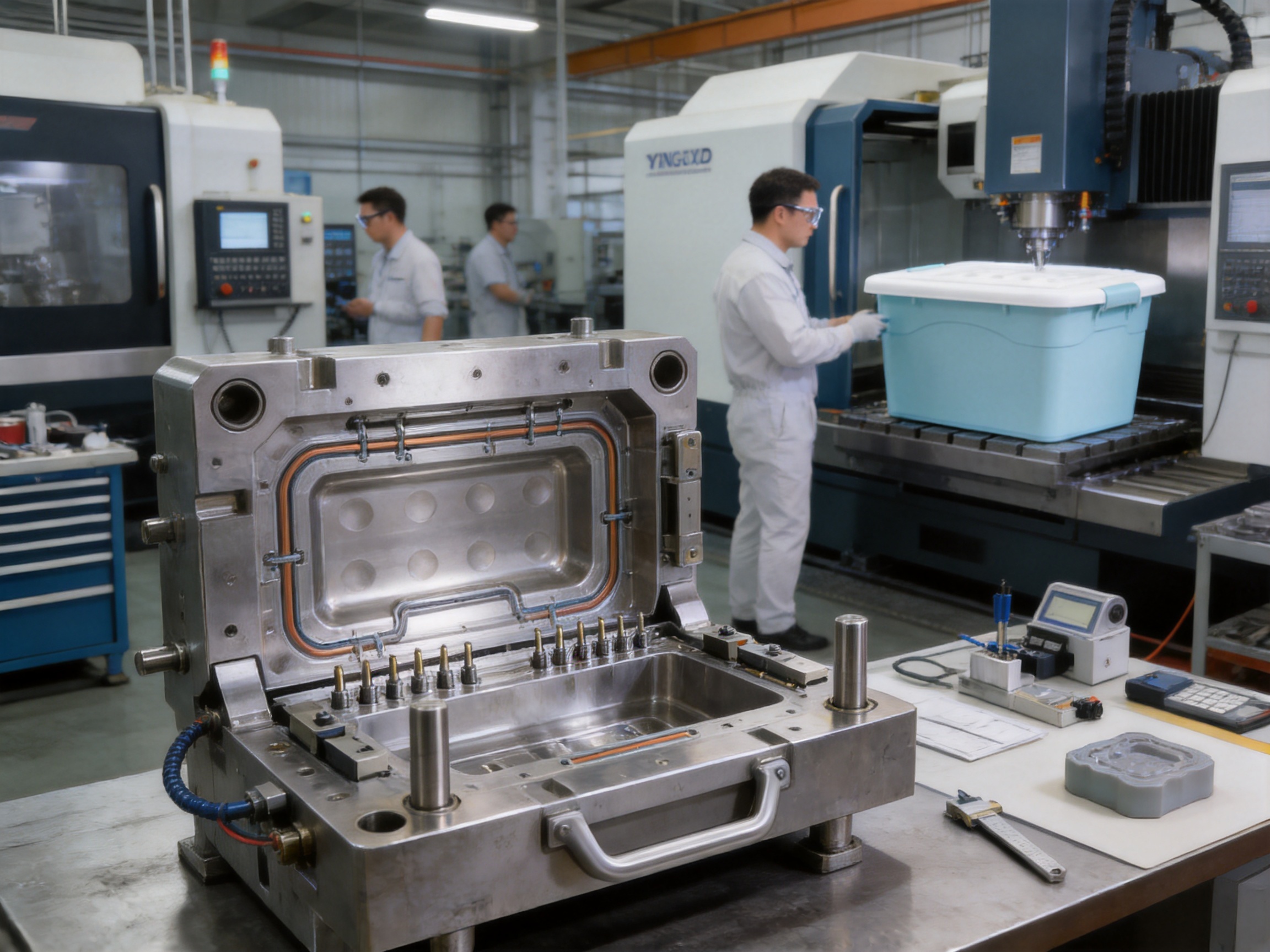
Manufacturing a reliable injection mould requires a controlled sequence from product review to final approval. Each stage influences the next. Errors in the product model may lead to incorrect machining. Inadequate steel preparation can affect polishing. Poor assembly control may create flash or uneven parting. A strong process therefore combines engineering review, modern equipment, experienced technicians, and documented inspection.
The process begins with a discussion of the customer’s product objectives. Important information includes the required box dimensions, lid structure, usable capacity, material, color, estimated production volume, injection machine specifications, surface finish, handle design, and packaging or shipping requirements.
The customer may provide a three-dimensional model, two-dimensional drawing, sample, sketch, or general concept. Engineers review the available information and identify any missing details. If the box is intended for stacking, nesting, retail display, warehouse storage, or vehicle use, those conditions should be included in the design discussion.
At this stage, the team can also clarify whether the customer needs one mould for the box body, a separate lid mould, or a complete matched tooling package. The relationship between the box and lid is particularly important because dimensional mismatch can reduce user satisfaction even when each component appears acceptable on its own.
CAD systems are used to refine the product design and prepare the mould architecture. Engineers define the cavity and core, parting surfaces, sliders, ejectors, runners, gates, cooling circuits, and standard mould components. They also review the assembly space required for the injection machine and auxiliary equipment.
For a large product, CAD analysis helps avoid interference between components and supports accurate calculation of steel dimensions. It also allows the team to study maintenance access. Components that require regular inspection, such as wear plates, guide elements, ejector systems, and hot runner parts, should be arranged so that service work is practical.
CAE tools can be used to predict filling patterns, pressure distribution, weld-line locations, air-trap risks, cooling behavior, and warpage tendencies. These predictions do not replace physical testing, but they allow engineers to identify probable risks before the mould is manufactured.
For the extra large storage box, flow analysis is especially useful because the product has broad panels and thickened sections. Engineers can compare gate positions, evaluate filling balance, and examine whether the proposed injection machine has sufficient capacity. Cooling analysis can also highlight hot spots around corners, ribs, handles, and the base.
Design modifications made during analysis are generally less expensive than changes made after mould assembly. The use of CAD, CAE, and CAM systems supports a more predictable development process and helps reduce avoidable trial-and-error work.
After design approval, mould steel is prepared according to the selected grade and component requirements. CNC machining creates the main cavity, core, inserts, sliders, and other precision features. High-quality machining is essential for dimensional accuracy, surface integrity, and correct alignment.
Large mould components must be supported carefully during machining to reduce vibration and distortion. Deep cavities, narrow ribs, handle openings, and detailed bottom patterns may require different tools and machining strategies. Roughing operations remove the majority of the material, while semi-finishing and finishing operations establish the final geometry.
CAM programming helps coordinate machining paths and improves repeatability. Experienced technicians review tool selection, cutting conditions, remaining stock, and possible collision risks. The objective is not only to create the correct shape but also to produce a mould that can withstand repeated production cycles.
Electrical discharge machining may be used for sharp internal details, narrow slots, deep ribs, complex corners, and other areas that are difficult to complete through conventional milling. Electrodes are designed and machined to transfer the required geometry accurately.
EDM parameters must be controlled to achieve the required surface condition and minimize excessive recast layers. After EDM, affected surfaces may require polishing or additional treatment depending on the product appearance requirements. The correct combination of CNC machining, EDM, wire cutting, and manual finishing allows the manufacturer to handle both large structural surfaces and intricate details.
The mould surface determines the appearance of the finished plastic part. Smooth surfaces may be polished to different grades, while textured surfaces may be created for appearance, grip, or functional reasons. The box can be developed with a practical matte surface, a patterned finish, or selected polished areas according to the customer’s requirements.
Surface treatment should be compatible with the chosen plastic and the intended product design. Over-polishing can make certain areas difficult to release if draft is insufficient. In contrast, an inconsistent texture can create visible differences between production batches. Skilled finishing technicians are therefore important to the final result.
After individual components are machined and inspected, the mould is assembled. Technicians check guide pillars, guide bushes, sliders, ejector systems, inserts, cooling connections, locking surfaces, and moving mechanisms. The mould must open and close smoothly without abnormal resistance.
Fitting work is especially important for a large mould because small alignment errors can become visible as flash, mismatch, uneven wall thickness, or difficult ejection. Contact surfaces are checked through controlled fitting procedures. Moving components are lubricated appropriately, and cooling circuits are tested for leakage and flow continuity.
The first mould trial provides practical information that cannot be obtained entirely through simulation. The trial evaluates filling, appearance, part dimensions, lid fit, handle strength, ejection, cooling time, cycle stability, and machine compatibility.
Trial parts are inspected for short shots, weld lines, sink marks, flash, warpage, burn marks, flow marks, ejector marks, and dimensional variation. If necessary, the mould may undergo corrections to the gate, venting, cooling, parting surfaces, ejection system, or local geometry.
A responsible mould manufacturer treats trial moulding as a structured validation stage rather than simply producing one sample. Several cycles may be required to confirm repeatability. The result should be a mould that can support stable production rather than a tool that produces only one acceptable sample under carefully adjusted conditions.
The manufacturer behind this mould solution is located in Huangyan, Taizhou, Zhejiang, an area widely associated with mould manufacturing. Established in 2012, the company operates a plant of approximately 7,000 square metres and has around 50 employees. Its production system combines CAD, CAE, and CAM technologies with modern equipment and experienced technicians.
This combination provides several advantages for customers seeking customized household and industrial plastic moulds. Engineering resources support product development and mould analysis. Machining equipment supports accurate fabrication of large and complex components. Skilled technicians contribute to fitting, polishing, assembly, trial production, and corrective work.
The company specializes in moulds for plastic crates, folding boxes, trays, pallets, beverage boxes, storage products, and daily household items. This product range is relevant to the extra large storage box because the same engineering principles apply across many large injection-moulded products: structural reinforcement, large projected surfaces, handling features, dimensional matching, and efficient production.
Experience across related products can help engineers identify common design risks. For example, crate and pallet moulds require attention to ribs, corners, impact resistance, and repeated handling. Folding box moulds require accurate moving features and reliable dimensional relationships. Household product moulds require good appearance and user-friendly details. Knowledge from these areas can contribute to a more complete storage box mould design.
Lean manufacturing focuses on reducing avoidable waste while maintaining product quality. In mould production, this may involve organized process planning, efficient material preparation, clear inspection points, controlled machining sequences, and improved communication between design, machining, assembly, and trial departments.
A lean approach is valuable because mould projects often involve many interconnected components. Delays in one operation can affect the entire delivery schedule. Clear planning and disciplined production help reduce rework, unnecessary movement, waiting time, and errors caused by incomplete information.
The expected service life of a mould depends on steel selection, heat treatment, machining quality, moving-component design, cooling management, operating conditions, and maintenance. The company’s stated focus on long-life moulds reflects the importance of producing tooling that supports ongoing customer production rather than only short-term output.
Long-life design may include wear-resistant components in high-friction areas, replaceable inserts, accessible cooling circuits, robust guide systems, appropriate steel grades, and maintenance-friendly construction. These features can help reduce downtime and make future repairs more manageable.
The product specification identifies OEM service as available. This means customers can request adaptations to dimensions, color, material, structural details, surface treatment, and branding-related requirements. A custom mould project should begin with a clear definition of ownership, technical responsibility, product approval procedures, and change-control arrangements.
Customization is particularly useful when a buyer wants a storage box designed for a specific retail channel or logistics application. The box may need to fit a particular shelf, vehicle compartment, warehouse rack, or packaging format. Custom dimensions can also improve material efficiency by matching the internal volume to the intended contents.
The stated supply capacity is approximately 50 mould sets per month. Actual delivery time for a specific project depends on mould size, complexity, steel selection, surface requirements, number of cavities, component availability, and the number of trial and correction cycles. Nevertheless, an established production system and dedicated plant provide a foundation for organized scheduling.
Delivery planning should include design confirmation, steel procurement, machining, assembly, first trial, correction, final approval, documentation, and export packaging. The use of composite wooden boxes helps protect moulds during transportation. Proper packaging should also include corrosion prevention, secure fixation of moving components, and clear identification of spare parts and accessories.
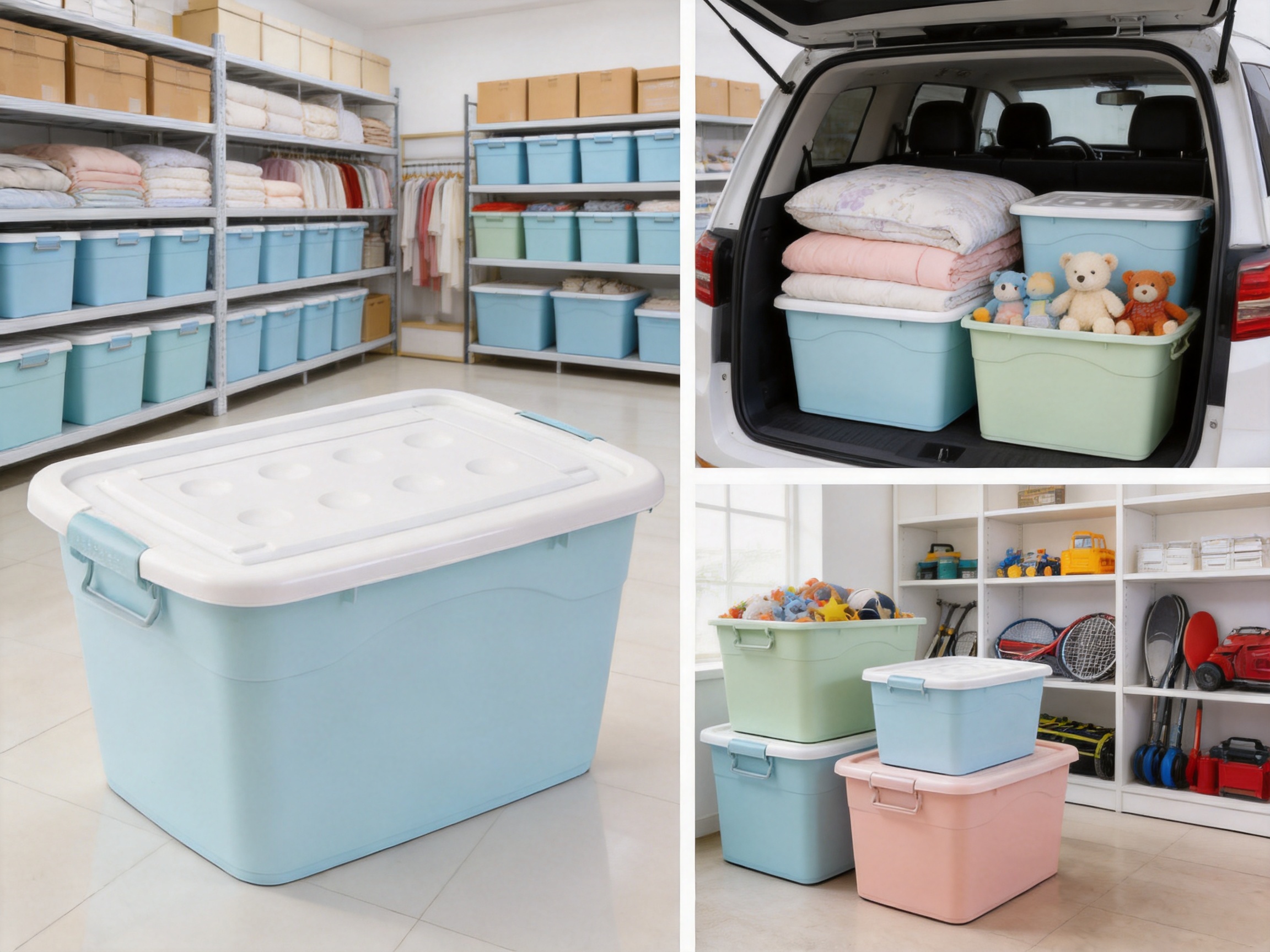
A major advantage of commissioning a custom extra large storage box mould is the ability to adjust the product to a defined commercial objective. Standard products may be readily available, but they may not provide the desired capacity, stacking behavior, handle position, lid security, or appearance. Custom tooling allows these factors to be considered together.
Length, width, and height can be adjusted to create the required internal capacity. The proportions should be reviewed carefully because an extremely wide or tall box may be difficult to lift even if the volume is attractive. The best design balances capacity with ergonomics, structural stability, machine capability, and shipping efficiency.
Customers should specify the approximate type and weight of contents. A box intended for bedding may require different reinforcement from one intended for books or tools. The load distribution, center of gravity, and lifting method should influence the bottom and handle design.
The lid can be designed as a simple cover, a fitted lid, a clip-style lid, or another configuration suited to the application. Reinforcing ribs may be added to prevent broad surfaces from flexing. The engagement area should be tested for ease of opening, secure closure, and dimensional stability after repeated use.
If the box will be moved frequently, the lid should remain secure during ordinary handling but should not require excessive force to remove. The mould must accurately reproduce the corresponding locking and alignment features on both the box and lid.
Side handles may be solid, recessed, open, ribbed, or integrated into the wall. The best design depends on the target load and the preferred manufacturing method. Open handles can improve grip and reduce material, while reinforced recessed handles may offer a cleaner external appearance.
Handle corners should be rounded to improve comfort. The transition between the handle and container wall should be reinforced without creating an overly thick area that may produce sink marks. The moulding team can evaluate these details through product analysis and trial production.
Color is customizable and may be selected to match a retail identity, household interior, warehouse classification system, or product family. PP can be produced in many colors through suitable masterbatch or compound selection.
The mould surface can also be customized. A textured finish may hide minor handling marks and improve grip. A smoother finish may create a cleaner visual appearance. Logo areas, identification panels, embossed text, and other surface details can be incorporated when they are defined before mould manufacture.
Although PP is the primary recommendation for this product concept, material selection should be made according to the final application. The manufacturer can review alternative plastics, additives, recycled content targets, impact requirements, and color requirements with the buyer.
When recycled material or regrind is considered, the customer should evaluate consistency, odor, color variation, mechanical performance, and regulatory requirements. The mould itself may remain similar, but processing conditions and product quality controls may need adjustment.
Quality control should not be limited to the final mould trial. It begins with verifying the product specification and continues through design review, steel inspection, machining, component measurement, assembly, trial moulding, and final acceptance.
Design verification checks whether the mould can produce the intended product consistently. Engineers review draft angles, wall transitions, parting surfaces, gate locations, venting, ejection, cooling, and interference between moving components.
Dimensional relationships between the box and lid must receive special attention. Even a small mismatch may lead to loose closure, excessive interference, or poor appearance. The box should also be checked for practical handling, stability, and compatibility with the customer’s intended use.
Steel certificates, hardness information, and component dimensions can be recorded as part of the quality file. Precision components should be measured according to the design tolerances. Critical inserts and moving parts require particular attention because their performance affects mould life and maintenance.
Inspection equipment may include coordinate measuring systems, height gauges, calipers, micrometers, and other precision instruments. The appropriate equipment depends on the feature being checked and the required accuracy.
During assembly, technicians confirm that the mould opens and closes correctly, the ejector system returns completely, sliders reach their intended positions, and cooling circuits remain free from leakage. The parting line should close evenly, and locking surfaces should provide sufficient support during injection.
Abnormal noise, excessive resistance, uneven wear, or incomplete movement should be corrected before the mould enters a formal trial. Early correction is generally more efficient than waiting until defects appear in the plastic product.
Trial parts should be evaluated visually, dimensionally, and functionally. Visual checks cover short shots, flash, weld lines, burn marks, sink marks, flow marks, scratches, and ejector marks. Dimensional checks verify the overall size, wall locations, handle openings, lid fit, and critical interfaces.
Functional checks may include lid opening and closing, handle lifting, bottom stability, stacking or nesting behavior, and basic load evaluation appropriate to the product design. Formal load ratings should be established through controlled testing rather than assumed from wall thickness alone.
The extra large thick storage box can serve several market segments. Its high capacity makes it suitable for household retailers, organization product brands, moving-supply companies, vehicle accessory suppliers, and storage equipment distributors.
Seasonal clothing and bedding often occupy considerable space. A large box allows users to store comforters, down jackets, pillows, blankets, and other bulky products in one organized container. Handles and a reinforced base make it easier to move the box from a bedroom to a storage room, attic, closet, or garage.
Toys and large plush products can be difficult to organize in small containers. The generous internal volume allows parents and childcare facilities to group products together while keeping them off the floor. A smooth internal surface also makes routine cleaning more manageable, subject to the selected material and product design.
During a move, users need containers that can hold varied household items and survive repeated loading and unloading. A reusable plastic box can provide better resistance to moisture and handling than ordinary paper cartons. The large format may reduce the number of separate packages required, although contents should be distributed carefully to keep lifting weight manageable.
The box can be used in cars, vans, recreational vehicles, garages, and outdoor storage areas for sports equipment, tools, camping supplies, cleaning products, or emergency materials. Anti-slip bottom stripes are useful where vibration or smooth surfaces may cause movement.
Schools, hotels, offices, retail stores, workshops, and community organizations may use large storage boxes to organize supplies. Different colors or labels can support category identification. Custom dimensions may allow the box to fit under counters, inside cabinets, or on storage racks.
Purchasing a large storage box mould is a long-term production decision. The initial mould price is only one part of the total cost. Buyers should also consider cycle time, scrap rate, maintenance, machine utilization, product consistency, repair access, and expected service life.
A low-cost mould may become expensive if it requires frequent correction, produces unstable dimensions, or has cooling and ejection problems. Conversely, a mould developed with appropriate analysis and robust construction can support a more predictable production process. The right balance is not necessarily the highest specification in every category, but the most suitable engineering solution for the intended output.
The manufacturer’s experience with household products, crates, folding boxes, trays, pallets, and beverage boxes is relevant because these products often involve large surfaces, repeated handling, structural reinforcement, and practical manufacturing requirements. This background helps connect the customer’s product concept with a mould structure that can be machined, assembled, tested, and maintained efficiently.
Professional communication is equally important. Drawings, material information, approval samples, machine specifications, inspection records, and change requests should be managed clearly. A mould project involves multiple decisions, and accurate communication reduces the risk of misunderstandings between the product owner and the tooling supplier.
Customers can improve project efficiency by preparing complete information before requesting a quotation. The recommended project workflow begins with a product brief that defines dimensions, capacity, intended contents, material, estimated annual volume, surface finish, color, handle style, lid design, and target market.
The next step is technical review. The mould manufacturer evaluates the product model, identifies risks, proposes modifications, and confirms the suitable injection machine range. Any changes should be approved before detailed mould design begins.
After design approval, the buyer should receive a clear production plan covering steel selection, expected lead time, trial arrangements, inspection criteria, and shipping method. During the trial stage, both parties should agree on how samples will be evaluated and which deviations require correction.
Before final shipment, the mould should be checked for appearance, operation, cooling, ejection, spare parts, identification, and packaging. The buyer should receive relevant documentation, including mould drawings or maintenance information when included in the commercial agreement.
| Project Stage | Buyer Input | Manufacturer Responsibility |
|---|---|---|
| Concept definition | Use, capacity, dimensions, material, and target volume | Technical feasibility review and initial recommendation |
| Product design | Approved product model and functional requirements | Draft analysis, structure review, and mouldability suggestions |
| Mould design | Confirmation of gates, surface, steel, and machine conditions | CAD, CAE, mould layout, and detailed engineering |
| Manufacturing | Approval of agreed changes | Steel preparation, CNC, EDM, finishing, and assembly |
| Trial production | Sample evaluation and feedback | Trial moulding, inspection, correction, and optimization |
| Delivery | Shipping information and final acceptance | Final inspection, protection, packaging, and dispatch |
It is designed for an extra large, thickened plastic storage box with a reinforced body, reinforced lid, symmetrical side handles, and anti-slip stripes on the bottom. The box is intended for bulky or heavy household and general storage applications.
PP is the primary recommended material because it offers a practical balance of toughness, low density, processability, chemical resistance, and cost. Other plastics may be considered when the application requires different impact, stiffness, appearance, or temperature characteristics.
Yes. The model, size, color, material, lid design, handle structure, and surface treatment can be customized according to the customer’s requirements. Any dimensional change should be reviewed through mouldability analysis before manufacturing begins.
Thick sections can create sink marks, internal stress, uneven cooling, and extended cycle times. A suitable mould must balance filling, packing, cooling, venting, and ejection. Reinforcement should be distributed intelligently rather than added without considering shrinkage and warpage.
A reinforced lid is less likely to deform or dent during normal closure and handling. Its performance also depends on accurate fit, appropriate rib design, suitable material selection, and correct moulding conditions.
The symmetrical handles are designed to support practical lifting by one or two people, depending on the total weight of the contents. The actual safe load should be established through product testing because it depends on material grade, handle geometry, wall thickness, moulding quality, and usage conditions.
Potential steel choices include P20, 718H, S136, 1CR13, 2CR13, 3CR13, 4CR13, CR16, 2316, and other suitable grades. The recommended selection depends on production volume, corrosion requirements, surface finish, plastic material, mould size, and budget.
It may be possible, but the recycled material must be evaluated for consistency, contamination, moisture, color, odor, shrinkage, and mechanical performance. Processing conditions and quality controls may need to be adjusted according to the material supplier’s specifications.
The manufacturing system uses CAD, CAE, and CAM technologies together with machining equipment and experienced technicians. Depending on the feature, production may include CNC machining, EDM, wire cutting, polishing, texturing, precision fitting, assembly, and injection trials.
Warpage is controlled through product geometry, balanced filling, suitable packing, uniform cooling, appropriate ejection, correct material processing, and dimensional inspection. CAE analysis can help identify risks before machining, while trial moulding confirms the actual result.
Yes. The storage box can be produced in customized colors using suitable PP colorants or compounds. Color consistency depends on resin preparation, masterbatch dosage, machine cleaning, processing conditions, and production control.
Buyers should confirm product dimensions, box and lid structure, material, color, surface finish, expected output, injection machine specifications, mould steel, gate system, acceptance criteria, delivery schedule, spare parts, packaging, and technical documentation.
Yes. The mould can be prepared for international shipment and protected in a composite wooden box. Export preparation should include rust prevention, secure positioning of movable parts, clear identification, and confirmation of the destination country’s packaging requirements.
An experienced supplier can contribute to product design review, material selection, flow analysis, cooling design, mould structure, machining, assembly, trial production, correction, and maintenance planning. This integrated support can reduce technical risk compared with purchasing a tool based only on a basic drawing and price.
The extra large thick storage box mould is a specialized injection solution for producing spacious, durable, and practical plastic containers. Its value comes from the combination of thickened PP construction, reinforced walls and bottom, a stronger lid, symmetrical handles, and anti-slip bottom features. These characteristics make the resulting product more suitable for bulky or heavy storage requirements than many thin, lightweight alternatives.
Reliable production depends on more than the product concept. The mould must be carefully engineered to manage large surfaces, thick sections, dimensional relationships, cooling balance, ejection force, handle geometry, and lid fit. CAD, CAE, and CAM systems support design accuracy and process planning, while CNC machining, EDM, polishing, assembly, and trial moulding convert the design into production tooling.
The manufacturer’s experience in household and industrial plastic moulds, combined with a 7,000-square-metre plant, approximately 50 employees, advanced engineering systems, and a stated focus on lean manufacturing and long-life tooling, provides a suitable foundation for customized storage box projects. OEM support allows buyers to adapt the product to different sizes, materials, colors, surface finishes, and commercial applications.
For companies seeking a dependable mould for large-capacity storage containers, the most important evaluation points are not only purchase price and delivery time. Product performance, mould structure, steel selection, cooling design, maintenance access, trial quality, production stability, and technical communication should all be considered. A properly developed mould can support consistent output, reduce avoidable waste, and provide a stronger foundation for the long-term success of the finished storage box.
1. Injection Molding Handbook, general principles of polymer processing, mould design, cooling, filling, and ejection.
2. Plastics Design Guidelines, principles of draft angles, wall-thickness transitions, ribs, bosses, shrinkage, and warpage control.
3. Engineering Plastics and Polymer Processing References, material behavior of polypropylene, polyethylene, ABS, polycarbonate, polystyrene, and related thermoplastics.
4. Mould Steel Selection Guides, comparative considerations for P20, 718H, S136, 2316, CR-series steels, hardness, corrosion resistance, polishability, and service life.
5. Computer-Aided Engineering Methods for Injection Moulding, applications of flow analysis, cooling analysis, pressure prediction, weld-line evaluation, and warpage estimation.
6. Quality Management Principles for Toolmaking, inspection planning, component measurement, mould assembly, trial production, corrective action, and final acceptance.
7. General Technical Information on Polypropylene Injection Moulding, recommended consideration of resin grades, processing windows, colorants, recycled content, and production stability.
8. Industrial Mould Maintenance Practices, guidance on lubrication, cooling circuits, wear components, corrosion prevention, storage, transportation, and scheduled servicing.
9. Product information and technical specifications supplied for the extra large thick storage box injection mould project.
10. Manufacturer information supplied for the customized plastic injection mould production facility and related household and industrial mould applications.
Product: Extra large thick storage boxIf you are interested in any of our products or services, please feel free to ask and we can talk about your ideas.
 QUICK LINKSMOBILE SITE
 FACTORY ADDRESS
 CONTACT INFORMATION



 English
 Español