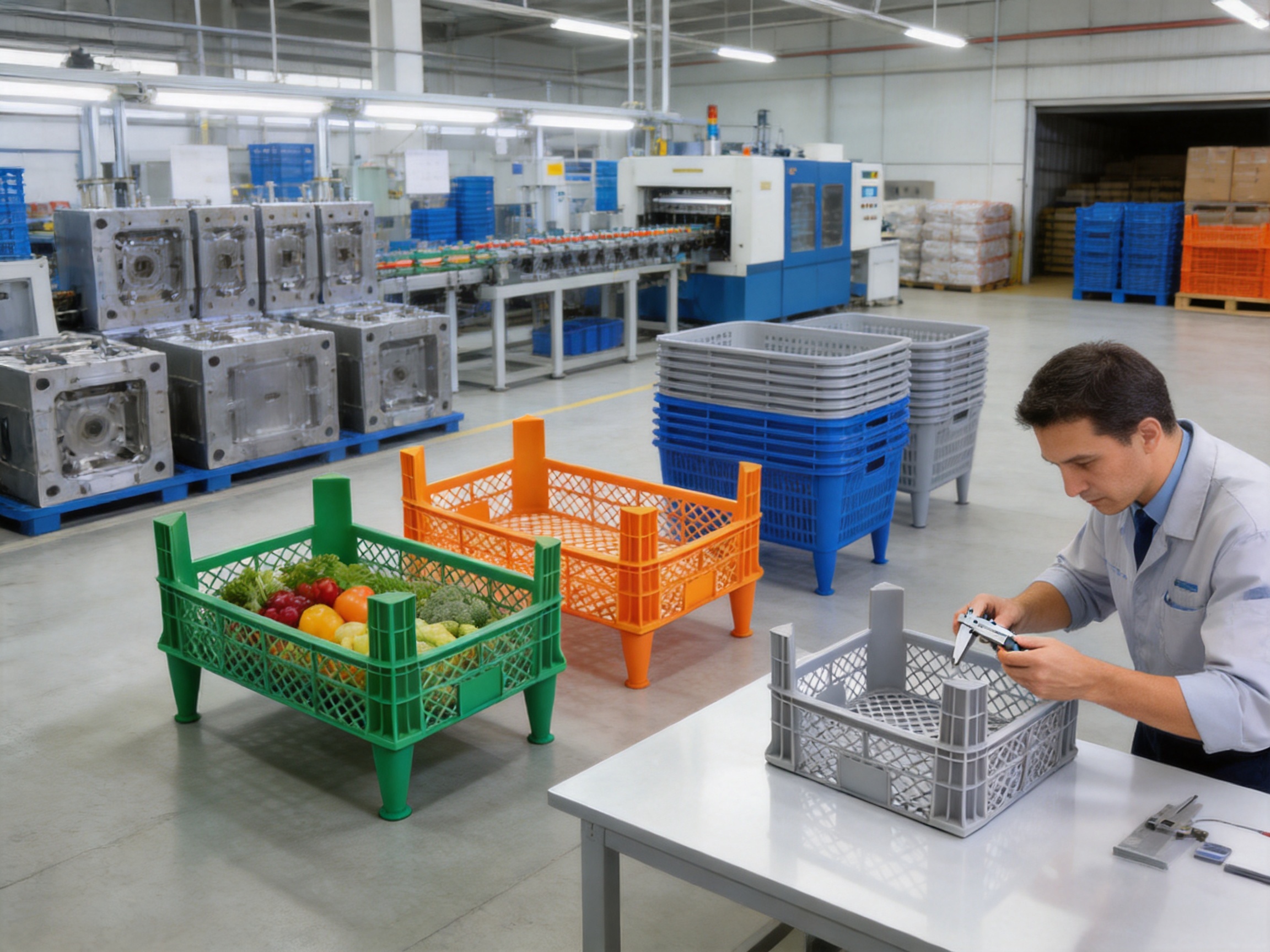
Fresh produce packaging must protect food, support efficient handling, encourage ventilation, and remain practical for retailers, distributors, restaurants, households, and consumers. A high-leg fruit and vegetable basket is designed to meet these requirements through a combination of elevated support, open ventilation, stable construction, and convenient handling. Compared with a conventional low-profile basket, its raised structure can improve airflow, reduce direct contact with wet surfaces, and make stacking, display, and storage more flexible.
The quality of a basket depends not only on its visible appearance but also on the precision of the injection mould used to produce it. A well-designed mould determines dimensional consistency, wall uniformity, corner strength, surface finish, handle performance, stacking accuracy, and production efficiency. For this reason, buyers seeking a dependable high-leg fruit and vegetable basket should evaluate both the product concept and the manufacturing capabilities behind the mould.
TaiZhou HuangYan YingXiang Plastic Mould Co., Ltd. provides customized plastic injection mould solutions for fruit baskets, logistics crates, folding boxes, pallets, beverage boxes, storage containers, household products, chairs, stools, trash cans, and other large or medium-sized plastic products. Located in Huangyan, Taizhou, Zhejiang, China, the company operates in a region widely recognized for mould manufacturing. Since its establishment in 2012, the company has developed experience in product analysis, mould design, machining, assembly, testing, and customer-oriented mould delivery.
This article examines the high-leg fruit and vegetable basket from a product and mould engineering perspective. It explains the basket’s functional advantages, important design features, injection moulding considerations, quality-control requirements, customization possibilities, and the manufacturing strengths that help support long-term commercial use.
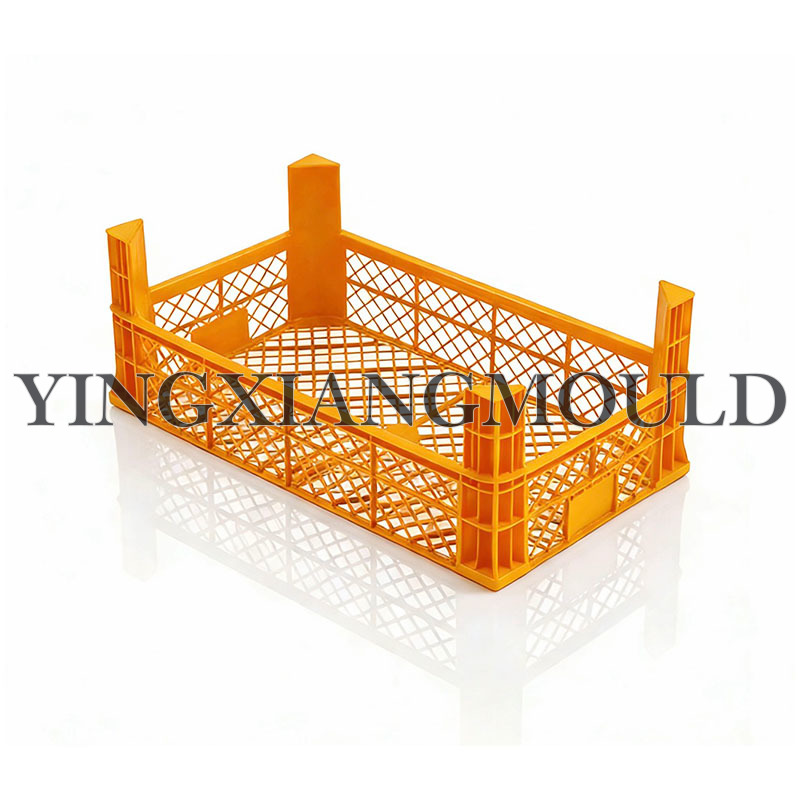
High-Leg Fruit & Vegetable Basket
A high-leg fruit and vegetable basket is an injection-moulded plastic container with a raised base or integrated supporting feet. The elevated structure separates the main basket body from the floor, shelf, pallet, countertop, or another supporting surface. The design is particularly suitable for produce that requires airflow and for applications where moisture management, cleanliness, and quick handling are important.
The basket may include a rigid rim, open side walls, ventilation slots, integrated handles, reinforcing ribs, and feet that allow multiple baskets to be placed in a stable arrangement. Depending on the product specification, the basket can be manufactured from food-contact-suitable plastic, general-purpose polypropylene, high-density polyethylene, or another selected thermoplastic. Material selection should be based on the required impact resistance, flexibility, temperature range, chemical exposure, load capacity, and applicable market regulations.
Although the basket may appear simple, its geometry contains many engineering challenges. The side walls must provide enough strength without becoming unnecessarily heavy. The ventilation openings must be sufficiently large to promote airflow while preserving product protection. The feet must support the filled basket without excessive deformation. The rim and handle zones must withstand repeated lifting. The mould must also produce a balanced part with minimal warpage and reliable ejection.
For commercial users, these details directly affect operating cost. A basket that cracks easily, twists during stacking, or retains water can cause product losses, labour delays, and replacement expenses. A properly designed basket and mould can provide repeatable dimensions, efficient production, longer service life, and a better user experience throughout the supply chain.
One of the most important advantages of an open high-leg basket is ventilation. Fruits and vegetables continue to exchange heat and moisture after harvesting. Poor airflow can increase condensation, accelerate deterioration, and create an environment that is less suitable for delicate produce. Open side walls and a raised base allow air to circulate around the contents more effectively than a closed or low-clearance container.
Improved airflow does not replace proper temperature control or good agricultural handling, but it can support better packaging performance. The open structure allows heat to dissipate and helps reduce the accumulation of moisture on the basket base. This is valuable for leafy vegetables, fruit, mushrooms, packaged produce, and other goods that benefit from a breathable container.
The size and arrangement of ventilation openings must be carefully balanced. Excessively large openings may reduce wall strength or expose produce to damage. Openings that are too small may not provide sufficient circulation and can make cleaning more difficult. Injection mould design therefore needs to account for opening geometry, local wall thickness, weld-line location, draft angles, and material flow.
The high-leg structure creates separation between the basket and the supporting surface. This can help reduce direct contact with damp floors, storage shelves, loading areas, or other surfaces that may contain moisture or contamination. It also provides a clearance zone beneath the basket, which can support drainage and make the container easier to clean around.
In produce markets and distribution environments, baskets are frequently moved between different locations. A raised base can help users lift the basket more easily with their fingers or equipment, depending on the leg and bottom design. It may also improve visibility during display, allowing the basket to appear more elevated and organized on a retail shelf or counter.
The feet must be designed for stability. If the legs are too narrow, the basket may rock under uneven loading. If they are too tall without adequate reinforcement, they may bend or break during transport. A professional mould designer evaluates the relationship between leg height, foot area, rib placement, material shrinkage, expected load, and stacking pattern.
Fresh produce containers are often lifted repeatedly. Workers may carry them from farms to collection points, from trucks to storage areas, or from stockrooms to retail displays. A suitable high-leg basket can include side handles or hand openings positioned for balanced lifting. Rounded edges and an appropriately shaped rim help improve comfort and reduce the chance of cuts or pressure points.
Ergonomic design also affects the basket’s empty weight. A container that is unnecessarily heavy increases labour effort and transportation cost. A container that is too light may lack the rigidity needed for stacking and repeated use. The most effective design uses ribs, curved transitions, reinforced corners, and optimized wall thickness to achieve a practical balance between weight and strength.
Handle openings should be evaluated under both static and dynamic conditions. The basket may be lifted when full, tilted during loading, or moved quickly over uneven ground. The handle region must transfer force into the side walls without creating stress concentrations. Smooth radii and gradual transitions are generally preferable to abrupt corners.
A high-leg basket can be designed for nesting when empty and stable stacking when filled. Nesting reduces the space required during return transport or warehouse storage. Stacking features can help prevent sliding and maintain alignment when multiple baskets are placed on top of one another.
Efficient stacking requires accurate dimensional control. Small deviations in foot height, rim width, or corner position can accumulate across a stack. If the mould does not maintain consistent dimensions, the baskets may lean, bind together, or become difficult to separate. A precision mould helps ensure that every production cycle produces parts that fit the intended stacking system.
The nesting ratio is another important commercial consideration. A well-designed basket can provide useful storage savings without compromising its open structure or load capacity. Customers may request different nesting depths, stacking heights, or interlocking arrangements depending on truck dimensions, warehouse equipment, and retail display requirements.
Reusable produce baskets must withstand repeated loading, unloading, washing, stacking, and transport. Durability depends on material choice, wall thickness, rib layout, corner design, mould precision, processing conditions, and actual use conditions. A basket that remains dimensionally stable after many handling cycles can offer better value than a cheaper container that requires frequent replacement.
Impact resistance is particularly important during cold-weather transport or rough handling. Some plastics become more brittle at low temperatures, while others maintain better impact performance. The selected material should correspond to the intended climate and distribution environment. If the basket is exposed to detergents, oils, fertilizers, or other chemicals, compatibility should also be reviewed.
The mould must support consistent filling and cooling so that the finished basket does not contain excessive internal stress. Inadequate cooling, unbalanced flow, or poor venting may cause warpage, sink marks, short shots, burn marks, or weak weld areas. These defects can reduce the useful life of the product even when the overall shape appears acceptable.
Open baskets are generally easier to rinse and inspect than containers with deep enclosed cavities. Smooth internal surfaces, rounded corners, and carefully designed openings can reduce locations where soil, leaves, and moisture accumulate. This is important for produce handling, where hygiene and rapid turnaround are essential.
A cleanable design also helps reduce maintenance requirements. The basket should avoid unnecessary recesses, sharp internal corners, and inaccessible cavities. If labels or identification markings are required, their placement should not interfere with cleaning or create areas where debris can collect.
The plastic material and surface finish can influence cleaning performance. A consistent mould surface makes the basket easier to wipe or wash. Where appropriate, the mould can include textured areas to improve grip, although excessive texture may make cleaning more difficult. The final surface specification should reflect the product’s actual operating environment.
Uniform wall thickness is a central objective in injection moulding. Large differences in thickness can create uneven cooling and differential shrinkage, resulting in warpage or visible sink marks. A high-leg basket often combines open walls, thicker rims, feet, ribs, and handles, so the designer must manage transitions carefully.
Uniformity does not mean every area must have exactly the same thickness. Structural regions may require reinforcement, but this reinforcement should be created through ribs, shaped profiles, or controlled local increases rather than unnecessarily thick solid sections. This approach can improve strength while limiting material consumption and cycle time.
Computer-aided engineering analysis can help predict filling behaviour, cooling patterns, pressure requirements, and potential deformation. CAE results should be reviewed alongside practical mould-making experience because simulation assumptions must be checked against material data, machine capability, gate design, and actual production conditions.
Ribs provide stiffness without adding excessive mass. In a produce basket, ribs may be placed along the bottom, side walls, rim, and leg connection areas. The rib layout should reinforce the basket without obstructing ventilation or creating difficult ejection conditions.
Corners are often exposed to impact during handling. Rounded external corners can reduce stress concentration and make the basket safer to handle. Internal corner radii also support smoother plastic flow and help reduce sharp changes in wall thickness. The design should consider both functional performance and mould machining requirements.
Leg-to-base transitions deserve special attention. This is a high-load area where forces from the filled basket are transferred into the feet. Generous fillets, reinforcement ribs, and suitable draft can improve reliability. The designer must also ensure that the feet do not interfere with nesting or stacking.
Ventilation openings may be rectangular, oval, rounded, elongated, or customized for a specific product appearance. Rounded openings typically reduce stress concentration compared with sharp-cornered openings. Their orientation can influence stiffness, appearance, and air movement.
The spacing between openings must preserve enough material for wall strength. Excessively close openings may create weak bridges, while excessive spacing may reduce ventilation. The opening pattern should also consider the expected size of produce, the need to prevent smaller items from falling through, and the visual requirements of a retail application.
From a mould perspective, openings increase the number of edges and steel details that must be machined accurately. Proper venting around the opening features is necessary to prevent trapped air and burn marks. The mould may require carefully arranged inserts, slides, or other mechanisms depending on the complexity of the basket shape.
Handles can be integrated into the side walls or formed as part of the upper rim. Their size should provide sufficient hand clearance while preserving the basket’s strength. Edges should be smooth and free from flash. If the basket is intended for heavy loads, the handle design should be validated through practical load testing.
The moulding process must maintain a clean handle opening and consistent edge quality. Flash in a hand opening is unacceptable because it can cause discomfort or injury. Gate location, mould alignment, clamping force, and parting-line control all influence the final handle quality.
A commercial basket may need to perform in several configurations: empty nesting, filled stacking, side-by-side display, or integration with pallets and crates. The mould should reproduce the interface features accurately so that the baskets align as intended.
Stacking stops, feet, rims, and locating surfaces must be designed with adequate tolerance. If the fit is too tight, operators may struggle to separate baskets. If it is too loose, stacks may shift during transport. The correct balance depends on product weight, load distribution, handling equipment, and the customer’s logistics process.
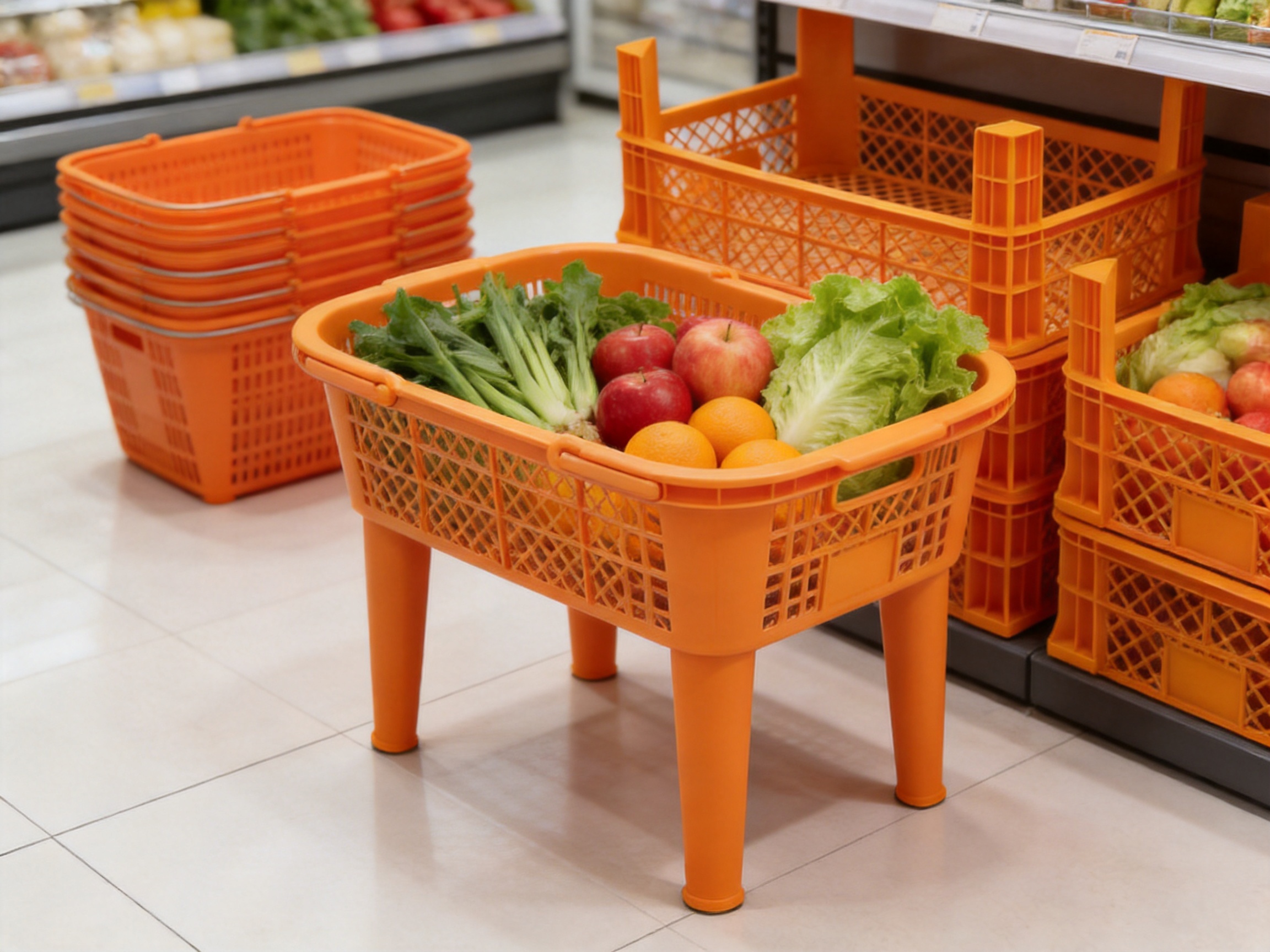
The injection mould is the foundation of a consistent high-leg basket. It must reproduce complex open geometry, maintain dimensional accuracy over many production cycles, and withstand the pressure, temperature, and mechanical forces associated with large plastic parts. Mould construction begins with product analysis and continues through design, steel selection, machining, fitting, trial production, correction, and final validation.
Before creating the mould structure, engineers review the product drawings or three-dimensional model. They examine wall thickness, draft angles, undercuts, parting lines, gate locations, ejection areas, cooling channels, and expected shrinkage. They also consider the customer’s target material, machine size, annual production volume, cycle-time goals, and acceptable cosmetic standards.
Early analysis can identify issues that would otherwise cause expensive modifications later. For example, a handle opening may require a different parting-line arrangement, or a tall leg may need additional draft to release smoothly. A ventilation pattern may look attractive but create excessive weld lines or weak areas. Resolving these topics before steel cutting can reduce project risk and shorten development time.
YingXiang uses advanced CAD, CAE, and CAM systems as part of its mould development process. CAD supports accurate three-dimensional mould and product design. CAE can assist with filling, cooling, pressure, and warpage analysis. CAM connects approved designs with CNC machining and other manufacturing equipment.
The value of these systems comes from their integration with experienced technicians. Software can identify likely flow patterns and deformation risks, but practical mould knowledge is needed to interpret the results and decide on suitable solutions. A strong engineering workflow combines digital analysis, manufacturing experience, and physical testing.
Integrated data management also helps maintain consistency between design revisions and machining operations. This is especially important for baskets with repeated openings, multiple ribs, symmetrical legs, or interchangeable inserts. Clear revision control reduces the risk of machining outdated geometry or applying inconsistent corrections.
The parting line determines how the mould separates and how the finished basket appears. A carefully selected parting line can simplify mould construction, minimize visible flash, improve ejection, and reduce the need for complex mechanisms. It should be positioned away from critical hand-contact surfaces whenever possible.
High-leg baskets can require careful treatment of their feet, handles, rim, and ventilation features. If the geometry includes undercuts, slides, lifters, or angled inserts may be necessary. The mould designer must balance functionality with reliability because every moving component adds maintenance requirements and potential wear points.
The gate system controls how molten plastic enters the cavity. For a large open basket, the gate design must support balanced filling and appropriate packing. Poorly balanced flow can create uneven filling, excessive weld lines, air traps, or dimensional differences between opposite sides of the basket.
Gate placement also affects appearance. Gates should be positioned in locations where marks are acceptable or less visible, while still allowing the plastic to flow efficiently into structural areas. The correct design depends on product size, material, wall thickness, machine capability, and production targets.
Runner dimensions must support stable processing without causing unnecessary material waste. Hot-runner or cold-runner solutions may be considered based on the project’s production volume, material selection, colour changes, maintenance preferences, and budget. A professional mould supplier can compare these alternatives with the customer rather than applying the same system to every product.
Cooling strongly affects cycle time and part quality. A basket with thick legs, a substantial rim, and thinner ventilated walls may cool unevenly. If the cooling channels are too far from critical regions, the part may remain hot after ejection and deform under its own weight or during stacking.
Cooling channels should be arranged to support balanced heat removal. Particular attention may be required around the rim, corners, feet, and areas with high material accumulation. Baffles, bubblers, or specialized cooling solutions may be used where ordinary straight channels cannot provide sufficient coverage.
Efficient cooling can improve productivity by reducing cycle time while maintaining dimensional stability. It can also reduce energy consumption per part. However, cooling performance must be validated through actual mould trials because theoretical calculations cannot capture every detail of machine settings, water flow, material behaviour, and production conditions.
After cooling, the basket must be released from the mould without deformation, scratches, drag marks, or damage to the legs and openings. Ejection forces should be distributed across suitable structural areas. Concentrating force in thin walls can leave marks or distort the basket.
Draft angles help the part release from the cavity and core. The required draft depends on the surface texture, material, depth, and shape. Textured surfaces generally require more draft than polished surfaces. The mould designer must also ensure that ejection does not interfere with ribs, handles, ventilation openings, or nesting features.
For complex products, a combination of ejector pins, stripper plates, lifters, or other mechanisms may be considered. The selected system should be reliable, accessible for maintenance, and compatible with the expected production volume.
Huangyan, Taizhou, Zhejiang, is recognized as an important mould-manufacturing area in China. Its industrial environment provides access to mould-making talent, machining resources, component suppliers, heat-treatment services, and plastic injection production knowledge. For an international buyer, working with a supplier in an established mould cluster can support communication between design, machining, fitting, and trial-production stages.
TaiZhou HuangYan YingXiang Plastic Mould Co., Ltd. is located in this manufacturing region and has specialized in customized plastic mould solutions since 2012. The company’s product scope includes crate and folding box moulds, tray and pallet moulds, beverage box moulds, fruit basket moulds, and moulds for daily household products.
The company has a reported plant area of approximately 7,000 square metres and a team of around 50 employees. This scale allows the business to combine focused project management with dedicated technical operations. Experienced technicians can contribute to mould assembly, fitting, testing, troubleshooting, and production support.
Advanced CAD, CAE, and CAM systems help connect product development with manufacturing. High-tech equipment supports precision machining and repeatable processing. For a high-leg basket mould, this combination is important because the product may contain many repeated details that require consistent positioning and accurate steel work.
A suitable plant structure also supports workflow separation. Design, programming, machining, electrode preparation, fitting, polishing, assembly, and trial production can be organized into coordinated stages. Clear process control helps reduce delays and makes it easier to identify the source of a problem when a trial part requires adjustment.
Different customers need different basket specifications. One buyer may prioritize maximum ventilation, another may require heavy-duty stacking, and another may focus on retail appearance and low part weight. Some applications require a compact basket, while others need a larger container compatible with pallets or automated handling systems.
YingXiang’s customized approach allows product details to be developed according to the customer’s intended use. Possible customization areas include overall dimensions, basket height, leg height, handle configuration, ventilation opening pattern, rib structure, stacking interface, logo placement, surface texture, material selection, colour, and packaging requirements.
Customization should begin with a clear review of the product’s operating conditions. Customers should communicate expected load, stacking height, transport method, cleaning process, temperature exposure, production quantity, and target market. This information allows the engineering team to recommend a mould structure and product design that are practical rather than based only on appearance.
Lean manufacturing focuses on reducing unnecessary waste, improving workflow, controlling variation, and delivering consistent value. In mould production, lean principles may be applied through organized planning, standard operating procedures, efficient material handling, accurate machining programs, inspection checkpoints, and structured correction processes.
For a basket mould, process discipline is important because a small dimensional problem can affect a large number of repeated features. A slight mismatch in a cavity insert may create visible differences in ventilation openings. Inaccurate machining around the feet can affect stacking. Uncontrolled polishing can alter draft or change the intended surface appearance.
A lean approach does not mean reducing necessary engineering work. Instead, it aims to prevent rework and make each stage more predictable. When design reviews, machining, assembly, and testing are coordinated, the customer can benefit from improved delivery reliability and a lower risk of unexpected mould modifications.
Mould life depends on steel quality, heat treatment, mould structure, processing conditions, maintenance, and production volume. A long-life mould should be designed for repeated cycling and accessible maintenance. Wear-prone components should be replaceable where practical, and cooling, ejection, and moving mechanisms should be arranged for inspection and service.
Long service life is especially valuable for reusable baskets because demand may continue over many years. A reliable mould supports stable part dimensions and reduces the cost of frequent replacement or major repairs. It also provides greater confidence when the customer invests in packaging standardization across multiple sites.
Before selecting a mould configuration, the customer and supplier should discuss expected production volume. A mould for a small initial order may have different cost and automation priorities from a mould intended for continuous mass production. The appropriate solution should balance initial investment, cycle time, maintenance, part price, and future expansion.
Design verification begins with confirming the product model, key dimensions, material assumptions, tolerances, and functional requirements. Engineers should review whether the basket can be moulded, ejected, stacked, cleaned, and used as intended. Potential risks should be recorded and addressed before manufacturing begins.
Important verification points include the position of the parting line, the adequacy of draft, the accessibility of cooling channels, the expected ejection force, the strength of leg connections, and the consistency of ventilation openings. If a logo or identification mark is included, its depth and location should be checked for appearance and mouldability.
During machining, inspection helps confirm that cavity and core components conform to the approved design. Critical dimensions may include the basket rim, foot height, handle openings, overall length and width, wall-forming surfaces, and alignment features.
Inspection is particularly important for large mould components because thermal changes, tool wear, machine setup, and clamping conditions can influence accuracy. Consistent measurement practices help detect issues before final assembly, when corrections may be more difficult.
After machining, the mould components are assembled and fitted. Technicians check parting surfaces, moving mechanisms, inserts, ejector systems, cooling connections, and alignment. Proper fitting helps prevent flash, sticking, leakage, uneven wear, and premature component damage.
Fitting quality is a practical indicator of mould-making capability. Even a well-designed digital model can produce poor results if the assembled steel does not align accurately. Experienced technicians are essential for hand fitting, polishing, mechanism adjustment, and final mould preparation.
Trial moulding validates the mould under actual processing conditions. The first trial can reveal filling imbalance, short shots, burn marks, sink marks, warpage, excessive flash, ejection problems, or dimensional variation. Trial samples should be evaluated against the approved product design and functional requirements.
It is normal for complex moulds to require controlled adjustments after the first trial. The important issue is whether corrections are identified systematically and carried out with clear records. A disciplined trial process can reduce the number of modification rounds and improve final approval efficiency.
High-leg baskets should be tested for more than visual appearance. Dimensional checks can confirm stacking and nesting performance. Load testing can evaluate the legs, handles, rim, and bottom structure. Impact testing may be appropriate for transport applications. Repeated washing or cycling can provide information about long-term performance.
Testing requirements should be agreed with the customer because the correct test depends on the final market and application. A basket used in a household kitchen may require different validation from a basket used in agricultural distribution or a high-volume logistics system.
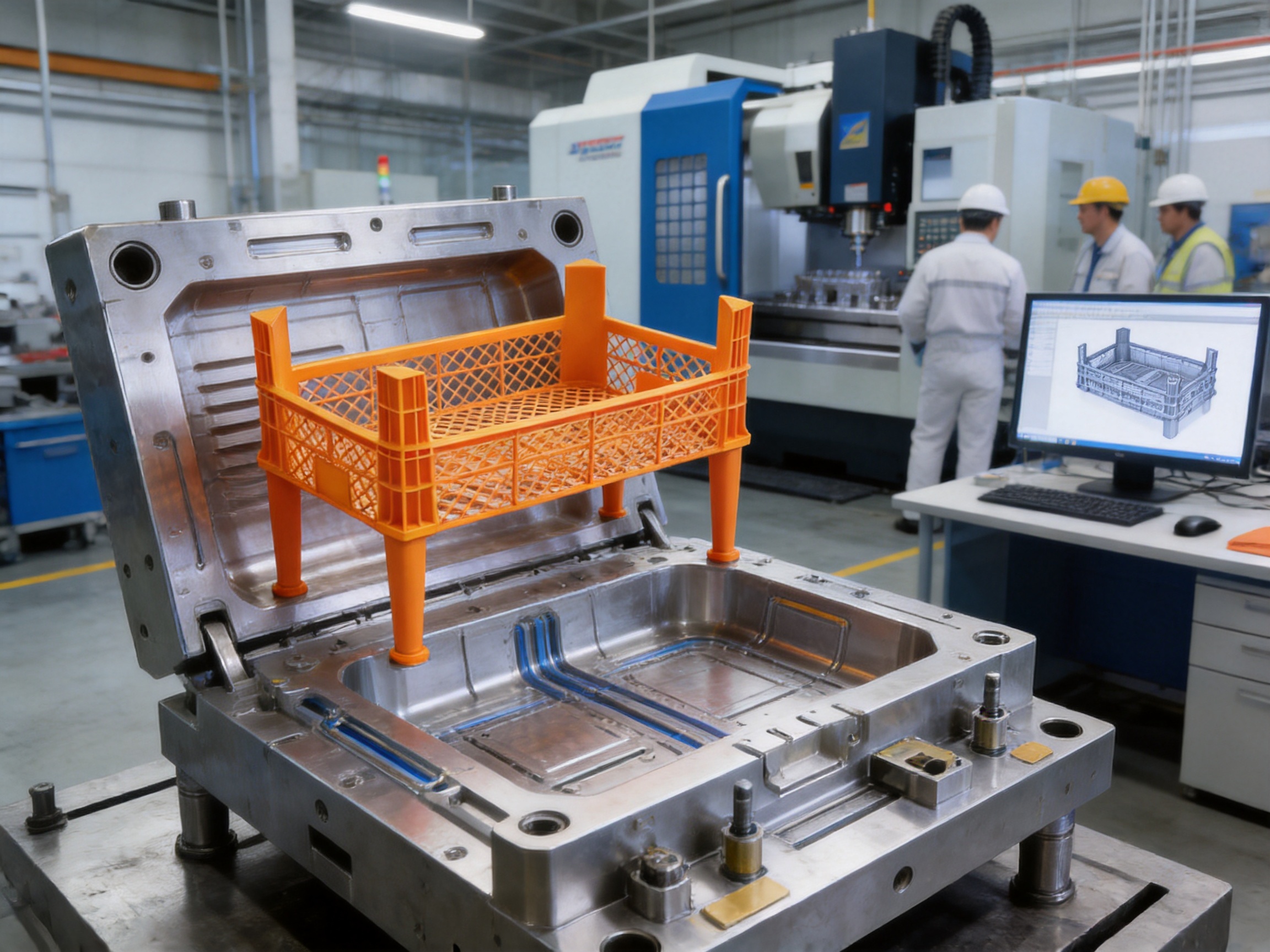
A conventional low-base basket may be sufficient for short-term display, but it may provide less clearance from wet or dirty surfaces. The high-leg design offers a more deliberate separation between the basket bottom and its support. This can improve drainage, ventilation, and ease of handling in environments where containers are frequently moved or washed.
The high-leg structure can also improve the visual presentation of produce. Elevated products may be easier for customers to see, and the basket can appear more organized on a display surface. For commercial users, the additional clearance can support more hygienic and practical storage arrangements.
Some low-cost containers reduce material to the point that the rim, handles, corners, or feet become vulnerable. While a lightweight design can reduce initial cost, frequent cracking and deformation may create a higher total cost over time. An engineered basket uses structural ribs and controlled material distribution to achieve a more useful balance between weight and durability.
Consistent moulding also reduces the risk of weak areas caused by uneven filling or uncontrolled wall thickness. When the mould is produced with accurate cooling and balanced flow in mind, the finished basket can provide more predictable performance from one production batch to another.
A basket may be marketed as stackable but still perform poorly if the feet and rim do not align precisely. Unstable stacks can occupy more space, increase handling risk, and cause produce damage if a container shifts or falls. Properly engineered stacking interfaces provide more controlled storage and transport.
The mould must reproduce these interfaces consistently. This is where the quality of the mould supplier becomes a competitive advantage. A product design can be excellent in theory, but its commercial value depends on the ability to manufacture it repeatedly within practical tolerances.
Reusable plastic baskets can offer advantages in repeated distribution cycles. Instead of relying on packaging that is discarded after one journey, users may wash, inspect, and return the basket to service. The economic and environmental results depend on material selection, actual reuse frequency, cleaning practices, repairability, and end-of-life recycling.
A long-life mould contributes to this model by enabling stable production of durable containers. When the basket design supports repeated handling and the mould maintains consistent dimensions, the packaging system may deliver better value across its operating life.
Polypropylene is commonly considered for reusable baskets because it can provide a useful combination of low density, chemical resistance, stiffness, and processability. Different grades have different impact, temperature, and food-contact characteristics. The selected grade should be confirmed for the intended use rather than chosen only by general material name.
Processing settings must match the specific grade. Melt temperature, injection speed, holding pressure, cooling time, and mould temperature can influence appearance and strength. A professional mould trial should use the customer’s intended material whenever possible, since changing the material may change shrinkage and warpage behaviour.
High-density polyethylene may be selected where toughness, chemical resistance, and impact performance are important. Its shrinkage and flow behaviour differ from polypropylene, so the mould and process window may need corresponding adjustments.
Material selection should also consider the basket’s rigidity requirements. A material that is highly flexible may be useful for impact resistance but may not provide the stacking stability required for heavy loads. The product design and material grade must be evaluated together.
If the basket is intended to hold unpackaged fruit or vegetables, the customer should identify applicable food-contact requirements in the target market. These requirements may affect the resin, colour masterbatch, additives, processing controls, documentation, and cleaning recommendations.
The mould manufacturer can support the product-development process by understanding the selected material and its processing needs. However, regulatory compliance responsibility should be clearly allocated among the material supplier, product manufacturer, importer, and end user. Technical documentation and testing should follow the relevant market requirements.
A high-leg fruit and vegetable basket can be adapted for farms, wholesale markets, supermarket displays, catering operations, household storage, and logistics systems. Customization can begin with dimensions. Customers may request a compact basket for countertop use, a wider model for retail display, or a larger container compatible with pallet loading.
Colour customization can support product identification, brand organization, or visual merchandising. Surface texture may be selected to improve grip or create a specific appearance. Embossed or recessed logos can provide durable identification without requiring separate labels, although the design must be reviewed for mouldability and cleaning.
Ventilation can also be customized according to the produce. Delicate items may require smaller openings, while robust products may benefit from a more open pattern. The bottom can include drainage features, while the side walls can be optimized for visibility and airflow.
The basket may be designed for manual handling, automated systems, or both. Compatibility with conveyors, pallet dimensions, warehouse shelving, and washing equipment should be considered at the beginning of the project. Late changes to these interfaces can affect the mould structure and increase development cost.
For customers seeking multiple sizes, a family-mould strategy may be discussed. Shared design principles, interchangeable inserts, or related mould configurations can help create a product series. The best approach depends on required volumes, size differences, tooling budget, and production planning.
The purchase price of a mould is only one part of the total cost. Buyers should also consider cycle time, material consumption, maintenance, scrap rate, mould life, labour requirements, packaging, transportation, and the cost of quality problems. A mould with a higher initial investment may offer a better commercial result if it produces parts faster and with fewer defects.
Material efficiency is particularly important for large baskets. Optimized wall thickness, rib design, and runner configuration can reduce unnecessary resin consumption. However, weight reduction must not compromise load-bearing areas or long-term durability. Engineering analysis and practical testing help identify a safe balance.
Cycle time depends on injection, packing, cooling, mould opening, ejection, and handling. Cooling is often a major factor for baskets with thicker structural zones. Effective cooling-channel design can support shorter cycles and more stable dimensions, improving the output of the customer’s injection moulding machine.
Maintenance planning should be included in the mould specification. Wear components, cooling connections, ejector systems, moving inserts, and parting surfaces all require periodic inspection. Accessible design and clear maintenance documentation can reduce downtime and extend mould service life.
| Evaluation Area | What the Buyer Should Review | Potential Commercial Benefit |
|---|---|---|
| Product strength | Rim, handles, feet, corners, ribs, and load-bearing zones | Fewer breakages and better reuse performance |
| Ventilation | Opening size, spacing, airflow, and produce protection | Better storage conditions and improved product presentation |
| Stacking and nesting | Alignment, clearance, stability, and storage ratio | Lower warehouse and transport space requirements |
| Mould cooling | Cooling coverage, water flow, and temperature balance | Shorter cycles and reduced warpage |
| Material efficiency | Wall thickness, rib geometry, runner design, and part weight | Lower resin consumption without unnecessary weakness |
| Quality control | Dimensional inspection, trial testing, and correction records | More consistent production and fewer rejected parts |
| Maintenance | Component accessibility, spare parts, and service procedures | Lower downtime and longer mould life |
Fruit baskets, crates, and storage boxes are not identical products. Each requires different decisions about flow, cooling, ejection, stacking, and structural reinforcement. A supplier experienced in plastic container moulds can recognize common failure risks and recommend solutions based on similar applications.
A specialized manufacturer can also understand the relationship between the mould and the injection moulding machine. The mould must match the machine’s shot capacity, platen dimensions, tie-bar spacing, clamping force, injection pressure, and automation arrangement. Ignoring these factors may result in a mould that is difficult or inefficient to run.
Communication is another important advantage. Customers often need support with product revisions, sample evaluation, dimensional concerns, or processing adjustments. A supplier with design, machining, assembly, and trial capabilities in one organization may be able to respond more efficiently than a fragmented supply chain.
YingXiang’s stated focus includes lean manufacturing, long-life moulds, on-time delivery, quality, competitive costs, and comprehensive customer service. These priorities are relevant to buyers who need more than a one-time tooling transaction. A successful mould project should provide a stable platform for continuous production and future product development.
The customer should first define what the basket will carry, where it will be used, how often it will be reused, and how it will be cleaned and transported. Information about produce size, load weight, temperature, stacking height, and handling method can prevent unsuitable design choices.
Dimensions, ventilation, leg height, handles, surface finish, colour, logo, material, tolerances, and packaging should be documented. If the basket must fit an existing pallet, shelf, washing line, or logistics system, the relevant interface dimensions should be supplied.
The mould manufacturer should review draft, wall thickness, ribs, corners, openings, parting lines, gates, ejection, and cooling. At this stage, the customer can compare alternative designs and understand how each option affects tooling cost, cycle time, weight, and performance.
After design review, the customer should approve the three-dimensional product and mould data, key dimensions, steel specification, mould base, hot-runner or cold-runner arrangement, expected cycle, and trial plan. Clear approval reduces the risk of disagreement during production.
The mould is then machined, assembled, fitted, polished, and inspected. Critical dimensions and moving mechanisms should be checked before trial moulding. Any deviation should be recorded and resolved according to the approved requirements.
Trial parts should be inspected for appearance, dimensions, stacking, nesting, handling comfort, and structural performance. The customer may request additional tests based on the final application. Corrections should be made systematically, followed by confirmation samples.
Before shipment or mass production, the project should include mould drawings, maintenance information, spare-part recommendations, processing references, inspection results, and approved samples where applicable. Proper documentation helps the customer establish a repeatable production process.
When evaluating a high-leg fruit and vegetable basket mould, buyers should ask whether the product has been designed for the intended load and transport conditions. They should confirm whether the feet remain stable when the basket is filled and whether multiple baskets stack without excessive movement.
They should also verify that ventilation openings are appropriate for the produce and that the basket can be cleaned efficiently. Handle edges, rim quality, corner strength, and the absence of flash are important for worker safety and daily usability.
From a tooling perspective, buyers should review the expected mould life, steel selection, cooling design, ejection system, gate position, maintenance requirements, and trial procedure. They should ask how dimensional corrections will be managed and whether the manufacturer can provide technical support after delivery.
Communication about material is essential. The customer should identify the resin grade, colour, additives, food-contact requirements, and recycled-content expectations where applicable. Material changes after mould completion can affect shrinkage, appearance, and performance, so they should be assessed carefully.
The raised base separates the basket from the supporting surface, which can improve airflow, drainage, cleanliness, and handling. It can also support more organized display and storage when the feet and stacking interfaces are properly designed.
Yes. The size, material, handle design, load capacity, and surface finish can be customized for wholesale distribution, supermarkets, restaurants, farms, catering operations, household storage, and other applications.
Mould precision controls the basket’s dimensions, wall thickness, ventilation openings, feet, handles, stacking features, and surface quality. Consistent moulding is necessary for reliable stacking, stable handling, reduced defects, and predictable service life.
Polypropylene and high-density polyethylene are common options, but the final choice depends on impact resistance, stiffness, temperature, chemical exposure, food-contact requirements, cost, and the customer’s processing conditions. The resin grade should be selected for the actual application.
Yes. A logo may be embossed, recessed, or otherwise integrated into the moulded surface. Its location, depth, draft, and size should be reviewed so that it does not interfere with filling, ejection, cleaning, stacking, or appearance.
Openings remove material and may create stress concentrations. Their shape, spacing, orientation, and connection to ribs must be engineered to provide airflow without weakening the side walls. Rounded openings and suitable material bridges are often helpful.
The buyer should provide the product drawing or three-dimensional model, target material, dimensions, expected production volume, machine information, load requirements, stacking method, surface finish, colour, logo details, and destination-market requirements. More complete information supports a more accurate quotation and design review.
Cooling influences cycle time, shrinkage, warpage, dimensional stability, and surface quality. Because a basket may contain thick feet and rims together with thin ventilated walls, balanced cooling is important for producing a flat and stable part.
Trial evaluation should include filling, flash, short shots, burn marks, sink marks, warpage, ejection, dimensions, stacking, nesting, handle strength, leg stability, surface finish, and overall appearance. Additional load or impact tests may be required for specific applications.
A manufacturer with experience in customized container moulds may support future size, colour, ventilation, or structural variations. The feasibility of shared components or a product family should be discussed during the initial project because it can influence the mould architecture.
TaiZhou HuangYan YingXiang Plastic Mould Co., Ltd. has experience in customized plastic moulds for fruit baskets, crates, folding boxes, pallets, beverage boxes, and household products. Its reported plant, CAD/CAE/CAM systems, technical team, and focus on lean manufacturing and long-life tooling support the development of practical injection mould solutions.
The high-leg fruit and vegetable basket combines ventilation, surface separation, handling convenience, stacking potential, and reusable durability in one practical packaging concept. Its advantages are most valuable when the product geometry is carefully matched to the produce, load, logistics system, and cleaning process.
Behind these visible features is a demanding mould-engineering project. Wall thickness, ribs, feet, handles, openings, parting lines, gates, cooling channels, and ejection systems must work together. A mould that is accurately designed, precisely machined, correctly fitted, and thoroughly tested can produce baskets with consistent dimensions and reliable performance over a long production life.
TaiZhou HuangYan YingXiang Plastic Mould Co., Ltd. offers customized plastic injection mould solutions from its Huangyan, Taizhou facility. With experience dating from 2012, a reported 7,000 square metre plant, approximately 50 employees, CAD/CAE/CAM capabilities, high-tech equipment, and experienced technicians, the company is positioned to support projects involving fruit baskets, logistics crates, folding boxes, pallets, storage containers, beverage boxes, and other plastic products.
For buyers planning a new high-leg fruit and vegetable basket, the best results come from early engineering communication. When product requirements, material, machine conditions, quality standards, production volume, and maintenance expectations are defined clearly, the mould can be developed as a long-term manufacturing asset rather than simply a tool for producing an attractive sample.
Businesses seeking further information about customized mould development can contact YingXiang Plastic Mould using the supplied details: telephone +86 17858690885, +86 13566828762, or +86 19957608921; email Chinayingxiang88@sina.com; address No. 2 Chaoyuan Road, North City Street, Huangyan, Taizhou, Zhejiang, China 318020.
1. Society of Plastics Engineers, Injection Molding Handbook, technical guidance on mould design, plastics processing, cooling, and quality control.
2. Rosato, D. V., Rosato, M. G., and Rosato, D. P., Injection Molding Handbook, reference material on injection mould construction, processing conditions, and troubleshooting.
3. International Organization for Standardization, ISO 20457, Plastics Moulded Parts—Tolerances and Acceptance Conditions.
4. International Organization for Standardization, ISO 294 series, Plastics—Determination of Moulding Shrinkage.
5. International Organization for Standardization, ISO 22000, Food Safety Management Systems—Requirements for Organizations in the Food Chain.
6. Company-provided technical and corporate information for TaiZhou HuangYan YingXiang Plastic Mould Co., Ltd., including product categories, manufacturing capabilities, facility information, and contact details.
If you are interested in any of our products or services, please feel free to ask and we can talk about your ideas.
 QUICK LINKSMOBILE SITE
 FACTORY ADDRESS
 CONTACT INFORMATION



 English
 Español