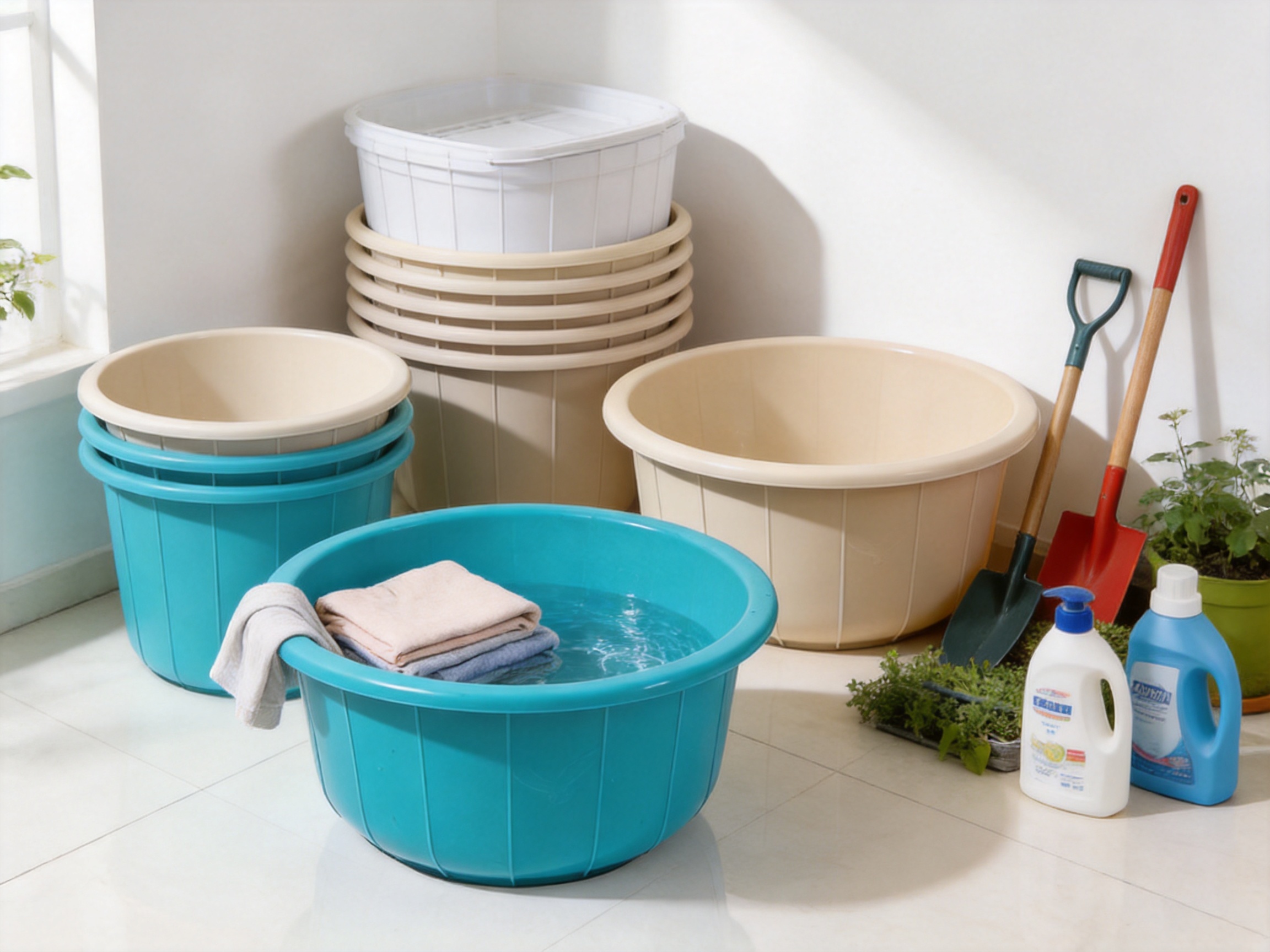
A large, extra-thick washbasin is designed for users who need dependable performance, generous capacity, and long-term resistance to daily wear. Unlike lightweight household basins that may flex under load, deform when exposed to hot water, or lose their appearance after repeated use, an extra-thick washbasin is built around a more substantial wall structure and carefully controlled geometry. Its quality, however, depends not only on the plastic material selected for production. The mould used to manufacture the basin has an equally important influence on strength, dimensional accuracy, surface quality, cycle efficiency, and production consistency.
The plastic wash basin mould for a large, extra-thick product must be engineered to manage a relatively large part size, heavier material distribution, deeper cavity geometry, and demanding cooling requirements. It must also support stable injection moulding without creating excessive sink marks, weld lines, warpage, flash, or uneven wall thickness. For manufacturers seeking a basin that can compete effectively in household, commercial, hospitality, cleaning, agricultural, and utility markets, mould quality is a decisive factor.
TaiZhou HuangYan YingXiang Plastic Mould Co., Ltd. develops customized plastic mould solutions for household and industrial products, including plastic wash basin moulds and other large injection moulds. Located in Huangyan, Taizhou, Zhejiang, China, a region recognized for mould manufacturing, the company combines engineering experience, CAD, CAE, and CAM systems, modern processing equipment, and practical production knowledge. Its approximately 7,000-square-metre plant, experienced technical team, and focus on long-life moulds provide a foundation for manufacturing large plastic products with repeatable quality.
This article examines the design requirements, performance advantages, manufacturing process, quality controls, and commercial value of the large, extra-thick washbasin. It also explains how an experienced mould manufacturer can help convert a basin concept into a reliable, efficient, and scalable injection moulding solution.
A washbasin is a familiar household product, but a large extra-thick model presents more demanding engineering challenges than an ordinary basin. The product generally features a broad opening, a deep cavity, a reinforced rim, a stable base, and a wall structure capable of carrying water, cleaning tools, clothing, or other household items. Depending on the intended use, the basin may also include integrated handles, pouring edges, stacking features, drainage openings, or reinforced ribs.
The defining characteristic of the product is its substantial wall thickness. Extra thickness can improve rigidity and resistance to impact, but it also increases the quantity of plastic required for each part. More material means a longer filling and cooling process, higher moulding energy consumption, and greater risk of internal stress if the injection system and cooling layout are not correctly designed. The mould must therefore achieve an appropriate balance between product strength, production speed, material economy, and visual quality.
A large basin also has a wide projected area and a relatively deep cavity. During injection, these characteristics can cause uneven pressure distribution, difficult filling conditions, and different cooling rates between the rim, side walls, bottom, and reinforcing structures. If the mould is poorly designed, the product may show distortion after ejection or fail to sit flat on a surface. A professionally engineered mould addresses these risks during the design stage rather than attempting to correct them after production begins.
The large extra-thick washbasin may be manufactured from materials such as polypropylene, high-density polyethylene, or other suitable thermoplastics, depending on the required impact resistance, flexibility, chemical resistance, surface appearance, and cost. Material selection must be considered together with mould design. Different plastics have different shrinkage rates, flow characteristics, cooling behaviour, and sensitivity to processing conditions. A mould manufacturer with broad practical experience can adapt the gate, runner, cooling, ejection, and dimensional compensation strategy to the selected resin.
The primary benefit of a thick-walled basin is increased rigidity. A rigid basin is less likely to bend when lifted, filled, carried, or placed on an uneven surface. This is particularly valuable for large products, because a wider basin naturally experiences greater bending forces than a small container. The thick wall helps the basin maintain its shape during use and gives the product a more substantial feel.
Compared with thin-wall alternatives, the extra-thick design can provide greater resistance to local deformation around the handles, rim, bottom, and corners. This makes it suitable for demanding domestic tasks, commercial cleaning, laundry operations, storage applications, and general utility use. The reinforced structure can also improve user confidence because the basin feels stable and dependable rather than fragile or excessively flexible.
Washbasins are frequently moved, stacked, dropped, filled, emptied, and exposed to contact with other household objects. A large extra-thick basin is better positioned to withstand this repeated handling. Its heavier structure can reduce the likelihood of cracking or permanent deformation caused by accidental impact.
This advantage is important for distributors and retailers because a more robust product may generate fewer customer complaints and lower replacement rates. For commercial buyers, product durability can reduce operating interruptions and improve the value obtained over the useful life of each basin. Although actual performance depends on material grade, design, processing conditions, and usage, a well-engineered thick-wall structure provides a strong basis for durability.
The basin may be used to carry water, clothing, cleaning supplies, food-related items, gardening materials, or other household goods. Its large capacity provides practical convenience, while the thicker walls and reinforced bottom help distribute the load across the structure. A properly designed base is especially important because it must support the contents while also maintaining dimensional stability.
Ribs, fillets, corner transitions, and bottom reinforcement can be incorporated into the product design to improve load distribution without creating unnecessary stress concentrations. These details are not merely decorative. They influence how the basin performs when filled, lifted by its handles, or placed on a hard floor. The mould must reproduce these features accurately and consistently in every production cycle.
A broad base and reinforced lower section can help the basin remain stable during washing, soaking, cleaning, or storage. A stable basin is less likely to tip when the contents move or when the product is placed on a smooth surface. The base can be designed with carefully positioned support areas, drainage considerations, and a controlled contact footprint.
Dimensional accuracy is essential for this benefit. Even a small amount of warpage in a large basin can cause rocking, uneven contact, or poor stacking. For that reason, mould cooling, ejection balance, material shrinkage, and product geometry must be evaluated together. CAE analysis can help identify potential deformation zones before steel machining begins.
The large format gives users additional working space and volume. A large washbasin can be used for laundry, cleaning, bathing-related tasks, storage, agricultural handling, and many other applications. Its versatility helps manufacturers address more than one market segment with a single product platform or a family of related sizes.
The extra-thick construction supports this versatility because the product can be used in more demanding environments than a lightweight basin. It can be positioned as a premium household item, a commercial utility product, or a durable general-purpose container. The final positioning depends on the material, finish, accessories, packaging, and branding selected by the buyer.
A high-quality basin should have a smooth, consistent surface that is easy to clean and comfortable to handle. The rim should be free from sharp edges, excessive flash, and uneven transitions. Smooth corners reduce the accumulation of dirt and simplify washing after use. Surface appearance is especially important when the product is sold through retail channels, where consumers often judge quality immediately by appearance and touch.
Surface quality begins with the mould steel, polishing standard, texture selection, parting-line control, and processing accuracy. A mould with a properly finished cavity can reproduce a clean product surface over many production cycles. Where a textured finish is selected, the texture must be applied consistently across the visible areas and managed carefully around the parting line and ejection features.
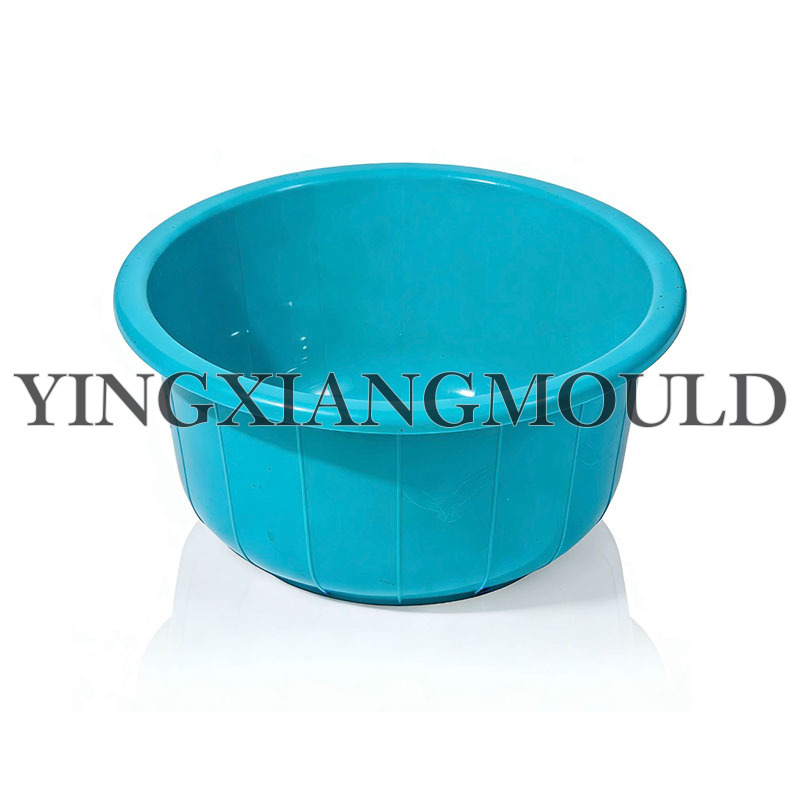
Large, Extra-Thick Washbasin
Before mould construction, the product design should be reviewed for manufacturability. This review considers wall thickness, draft angles, corner radii, handle transitions, bottom reinforcement, parting-line location, gate position, ejection access, and possible undercuts. A product that looks attractive on a screen may still require modification before it can be moulded efficiently and consistently.
Uniform wall thickness is one of the most important considerations. A very sudden transition from a thin wall to a thick rib can create uneven cooling and visible sink marks. Conversely, an excessively thin region can fill poorly or become a weak point. The design team should use gradual transitions, generous fillets, and appropriately proportioned reinforcement features to support both strength and mouldability.
Draft angles are also necessary to allow the finished basin to release from the cavity and core. Large, deep products generally require careful draft management because friction can increase across the side walls. Insufficient draft may cause scuffing, drag marks, difficult ejection, or damage to the product. The required draft depends on the material, surface texture, wall depth, and mould finish.
The parting line determines how the mould separates and where the two principal mould halves meet. For a washbasin, the parting line is often positioned around the upper rim or another carefully selected perimeter. The location should minimize visible witness marks, simplify ejection, and avoid interference with handles, reinforcing details, or functional surfaces.
A well-designed parting line also reduces the risk of flash. On a large basin, even a small mismatch along a long perimeter can create a visible and uncomfortable edge. Precision machining, appropriate mould support, and accurate alignment components are essential to maintain a stable parting surface throughout the mould’s service life.
The injection system must deliver molten plastic into the cavity with sufficient flow and balanced pressure. A large extra-thick basin may require a gate arrangement that supports fast, even filling while reducing weld lines in visible or highly stressed areas. The gate position influences the flow path, packing behaviour, appearance, and ease of trimming.
For certain designs, a centrally positioned gate may help distribute material toward the perimeter. Other designs may benefit from multiple gates or a carefully balanced runner system. The correct choice depends on the basin dimensions, material, wall structure, production machine, and quality objectives. Flow simulation can be used to assess filling time, pressure requirements, air traps, weld lines, and potential hesitation before the mould is manufactured.
Gate design must also consider the customer’s preferred production process. A cold runner system may offer simplicity and lower initial tooling complexity, while a hot runner system can reduce runner waste and support more consistent filling in some applications. The decision should be based on expected volume, material behaviour, machine configuration, maintenance preferences, and total operating cost rather than on a single factor.
Cooling is one of the most important elements of a large thick-wall mould. Plastic must be cooled sufficiently before ejection so that the basin can retain its shape. If the cavity and core cool unevenly, different areas of the product may shrink at different rates, causing warpage, ovality, base distortion, or changes in the rim dimensions.
Cooling channels should be arranged to follow the product geometry as closely as practical. Special attention is required around thick sections, corners, the bottom, the rim, and any integrated handles. The cooling circuit should support efficient heat transfer while remaining accessible for cleaning, maintenance, and troubleshooting. Water flow, circuit balance, connector arrangement, and temperature control should be considered during design.
For a thick-wall product, the cooling phase can represent a significant portion of the overall cycle time. Improving cooling efficiency can therefore increase output and lower energy consumption without compromising product quality. However, cooling should not be accelerated in a way that produces excessive residual stress. The objective is controlled, balanced cooling that supports both dimensional stability and production efficiency.
The ejection system must remove the large basin smoothly without leaving visible marks or causing deformation. Because the product has a broad surface and deep cavity, the ejection force should be distributed across suitable areas. An unbalanced ejection system may twist the basin, distort the rim, or leave localized stress marks.
Ejector pins, sleeves, stripper plates, or combinations of these systems may be considered depending on the product geometry. Ejection locations should generally be placed on structurally strong areas that are not highly visible to the end user. The system must also work reliably during long production runs, with appropriate guidance, wear resistance, lubrication access, and maintenance provisions.
Air trapped in a large cavity can cause short shots, burn marks, incomplete filling, surface defects, and inconsistent appearance. Venting is particularly important near the end of the flow path, around corners, at the bottom of deep features, and where multiple flow fronts meet. Proper vent dimensions and locations allow air to escape while limiting the risk of plastic flash.
Venting should be reviewed using both simulation and practical moulding experience. A theoretically correct vent may still require adjustment during trials if the actual resin, machine, or processing speed differs from the original assumptions. An experienced mould maker can evaluate trial results and make controlled improvements without unnecessarily altering the product surface.
The quality of the final basin depends on a structured manufacturing process. Each stage, from initial consultation to final acceptance, contributes to the reliability of the mould. A professional manufacturer does not treat mould construction as a simple cutting operation. It is a coordinated engineering and production activity involving design, analysis, precision machining, assembly, testing, and documentation.
The process begins with an exchange of product information and production requirements. Important details include the basin’s dimensions, expected weight, material, surface finish, annual volume, injection machine specifications, preferred cycle time, colour, packaging method, and target market. The mould supplier should also understand whether the customer requires a single-cavity or multi-cavity tool, a cold runner or hot runner system, and any special features such as logos, handles, stacking points, or drainage details.
Clear requirement confirmation reduces misunderstandings and allows the engineering team to identify potential risks early. If the buyer has only a sketch or sample, the manufacturer can assist with design development and manufacturability improvements. If a complete three-dimensional model is available, the team can proceed to detailed analysis and mould layout.
CAD systems are used to develop the product and mould structure in detail. The design team evaluates the cavity and core arrangement, mould base, steel thickness, support components, parting line, injection system, cooling layout, ejection mechanism, and standard components. A complete three-dimensional model helps reveal interference, insufficient clearance, weak support areas, and difficult maintenance points before machining.
The mould layout should also consider installation and operation on the customer’s injection machine. The mould dimensions, clamping requirements, locating ring, sprue interface, ejector connection, cooling connections, and lifting provisions must be compatible with the machine and factory workflow. Practical details at this stage can prevent unnecessary modifications after delivery.
Computer-aided engineering can support the evaluation of filling, packing, cooling, and warpage. For a large extra-thick basin, simulation may help identify high-pressure areas, weld-line locations, air traps, unbalanced filling, excessive cooling time, and possible deformation. It can also assist in comparing different gate positions or runner configurations.
Simulation is not a substitute for experience, but it is a valuable decision-making tool. The accuracy of the results depends on the quality of the product model, material data, processing assumptions, and boundary conditions. Engineers should interpret the results together with practical knowledge of the selected resin and moulding machine. The purpose is to reduce avoidable risk and create a more robust design before steel is committed.
Mould steel must be selected according to the expected production volume, material characteristics, surface requirements, and maintenance expectations. The cavity and core should have sufficient hardness, toughness, wear resistance, and dimensional stability for the intended service conditions. The choice of steel influences polishing, texturing, machining, repairability, and long-term performance.
Steel preparation includes cutting, rough machining, stress relief where appropriate, and accurate referencing. Large mould components require stable processing because internal stress or insufficient support can affect dimensional accuracy during later machining. A disciplined preparation process provides a reliable foundation for the cavity, core, mould base, and moving components.
CNC machining is used to create the principal cavity and core geometry, mould plates, cooling features, and other accurately controlled components. Complex details, deep corners, ribs, or difficult internal shapes may require electrical discharge machining or other specialized processes. The selection of processing technology depends on the geometry, steel type, tolerance requirements, and surface finish.
Machining accuracy is particularly important around the rim, parting line, handle transitions, and base. These areas affect product appearance, fit, stability, and user comfort. Precision processing also supports consistent wall dimensions and reduces the amount of manual correction required during mould assembly.
The cavity surface can be polished to a smooth finish or prepared for a specified texture. Polishing must be controlled carefully because excessive manual work can alter dimensions or create uneven reflections. Texturing requires consistent preparation and accurate application, especially across large visible surfaces.
The selected surface treatment should support the product’s intended use. A smooth basin may be easier to clean and may provide a bright appearance, while a controlled matte texture can reduce the visibility of minor handling marks and provide a distinctive visual character. The mould maker should confirm the customer’s expectations using samples or approved reference standards where possible.
After the principal components are machined, the mould is assembled and fitted. This stage checks the alignment of the cavity and core, the movement of slides or inserts if present, the operation of the ejection system, the sealing of cooling circuits, and the engagement of the parting surfaces. Skilled fitting is important because a mould may contain numerous moving and stationary components that must work together precisely.
Proper assembly also supports future maintenance. Components should be accessible for inspection, cleaning, replacement, and adjustment. Wear parts should be identified, and cooling or lubrication points should be arranged in a practical manner. A mould that is difficult to maintain may create unnecessary downtime even if the initial product quality is acceptable.
Trial moulding verifies how the tool performs under actual injection conditions. The trial process examines filling, packing, cooling, ejection, cycle time, product weight, dimensions, surface quality, flash, sink marks, weld lines, and warpage. The basin should also be evaluated for stability, handle strength, rim quality, and general appearance.
Trial results may lead to adjustments in processing parameters or mould details. These can include gate balance, venting, cooling flow, ejection timing, packing pressure, holding time, or local polishing. Controlled optimization helps ensure that the mould is not merely capable of producing one acceptable sample but can support stable production across repeated cycles.
Huangyan, Taizhou, Zhejiang, is widely associated with mould manufacturing and plastic processing. A company operating in this environment can benefit from access to technical talent, supporting suppliers, machining resources, heat-treatment services, and injection moulding experience. TaiZhou HuangYan YingXiang Plastic Mould Co., Ltd. is located in this mould-making region and has developed its capabilities around customized plastic mould solutions.
Regional expertise is valuable because large household moulds require more than standard design software. Practical experience with similar products helps engineers anticipate shrinkage, material flow, cooling challenges, ejection problems, and common production defects. This accumulated knowledge can shorten development time and reduce unnecessary trial-and-error.
Established in 2012, Yingxiang Mould has developed a production operation with an approximately 7,000-square-metre plant and around 50 employees. A dedicated facility of this scale provides room for design, machining, fitting, testing, inspection, and project coordination. It also supports the organization of multiple mould projects while maintaining control over key manufacturing stages.
For customers purchasing a large washbasin mould, the production environment matters. The mould may include large steel components, complex cooling passages, substantial lifting requirements, and several rounds of testing. Adequate space and equipment improve safety, workflow, inspection access, and delivery coordination.
The use of CAD, CAE, and CAM systems supports a connected development process. CAD creates and manages the product and mould geometry. CAE assists with filling, cooling, and deformation analysis. CAM translates approved geometry into machining paths for CNC equipment and other processing systems.
Integration among these systems helps reduce data transfer errors and improves communication between engineering and production teams. It also makes it easier to update a mould when the product design changes. For custom projects, this flexibility is important because customers may adjust dimensions, handles, surface texture, colour, or functional features during development.
Yingxiang specializes in a broad range of customized plastic moulds, including crate and folding box moulds, tray and pallet moulds, beverage box moulds, storage box moulds, and moulds for daily household products. This product diversity is relevant to washbasin development because many of the underlying engineering principles are shared across large injection-moulded containers.
Crate, pallet, and box moulds require attention to structural reinforcement, dimensional stability, impact resistance, stacking, cooling, and high-volume production. Household products require additional attention to ergonomics, appearance, edge quality, and ease of use. Experience across both areas can support a balanced approach to designing a basin that is strong, attractive, practical, and manufacturable.
A long-life mould is designed not only to produce an acceptable first sample but also to maintain performance throughout extended production. This requires suitable steel, robust mould structure, reliable guide components, effective cooling, appropriate wear protection, accurate alignment, and maintainable moving parts.
Long service life can improve the total economics of the customer’s project. The initial mould investment is distributed across a larger number of products, while unplanned downtime and repair costs may be reduced. The actual service life depends on material, machine conditions, production volume, maintenance, and operating practice, but the design goal should be clear from the beginning.
Lean manufacturing principles can help reduce avoidable waiting, rework, material waste, and process variation. In mould production, lean organization may include clear project milestones, standardized inspection points, coordinated purchasing, efficient machine scheduling, and early identification of technical risks.
On-time delivery is especially important when the mould is part of a product launch or a planned production expansion. Delays can affect packaging, marketing, machine booking, inventory planning, and customer commitments. A manufacturer that combines technical control with project coordination can provide greater confidence throughout the development cycle.
The large extra-thick washbasin and its mould can offer several advantages over ordinary thin-wall basin solutions. These advantages should be assessed according to the customer’s market, production volume, and product positioning rather than treated as universal claims. A premium or heavy-duty product generally requires a different moulding strategy from a low-cost, lightweight basin.
| Evaluation Area | Large Extra-Thick Washbasin | Ordinary Thin-Wall Basin | Commercial Implication |
|---|---|---|---|
| Structural rigidity | Higher rigidity and improved resistance to bending when properly designed | More flexible and potentially more sensitive to deformation | Supports durable and premium product positioning |
| Impact resistance | Substantial wall and reinforced areas can improve resistance to repeated handling | More dependent on material flexibility and careful handling | May reduce replacement and complaint risk |
| Load capability | Suitable for larger volumes and heavier household or utility loads | Typically better suited to lighter-duty applications | Expands potential use environments |
| Product feel | Solid, stable, and substantial in the user’s hands | Lightweight and easier to handle but may feel less robust | Supports differentiated retail presentation |
| Moulding requirements | Requires balanced filling, controlled cooling, strong ejection, and warpage management | May have lower material demand but can still face thin-wall filling risks | Engineering quality strongly affects final performance |
| Production economics | Higher material use may be offset by durability and product value | Lower material consumption may support lower unit cost | Choice depends on target price and market expectations |
| Application range | Household, commercial cleaning, laundry, storage, and utility applications | Commonly focused on lighter domestic use | Offers broader positioning opportunities |
The comparison shows that the extra-thick basin is not simply a larger version of a standard product. It represents a different value proposition. The manufacturer accepts additional material and moulding complexity in exchange for strength, stability, durability, and a more substantial user experience. The mould must be developed to support these advantages; otherwise, extra material may increase cost without delivering the desired performance.
Quality control should be applied throughout the mould project rather than concentrated only at final inspection. Incoming steel and purchased components should be checked against specifications. Machined dimensions should be inspected before assembly. Cooling circuits should be pressure-tested. Ejection and moving components should be operated repeatedly to confirm smooth movement.
During trial moulding, product samples should be examined for dimensions, weight, surface finish, flash, short shots, sink marks, weld lines, burn marks, warpage, and ejection marks. Critical dimensions may include overall length and width, basin depth, rim flatness, handle spacing, base contact areas, and stacking or nesting dimensions if applicable.
Functional inspection should also reflect the intended use. The basin can be checked for stability on a flat surface, handle comfort, resistance to ordinary lifting, drainage behaviour if drainage features are included, and visible edge quality. If the product is intended for repeated commercial use, the customer may request additional impact, load, temperature, or chemical-resistance testing according to the selected material and application.
Documentation adds value to the mould delivery. A professional project file may include approved drawings, mould specifications, component information, trial records, sample approval details, maintenance recommendations, and spare-part information. Clear documentation helps the customer operate and maintain the mould correctly after it arrives at the production facility.
The cost of a washbasin mould should be evaluated through total project value rather than purchase price alone. A lower-priced mould may appear attractive initially, but inadequate cooling, weak components, poor alignment, or unstable ejection can create higher costs during production. These costs may include longer cycle times, material waste, repeated adjustments, machine downtime, repairs, and inconsistent products.
A well-designed extra-thick basin mould may require a stronger mould base, more sophisticated cooling, robust ejection, higher-quality steel, or additional analysis. These features increase the initial investment but can support more stable operation and longer service life. The appropriate specification depends on the expected annual output, product selling price, production machine, material, and target mould life.
Cycle time is another important consideration. The large quantity of plastic in an extra-thick basin means that cooling can become a production bottleneck. Efficient water circuits and balanced product geometry can help reduce cooling time while preserving dimensional stability. The moulding process should be optimized through a combination of mould design, machine settings, material selection, and trial data.
Material utilization should also be considered. The product should be strong enough for its intended purpose without adding thickness where it does not improve performance. Ribs, fillets, and local reinforcement can sometimes provide structural benefits more efficiently than simply increasing the thickness of every wall. Product engineers and mould designers should work together to identify the best balance between strength and material consumption.
One of the strengths of injection moulding is the ability to customize the product for different markets. The large extra-thick washbasin can be adapted in size, capacity, colour, handle configuration, surface finish, base design, and accessory features. A family of related basin sizes may be developed from a common design language while using separate moulds or modular tooling strategies.
Colour can be matched to a brand identity, retail category, or regional preference. Pigments should be compatible with the selected resin and processed consistently to avoid colour variation. The mould surface can be polished, matte, or textured according to the product’s appearance and cleaning requirements.
Handle design influences both ergonomics and mould complexity. Integrated handles should have smooth transitions, sufficient local strength, and suitable draft. The handle opening must also allow reliable core and cavity separation. If the product is intended for heavier loads, the handle area should be analyzed carefully because it may concentrate stress during lifting.
Other possible features include pouring lips, drainage channels, stacking guides, nesting stops, printed or moulded logos, measurement marks, and reinforced feet. Each feature should be reviewed for its effect on filling, cooling, ejection, and cleaning. Customization creates market differentiation, but unnecessary complexity should be avoided when it does not deliver a clear user benefit.
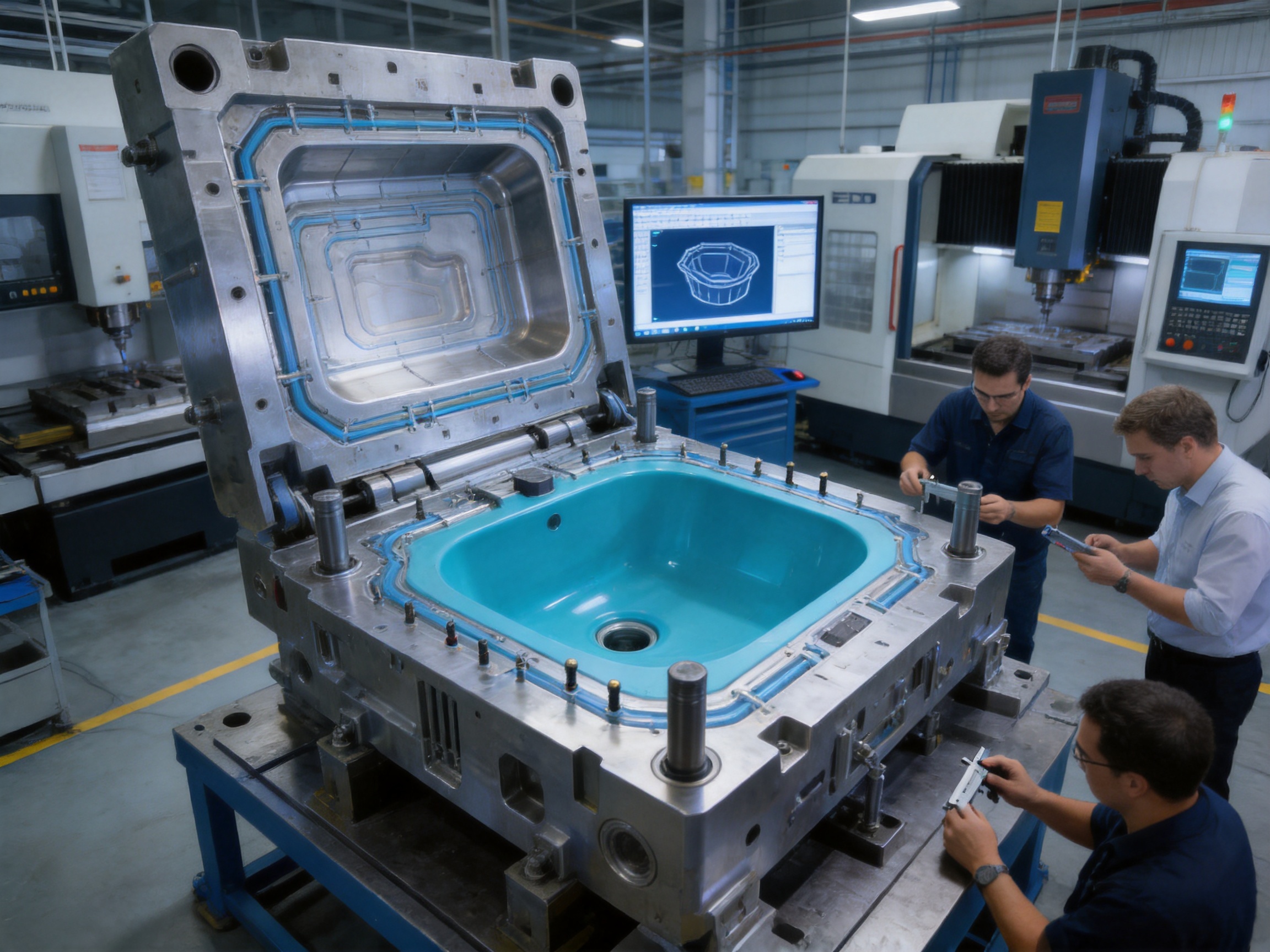
The basin can support washing clothes, soaking fabrics, cleaning household items, and organizing water-based tasks. Its large capacity gives users space to work, while the extra-thick structure improves stability during handling. A smooth internal surface can also make it easier to rinse and clean after use.
Hotels, cleaning contractors, restaurants, schools, and other institutions may require durable basins for routine cleaning operations. In these environments, products are handled frequently and may be exposed to detergents, water, and accidental impact. A robust basin can be more suitable than a lightweight domestic product when reliability and repeated use are priorities.
In homes, gardens, farms, and workshops, a large basin can be used for carrying materials, washing tools, mixing suitable non-hazardous substances, or organizing supplies. The selected plastic must match the chemical and temperature conditions of the intended application. Product claims should always be based on verified material performance and appropriate testing.
The basin may also serve as a temporary storage container for household objects, toys, cleaning equipment, or work materials. If nesting or stacking is incorporated into the design, multiple empty basins can be stored more efficiently during transport and retail display. These features require careful dimensional control so that products can separate easily without excessive friction.
Regular maintenance helps preserve mould performance and extend service life. After production, the mould should be cleaned to remove resin residue, moisture, and contaminants. Cooling channels should be monitored for restricted flow, scale, corrosion, or leakage. The parting surface should be inspected for damage or flash buildup.
Guide pins, bushes, ejector components, slides, and other moving parts should be lubricated according to the mould maker’s recommendations. Excessive or unsuitable lubricant should be avoided because it can contaminate the cavity or affect the product surface. Wear components should be checked at planned intervals rather than waiting for a production failure.
When the mould is stored, the cavity and core should be protected against corrosion, and the mould should be secured in a safe position. Records of production cycles, repairs, part replacements, and recurring defects can help the customer identify trends and plan preventive maintenance. A maintenance schedule is especially valuable for large moulds used in high-volume production.
The development of a large extra-thick washbasin mould involves decisions that influence product quality for years. A supplier should therefore act as an engineering partner rather than simply a tool vendor. Early communication can identify opportunities to improve strength, reduce material, simplify ejection, shorten cycle time, or enhance appearance.
Yingxiang Mould’s focus on customized plastic mould solutions allows the project to be adapted to the buyer’s product and production conditions. Its experience with household products, storage containers, logistics products, pallets, trays, crates, and beverage boxes provides a broad technical base for evaluating large injection-moulded geometries.
The company’s stated priorities include lean manufacturing, long-life moulds, on-time delivery, premium quality, competitive costs, and comprehensive customer service. These priorities align with the needs of buyers who require more than a basic prototype. They support a project approach that considers design, manufacturing, testing, production stability, and after-sales requirements together.
The main benefit is improved structural rigidity and durability. A thick-walled basin can resist bending, impact, and repeated handling more effectively than many lightweight alternatives. Its actual performance depends on the selected plastic, product geometry, mould quality, and processing conditions.
A large basin has a wide projected area, deep cavity, substantial material volume, and potentially uneven cooling requirements. The mould must manage filling pressure, air evacuation, cooling balance, ejection force, and warpage. A standard small-container moulding approach may not provide sufficient control.
Suitable materials may include polypropylene, high-density polyethylene, or other thermoplastics selected according to impact resistance, flexibility, chemical resistance, appearance, temperature exposure, and cost. The final material should be confirmed through product requirements and application testing.
Sink marks can be managed through balanced wall thickness, gradual transitions, appropriate rib design, correct gate placement, sufficient packing, and effective cooling. Local thick sections should be reviewed during product design and CAE analysis. Processing parameters also influence the final result.
Warpage can be reduced through balanced filling, uniform cooling, proper mould support, suitable ejection, controlled packing, and compensation for material shrinkage. The product geometry should also avoid unnecessary asymmetry or abrupt thickness changes. Trial moulding is required to verify the actual result.
Not necessarily. A hot runner may provide benefits in certain high-volume or multi-gate applications, but a cold runner can also be suitable depending on the product, material, machine, production volume, and customer preference. The injection system should be selected after evaluating total cost, maintenance, waste, and filling performance.
The buyer should provide the product drawings or samples, material requirements, expected annual output, machine specifications, surface finish, colour, target weight, packaging requirements, preferred cycle time, and any special features. Clear information helps the manufacturer develop a more accurate quotation and mould design.
Yes. The basin can be customized in length, width, depth, capacity, handle design, base structure, colour, surface finish, logo, and other features. Each change should be reviewed for its influence on filling, cooling, ejection, product strength, and production cost.
Mould life depends on steel quality, product material, production volume, machine operation, maintenance, cycle conditions, and mould structure. A long-life mould is designed with suitable materials, robust components, accurate alignment, effective cooling, and maintainable construction. The expected cycle requirement should be agreed before manufacturing begins.
Trial moulding verifies that the tool can produce acceptable parts under practical conditions. It allows the manufacturer to inspect dimensions, appearance, filling, cooling, ejection, flash, warpage, and cycle performance. Trial results provide an opportunity for controlled adjustments before the mould enters regular production.
TaiZhou HuangYan YingXiang Plastic Mould Co., Ltd. was established in 2012 and operates in Huangyan, Taizhou, Zhejiang, a recognized mould-making region. The company has an approximately 7,000-square-metre plant, around 50 employees, CAD, CAE, and CAM systems, advanced equipment, and experienced technicians. Its product scope includes household moulds, logistics crate moulds, pallet moulds, storage box moulds, beverage box moulds, folding box moulds, and other custom plastic mould solutions.
The customer can begin by sharing the product concept, drawings, three-dimensional model, or sample together with the intended material, dimensions, annual quantity, machine information, and target market. The mould manufacturer can then evaluate manufacturability, recommend design improvements, prepare a mould concept, and discuss tooling cost, schedule, testing, and delivery requirements.
The large, extra-thick washbasin is a practical product with strong potential across household, commercial, cleaning, storage, agricultural, and utility markets. Its principal advantages include improved rigidity, higher resistance to repeated handling, greater load capability, better stability, broad capacity, and a more substantial user experience than many ordinary thin-wall alternatives.
These advantages depend on more than additional plastic. The product must be supported by a carefully engineered mould with balanced filling, effective cooling, reliable ejection, appropriate venting, accurate parting surfaces, and durable construction. Product design, material selection, CAE analysis, machining quality, trial moulding, and maintenance planning all contribute to the final result.
TaiZhou HuangYan YingXiang Plastic Mould Co., Ltd. provides a relevant manufacturing base for this type of project through its experience in customized plastic mould solutions, household products, logistics containers, pallets, trays, crates, storage boxes, and beverage boxes. Its Huangyan location, approximately 7,000-square-metre plant, experienced workforce, CAD, CAE, and CAM capabilities, and focus on long-life moulds support an integrated approach from design evaluation through mould delivery.
For buyers seeking a durable and commercially differentiated washbasin, the best results come from treating the mould as a long-term production asset. A well-planned mould can improve product consistency, reduce production risks, support stable cycle times, and protect the value of the final basin throughout its market life.
1. Society of Plastics Engineers, Injection Molding Fundamentals and Processing Considerations.
2. D.V. Rosato, D.F. Rosato, and M.G. Rosato, Injection Molding Handbook.
3. John P. Beaumont, Runner and Gating Design Handbook for Injection Molding of Plastics.
4. International Organization for Standardization, Plastics — Injection Moulding Materials and Product Quality Principles.
5. Society of Plastics Engineers, Practical Guidelines for Plastic Part and Mould Design.
6. Standard engineering practices for cooling, venting, ejection, and dimensional control in thermoplastic injection moulds.
7. Technical information supplied by TaiZhou HuangYan YingXiang Plastic Mould Co., Ltd. regarding company capabilities, product categories, facilities, and customized plastic mould manufacturing.
If you are interested in any of our products or services, please feel free to ask and we can talk about your ideas.
 QUICK LINKSMOBILE SITE
 FACTORY ADDRESS
 CONTACT INFORMATION



 English
 Español