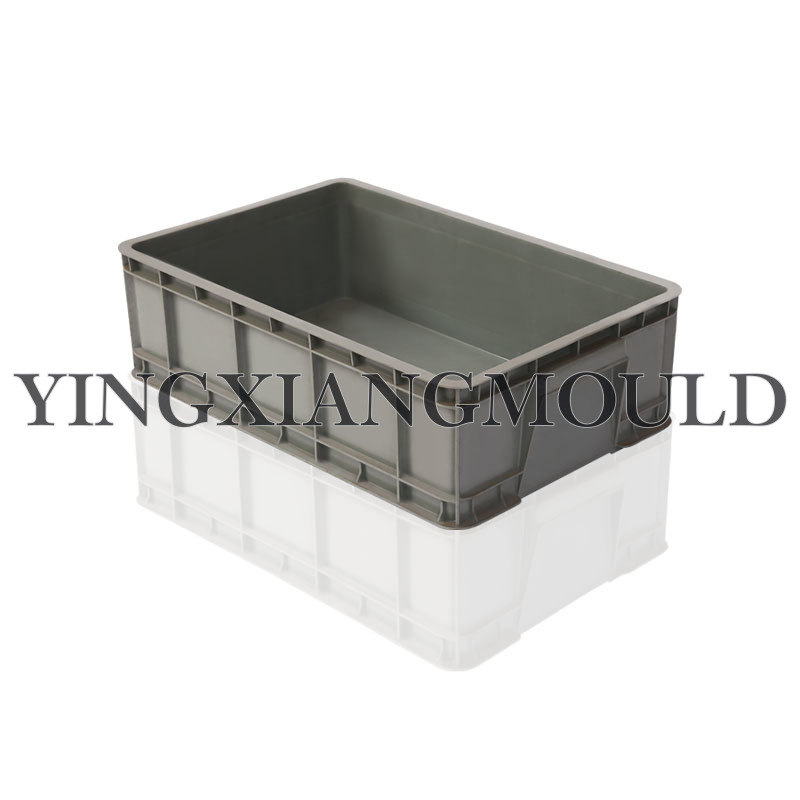
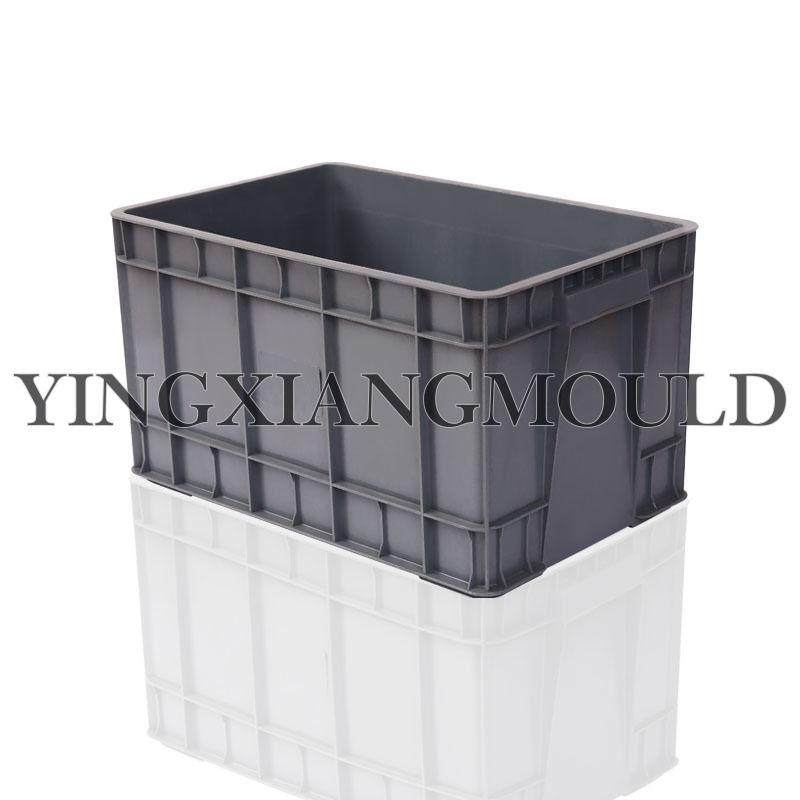
Modern supply chains require storage containers that are durable, hygienic, easy to identify, and efficient to transport. A conventional rigid crate may provide strength, but it occupies the same amount of space whether it is full or empty. A soft bag may save space, but it often lacks stacking stability, protection, and long-term structural performance. The multi-color mesh folding turnover box is designed to balance these requirements in one practical container solution.
With breathable mesh walls, a foldable structure, reinforced handles, impact-resistant plastic construction, and a selection of colors, this folding turnover box supports a wide range of applications. It can be used for fruits and vegetables, food preparation areas, retail handling, express delivery transfer, clothing storage, electronic components, household organization, and other circulation or storage tasks. Its folding function significantly reduces the volume of empty containers, helping users save warehouse space and reduce return-transport costs.
The box is manufactured through plastic injection molding and can be customized in model, color, size, plastic material, and structural details. The related mold solution is suitable for customers seeking dependable production tooling for folding boxes and other plastic packaging products. TaiZhou HuangYan YingXiang Plastic Mould Co., Ltd. combines mold design, engineering analysis, machining, assembly, testing, and production support to deliver customized injection mold solutions for this product category.
In addition to the product’s practical advantages, the mold manufacturing process has a direct effect on service life, dimensional consistency, folding performance, surface quality, and production efficiency. A well-engineered folding box mold must account for the product’s hinges, handles, mesh openings, reinforced edges, stackability, draft angles, cooling requirements, and material flow. These requirements make folding turnover box tooling more demanding than a simple open container mold.

Multi-Color Mesh Folding Turnover Box
The multi-color mesh folding turnover box is a reusable plastic container with ventilated walls and a foldable side-wall structure. When opened, it provides a firm internal cavity for loading and stacking. When empty, the side panels fold inward so that the container occupies only a fraction of its operating height. This feature makes the product suitable for closed-loop logistics systems in which empty containers must be collected, returned, stored, or redistributed.
The product is made from plastic materials selected according to the intended application. Food-grade polypropylene is particularly suitable for fresh produce, food handling, and household storage because it combines low weight, chemical resistance, impact performance, and ease of cleaning. Other available material options may include PC, PS, POM, PE, PU, PVC, ABS, and PMMA, depending on the required mechanical, visual, thermal, or chemical properties.
The box can be produced in multiple colors. Color selection is more than an aesthetic decision. In warehouses, supermarkets, kitchens, workshops, and distribution centers, different colors can be assigned to specific products, departments, shifts, personnel, destinations, or hygiene zones. This visual coding reduces sorting time and helps prevent cross-use between different material categories.
The mesh design creates openings in the walls and bottom of the container. These openings allow air circulation around the contents and can help drain moisture after washing. Ventilation is especially useful for fruits, vegetables, flowers, seafood packaging, clothing, and components that should not remain enclosed in stagnant air. The open structure can also reduce the weight of the finished box compared with a fully solid-wall alternative.
Although the box is lightweight and ventilated, it is not designed as a fragile disposable package. Reinforced folding edges, strengthened side panels, integrated handles, and a stable base contribute to repeated-use performance. The structure is intended to withstand routine handling, stacking, loading, unloading, and transport in commercial and household environments.
Color customization supports visual management throughout the product life cycle. A logistics operator can use one color for a particular customer or route, while a supermarket can allocate different colors to separate vegetables, fruit, bakery products, or returned packaging. A restaurant may use color coding to distinguish raw ingredients from prepared items, and a household may use different colors for toys, laundry, tools, or seasonal goods.
Compared with a single-color container fleet, a multi-color system can make handling more intuitive. Employees can recognize the correct box from a distance without reading labels or checking barcodes. Color does not replace formal tracking systems, but it provides a fast supplementary identification method that is useful in busy operating environments.
The perforated walls and bottom are designed to support ventilation. For fresh produce, air circulation may help reduce the accumulation of heat and moisture during temporary storage and movement. For clothing and household articles, the mesh structure allows the contents to remain less enclosed. For electronic components or industrial parts, the open design can make visual inspection easier while reducing unnecessary packaging mass.
The mesh pattern must be carefully engineered. Openings need to be large enough to provide effective airflow and reduce weight, but small enough to prevent excessive loss of contents and maintain structural strength. The arrangement of ribs around the openings affects both appearance and load-bearing performance. Uniform wall thickness and balanced material flow are also important for avoiding warpage and weak points during injection molding.
One of the most significant advantages of the product is its ability to fold when empty. According to the supplied product information, the folded thickness can be approximately one-fifth of the unfolded size. The exact result depends on the final design, wall height, hinge arrangement, and folding direction, but the operating principle remains the same: empty boxes require much less space than full-height rigid containers.
This reduction provides benefits in several stages of the supply chain. Empty boxes can be returned from retail locations to distribution centers with fewer vehicle trips or more units per trip. Warehouses can store larger numbers of folded units in the same floor area. Restaurants, shops, and homes can put away unused boxes without dedicating an entire room or shelf to rigid containers. The reduction in empty volume can also improve handling efficiency during seasonal fluctuations in demand.
The side walls include reinforced handle areas to provide a secure gripping position. Handles must be comfortable enough for repeated lifting while remaining strong under loaded conditions. A poorly designed handle can cause pressure points, cracking, or deformation, particularly when the box is moved by workers wearing gloves or when it is lifted from a low position.
The integrated handle design avoids the need for separate metal or fabric components that could become loose, corroded, contaminated, or lost. Because the handles are formed as part of the injection-molded structure, their dimensions and position can be controlled consistently from unit to unit. The handle area can also be reinforced with ribs or locally increased material thickness where necessary.
Reusable turnover boxes are exposed to repeated impacts. They may be placed on floors, pushed across warehouse surfaces, loaded into vehicles, or stacked with other containers. Food-grade polypropylene is commonly selected for this type of application because it offers a favorable balance between impact resistance, weight, chemical resistance, and cost.
Material selection should be based on actual working conditions. Temperature, ultraviolet exposure, cleaning chemicals, impact frequency, load weight, and contact with food or industrial substances can all influence the most suitable resin. The mold manufacturer can work with the customer to align plastic selection with product performance requirements, production conditions, and target market regulations.
The upper edges and folding zones are strengthened to improve rigidity when the box is open. Reinforced edges help maintain the shape of the container and create a more stable contact area for stacking. Stable stacking is especially important in supermarkets, warehouses, delivery hubs, and processing facilities where floor space is limited.
A stackable folding box should remain secure whether it is fully loaded, partially loaded, or empty. The design must control the interaction between the upper rim, lower base, folded walls, and adjacent boxes. Small dimensional deviations may become noticeable when many units are stacked, so mold precision and process control are essential.
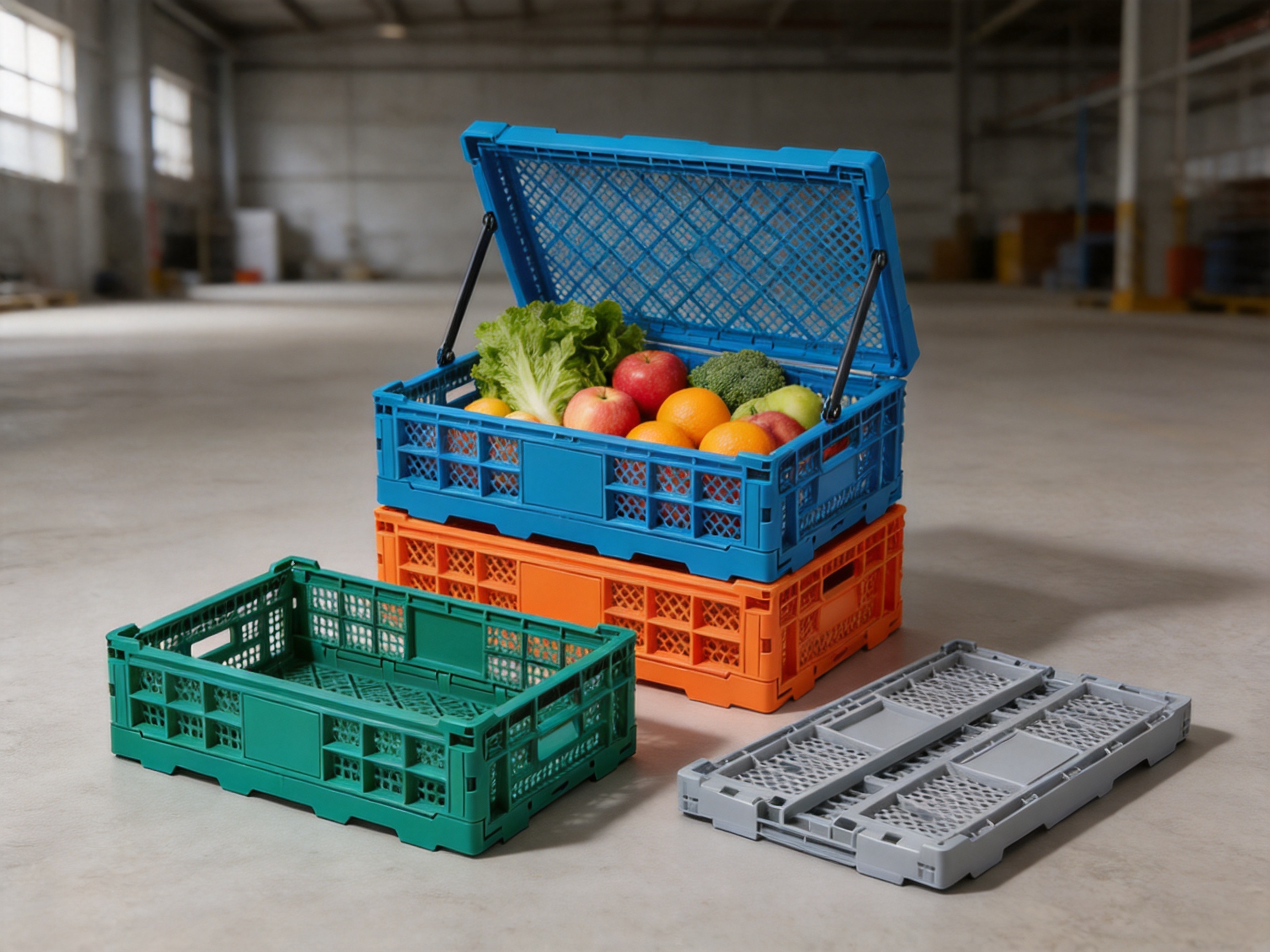
Fixed rigid crates are often dependable when loaded, but their full height remains unchanged after unloading. During reverse logistics, this can lead to inefficient use of truck capacity and warehouse space. The folding turnover box addresses this weakness by reducing its height when empty. Users can return or store more containers without increasing the number of trips or expanding storage areas.
This advantage is particularly relevant to businesses with high container circulation. Fresh produce distributors, courier companies, supermarkets, food service operators, and industrial parts suppliers may move empty packaging every day. A foldable container can improve the economics of the entire circulation system rather than simply improving the performance of one loading operation.
Soft bags are inexpensive and easy to fold, but they may collapse under load and do not normally provide reliable stacking. Their contents can also be more difficult to organize, inspect, or protect. The mesh folding box preserves a defined shape when opened, allowing users to load articles in a more orderly manner and place boxes on top of one another.
The rigid base helps support the contents, while the side walls provide a degree of separation and protection. At the same time, the box remains more space-efficient than a fully rigid container when it is not in use. This combination of structure and collapsibility gives it a practical advantage over storage formats that provide only one of these characteristics.
Solid-wall storage containers can protect contents from external contact, but they may restrict airflow. For products sensitive to heat or moisture, a mesh container can be more suitable. The ventilated design also makes it easier to see whether a box is full, empty, clean, or in need of inspection.
Of course, the mesh structure is not intended to replace sealed packaging where liquid containment, dust protection, or sterile conditions are required. Its advantage is found in applications where ventilation, drainage, visibility, and moderate protection are more important than complete enclosure.
Disposable cartons and single-use plastic bags are usually designed for one product or one delivery cycle. The folding turnover box is reusable and can serve multiple functions during its service life. The same basic design can be used in production, distribution, retail display, back-room storage, and household organization.
Multiple colors and customizable dimensions further expand its usefulness. A customer can specify a format for a particular product range, operating aisle, vehicle, or shelf system. This flexibility can reduce the need to maintain several unrelated packaging formats.
Unreinforced plastic containers may deform around the handles or edges after repeated use. The folding turnover box incorporates strengthened areas in locations that experience frequent loads. Reinforced handles support safer manual handling, while thickened folding edges help maintain the geometry of the open box.
These design details are important because practical container performance depends on more than the nominal resin grade. A well-designed structure distributes stress across ribs, corners, handles, and base sections instead of concentrating it in one thin wall.
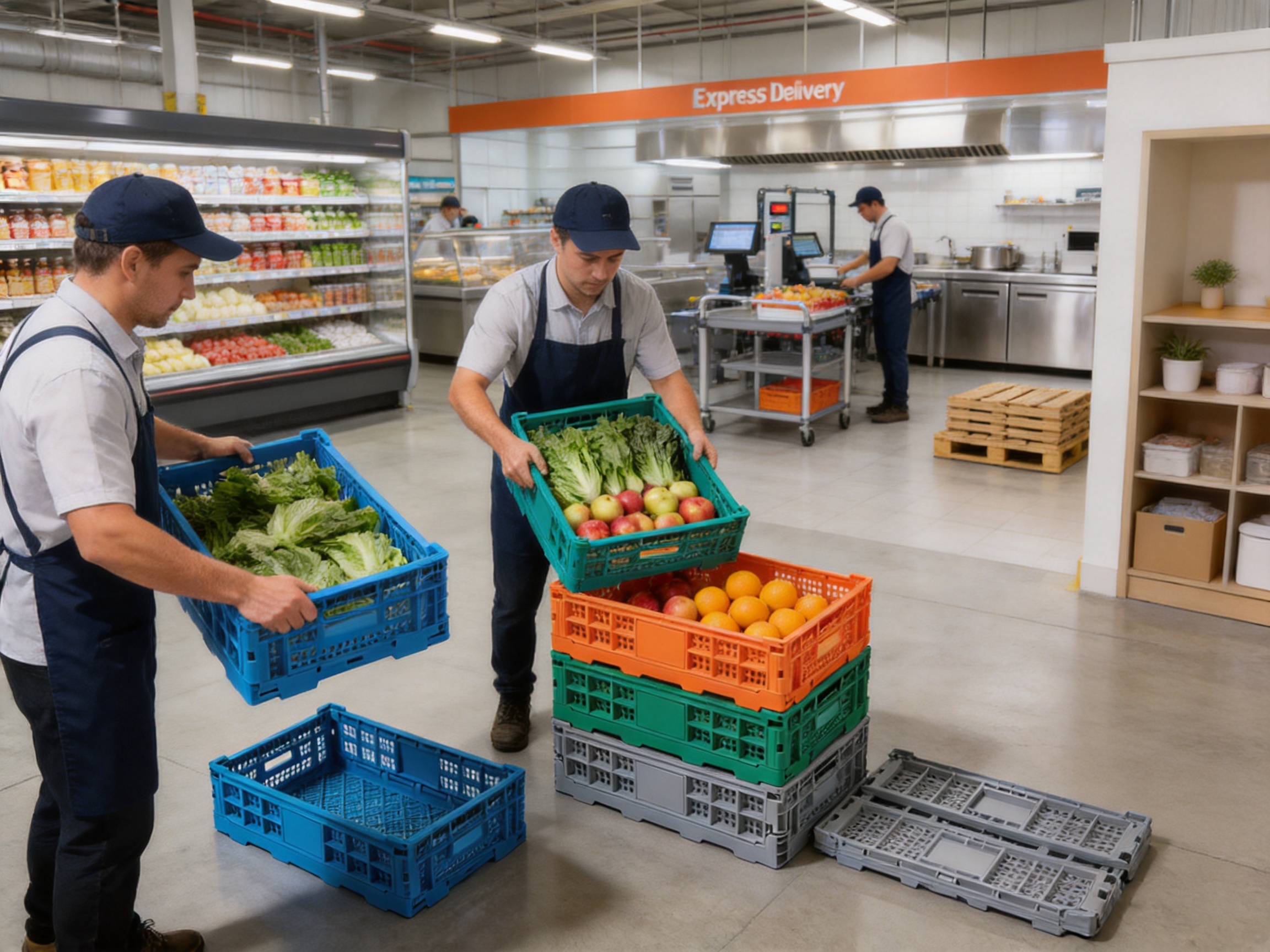
Fresh produce departments require containers that support ventilation, rapid handling, easy cleaning, and quick visual identification. The mesh folding turnover box can be used for fruits, vegetables, mushrooms, herbs, and other products that benefit from airflow during short-term handling and display preparation.
When the boxes are empty, they can be folded and moved to the receiving area or stored beneath shelving. Different colors can support product separation or identify the source of goods. The box can also be used behind the sales floor for replenishment, helping staff move products from receiving to display without transferring them between multiple packaging types.
In commercial kitchens, storage space is valuable and cleaning routines are frequent. A washable plastic container with ventilated walls can help organize ingredients, utensils, packaging supplies, and non-sensitive kitchen articles. Color allocation can separate preparation areas or distinguish different handling categories.
Food-contact applications should always be matched with appropriate resin selection, cleaning procedures, and local regulatory requirements. The product information identifies food-grade polypropylene as a suitable material option, while the final compliance requirements should be confirmed for the intended market and use conditions.
Express delivery centers and distribution hubs handle large quantities of parcels and components under time pressure. Folding boxes can be used for internal transfer, sorting, temporary storage, and empty-container return. Their handles help workers move them between stations, while the open mesh design allows quick visual checking of contents.
The color system can support route or zone allocation. For example, different colors may represent delivery regions, processing lines, or priority categories. When the box is no longer needed at a station, it can be folded to reduce obstruction around conveyors, loading bays, and worktables.
The product is also suitable for household organization. It can hold clothing, linens, toys, books, gardening items, cleaning supplies, or seasonal goods. The mesh construction allows users to see the general contents without opening the box, and the folding function makes it convenient for occasional use.
In homes with limited storage space, a collapsible container can be more practical than a fixed plastic bin. It can be opened when needed and folded flat or partially folded when the contents have been removed. The choice of colors can support room organization or family member allocation.
Workshops and production facilities often require reusable containers for small parts, fittings, tools, and work-in-progress items. The box can support line-side organization while its multiple color options help distinguish part families, production stages, or inspection status.
For electronic components, the final plastic selection and electrostatic-control requirements should be evaluated carefully. The standard product description includes several plastic material options, but specialized applications may require a resin or additive system with specific electrical properties.
A folding box mold must produce more than a simple rectangular cavity. The tooling needs to form large mesh surfaces, functional hinges or folding joints, reinforced handles, stacking features, and accurately aligned edges. These components must work together after molding and throughout repeated opening and closing cycles.
Before manufacturing begins, the product geometry should be reviewed using three-dimensional CAD data. Engineers evaluate wall thickness, draft angles, rib layout, gate positions, ejection areas, parting lines, and potential undercuts. For complex structures, CAE analysis can help identify filling behavior, weld-line locations, air-trap risks, shrinkage, and likely warpage.
Mesh openings require precise steel details and adequate cooling around narrow ribs. If the ribs are too thin, they may not fill consistently or may wear prematurely. If the openings are poorly balanced, the part may show uneven shrinkage or local deformation. The mold must also release the molded part without damaging the mesh edges.
The arrangement of openings influences both mold machining and injection performance. A balanced pattern can improve material flow and reduce pressure differences across the panel. The final design may include different rib thicknesses or local reinforcements around handles, corners, and folding joints.
Folding areas require particular attention because they experience repeated movement. The mold must reproduce the intended joint geometry with consistent thickness and smooth transitions. Sharp corners can create stress concentration, while excessive thickness may make folding difficult.
Material orientation caused by injection flow can influence hinge durability. Gate location, flow length, packing pressure, and cooling conditions should therefore be considered together. The objective is to create a folding joint that opens and closes smoothly while maintaining sufficient resistance to fatigue during normal use.
Handle openings must be comfortable to grip and strong enough to support the expected loaded weight. Mold design should avoid abrupt thickness changes that could cause sink marks, voids, or weak weld lines. Reinforcing ribs can be positioned around the handle perimeter, but they should not create uncomfortable edges or interfere with the user’s hand.
In production, the handle area should be inspected for flash, incomplete filling, deformation, and dimensional consistency. These defects can affect both user comfort and structural reliability. A robust mold and a controlled injection process are essential for maintaining the handle’s intended function.
The upper rim and lower base must be designed as a coordinated system. The rim should provide stable contact with the box above, while the base should distribute load without excessive deformation. Folding side panels must lock or align correctly when open so that the container retains its shape during stacking.
Dimensional control is especially important when the boxes will be used in large quantities. Small differences in height or rim position can accumulate across a stack. Precision machining, careful mold assembly, and sample testing help confirm that the finished units meet the customer’s stacking requirements.
Plastic injection molding productivity depends heavily on cooling. Uneven cooling can cause warpage, especially in large panels with varying rib density and wall thickness. Properly designed cooling channels help control shrinkage and shorten cycle time without compromising product quality.
The mold engineering team must balance cooling-channel placement with the available space around mesh cores, slides, lifters, hinges, and other mechanisms. A well-designed cooling system contributes to dimensional stability, consistent folding action, improved surface appearance, and higher production efficiency.
The manufacturing process begins with a clear understanding of the customer’s intended use. Engineers review required dimensions, load capacity, stacking conditions, folding frequency, color requirements, resin selection, surface finish, production quantity, and packaging expectations.
Using CAD, CAE, and CAM systems, the design is developed from concept through detailed mold construction. Three-dimensional modeling allows the team to study the relationship between the box, folding mechanisms, handles, mesh patterns, and stacking surfaces before steel is cut. This early review can reduce design changes during machining and improve the chance of a successful first trial.
The supplied mold material options include 1CR13, 2CR13, 3CR13, 4CR13, S136, CR16, 2316, 718H, P20, and other suitable grades. The appropriate steel depends on expected production volume, corrosion resistance requirements, plastic material, surface finish, mechanical wear, and budget.
For molds used with moisture-prone materials or applications requiring frequent cleaning, corrosion-resistant steel can be beneficial. For general-purpose production, pre-hardened mold steels may offer a practical balance between machinability, strength, and cost. The final choice should be made according to the technical specification rather than by selecting the most expensive material in every case.
High-quality machining is important for large folding boxes because the mold contains many fine ribs, openings, moving elements, and functional interfaces. CNC machining, electrical discharge machining, grinding, drilling, and fitting operations may all be required to achieve the intended geometry.
Mesh cores and narrow ribs must be manufactured accurately so that the openings remain consistent throughout the part. Moving components such as slides and lifters must travel smoothly and align correctly. Precision machining also reduces the risk of flash, mismatch, sticking, and premature wear during mass production.
After individual mold components are machined, they are assembled and fitted. This stage confirms the relationship between the cavity, core, inserts, ejector system, guide components, cooling circuits, and any folding or side-action mechanisms. Skilled technicians examine contact surfaces and adjust the mold where necessary.
Fitting quality directly affects the final product. Even if each component meets its individual drawing, the assembled mold must also operate as a unified system. Proper alignment helps maintain parting-line quality, prevent unwanted flash, and support smooth mold opening and closing.
Trial molding is used to verify filling, cooling, ejection, folding action, surface appearance, and product dimensions. Engineers inspect the sample for short shots, sink marks, weld lines, burn marks, warpage, flash, and deformation around the handles or mesh ribs.
Process parameters may be adjusted during the trial stage. Injection speed, pressure, holding time, cooling time, melt temperature, mold temperature, and ejection timing can all influence the final result. If a structural issue is identified, the mold may require modification before final acceptance.
Finished samples should be checked against the approved drawings or technical specifications. Measurements may include external dimensions, wall thickness, box height, handle size, folding clearance, rim alignment, opening dimensions, and base flatness.
Functional tests can include repeated opening and folding, loaded lifting, stacking, impact evaluation, cleaning compatibility, and visual inspection. The appropriate test program depends on the customer’s application. A box intended for household storage may require different validation from one used in intensive distribution or fresh-produce circulation.
Completed molds are prepared for shipment in composite wooden boxes. Proper packaging protects precision components from moisture, impact, contamination, and movement during transport. Documentation may include mold drawings, maintenance recommendations, spare-part information, trial reports, and operating notes as agreed with the customer.
Yingxiang reports a supply capacity of approximately 50 mold sets per month. This capacity supports customers requiring both individual custom projects and continuing mold development across several plastic product categories.
TaiZhou HuangYan YingXiang Plastic Mould Co., Ltd. was established in 2012 and is located in Huangyan, Taizhou, Zhejiang, China, a region widely associated with plastic mold manufacturing. The company operates a plant of approximately 7,000 square meters and has around 50 employees, including experienced technicians and engineering personnel.
The company uses CAD, CAE, and CAM systems to support product development and mold engineering. These digital tools help connect design, analysis, machining, and production. For complex folding box molds, this connection is important because changes to one feature may affect mold structure, injection balance, cooling, ejection, and assembly.
Yingxiang specializes in customized plastic mold solutions. Its product range includes crate molds, folding box molds, tray molds, pallet molds, beverage box molds, and molds for daily household products. This experience gives the company familiarity with large-format injection molding, repeated-use packaging, ventilation structures, reinforced corners, handles, stacking features, and other practical container details.
The company’s manufacturing approach emphasizes lean production, long mold life, on-time delivery, competitive cost, and customer service. These priorities are relevant to folding box projects because customers generally require more than a visually attractive sample. They need tooling that can operate consistently, support the required cycle time, and remain serviceable throughout the expected production period.
The availability of OEM service allows customers to develop boxes according to their own dimensions, color systems, branding requirements, loading conditions, and application environments. Customization may include the overall box size, mesh arrangement, base structure, handle shape, stacking interface, folding mechanism, surface texture, and resin selection.
Because product specifications differ between markets, engineering communication is essential. The supplier can review the customer’s drawings, product samples, reference images, or functional requirements before confirming the mold structure. This project-based approach is more suitable for professional packaging programs than relying only on a standard, non-adjustable design.
| Customization Area | Available Direction | Practical Purpose |
|---|---|---|
| Product dimensions | Customized length, width, and height | Matching shelves, pallets, vehicles, and product sizes |
| Color | Multiple customer-selected colors | Visual classification by product, department, route, or user |
| Plastic material | PP, PC, PS, POM, PE, PU, PVC, ABS, PMMA, and other options | Balancing impact, chemical, thermal, visual, and application requirements |
| Mold steel | 1CR13, 2CR13, 3CR13, 4CR13, S136, CR16, 2316, 718H, P20, and others | Selecting durability and corrosion resistance for the expected production program |
| Mesh structure | Customized opening shape, spacing, and rib arrangement | Balancing ventilation, weight, visibility, and strength |
| Handle design | Customized opening, reinforcement, and grip position | Improving lifting comfort and load performance |
| Stacking system | Customized rim, base, and alignment features | Supporting stable stacking and warehouse organization |
| Surface finish | Texture or smooth finish according to requirements | Influencing appearance, grip, release, and scratch visibility |
| OEM details | Customer-specific identification or structural details | Supporting private-label and application-specific product programs |
Customization should be evaluated as a complete system. Increasing the box size may require additional reinforcement, stronger handles, revised cooling, or changes to the injection machine requirements. A finer mesh may improve ventilation but make the mold more complex. A heavier load rating may require thicker ribs or a different resin. By reviewing these factors together, the customer can avoid solving one requirement at the expense of another.
The folding turnover box is a reusable product, and its primary environmental advantage comes from repeated circulation. A container that remains in service for many handling cycles can reduce dependence on disposable cartons, thin bags, or one-time packaging formats. Its foldability also supports more efficient empty transport and storage.
Material efficiency should be considered alongside service life. A lightweight design can reduce resin consumption and handling weight, but excessive material reduction may shorten durability. The most effective design uses ribs, mesh openings, reinforced edges, and material distribution to achieve the necessary strength without making every section unnecessarily thick.
At the end of its useful life, recyclability depends on the resin type, additives, contamination level, local collection systems, and product construction. Using a clearly identified plastic material can support appropriate sorting. Customers should establish cleaning, inspection, repair, and replacement procedures to maximize the useful life of the box fleet.
Operational sustainability also includes labor and space efficiency. A box that is easier to identify, carry, stack, clean, and return can reduce wasted motion and unnecessary handling. These improvements may be modest for one unit but significant across thousands of containers circulating through a supply chain.
Before first use, the boxes should be inspected for sharp flash, incomplete folding, foreign material, and damage caused during transport. Any abnormality should be reported before the boxes enter a production or food-handling system.
Users should avoid loading the container beyond its intended capacity. Heavy products should be distributed evenly across the base rather than concentrated in one corner or against one handle. When stacking, the boxes should be fully opened and correctly aligned. A partially folded box should not be used as a load-bearing container unless the design specifically permits that condition.
Cleaning procedures should match the selected plastic material and the operating environment. Strong chemicals, excessive heat, or abrasive tools may damage certain resins or surface finishes. After washing, the mesh design can help water drain and air circulate, but boxes should still be allowed to dry properly before use in hygiene-sensitive applications.
Regular inspection should focus on handles, hinges, folding edges, corners, base ribs, and stacking surfaces. Cracks, severe deformation, broken ribs, or loose folding joints may indicate that a box should be removed from service. A planned inspection program is more reliable than waiting for a failure during transport.
For mold owners, maintenance should include cleaning the cavity and core surfaces, checking cooling channels, lubricating moving components where appropriate, inspecting ejector pins and slides, and protecting the mold against corrosion during storage. Preventive maintenance can reduce downtime and preserve the dimensional consistency of future production runs.
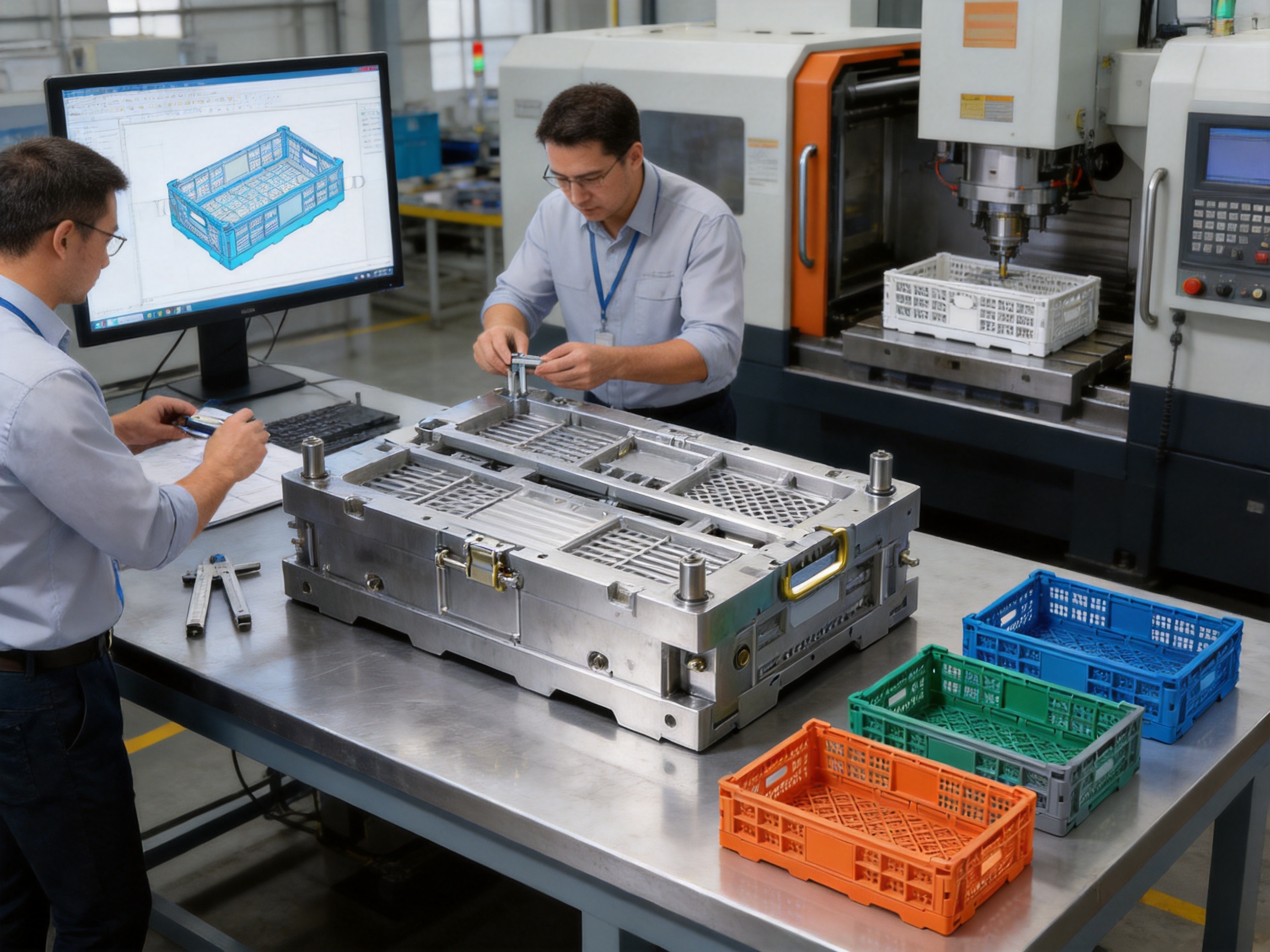
The performance of a folding turnover box begins with the mold. If the cavity dimensions are inconsistent, the finished box may not fold smoothly or stack correctly. If the mesh cores are misaligned, the openings may vary or produce excessive flash. If cooling is unbalanced, the side walls may warp and the handles may not remain in their intended position.
Mold quality also affects production economics. A stable mold reduces rejected parts, repeated adjustments, machine stoppages, and unplanned repairs. It supports predictable cycle times and makes it easier for the processor to maintain consistent color, weight, dimensions, and folding behavior across production batches.
For customers purchasing a mold rather than finished boxes, the engineering partnership is therefore as important as the steel and machining. The supplier must understand how the box will be used, what resin will be processed, what machine will be installed, and what output level is expected. A mold designed without this information may work in a trial but fail to deliver reliable commercial production.
Yingxiang’s experience with crate, folding box, pallet, tray, beverage box, and household product molds supports a practical understanding of these requirements. Its equipment, technical personnel, and digital design systems are intended to connect the customer’s product concept with a production-ready injection mold.
When selecting a supplier for a mesh folding box mold, customers should first define the product’s operating requirements. Important questions include the expected box load, folding frequency, stack height, ambient temperature, cleaning method, plastic resin, production quantity, and target service life.
Customers should also request a clear mold specification. This may include the mold dimensions, estimated weight, number of cavities, recommended injection machine size, cycle-time target, steel grade, cooling arrangement, ejection system, hot-runner or cold-runner configuration, spare parts, and acceptance criteria.
Sample approval should cover both appearance and function. A visually acceptable sample may still have problems with folding force, handle strength, base flatness, stacking alignment, or long-term fatigue. Where the box will be used intensively, functional testing should be agreed before the mold is accepted.
Communication about color and material is equally important. Different colors or additives can influence processing behavior, while recycled content, fillers, or special performance modifiers may affect shrinkage and surface finish. The mold and process should be developed around the resin that will actually be used in production.
After-sales support should include maintenance guidance, technical communication, replacement-part availability, and assistance with process optimization. A long-term supplier relationship can be valuable when the customer later introduces a larger size, a new mesh pattern, a different stacking system, or an additional color-coded product line.
The main advantage is the combination of ventilation, reusable strength, stacking capability, and reduced empty-storage volume. Unlike a fixed rigid crate, it can be folded when empty. Unlike a soft bag, it provides a stable container shape when opened.
The supplied material options include PP, PC, PS, POM, PE, PU, PVC, ABS, PMMA, and other plastics. Food-grade polypropylene is identified as a suitable choice for many fresh-produce, food-service, and household applications. The final material should be selected according to load, temperature, chemical exposure, impact, appearance, and regulatory requirements.
Yes. Color is customizable and can be used for product classification, route management, departmental allocation, hygiene separation, or household organization. The customer should confirm the required color system and resin additives during the design stage.
Yes. The model and size can be customized. Dimensions should be developed together with the intended shelf space, pallet size, vehicle interior, product dimensions, stacking height, and injection machine capacity.
Typical applications include fruits, vegetables, clothing, electronic components, household articles, kitchen supplies, parcels, and industrial parts. The open mesh structure is most suitable where ventilation, visibility, and drainage are useful. It is not intended to replace sealed packaging for liquids, dust-sensitive products, or sterile applications.
The supplied product information states that the folded thickness can be approximately one-fifth of the unfolded size. The exact space reduction depends on the final dimensions and folding geometry. Customers should confirm the folded dimensions during product and mold design.
Yes. The product includes thickened folding edges and a structure designed for multi-layer stacking. The actual stacking limit depends on the box dimensions, resin, load distribution, environmental conditions, and final engineering specification.
The side walls feature reinforced handles intended to provide a secure and comfortable grip. The allowable load should be validated through testing based on the selected resin, handle structure, box dimensions, and intended handling method.
Available options include 1CR13, 2CR13, 3CR13, 4CR13, S136, CR16, 2316, 718H, P20, and other grades. Steel selection depends on production volume, corrosion conditions, plastic material, surface requirements, and the desired mold service life.
Yes. OEM service is available. Customers can request customized dimensions, colors, mesh layouts, handles, stacking features, materials, surface finishes, and other structural details.
The company uses CAD, CAE, and CAM systems. These tools support three-dimensional product design, filling and deformation analysis, machining preparation, and communication between engineering and manufacturing teams.
The supplied information indicates a capacity of approximately 50 mold sets per month. The actual schedule for a specific project depends on mold complexity, order quantity, design approval, material selection, and production planning.
TaiZhou HuangYan YingXiang Plastic Mould Co., Ltd. is located at No. 2 Chaoyuan Road, North City Street, Huangyan, Taizhou, Zhejiang, China 318020.
Customers should provide product drawings, three-dimensional files, physical samples, reference images, or a written description of the required function. They should also specify resin, annual output, machine information, load requirements, folding cycles, stacking conditions, and target delivery schedule.
The multi-color mesh folding turnover box is a practical response to the combined demands of modern storage and logistics. Its ventilated walls support air circulation and visibility, while the folding structure reduces empty volume for return transport and storage. Reinforced handles improve manual handling, thickened edges support stacking, and impact-resistant plastic enables repeated use in commercial, industrial, and household environments.
Its advantages become particularly clear when compared with conventional alternatives. It is more space-efficient than a fixed rigid crate during reverse logistics, more structured than a soft storage bag, more breathable than a fully enclosed container, and more adaptable than single-purpose disposable packaging. Multi-color production adds a useful visual-management function that can simplify sorting and allocation.
The performance of this product depends heavily on the quality of its injection mold. Mesh openings, folding joints, handles, ribs, cooling channels, stacking interfaces, and ejection systems must all be designed as part of one coordinated structure. Precision engineering and controlled manufacturing help ensure that the finished box folds smoothly, stacks consistently, withstands repeated handling, and remains economical to produce.
With a 7,000-square-meter plant, around 50 employees, CAD/CAE/CAM capabilities, experienced technicians, OEM service, and specialization in crate, folding box, pallet, tray, beverage box, and household product molds, Yingxiang provides a complete foundation for customized plastic injection mold projects. The company’s focus on long mold life, lean manufacturing, delivery performance, competitive cost, and customer service makes it a suitable partner for businesses developing reusable plastic packaging and storage systems.
For companies seeking a container that balances ventilation, durability, color management, stacking, and space saving, the multi-color mesh folding turnover box offers a versatile solution. For customers requiring reliable tooling, a professionally engineered folding box mold is the essential first step toward stable, high-volume production.
1. Product specification and application information supplied for the multi-color mesh folding turnover box.
2. Company information supplied for TaiZhou HuangYan YingXiang Plastic Mould Co., Ltd., including company history, facility size, personnel, equipment, product categories, and manufacturing capabilities.
3. General principles of plastic injection mold design, including parting-line planning, draft-angle design, cooling, ejection, material flow, and dimensional control.
4. General engineering guidance for reusable plastic containers, folding packaging, stackable crates, and returnable logistics systems.
5. General material-selection considerations for polypropylene and other thermoplastic resins used in injection-molded storage and transport products.
6. General quality-control practices for injection-molded parts, including visual inspection, dimensional verification, functional testing, and preventive mold maintenance.
If you are interested in any of our products or services, please feel free to ask and we can talk about your ideas.
 QUICK LINKSMOBILE SITE
 FACTORY ADDRESS
 CONTACT INFORMATION



 English
 Español