
Openwork Wastepaper Basket with Retaining Ring
An openwork wastepaper basket with a retaining ring is a practical household product designed to combine visual lightness, dependable waste containment, easy cleaning, and efficient production. Although a wastepaper basket may appear simple, its performance depends on numerous carefully coordinated details: the geometry of the perforated or openwork body, the rigidity of the rim, the stability of the base, the fit of the retaining ring, the quality of the mould surface, and the consistency of the injection-moulding process.
For distributors, product brands, household-goods manufacturers, and injection-moulding companies, the mould is the foundation of all these characteristics. A well-engineered mould does more than reproduce the general shape of a basket. It controls wall thickness, opening definition, parting-line quality, ejection reliability, assembly accuracy, cycle stability, and long-term production cost. The mould must also accommodate the special challenges created by a basket body containing repeated openings and a separate or integrated retaining ring.
TaiZhou HuangYan YingXiang Plastic Mould Co., Ltd. develops customized plastic mould solutions for household products, storage containers, logistics crates, folding boxes, pallets, trays, beverage boxes, chairs, stools, and other injection-moulded products. Based in Huangyan, Taizhou, Zhejiang, China, the company combines design capability, mould-making experience, modern CAD/CAE/CAM systems, production equipment, and practical knowledge of high-volume plastic manufacturing.
This article examines the product from both the buyer’s and mould-engineering perspectives. It explains how an openwork wastepaper basket with a retaining ring creates advantages in daily use, why its mould structure requires careful engineering, how manufacturing technology affects product quality, and which factors should be considered when selecting a mould supplier.
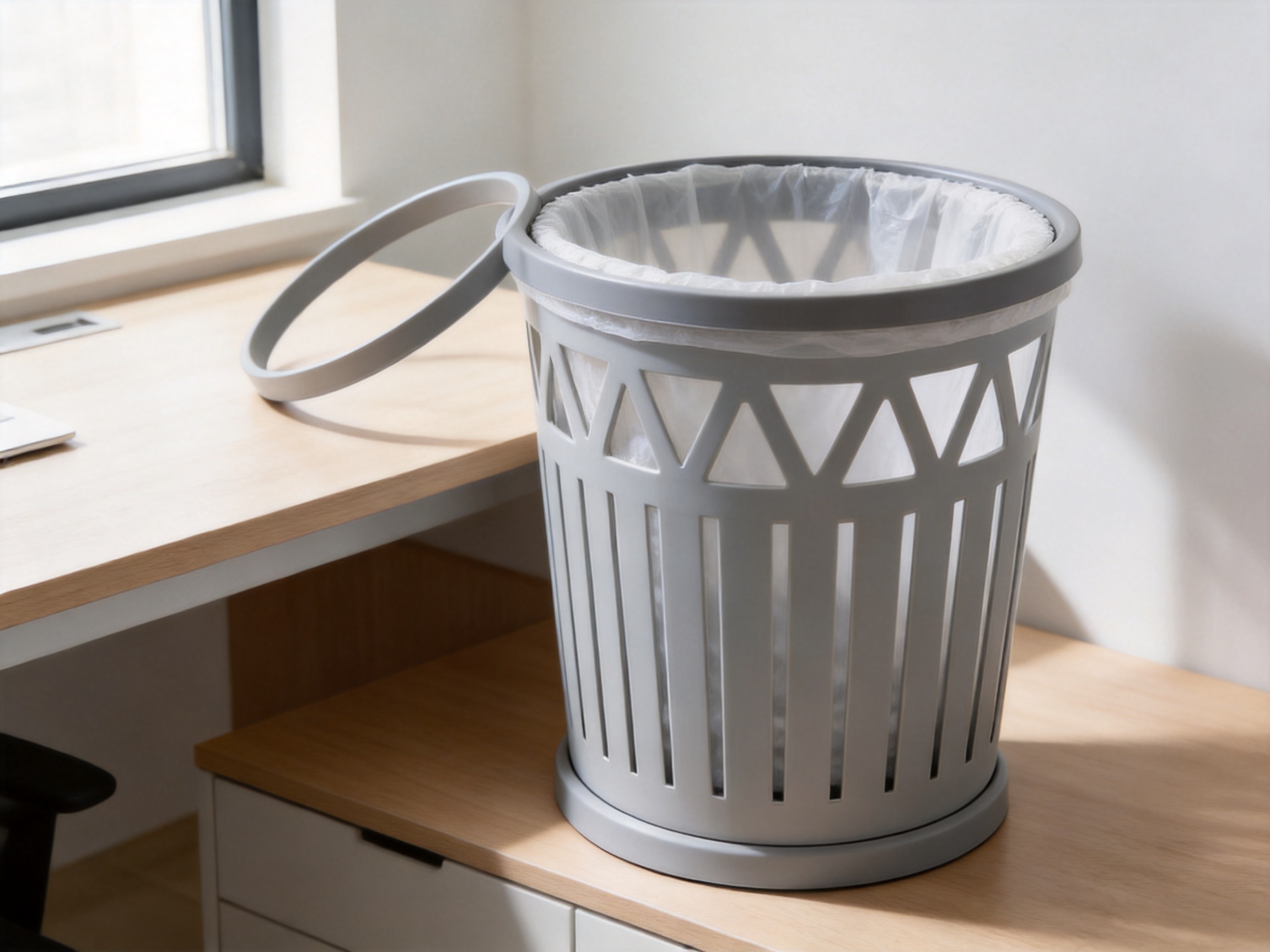
The openwork wastepaper basket with a retaining ring is a lightweight plastic waste container intended for offices, bedrooms, classrooms, commercial spaces, hotels, public facilities, and general household use. Its body generally consists of an openwork wall with repeated windows, slots, perforations, or decorative cut-outs. A retaining ring is positioned around the upper edge to help hold a disposable liner, paper bag, or plastic bag in place.
The product’s open structure gives it a distinctive appearance compared with a conventional solid-wall bin. It may also reduce material usage, improve visual integration with modern interiors, and allow users to see whether the basket needs emptying. The retaining ring adds functional value by concealing the liner edge and reducing the possibility of the bag slipping into the container during use.
From a mould-development standpoint, the product is more demanding than a plain cylindrical wastebasket. The openwork sections create many transitions between solid ribs and empty spaces. These transitions must fill evenly during injection. The retaining ring must be dimensionally consistent so that it can engage with the basket body accurately. The upper rim must also remain strong enough to resist deformation when the user installs or removes a liner.
A successful mould therefore requires a balance between appearance, structural performance, manufacturability, and cost. The design must be attractive to consumers, practical for daily use, suitable for automatic or semi-automatic production, and stable over a long service life.
Openwork construction can reduce the amount of plastic required compared with a fully solid container of similar external dimensions. Lower material consumption may reduce the part weight and improve handling during transport, stocking, and daily use. A lightweight basket is easier to move, empty, and clean, especially in environments where several units are handled each day.
Material reduction must not compromise rigidity. The ribs surrounding the openings must be designed to distribute loads around the basket wall. A strong upper rim, a stable lower section, and well-positioned vertical or diagonal ribs can help the product retain its shape while maintaining a relatively low weight.
The openwork pattern provides a decorative appearance that can be adapted to different markets. Regular geometric openings create a clean and orderly look, while rounded or organic openings may produce a softer household style. The same fundamental basket concept can be customized with different colours, patterns, surface textures, logos, and proportions.
Because the product is often placed in visible locations, appearance is important. A mould with accurate cavity machining can reproduce consistent openings, smooth transitions, and a uniform rim. Any mismatch between mould components may be noticeable along the openwork edges, so mould precision directly affects the perceived quality of the finished basket.
The retaining ring is one of the product’s most useful features. Without a dedicated ring, a disposable liner may slide downward when waste is placed inside the basket. The liner may also fold over unevenly, creating an untidy appearance. A retaining ring helps secure the upper edge of the liner around the basket and can cover the folded material from ordinary view.
Correct ring tension is essential. If the ring is too loose, the liner may not remain secure. If it is too tight, users may find it difficult to install or remove the ring. The mould must therefore produce consistent dimensions on both the basket rim and the retaining ring. The relationship between these parts should be evaluated through tolerance analysis, trial assembly, and repeated installation testing.
The lightweight body and open structure can make the basket easy to handle. The smooth plastic surface generally allows routine wiping and cleaning. Compared with porous materials, injection-moulded plastic is less likely to absorb moisture, odours, or stains. Rounded corners and carefully controlled transitions can further reduce locations where dirt accumulates.
The retaining ring can usually be removed when the basket requires a more thorough cleaning. A well-designed ring should be removable without excessive force while remaining secure during normal operation. The design of finger-access areas, snap features, and local clearances should be considered during the mould-development stage.
An openwork wastepaper basket can serve many environments. In offices, it can be used beside desks or workstations. In bedrooms and living areas, its decorative form can complement interior furnishings. In schools, it can offer a practical container for lightweight waste. In hotels, retail locations, and administrative buildings, the product can provide a consistent appearance across multiple rooms.
Different applications may require different dimensions, colours, opening patterns, and plastic materials. A mould supplier capable of customization can help adapt the product to market-specific requirements while maintaining the same basic manufacturing principles.
A basic wastebasket without a retaining system may expose the liner, allowing the bag to hang irregularly over the upper edge. The retaining ring gives the product a cleaner appearance by controlling the liner position. This is particularly valuable in offices, hotels, reception areas, and other spaces where visual presentation matters.
Users do not need to tie the liner around the basket or repeatedly adjust it after waste is added. The ring provides a simple mechanical solution. When designed correctly, it can be removed and replaced quickly, reducing the time required for routine cleaning operations.
Many low-cost wastebaskets use a simple solid-wall structure. An openwork design creates stronger shelf recognition and allows product brands to distinguish their range through patterns and proportions. The retaining ring can also become part of the visual identity by using a contrasting colour, a textured finish, or a coordinated shape.
Injection moulding allows the basket body and retaining ring to be produced repeatedly with consistent dimensions. Once the mould has been validated, large production runs can achieve stable cycle times and repeatable quality. This is an advantage over labour-intensive fabrication methods, especially when demand is high or the product must be supplied in several colours.
The basket’s shape can be evaluated for nesting. If the walls taper appropriately and the retaining rings are designed for stacking or separate packing, multiple units may occupy less space during transport and storage. Better nesting can reduce packaging volume, warehouse requirements, and shipping cost.
Nesting must be balanced against demoulding and product-use requirements. Excessive taper may affect the appearance or usable capacity, while insufficient clearance may cause nested baskets to become difficult to separate. These factors should be considered during the initial product and mould design rather than added as corrections later.
The external height, upper diameter or width, lower footprint, and internal usable volume determine the product’s market position. A compact model may suit desks and bedrooms, while a larger version may be intended for shared offices or commercial facilities.
The capacity should be calculated using the internal geometry rather than the external envelope. Wall ribs, the retaining ring, and the base structure may reduce the actual usable volume. A product specification should clearly distinguish nominal capacity from the practical amount of waste that users can place inside without interfering with the retaining ring.
A tapered basket is generally easier to demould and may allow units to nest for transport. The taper must be sufficient to release the part from the cavity without scuffing the openwork ribs. At the same time, it should not make the basket appear unstable or reduce its internal volume excessively.
Draft angles should be applied to vertical faces, openings, ribs, and other surfaces where appropriate. Since the basket contains repeated openings, draft consistency is especially important. A surface that is easy to release in one region but difficult in another may lead to local whitening, drag marks, or ejection stress.
Ribs surrounding the openings provide structural support. Their width, thickness, curvature, and connection to the upper and lower bands affect both rigidity and appearance. Ribs that are too thin may produce short shots or weak sections. Ribs that are too thick may create sink marks, visible flow differences, or unnecessary material use.
Transitions between ribs and bands should be designed with suitable radii. Sharp internal corners can concentrate stress and restrict plastic flow. Rounded transitions usually improve filling behaviour and reduce the risk of cracking during ejection or use.
The upper rim serves several purposes. It gives the basket a finished appearance, provides local stiffness, supports the retaining ring, and distributes the force applied during liner installation. It must be sufficiently rigid to resist distortion but not so thick that it creates excessive cooling variation or sink marks.
The rim should also provide a clear and controlled parting area. A visible mismatch or sharp edge around the rim can affect user comfort and product appearance. Mould alignment, insert accuracy, polishing, and trial adjustment all contribute to the final result.
A wastepaper basket should remain stable when placed on a floor, desk, or other flat surface. The base may include a reinforced perimeter, a slightly raised foot, or a defined contact ring. The contact geometry should be consistent around the circumference to reduce rocking.
Base design must also account for cooling and shrinkage. Thick areas can cool more slowly and may deform after ejection. A balanced base structure, controlled wall thickness, and suitable processing conditions help maintain flatness.
The retaining ring is not merely a decorative accessory. It is a working component that must engage with the basket body, grip the liner, withstand repeated handling, and preserve its shape over time. Its section may include a lip, groove, snap feature, or overlapping edge that interacts with the basket rim.
The ring should be easy to identify and handle. If it is too narrow, it may not cover the liner effectively. If it is too wide or heavy, it may increase material use and make removal inconvenient. The design should reflect the intended liner size and the expected frequency of replacement.
The basket and ring require coordinated tolerances. The inner and outer diameters, local roundness, snap engagement, and height relationship all affect assembly. Plastic parts naturally experience shrinkage, and shrinkage may vary according to material, wall thickness, mould temperature, cooling efficiency, and processing conditions.
For this reason, the mould designer should not rely solely on nominal CAD dimensions. Engineering analysis and trial moulding are necessary to confirm actual fit. The first mould trial can reveal whether the ring is too tight, too loose, unevenly engaged, or difficult to remove from one side.
Although the ring may not carry heavy loads, it can be removed many times during the product’s service life. Repeated flexing or snap engagement may gradually affect its performance if the plastic grade, feature geometry, or wall thickness is not suitable.
A durable design should avoid unnecessarily sharp stress concentrations. Snap arms or flexible lips should have adequate length and root radii. The selected material should provide an appropriate balance of stiffness, toughness, dimensional stability, and cost.
The retaining ring is located at a highly visible part of the product. Surface defects, weld lines, ejector marks, or uneven texture may be easy for users to notice. The mould finish should therefore be selected according to the desired product appearance, whether that is a polished surface, fine texture, matte finish, or decorative pattern.
The appropriate plastic material depends on the required appearance, stiffness, impact resistance, production volume, colour, cost, and application environment. Common thermoplastics for household containers include polypropylene, high-density polyethylene, acrylonitrile butadiene styrene, and other injection-moulding grades selected according to product requirements.
Polypropylene is often considered when low density, chemical resistance, and a balance of flexibility and stiffness are important. High-density polyethylene may be suitable where toughness and moisture resistance are priorities. Other materials may be considered when a more rigid feel, particular surface appearance, or enhanced dimensional stability is required.
Material selection should be made together with mould design. A plastic with higher shrinkage may require different compensation in the cavity dimensions. A material with greater flow sensitivity may require modified gate locations or processing parameters. Colourants, recycled content, mineral fillers, and additives can also affect flow, shrinkage, surface appearance, and mould wear.
For a household wastepaper basket, the material should normally be evaluated for odour, surface feel, colour stability, impact behaviour, and resistance to common cleaning products. If the product is intended only for dry paper waste, the requirements may differ from those for a container exposed to damp waste or frequent washing.
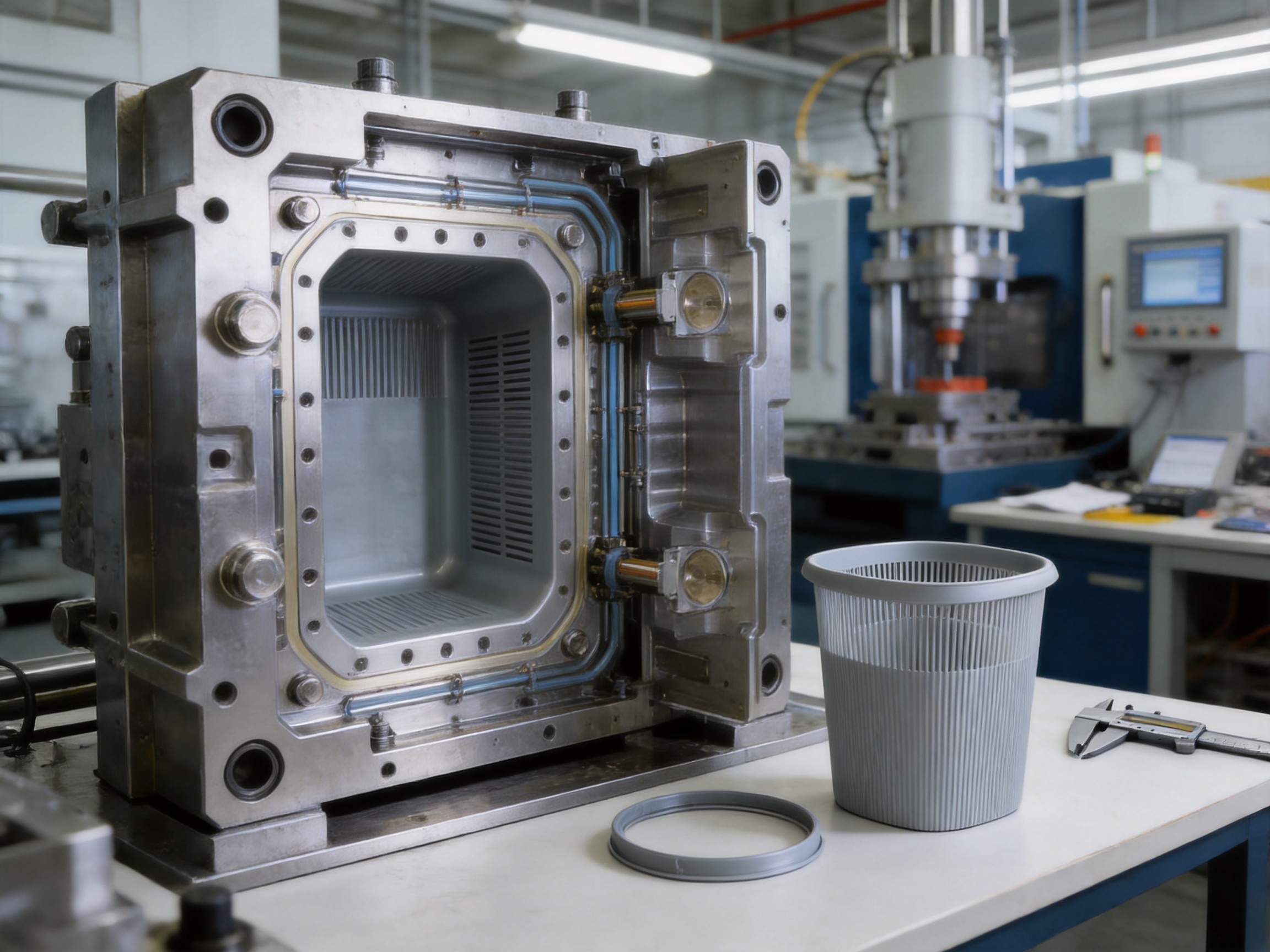
The mould must reproduce both the external and internal surfaces of the basket. The cavity forms the outside appearance, while the core forms the inner wall and controls the internal volume. The openwork regions require carefully designed steel features or inserts that define the ribs and openings.
The core and cavity should be arranged to support reliable demoulding. Depending on the product geometry, a conventional two-plate mould may be appropriate, while other designs may require additional mechanisms or specialized inserts. The final structure depends on the opening pattern, retaining features, draft angles, undercuts, production volume, and machine capability.
The parting line should be positioned to minimize visible marks and simplify mould construction. On an openwork basket, the parting line may pass through the upper rim or another controlled region. Poor placement can create flash on highly visible edges or complicate the release of the numerous ribs.
Parting-line planning should be completed before detailed steel machining. The designer must consider how the component separates, how the ejection force is distributed, how the openings are formed, and how operators or automation will handle the finished part.
Gate design has a major effect on the quality of a thin-wall openwork product. The melt must travel through the basket geometry and fill the ribs and bands without creating unacceptable weld lines, hesitation marks, burn marks, or short shots.
Potential gate strategies include a central base gate, edge gates, multiple gates, or other arrangements selected through flow analysis and practical experience. The ideal solution depends on the part size, material, wall thickness, appearance requirements, moulding machine, and acceptable cycle time.
For a basket with repeated openings, flow may divide and reunite around the features. Weld lines can appear where separate melt fronts meet. If these lines occur in highly stressed or visible areas, the gate location, venting, temperature, injection speed, or local geometry may need adjustment.
Air trapped in the cavity can cause incomplete filling, burn marks, silver streaks, or surface defects. Openwork geometry may create multiple pockets where air becomes compressed. Effective venting should be incorporated into the parting surfaces, inserts, ejector areas, or other suitable locations.
Vents must be deep enough to release air but controlled to prevent flash. Their condition should be checked during mould trials and maintained throughout production. Blocked vents can gradually reduce product quality even when the mould originally performed well.
Cooling affects cycle time, dimensional stability, and surface quality. The basket body may contain regions with different thicknesses, including the upper rim, ribs, lower band, and base. Cooling channels should be planned to remove heat evenly and reduce warpage.
Insufficient cooling near the rim may cause deformation that affects ring assembly. Uneven cooling around the base may create rocking. Effective cooling design is therefore directly related to product performance, not just productivity.
The finished basket must be ejected without damaging thin ribs, openings, the rim, or the retaining features. Ejection should be distributed over sufficiently strong areas. Excessive force at a small number of points may leave marks or deform the part.
Depending on the design, ejector pins, sleeves, stripper systems, or other mechanisms may be used. The selection should consider the available ejection area and the risk of visible marks. Ejection speed and timing also influence whether the part releases smoothly.
The production of a reliable mould begins with a disciplined engineering process. Yingxiang Plastic Mould applies CAD, CAE, and CAM systems to support product analysis, mould construction, machining, and trial correction. These digital tools help connect the customer’s product concept with the physical mould and finished injection-moulded part.
Before steel is ordered or machining begins, the product should be reviewed for draft, wall thickness, undercuts, shrinkage, rib proportions, opening geometry, assembly tolerances, and ejection requirements. This stage helps identify problems while changes are still economical.
For the openwork wastepaper basket, special attention should be paid to the relationship between the openings and the surrounding ribs. A visually attractive pattern may still be difficult to fill or release if the design lacks sufficient draft or contains abrupt thickness changes.
Three-dimensional CAD modelling establishes the product surfaces, mould layout, inserts, cooling channels, ejection system, and supporting components. Detailed digital assembly allows engineers to check clearances and movement before machining.
CAD data also supports communication with customers. Product dimensions, ring fit, opening patterns, textures, logos, and colour-related surface decisions can be reviewed more clearly in a three-dimensional environment than through two-dimensional sketches alone.
Computer-aided engineering can be used to evaluate filling behaviour, pressure distribution, weld-line locations, air traps, cooling, shrinkage, and potential warpage. Simulation does not replace practical mould trials, but it can identify likely risks earlier and help compare alternative gate or cooling concepts.
For a product with openwork features, flow analysis can be particularly useful because the melt path may divide around repeated openings. The results can guide gate placement, injection sequencing, venting, and local thickness adjustments.
Computer-aided manufacturing converts approved mould data into machining instructions. CNC milling, drilling, electrical discharge machining, wire cutting, grinding, and polishing may be used according to the geometry and material of each component.
Accurate machining is important for the retaining ring because small dimensional errors can influence snap fit and assembly. It is equally important for the basket body because repeated opening features must remain consistent around the entire product.
After machining, mould components must be measured, fitted, and assembled carefully. Slides, inserts, ejector parts, guide systems, and cooling components should move correctly and align under production conditions.
Manual fitting remains an important part of mould making. Even with advanced equipment, skilled technicians are needed to assess shut-off surfaces, adjust clearances, polish critical areas, and correct small differences between components.
A mould trial provides evidence of actual performance. The team can inspect filling, part appearance, ring engagement, demoulding, cycle behaviour, warpage, flash, weld lines, and dimensional stability. Trial parts should be evaluated against approved drawings and agreed quality standards.
Corrections may include polishing, steel adjustment, vent improvement, gate modification, processing changes, or cooling optimization. A controlled trial-and-correction process helps ensure that the final mould performs consistently rather than merely producing one acceptable sample.
TaiZhou HuangYan YingXiang Plastic Mould Co., Ltd. is located in Huangyan, Taizhou, Zhejiang, a region widely associated with mould manufacturing and plastics processing. The company was established in 2012 and operates a plant of approximately 7,000 square metres with around 50 employees.
The company’s size supports a practical combination of engineering coordination, mould production, technical supervision, and customer communication. Its equipment and experienced technicians are used to develop moulds for household products and industrial plastic containers, including logistics crates, folding boxes, pallets, trays, beverage boxes, chairs, stools, and storage products.
One important strength is product diversity. Experience with crates, pallets, boxes, and household products exposes the engineering team to different requirements for impact resistance, stacking, nesting, handling, appearance, and dimensional accuracy. This knowledge can be applied to the openwork wastepaper basket and its retaining ring.
Another strength is the ability to support customized solutions. Customers may require changes in capacity, opening pattern, surface texture, colour arrangement, liner retention, packaging method, or production output. A mould supplier with design and manufacturing resources can evaluate these changes as part of a complete project rather than treating the mould as an isolated component.
Yingxiang emphasizes lean manufacturing, long-life mould construction, on-time delivery, quality control, competitive costs, and customer service. These priorities are relevant to buyers because the initial mould price is only one part of the total project cost. Stable production, reduced downtime, easy maintenance, and predictable delivery can have a greater effect on long-term profitability.
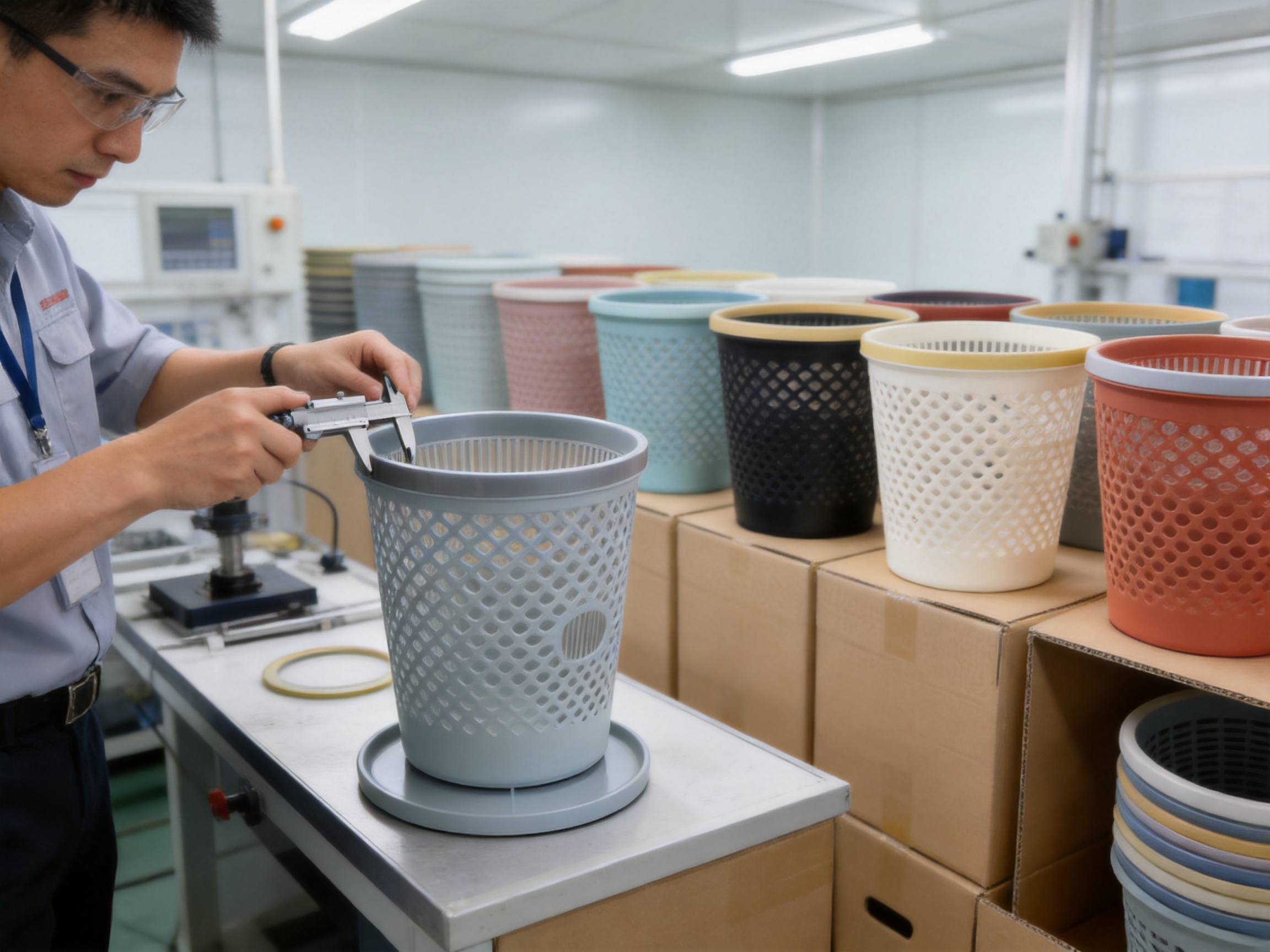
Critical dimensions should be checked on both the basket and retaining ring. These may include overall height, upper and lower dimensions, wall thickness, opening dimensions, rim size, base flatness, ring diameter, snap features, and assembly clearance.
Inspection methods may include calibrated measuring tools, gauges, three-dimensional measurement, visual comparison, and functional assembly checks. The inspection plan should distinguish critical dimensions from cosmetic or non-critical features.
Appearance inspection should cover flash, short shots, burn marks, flow marks, weld lines, colour variation, sink marks, scratches, ejector marks, and surface texture. Openwork products often make defects easier to see because light passes through the openings and highlights irregular edges.
Samples should be inspected under consistent lighting and compared with an approved standard. If the product is sold in several colours, each colour should be reviewed because pigments and additives can change flow and surface appearance.
The retaining ring should be assembled and removed repeatedly to confirm that it remains secure during normal use and does not become excessively difficult to handle. A liner should be installed to verify that the ring holds it evenly around the rim.
The basket should also be placed on a flat surface to check stability. Light manual loading, handling, stacking, and cleaning tests can reveal problems that dimensional inspection alone may not detect.
Mould durability depends on steel selection, heat treatment, surface finish, cooling design, moving-component construction, maintenance, and operating conditions. A mould intended for large production volumes should be designed with service access and replaceable wear components where appropriate.
Maintenance documentation should identify lubrication points, inspection intervals, vent-cleaning requirements, cooling checks, and recommended replacement parts. Preventive maintenance reduces the risk of unexpected production interruption.
The cost of an openwork wastepaper basket includes product material, mould investment, injection-machine time, labour, packaging, transport, quality inspection, maintenance, and rejects. Mould design influences nearly every one of these factors.
A mould that fills evenly can reduce short shots and cosmetic defects. A mould that cools efficiently can shorten cycle time. A mould with reliable ejection can reduce operator intervention. A mould with durable components can reduce repair frequency. These benefits may justify a higher initial engineering investment when the production volume is substantial.
Material efficiency should be evaluated carefully. Reducing wall thickness may lower part weight but can increase the risk of deformation or incomplete filling. Adding unnecessary reinforcement may improve stiffness but increase material cost and cooling time. The best solution is usually a balanced design based on actual loading, handling, and appearance requirements.
Cycle time can be improved through balanced cooling, suitable gate design, efficient ejection, and stable processing conditions. However, cycle reduction should not be pursued at the expense of dimensional stability. If faster moulding creates a distorted rim or inconsistent ring fit, the apparent productivity gain may be lost through increased rejection and rework.
Because the basket is relatively lightweight and may be nestable, packaging should be developed around the product geometry. Protective packaging may be required for the upper rim, openwork ribs, and retaining rings, especially when the product is transported over long distances.
The retaining rings may be packed separately, nested in groups, or assembled before shipment. The choice depends on the risk of deformation, the customer’s production and distribution process, and the available packaging space.
Mould delivery should also include proper protection against corrosion, impact, and contamination. Mould components should be secured, moving parts protected, and documentation provided for installation, operation, maintenance, spare parts, and trial settings.
The product can be adapted for different markets without changing its basic function. Potential customization areas include:
• Overall height and diameter for compact, standard, or high-capacity versions.
• Opening size and pattern to create different visual styles and levels of transparency.
• Basket taper to improve nesting, stability, or internal capacity.
• Retaining-ring structure for different liner sizes and assembly preferences.
• Surface texture, matte finish, polished finish, or decorative effects.
• Single-colour, two-colour, or coordinated basket-and-ring colour schemes.
• Embossed or moulded branding elements where suitable.
• Packaging and stacking arrangements for retail or institutional distribution.
• Plastic material selection according to stiffness, toughness, colour, and cost.
Customization should be managed through a controlled design process. A small change to the opening pattern may affect filling, ejection, cooling, and mould cost. A change to the retaining ring may require a complete tolerance review. Early communication between the product owner and mould manufacturer helps avoid expensive revisions.
Choosing a mould supplier solely by comparing quotations can create risks. Two suppliers may offer similar prices while providing very different levels of design review, machining accuracy, trial support, communication, and after-sales assistance.
For an openwork basket, experience with household moulds is valuable because appearance and usability are both important. Experience with industrial containers is also relevant because it develops knowledge of ribs, wall-thickness control, nesting, dimensional stability, and high-volume production.
A capable supplier should be able to discuss the customer’s product concept, identify potential moulding problems, recommend practical modifications, explain the effect of material selection, and provide a realistic production schedule. The supplier should also be able to support mould trials and corrections after the first samples are produced.
Yingxiang’s background in customized plastic mould solutions, household products, logistics crates, pallets, folding boxes, and other injection-moulded products positions it to manage the product as part of a wider manufacturing project. Its Huangyan location also provides access to a region with established mould-making knowledge, technical resources, and plastics-industry experience.
The customer should provide product drawings or reference samples, target dimensions, expected annual output, preferred plastic material, surface requirements, colour information, packaging expectations, and the intended application. If the product is a new concept, sketches and functional descriptions may be used as a starting point.
The mould team should review draft angles, wall thickness, rib design, opening geometry, ring engagement, ejection, gate location, cooling, and potential deformation. Recommended modifications should be documented before the design is frozen.
The customer should review the mould layout, parting line, gate concept, ejection method, cooling plan, and component assembly. Approval at this stage reduces the risk of misunderstanding and ensures that important appearance or functional requirements are recorded.
After approval, steel preparation, CNC machining, electrical discharge machining, wire cutting, grinding, polishing, fitting, and assembly are carried out according to the production plan. Inspection should be performed throughout the process rather than only at the end.
The first trial should use an agreed material and a documented set of processing conditions where possible. Samples should be evaluated for appearance, dimensions, assembly, stability, filling, demoulding, and cycle behaviour.
Any required corrections should be recorded and verified through additional trials. Final acceptance should include approved samples, dimensional data, functional checks, mould documentation, and a maintenance plan.
For product owners, the openwork wastepaper basket provides a combination of practical function and retail differentiation. The retaining ring gives the product a clear selling point that can be communicated easily: a cleaner liner installation, a more orderly appearance, and convenient everyday use.
For distributors, the product can fit several sales channels, including office supplies, household goods, hotel supplies, school products, facility management, and general retail. Multiple colour and size options can support different price levels and customer groups.
For injection-moulding manufacturers, the product offers a manageable platform for repeated production once the mould has been properly validated. Stable dimensions between the body and ring can reduce assembly complaints. A carefully designed openwork structure can also provide good shelf recognition without excessive material consumption.
For end users, the benefits are straightforward: the basket is lightweight, visually attractive, easy to move, simple to clean, and capable of holding a liner neatly. These everyday advantages are the result of decisions made during product design and mould engineering.
Plastic product sustainability should be considered across the entire product life cycle. A lightweight design can reduce material consumption and transport weight, but durability is equally important. A product that remains functional for a long period may provide better resource efficiency than a very lightweight product that breaks or deforms quickly.
The mould can support responsible material use by producing consistent parts with low reject rates. Stable filling, accurate cooling, and reliable ejection help reduce scrap. Where technically and commercially appropriate, the product owner may also evaluate recyclable material options or the use of suitable recycled content.
Material decisions must account for colour, strength, odour, surface quality, and the intended application. Recycled or modified materials may behave differently during injection moulding, so the moulding process should be validated rather than assumed to remain unchanged.
End-of-life considerations may also influence product design. Avoiding unnecessary combinations of incompatible materials can simplify recycling. If the basket and retaining ring use the same or compatible plastic family, sorting and recycling may be easier, subject to local recycling systems and material identification requirements.
A retaining ring that is difficult to remove may result from excessive interference, local deformation, insufficient draft, material shrinkage, or uneven cooling. The solution may involve adjusting the ring geometry, improving dimensional control, changing processing conditions, or modifying the mould steel after trial evaluation.
A loose ring may be caused by excessive clearance, shrinkage differences, insufficient engagement depth, or deformation of the basket rim. The mould and material conditions should be reviewed together because a dimensional change in one component may affect the whole assembly.
Incomplete filling can result from thin ribs, excessive flow length, inadequate melt temperature, insufficient injection pressure, poor venting, or an unsuitable gate location. CAE analysis and mould-trial observation can help identify the principal cause.
Flash may indicate insufficient shut-off accuracy, excessive injection pressure, mould wear, inadequate clamping force, or damage to the parting surfaces. Because flash around an opening is highly visible, the mould should be inspected and corrected promptly.
Warpage may result from uneven wall thickness, unbalanced cooling, non-uniform packing, ejection stress, or material shrinkage. Cooling-channel optimization, geometry adjustment, processing changes, and improved ejection balance may all be considered.
Weld lines form where separate melt fronts meet. They may be acceptable in hidden or low-stress areas, but visible or weak weld lines may require gate relocation, flow adjustment, temperature changes, improved venting, or geometry refinement.
| Item | Design or Manufacturing Focus | Expected Benefit |
|---|---|---|
| Openwork basket body | Balanced ribs, consistent openings, suitable draft, controlled wall thickness | Attractive appearance, reduced weight, reliable demoulding |
| Retaining ring | Accurate dimensions, controlled snap or interference fit, user-friendly removal | Secure liner retention and cleaner appearance |
| Upper rim | Rigidity, smooth surface, correct parting-line control | Improved durability, comfort, and assembly stability |
| Base | Balanced contact area, flatness, suitable cooling | Stable placement and reduced rocking |
| Gating | Flow analysis, balanced filling, controlled weld-line position | Fewer short shots and improved cosmetic quality |
| Venting | Air-release paths near filling fronts and enclosed regions | Reduced burns, trapped air, and incomplete filling |
| Cooling | Even heat removal around rim, ribs, and base | Shorter cycle potential and improved dimensional stability |
| Ejection | Distributed force on strong areas, suitable ejector arrangement | Lower risk of deformation and ejector marks |
| Inspection | Dimensional, visual, functional, and assembly checks | Consistent production and fewer customer complaints |
| Maintenance | Vent cleaning, lubrication, cooling checks, wear inspection | Longer mould life and reduced downtime |
It is a plastic waste container whose wall includes repeated openings or decorative cut-outs and whose upper edge uses a retaining ring to hold a disposable liner in position. The ring also helps conceal the liner edge and improve the product’s appearance.
The retaining ring prevents the liner from slipping into the basket and reduces the untidy appearance caused by a bag hanging over the rim. It must be secure during use but easy enough to remove when the liner is replaced or the basket is cleaned.
Not necessarily. Strength depends on the design of the ribs, rim, base, material, and transitions. A properly engineered openwork structure can provide adequate rigidity while using less material and offering a lighter, more decorative appearance.
Possible materials include common injection-moulding thermoplastics such as polypropylene and high-density polyethylene, along with other grades selected for specific requirements. The final choice should consider stiffness, toughness, shrinkage, colour, surface quality, cleaning resistance, and cost.
Yes. Common customization options include size, capacity, opening pattern, colour, surface texture, material, liner-fit geometry, and packaging arrangement. Each change should be reviewed for its effect on mould filling, cooling, ejection, tolerances, and mould cost.
Potential problems include short shots in thin ribs, flash around openings, visible weld lines, trapped air, uneven cooling, warped rims, base instability, and inconsistent ring fit. Product design review, CAE analysis, suitable gating, venting, cooling, and trial moulding help control these risks.
CAD defines the product and mould geometry. CAE helps evaluate filling, pressure, weld lines, cooling, shrinkage, and warpage. CAM converts the approved design into machining instructions for CNC and other equipment. Together, these systems improve coordination and reduce avoidable design errors.
Computer analysis and drawings cannot fully reproduce actual material behaviour, machine conditions, mould temperature, ejection forces, and assembly feel. Trial moulding produces physical parts that can be measured and tested. Corrections made after a controlled trial help establish reliable production performance.
They may be designed for nesting if the wall taper, opening pattern, rim, and base geometry provide sufficient clearance. Nesting should be evaluated together with demoulding, stability, usable capacity, and the risk of parts becoming stuck.
A buyer should ask about experience with similar household products, design-for-manufacturing review, mould structure, material compatibility, gate and cooling concepts, trial procedures, inspection standards, expected cycle time, maintenance support, spare parts, delivery schedule, and after-sales service.
An experienced manufacturer can identify risks before machining, recommend practical design changes, coordinate product and mould tolerances, manage trial corrections, and provide long-term technical support. This can reduce development delays and improve production stability.
Appropriate steel and component design are important, but maintenance is equally necessary. Regular vent cleaning, lubrication, cooling-system inspection, rust prevention, correct handling, and timely replacement of worn components can help extend service life.
Yes, injection moulding is suitable for repeated production when the mould is designed for the required output, machine size, cycle time, cooling performance, and maintenance conditions. The appropriate mould structure depends on the annual volume and the customer’s production plan.
The openwork wastepaper basket with a retaining ring is a compact product with meaningful functional and commercial advantages. Its openwork body can provide a lighter, more modern, and more distinctive design, while the retaining ring improves liner retention and keeps the upper edge orderly. These features make the product suitable for homes, offices, hotels, schools, commercial spaces, and institutional environments.
Behind the simple appearance is a detailed mould-engineering challenge. The product requires accurate control of ribs, openings, rim geometry, ring tolerances, cooling, venting, ejection, and surface finish. The quality of the finished basket depends on how effectively these elements are coordinated from the first product review through final mould validation.
TaiZhou HuangYan YingXiang Plastic Mould Co., Ltd. offers customized plastic mould solutions from its 7,000-square-metre facility in Huangyan, Taizhou, Zhejiang. Established in 2012, the company combines CAD/CAE/CAM capabilities, modern equipment, experienced technicians, and knowledge of household and industrial injection-moulded products. Its experience with storage containers, crates, folding boxes, pallets, trays, beverage boxes, chairs, stools, and other products supports a practical understanding of both appearance-driven household goods and high-volume plastic manufacturing.
For buyers seeking a dependable mould for this product, the most important considerations are not only the initial quotation. Design review, mould accuracy, trial support, production stability, maintenance planning, delivery reliability, and communication all influence the total value of the project. A well-developed mould can help produce a wastepaper basket that is attractive, easy to use, consistent in quality, efficient to manufacture, and competitive in the marketplace.
1. Society of Plastics Engineers, injection-moulding design and processing principles.
2. International Organization for Standardization, general guidance for plastics injection-moulding processes and dimensional control.
3. American Society of Mechanical Engineers, principles of engineering drawing, tolerancing, and design verification.
4. Standard references on thermoplastic material selection, mould cooling, venting, ejection, and product manufacturability.
5. General industrial practices for plastic household-product design, mould maintenance, quality inspection, and production validation.
If you are interested in any of our products or services, please feel free to ask and we can talk about your ideas.
 QUICK LINKSMOBILE SITE
 FACTORY ADDRESS
 CONTACT INFORMATION



 English
 Español