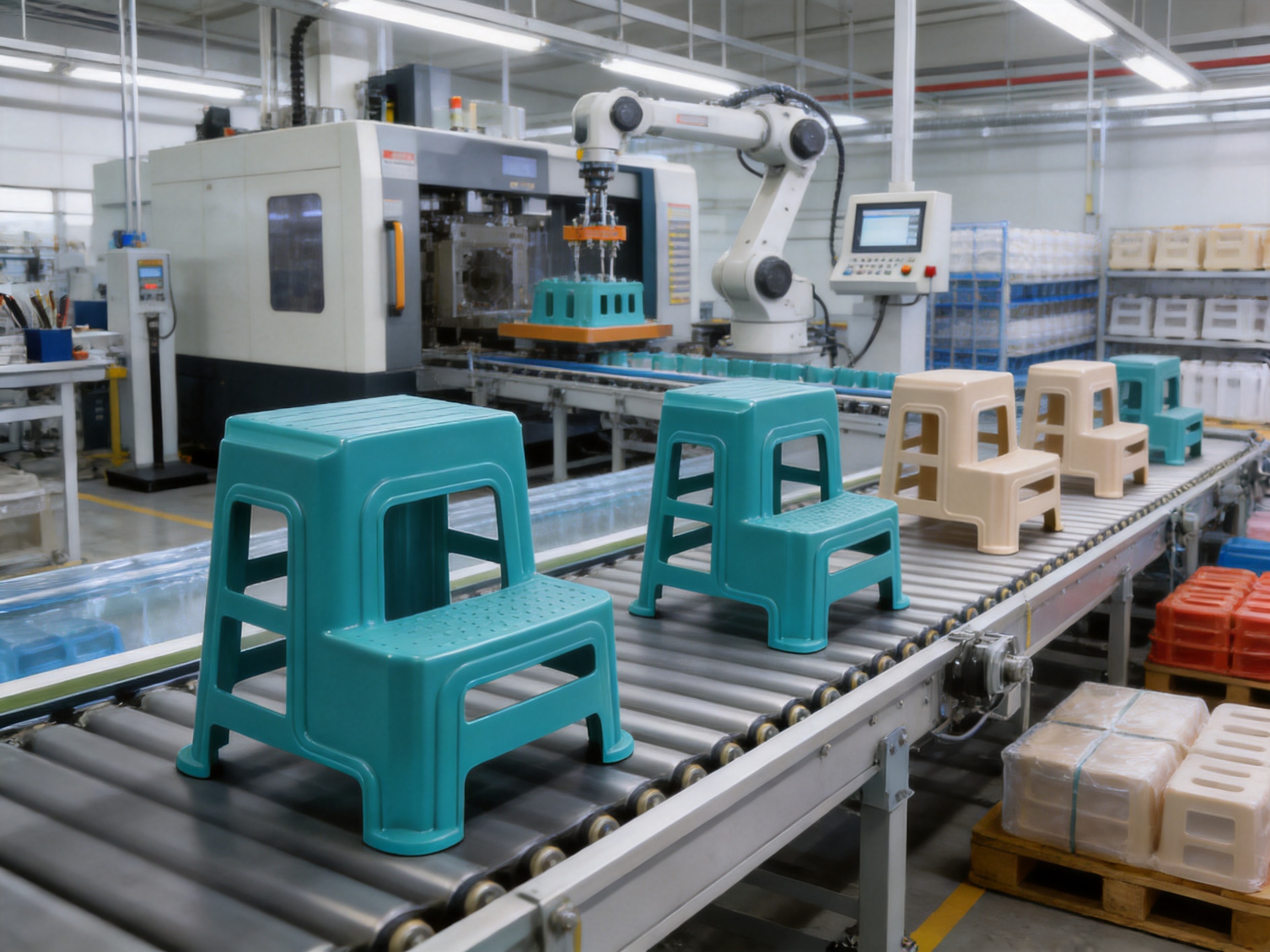
A rectangular two-step stool is a practical household product designed to provide safe, convenient height extension for children, adults, and elderly users in homes, shops, offices, kitchens, bathrooms, warehouses, and service areas. Although the finished stool appears simple, producing a reliable, attractive, and cost-effective two-step stool requires carefully engineered tooling, precise mould manufacturing, suitable material selection, controlled injection moulding, and strict quality management.
The mould is the foundation of the entire product. Its structure determines the stool’s dimensions, surface quality, strength, assembly accuracy, production cycle, appearance, and long-term manufacturing cost. A well-designed rectangular two-step stool mould can produce thousands or even millions of consistent parts while reducing flash, deformation, short shots, sink marks, and other common injection moulding defects. A poorly designed mould, by contrast, can create unstable production, excessive maintenance requirements, and safety problems in the finished stool.
For this reason, manufacturers and product developers need more than a basic cavity and core. They need a complete moulding solution that considers load-bearing structure, non-slip details, wall thickness, draft angles, ejection, cooling, gate location, mould steel, production volume, machine compatibility, packaging, and future maintenance. An experienced plastic mould manufacturer can turn a product concept into a practical production tool that supports stable quality and competitive unit costs.
The rectangular two-step stool mould is especially suitable for manufacturers seeking a durable, stackable, modern-looking household stool with efficient mass-production capability. Its rectangular form provides a broad standing platform, stable visual proportions, and useful space for reinforcing ribs, anti-slip textures, handles, and nesting features. When the mould is developed correctly, the product can combine strength, light weight, ease of cleaning, attractive appearance, and economical production.
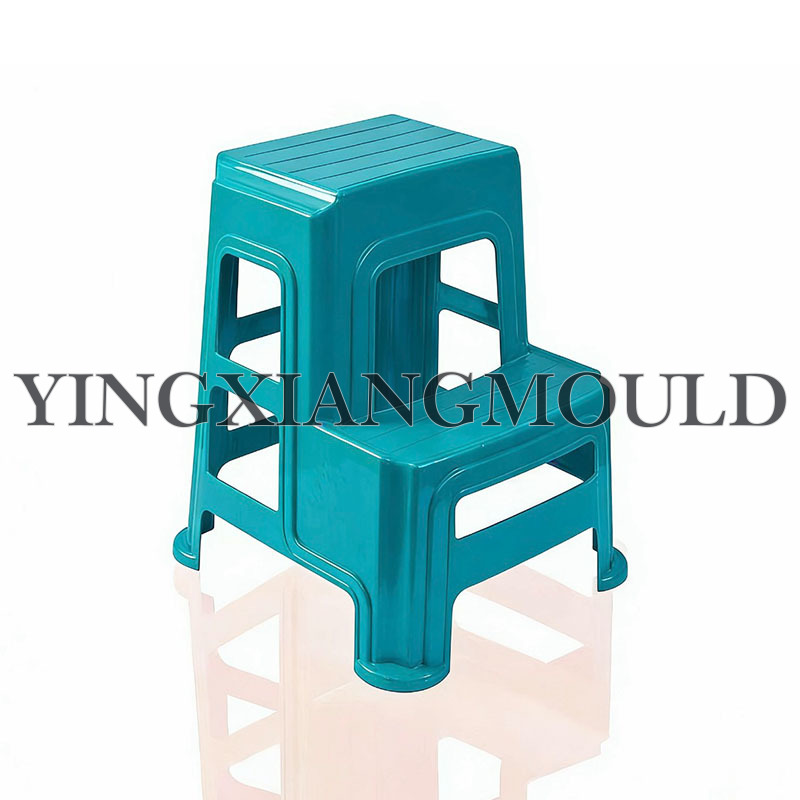
Rectangular Two-Step Stool
A two-step stool generally consists of a lower step, an upper step, supporting side walls or legs, and a surrounding frame. The rectangular configuration gives the product a practical footprint for use in confined areas such as kitchens, bathrooms, bedrooms, storage rooms, and retail environments. Compared with a narrow round stool, a rectangular stool can offer a larger usable standing surface and more predictable contact with the floor.
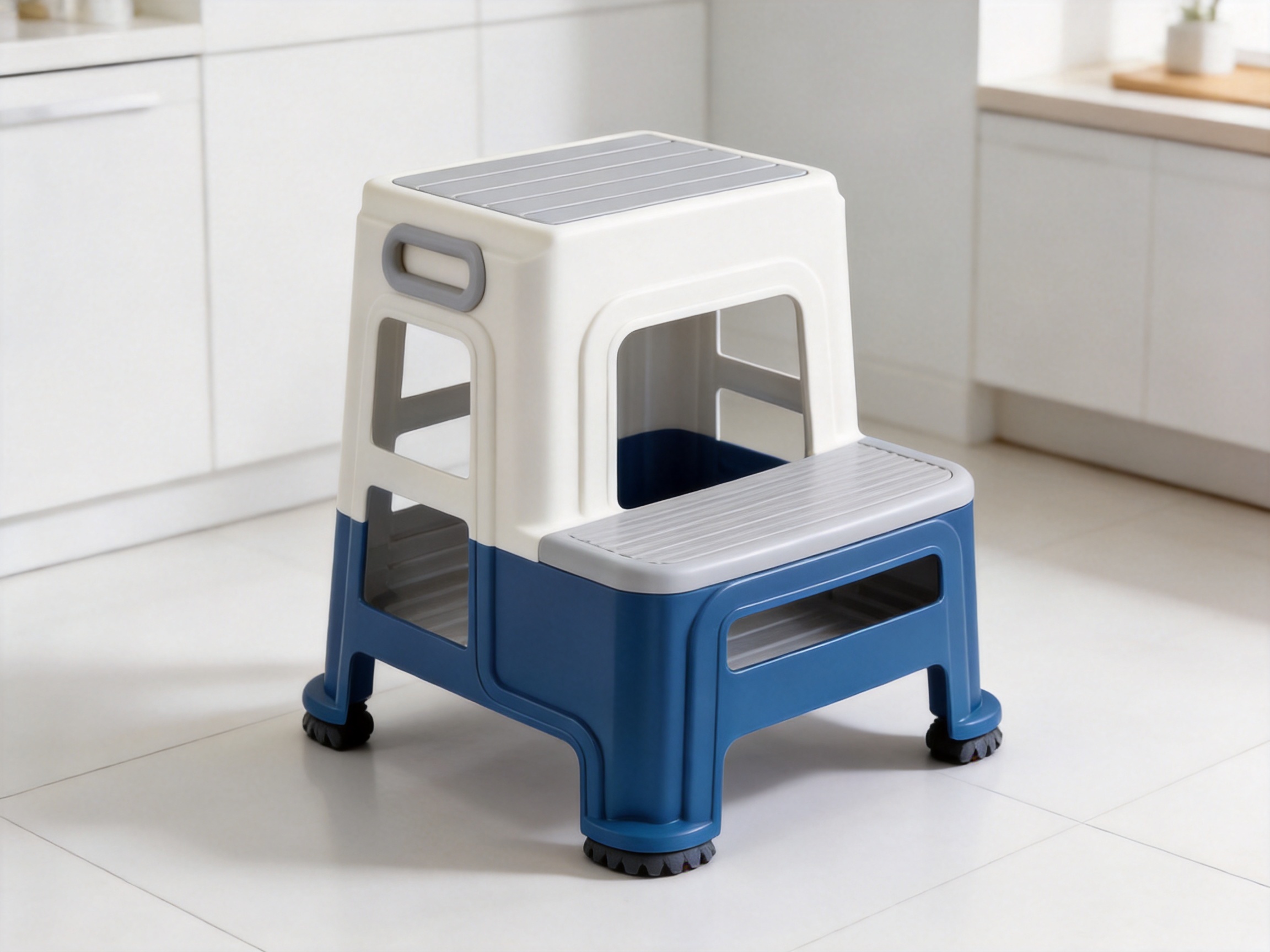
The product may be manufactured as a one-piece injection-moulded structure or as several moulded components assembled after production. A one-piece structure can reduce assembly labour and eliminate fasteners, but it places higher demands on mould design, material flow, cooling, and ejection. A multi-piece design may allow more flexibility in colour combinations, part replacement, and decorative styling, although it introduces additional assembly operations and potential connection points.
The two-step arrangement is useful because it provides more height than a single step while remaining more compact than a folding ladder. The lower step supports the user during the first movement, while the upper platform provides access to higher shelves, cabinets, sinks, and other domestic areas. The product must therefore resist repeated stepping loads, shifting forces, twisting, impact, and occasional misuse.
Important product functions include:
• Providing a stable elevated standing surface.
• Supporting repeated loading without cracking or excessive deformation.
• Maintaining reliable contact with the floor.
• Offering a comfortable and safe step geometry.
• Allowing easy cleaning and resistance to common household moisture.
• Enabling efficient stacking, nesting, or storage where required.
• Presenting a smooth and attractive exterior suitable for retail sale.
• Supporting economical high-volume manufacturing.
These functions must be translated into mould features. For example, a requirement for a non-slip step may require an etched texture, raised pattern, rubber insert, or secondary assembly. A requirement for nesting may influence the draft angle, side-wall profile, and external dimensions. A requirement for low-cost production may favour a carefully balanced multi-cavity tool or a mould architecture that reduces cycle time.
The most important design consideration is the relationship between the stool’s external shape and its internal reinforcement. A broad platform alone does not guarantee strength. The underside should normally include ribs, support webs, gussets, or box-section structures that distribute force across the product. These features can reduce deflection while allowing the main wall sections to remain reasonably thin.
Ribs should be designed with suitable thickness in relation to the nominal wall. Excessively thick ribs can produce sink marks, voids, uneven shrinkage, and longer cooling times. Very thin ribs may not fill properly or may provide insufficient structural support. The correct relationship depends on the selected resin, product dimensions, expected loading, moulding machine, and production conditions.
Corner regions deserve particular attention. Rectangular products naturally create corners where stress can concentrate. Generous internal radii help the plastic flow more smoothly and reduce sharp stress transitions. Radiused corners also make the mould easier to polish and reduce the risk of premature cracking in the steel. External corner treatment can improve the product’s appearance and reduce the possibility of injury during daily use.
The upper and lower steps should provide enough usable area for the intended application. The surface may be smooth, textured, embossed, or fitted with a separate anti-slip element. For a fully moulded plastic solution, a carefully selected mould texture can improve traction while preserving a clean appearance.
Surface texture must be compatible with mould release. Deep or poorly oriented texture can lock the part in the cavity, increase ejection force, or cause visible drag marks. Draft angles should be increased where the texture is deep, and the direction of mould opening should be considered during early product design rather than after the mould has been built.
The step edges should be rounded or softened. This improves comfort, supports safer handling, and reduces sharp flash risks. The mould maker must also ensure that parting lines do not cross areas where they could create an uncomfortable ridge or visible defect. A well-positioned parting line can protect both product quality and user experience.
A two-step stool must remain stable on the intended floor surface. The bottom perimeter should be designed with a consistent contact plane, and the mould must maintain dimensional control in this region. Warpage in the legs or base frame can cause rocking, which is unacceptable for a product intended to carry a standing user.
Manufacturers may add rubber feet, elastomer pads, textured plastic contact zones, or a continuous anti-slip base. If these features are moulded directly into the plastic, the mould must reproduce them accurately and consistently. If separate feet are assembled later, the mould should provide reliable locating areas and sufficient dimensional accuracy for secure installation.
Flatness is influenced by material shrinkage, cooling balance, rib layout, gate position, injection pressure, holding pressure, and mould temperature. Advanced mould development therefore relies on simulation, practical experience, and trial moulding rather than simply copying the external product shape.
Many rectangular stools include a carrying handle or hand opening. This feature improves portability, but it also creates a potential stress concentration and may complicate the mould structure. The opening can be formed using a core, slider, lifter, or a carefully arranged parting line, depending on its orientation and geometry.
Handle edges should be comfortable and free from sharp transitions. Reinforcing material around the opening can prevent cracking during carrying. At the same time, the surrounding wall must not become so thick that it creates sink marks or an unnecessarily heavy product.
Some models include nesting guides, stacking stops, drainage holes, or storage recesses. These details can increase product utility but must be assessed for mould release, cleaning, structural performance, and manufacturing cost. Every additional feature should have a clear functional or commercial purpose.
Common materials for a rectangular two-step stool include polypropylene, high-density polyethylene, acrylonitrile butadiene styrene, and selected engineering or impact-modified grades. The final choice depends on the required stiffness, impact resistance, appearance, chemical resistance, operating temperature, colour, cost, and regulatory requirements.
Polypropylene is widely considered for household products because it offers low density, good chemical resistance, practical impact performance, and competitive cost. It can also be processed efficiently in high-volume injection moulding. Its shrinkage and warpage behaviour must be considered during mould design, especially when the stool includes broad flat surfaces and asymmetrical reinforcement.
High-density polyethylene can provide good impact resistance and chemical durability. It may be suitable for robust utility stools, although its shrinkage characteristics and surface appearance require careful control. Acrylonitrile butadiene styrene can offer a harder surface and attractive appearance, but material cost and impact performance at low temperatures should be evaluated for the intended market.
Recycled or reprocessed material may be commercially attractive, but its use requires careful control. Variation in moisture, contamination, melt flow, colour, and mechanical performance can influence dimensional stability and appearance. For a load-bearing product, the material specification should be clearly defined and validated through sample testing.
Glass fibre reinforcement may increase stiffness, but it can also increase mould wear, alter shrinkage, and create a less uniform surface. Fibre-filled compounds therefore require suitable steel selection, gate design, venting, and maintenance planning. The manufacturer should not select reinforcement solely to increase strength without reviewing the complete moulding process.
The parting line is one of the most influential decisions in mould design. It determines how the product separates from the mould, where flash may appear, how the cavity and core are machined, and how visible mould marks are distributed. For a rectangular two-step stool, the parting line should ideally be positioned away from important standing surfaces and comfortable hand-contact areas.
The product’s draft direction should be established before the final mould structure is approved. If the stool has undercuts, handles, horizontal openings, or complex support features, sliders or lifters may be required. These mechanisms can increase mould cost and maintenance, so the product designer should consider whether the geometry can be simplified without reducing function.
The cavity creates the external appearance of the stool, while the core forms the internal structure. Both components need adequate strength, dimensional stability, and resistance to wear. Large mould surfaces must be supported properly to prevent deflection under injection pressure.
The mould may use separate inserts in areas that require frequent modification, special polishing, deep texture, or enhanced wear resistance. Replaceable inserts can reduce future maintenance cost and make engineering changes more practical. They can also allow the same base mould structure to support different product versions.
For a product with substantial dimensions, mould base rigidity is important. A weak or poorly supported base can cause flash, uneven parting, cavity misalignment, or premature wear. The mould should be compatible with the customer’s injection machine, including platen dimensions, tie-bar spacing, mould height, ejection stroke, injection capacity, and available hydraulic or electrical connections.
The ejection system must remove the stool without damaging the product or leaving unacceptable marks. Ejector pins, sleeves, lifters, stripper plates, or combinations of these methods may be used. The best arrangement depends on the product’s internal ribs, wall structure, visible surfaces, and release direction.
Ejection force should be distributed across structurally strong areas. Placing pins only in thin walls can create whitening, deformation, or local stress. Ejector marks should be positioned on hidden or less sensitive surfaces whenever possible. For broad products, a balanced ejection layout helps prevent one side from releasing earlier than the other.
The ejection sequence should also be checked for interference with sliders, inserts, lifters, and return pins. Reliable mould operation depends on mechanical coordination. Sensors, forced-return systems, and protective interlocks may be considered where they provide meaningful production benefits.
Cooling has a major effect on cycle time, dimensional stability, and surface quality. The stool may contain thick corners, ribs, step platforms, and side walls that do not cool at the same rate. If the cooling system is poorly arranged, the part may warp, sink, or remain too hot during ejection.
Cooling channels should be positioned as close as practical to the moulding surfaces while preserving steel strength. Baffles, bubblers, drilled channels, or conformal cooling approaches may be considered depending on the mould structure and budget. The cooling circuit should support balanced heat removal rather than merely providing the maximum number of water connections.
Separate circuits for different mould regions can help operators control temperatures more accurately. Flow meters and temperature monitoring may be beneficial for production moulds where cycle stability is critical. The mould manufacturer should also provide clear recommendations for water quality, connection layout, and maintenance to reduce corrosion and blockage.
The gate must deliver molten material into the cavity with suitable pressure, speed, and flow balance. A poorly selected gate can cause weld lines in high-stress areas, visible flow marks on cosmetic surfaces, air traps, excessive packing near one region, or uneven shrinkage.
For a rectangular two-step stool, gate location should be considered together with wall thickness, rib layout, handle openings, and expected load paths. The aim is to achieve an efficient flow pattern that fills the cavity without creating avoidable weaknesses in the standing platform or supporting legs.
Hot runner systems may reduce runner waste and support faster automated production, especially for high-volume projects. Cold runner systems may offer lower initial tooling cost and simpler maintenance. The correct choice depends on production volume, material, colour changes, mould size, cycle requirements, and the customer’s available equipment.
Air trapped in the cavity can create burn marks, short shots, silver streaks, and weak weld lines. Venting is especially important around the ends of flow paths, deep ribs, corners, and areas behind core features. Vent dimensions must be sufficient to release air while preventing excessive flash.
Venting should be evaluated during mould trials and adjusted when necessary. In some cases, venting can be improved through parting-line vents, ejector clearances, dedicated vent inserts, or porous steel components. A stable venting design contributes to consistent filling and reduces the need for excessive injection pressure.
Professional mould manufacturing begins with a clear understanding of the product, production target, material, machine, and expected service life. The manufacturer should review two-dimensional drawings, three-dimensional models, reference samples, packaging requirements, and any applicable safety expectations before finalising the tooling plan.
A feasibility review identifies risks before steel cutting begins. Engineers examine wall thickness, draft, undercuts, ribs, corner radii, ejection areas, parting lines, gate locations, cooling access, and anticipated shrinkage. They also evaluate whether the proposed design can be moulded within the customer’s machine capacity.
This stage is valuable because design changes are relatively inexpensive before mould construction but can become costly after machining. A digital review can identify regions where the product may stick, warp, trap air, or require unnecessary mechanisms. It can also reveal opportunities to simplify the mould and reduce long-term maintenance.
Computer-aided design systems are used to develop the part model, mould assembly, component drawings, cooling circuits, ejection layout, and manufacturing documentation. Computer-aided engineering analysis may be applied to predict filling behaviour, pressure distribution, weld lines, air traps, cooling imbalance, shrinkage, and warpage.
Simulation does not replace practical mould-making experience, but it provides useful evidence for engineering decisions. For example, an analysis may show that a gate should be moved away from a high-load zone or that a thick rib needs modification to reduce sink marks. Early analysis can reduce trial-and-error during mould testing.
Computer-aided manufacturing transfers approved geometry to CNC machining, electrical discharge machining, wire cutting, drilling, and other processes. Consistent data management helps maintain alignment between design intent and actual steel components. It also improves revision control and documentation for future repairs or replacement parts.
Mould steel should be selected according to production volume, plastic material, surface requirements, expected wear, corrosion risk, and budget. Pre-hardened steels may be suitable for certain components and moderate production requirements, while hardened tool steels can provide greater wear resistance and service life in demanding applications.
Steel preparation must include accurate cutting allowances, stress management, and appropriate heat treatment where required. Poorly controlled heat treatment can lead to distortion, dimensional instability, or reduced toughness. Experienced mould manufacturers understand that material quality and processing history are closely connected.
For glass-filled materials or high-volume production, wear-resistant inserts may provide a valuable advantage. Corrosion-resistant steel can be beneficial where cooling water quality is difficult to control or where the product material contains corrosive additives. The selection should balance performance and cost rather than automatically choosing the most expensive steel.
CNC milling forms many of the principal cavity, core, mould base, and insert surfaces. High-speed machining can improve surface quality and reduce the amount of manual polishing required. Deep cavities and narrow ribs may require specialised tools, multiple setups, or electrode machining.
Electrical discharge machining is useful for deep, narrow, intricate, or difficult-to-cut details. Wire electrical discharge machining can produce accurate profiles in inserts, slides, and other components. Precision drilling is used for cooling channels, ejector holes, leader pin holes, and other functional passages.
Machine calibration, fixture stability, tool condition, cutting parameters, and operator skill all influence the final result. A modern equipment list is valuable, but equipment must be supported by disciplined process control and experienced technicians.
Visible surfaces may require polishing to achieve a glossy, semi-gloss, or controlled matte appearance. Polishing must preserve the intended geometry and avoid rounding edges that are needed for accurate parting or texture definition.
Texturing can provide a functional anti-slip effect or a decorative appearance. The texture depth, direction, and location should be approved before processing. A texture that is too deep for the available draft may cause ejection problems. A texture that is too shallow may not produce the desired visual or functional result.
Surface finishing is also important for cleaning. Household products often encounter dust, food residue, water, detergents, and skin oils. Smooth transitions and controlled texture help users maintain the stool more easily and reduce dirt accumulation in difficult-to-reach areas.
After machining, mould components are assembled and fitted. This stage checks the relationship between cavity, core, slides, lifters, ejectors, guide systems, inserts, cooling circuits, and mould base components. Skilled bench fitting is particularly important where several parts must meet precisely under operating conditions.
The mould should open and close smoothly without abnormal resistance. Ejectors should move evenly and return completely. Sliders should travel without excessive looseness or binding. Cooling circuits should be pressure-tested, and electrical or hydraulic connections should be verified where applicable.
A mould is not complete merely because it has been assembled. Trial moulding validates whether it performs effectively with the selected material and machine. The trial process should record machine type, resin grade, melt temperature, mould temperature, injection speed, holding pressure, cooling time, cycle time, and other relevant parameters.
The first trial focuses on basic filling and ejection. Engineers inspect whether the cavity fills completely, whether the product releases without damage, and whether there are obvious flash, burn, sink, weld-line, or short-shot problems. Adjustments may include gate balancing, vent improvement, process changes, or limited mould correction.
Later trials focus on dimensional accuracy, appearance, flatness, step stability, structural details, assembly fit, and repeatability. Samples should be measured against approved drawings or reference standards. Where the product is load-bearing, practical performance testing should be performed according to the customer’s intended market and internal quality procedures.
Important dimensions include overall length, width, height, step height, platform size, wall thickness, handle opening, base dimensions, and stacking or nesting features. Dimensional inspection may use callipers, height gauges, coordinate measuring equipment, optical systems, templates, or dedicated fixtures.
The inspection method should reflect the tolerance and function of each feature. A cosmetic dimension may permit a different tolerance from a critical assembly or stability dimension. Establishing this distinction avoids unnecessary cost while protecting product performance.
Appearance inspection covers colour, gloss, texture, weld lines, flow marks, ejector marks, parting-line flash, sink marks, burn marks, scratches, and contamination. Lighting conditions and inspection distance should be defined so that judgements are consistent between operators.
Cosmetic expectations should be agreed before mass production. A household stool intended for retail display may require a higher visual standard than a utility stool intended for industrial use. Clear specifications prevent disputes and help the moulding factory establish appropriate process controls.
Functional tests may include static loading, repeated loading, impact testing, stability testing, slip assessment, handle strength testing, and environmental exposure. The exact test programme should be based on the product’s intended use, local regulations, customer requirements, and risk assessment.
Testing should not be limited to a single perfect sample. Several samples from different production cycles provide more useful evidence of repeatability. The objective is to confirm that the product remains stable and safe when normal manufacturing variation occurs.
| Evaluation Area | What Is Checked | Why It Matters | Typical Improvement Direction |
|---|---|---|---|
| Dimensional accuracy | Height, width, step size, wall position, and base geometry | Supports stability, assembly, and consistent appearance | Adjust steel, process settings, cooling balance, or shrinkage compensation |
| Surface quality | Texture, gloss, weld lines, marks, and flash | Influences retail appeal, safety, and cleaning | Improve polishing, venting, gating, process control, or parting-line fit |
| Structural strength | Steps, ribs, legs, corners, and handle areas | Protects users during repeated loading | Modify rib geometry, material grade, wall thickness, or gate position |
| Flatness and stability | Base contact and rocking behaviour | Reduces tipping and improves user confidence | Balance cooling, refine base geometry, or adjust moulding conditions |
| Cycle performance | Filling, cooling, ejection, and total cycle time | Determines production capacity and unit cost | Optimise cooling, runner design, injection settings, and automation |
| Maintenance readiness | Access to wear parts, cooling circuits, ejectors, and inserts | Reduces downtime over the mould’s service life | Use replaceable inserts, accessible components, and clear documentation |
One of the main advantages of a professionally engineered mould is consistency. Every production cycle should deliver products with closely controlled dimensions, surface appearance, step alignment, and base contact. Consistency reduces sorting, rework, customer complaints, and product returns.
Less-advanced tooling may depend heavily on manual corrections and unstable process settings. Such moulds can produce acceptable parts during a short trial but become difficult to control during continuous production. A stronger engineering foundation supports predictable performance across long production runs.
Through carefully designed ribs, load paths, corner radii, and wall transitions, the stool can achieve useful strength without unnecessary material. This is commercially important because resin consumption affects unit cost, product weight, freight expense, and environmental impact.
Simply increasing wall thickness is not always the best method for improving strength. Thick sections can increase sink marks, warpage, cycle time, and material use. A mould designed around structural efficiency can deliver a better balance between durability and economy.
Balanced cooling, suitable runner design, smooth ejection, and appropriate cavity layout can reduce cycle time. Even a small cycle-time improvement can create substantial annual savings in high-volume production.
Cycle efficiency should not be pursued at the expense of quality. Removing too much cooling time may cause distortion, while increasing injection speed without sufficient venting may create burns or flash. The best result comes from optimising the complete process rather than focusing on a single parameter.
Appropriate steel, accurate fitting, good cooling-water management, and replaceable wear components help extend mould life. A long-life mould provides a lower cost per part over its operating period and reduces the disruption associated with frequent repairs or replacement tooling.
Maintenance-friendly construction is an important competitive advantage. Engineers should consider how technicians will clean cooling channels, replace ejector pins, inspect guide components, repair texture, and correct minor wear. Easy access and clear documentation can significantly reduce downtime.
A well-planned mould platform can make future changes easier. Replaceable inserts, modular cores, and carefully selected parting surfaces may permit adjustments to logo details, handle geometry, texture, colour separation, or selected dimensions without rebuilding the entire mould.
Customers should discuss possible future variations at the beginning of the project. A small investment in modularity may be worthwhile when the product is expected to evolve or when several market versions are planned.
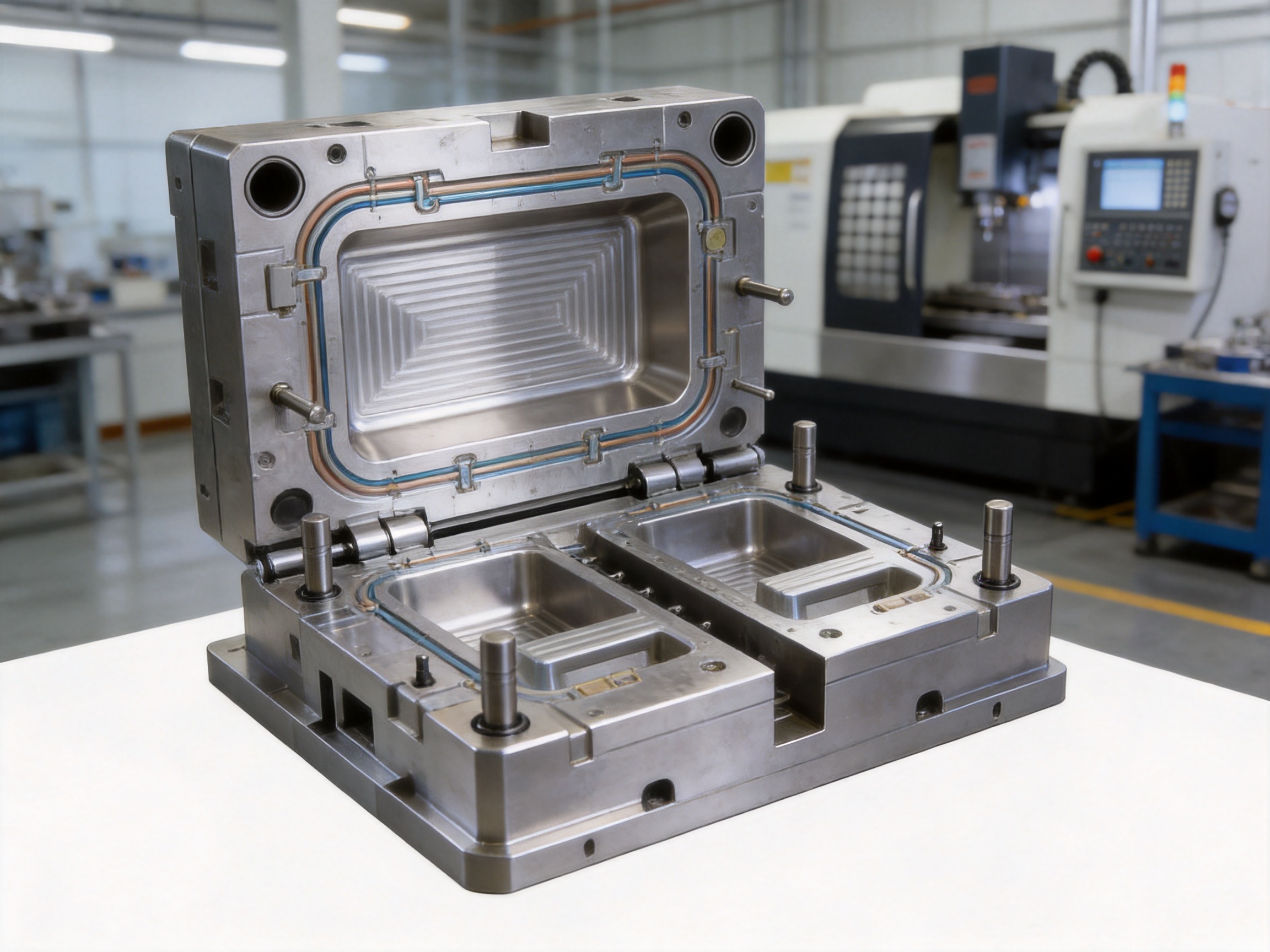
A capable mould factory combines design knowledge, production equipment, project management, quality control, and communication. The company behind a tooling project should be able to support the complete process from initial concept through mould delivery, trial production, correction, and after-sales service.
An established manufacturer located in Huangyan, Taizhou, Zhejiang, China, operates in one of the world’s recognised mould-making regions. The local industrial environment provides access to experienced technicians, machining resources, component suppliers, material knowledge, and supporting production services. For international customers, this regional concentration can support competitive pricing and efficient access to specialised tooling capabilities.
The manufacturer described in the supplied information was established in 2012 and operates a 7,000-square-metre plant with approximately 50 employees. Its production resources include advanced CAD, CAE, and CAM systems, high-tech equipment, and experienced technicians. These capabilities are relevant to rectangular two-step stool tooling because the product requires coordinated development across design, analysis, machining, fitting, trial moulding, and quality inspection.
Experience with other household and logistics products can strengthen stool mould development. Crate moulds, folding box moulds, beverage box moulds, pallet moulds, storage container moulds, chair moulds, trash can moulds, and floor mat moulds each involve different technical challenges. Together, they expose engineers to large surfaces, load-bearing structures, stacking features, moving mechanisms, texture, cooling, and high-volume production.
This broader experience can help a mould maker recognise recurring risks. For example, a stool and a logistics crate may both require strong ribs and controlled warpage, while a chair and a stool may share concerns related to user loading, ergonomic surfaces, and visible cosmetic areas. Knowledge from multiple product categories can therefore support better design decisions.
Lean manufacturing principles focus on reducing avoidable waste, improving workflow, controlling variation, and delivering projects on schedule. In mould manufacturing, this may include organised production planning, standardised inspection points, controlled drawing revisions, efficient material movement, preventive maintenance, and structured trial procedures.
Lean production does not mean reducing necessary engineering work. Instead, it aims to eliminate errors and delays that do not create value for the customer. A clear project schedule and transparent communication help ensure that design approval, steel preparation, machining, assembly, trials, and final delivery remain coordinated.
Not every customer has a complete product design. Some may provide a physical sample, a basic sketch, a packaging concept, or only a functional requirement. A professional mould supplier can assist with product optimisation, draft analysis, rib design, parting-line planning, material recommendations, and mould architecture.
Custom engineering is particularly important when the stool must satisfy a specific market requirement. The customer may need a special height, a distinctive handle, a nesting configuration, a private logo, a particular anti-slip texture, two-colour moulding, or compatibility with an existing production machine. These requirements should be addressed in the product and mould design rather than improvised during trial production.
Quality and delivery are closely connected. A rushed mould with insufficient inspection may arrive on time but require extensive correction. A well-managed project includes realistic scheduling, documented approvals, progressive inspection, and early identification of risks.
After delivery, the customer may require mould maintenance guidance, spare parts, process recommendations, technical support, or assistance with later modifications. A supplier that remains available after the mould leaves the factory provides additional value and helps protect the customer’s production investment.
The purchase price of a stool mould is only one part of the total cost. Buyers should also consider production cycle time, resin consumption, expected mould life, maintenance, machine requirements, labour, scrap, packaging, transport, and future product changes.
A lower-cost mould may use less expensive steel or a simpler cooling system, but it could create higher production costs over time. Conversely, an expensive mould is not automatically better if its additional features do not support the project’s actual volume or quality requirements. The right solution should be matched to annual demand, product positioning, expected service life, and available capital.
Cavity quantity is another important decision. A single-cavity mould may be suitable for moderate demand, new product validation, or large products that require substantial injection capacity. A multi-cavity mould can improve output but increases initial cost, balancing complexity, and machine requirements. For a rectangular two-step stool, the choice must account for product size, mould weight, filling balance, and the customer’s expected production schedule.
Hot runner technology may reduce runner waste and support automation, but it requires a higher initial investment and specialised maintenance. Cold runner systems may be preferable for smaller volumes or projects where simple operation is a priority. The decision should be based on a complete cost analysis rather than a general preference.
Once the mould enters production, operators should maintain stable material drying, melt temperature, mould temperature, injection speed, holding pressure, cooling time, and ejection conditions. Significant changes in resin batch, colourant, regrind ratio, or machine setup can affect product quality.
Process parameters should be recorded and linked to approved sample standards. If a defect appears, technicians can then identify whether the cause is related to material, equipment, mould condition, or process settings. Uncontrolled parameter changes make troubleshooting more difficult and can lead to inconsistent stool performance.
After production, the mould should be cleaned of resin residue, dust, grease contamination, and moisture. Textured surfaces, vent areas, parting lines, and ejector regions require particular attention. Appropriate cleaning methods should be used to avoid damaging polished or textured steel.
Cooling channels should be monitored for scale, rust, blockage, and reduced flow. Water treatment and regular flushing can help maintain heat-transfer performance. Poor cooling maintenance may gradually increase cycle time and cause dimensional instability even when the mould appears visually acceptable.
Guide pillars, bushes, slides, lifters, ejector systems, and other moving components should be lubricated according to the mould manufacturer’s recommendations. Excessive lubricant can contaminate the product, while insufficient lubrication can accelerate wear or cause movement problems.
Periodic inspection should check for loose screws, damaged ejector pins, guide wear, slider marks, flash development, cooling leaks, and changes in parting-line fit. Early correction is generally less expensive than repairing a major failure after production has stopped.
When the mould is not in use, it should be dried, protected against corrosion, and stored in a safe position. The cavity and core should not be left exposed to moisture or contaminated air. Moving components should be placed in a condition that minimises stress, and mould records should remain with the tooling documentation.
A durable two-step stool can provide sustainability benefits by remaining in service for a long period and reducing the frequency of replacement. The mould contributes to this result by enabling consistent structural quality and efficient use of plastic material.
Material reduction should be approached carefully. Lightweighting that compromises stability or impact resistance can shorten product life and create safety risks. Better results often come from optimising rib geometry, reducing unnecessary thick sections, improving flow balance, and controlling process waste.
Where appropriate, the product may be designed for mono-material construction, easier separation of components, or use of recyclable thermoplastics. Colourants, coatings, rubber feet, metal inserts, and adhesives should be evaluated for their effect on future recycling. The practical recycling route depends on local infrastructure and the final product composition.
Efficient mould cooling can also reduce energy consumption during production. A balanced cooling system shortens the time the machine must remain in operation for each part. Reduced scrap and stable first-pass quality further improve resource efficiency.
Before placing a tooling order, the buyer should prepare clear information about the finished product and manufacturing expectations. The following questions help align the product design with the mould solution.
• What are the finished stool’s overall dimensions and target weight?
• What material and grade will be used?
• What is the expected annual production volume?
• Will the stool be produced on an existing injection machine?
• What are the machine’s clamping force, platen size, tie-bar spacing, and injection capacity?
• Is the product one piece or assembled from multiple moulded components?
• Does it require a handle, anti-slip pattern, rubber feet, or drainage openings?
• Must the stool stack or nest for transport and storage?
• Which surfaces require a special texture, gloss, or logo?
• What level of dimensional and cosmetic tolerance is required?
• What mould life is expected?
• Is a hot runner or cold runner system more appropriate?
• Are spare inserts or future product modifications likely?
• What inspection reports and trial samples are required?
• What maintenance documents and spare parts will be supplied?
Clear answers reduce misunderstandings and allow the mould manufacturer to recommend an appropriate solution. They also help distinguish between essential features and optional features that may increase cost without improving the product’s commercial value.
Mould design controls the product’s dimensions, strength, appearance, flatness, ejection, cooling, and production efficiency. Since the stool is a load-bearing household product, the mould must support reliable structural performance as well as attractive appearance. Good design also reduces defects and long-term manufacturing cost.
Polypropylene and high-density polyethylene are common choices because they offer useful impact performance, chemical resistance, low density, and competitive cost. Other materials, including acrylonitrile butadiene styrene or reinforced compounds, may be selected when higher stiffness, surface hardness, or a specific appearance is required. Final selection should be validated against the product’s loading, environment, and target price.
Yes, many designs can be produced as a single part, but this depends on the geometry, undercuts, handles, support structure, and ejection direction. A one-piece stool can reduce assembly work, while a multi-piece design may provide greater flexibility. Product feasibility analysis should be completed before tooling begins.
Strength can be improved through efficient ribs, gussets, rounded corners, balanced wall transitions, and well-planned load paths. Simply increasing wall thickness may create sink marks, longer cooling time, and unnecessary material use. Structural design and moulding simulation help achieve a better strength-to-weight balance.
Rocking may result from warpage, uneven cooling, inconsistent shrinkage, an unbalanced rib layout, distorted legs, or an inaccurate base contact plane. It can also be caused by unstable process conditions. The mould and product should be reviewed together because the solution may involve geometry changes, cooling adjustments, or process optimisation.
A textured step can improve grip and provide a distinctive appearance, but the texture must be compatible with draft and ejection. Texture depth, direction, and location should be selected according to the intended use. In some products, a separate anti-slip insert may be more suitable than an integrated mould texture.
Not always. A hot runner can reduce runner waste and support efficient automated production, particularly at high volume. A cold runner may offer lower initial tooling cost and simpler maintenance. The best choice depends on product volume, material, colour requirements, machine configuration, and production strategy.
Mould life depends on steel grade, material abrasiveness, production volume, maintenance, cooling-water quality, moulding conditions, and component design. A properly manufactured and maintained mould can support long production service, but the expected life should be discussed in relation to the selected steel and annual output.
The buyer should provide the three-dimensional product file or drawing, target material, estimated product weight, expected production volume, injection machine information, surface requirements, colour details, packaging needs, and any available reference sample. Information about handles, anti-slip features, stacking, logos, and future variations is also useful.
Some changes are possible when the mould is designed with replaceable inserts or modular components. However, not every dimensional or structural change can be made economically after construction. Future versions should therefore be discussed during the initial design review.
A mould trial verifies filling, ejection, surface appearance, dimensions, flatness, stability, cooling, cycle performance, and the operation of moving components. It may also confirm the compatibility of the mould with the customer’s material and injection machine.
Experience across household and industrial products exposes the engineering team to a broad range of structural, cosmetic, cooling, ejection, and production challenges. This wider knowledge can help the manufacturer identify risks earlier and recommend practical solutions for the stool mould.
A rectangular two-step stool is a practical product with clear commercial potential, but its quality depends heavily on the mould behind it. The mould must support structural strength, safe step surfaces, stable floor contact, attractive appearance, efficient cycle time, reliable ejection, and long service life. These requirements cannot be addressed effectively through cavity machining alone. They require coordinated product engineering, material knowledge, simulation, precision machining, skilled fitting, trial moulding, and disciplined maintenance.
The most competitive stool mould solution is one that balances performance and cost. It should use material efficiently, cool the product evenly, minimise defects, support stable production, and remain serviceable throughout its operating life. Features such as replaceable inserts, balanced cooling circuits, suitable steel, accurate ejection, and carefully placed gates can provide measurable advantages over simpler or less carefully engineered tooling.
An experienced manufacturer with CAD, CAE, and CAM capabilities, modern production equipment, skilled technicians, and a structured quality process can help customers move from concept to reliable mass production. Experience with crates, folding boxes, pallets, chairs, storage containers, and other household products can further strengthen the engineering approach.
For buyers seeking a dependable rectangular two-step stool mould, the best project begins with a detailed technical discussion. Product function, material, annual volume, machine conditions, appearance, safety expectations, future variations, and maintenance requirements should all be considered before steel is ordered. With the right design strategy and manufacturing partner, the resulting mould can deliver consistent stools, efficient production, lower long-term costs, and a strong foundation for successful market development.
1. General principles of plastic injection mould design, including parting-line planning, draft angles, ejection, gating, venting, and cooling.
2. General design guidance for injection-moulded thermoplastic products, including ribs, wall-thickness transitions, radii, shrinkage, and warpage control.
3. General technical references for polypropylene, high-density polyethylene, acrylonitrile butadiene styrene, and reinforced thermoplastic processing.
4. General engineering practices for mould steel selection, heat treatment, CNC machining, electrical discharge machining, polishing, texturing, and preventive maintenance.
5. General quality-control principles for dimensional inspection, appearance inspection, stability assessment, load testing, and injection moulding process validation.
6. Product and company information supplied for the development of this article, including the rectangular two-step stool product concept and plastic mould manufacturing capabilities.
If you are interested in any of our products or services, please feel free to ask and we can talk about your ideas.
 QUICK LINKSMOBILE SITE
 FACTORY ADDRESS
 CONTACT INFORMATION



 English
 Español