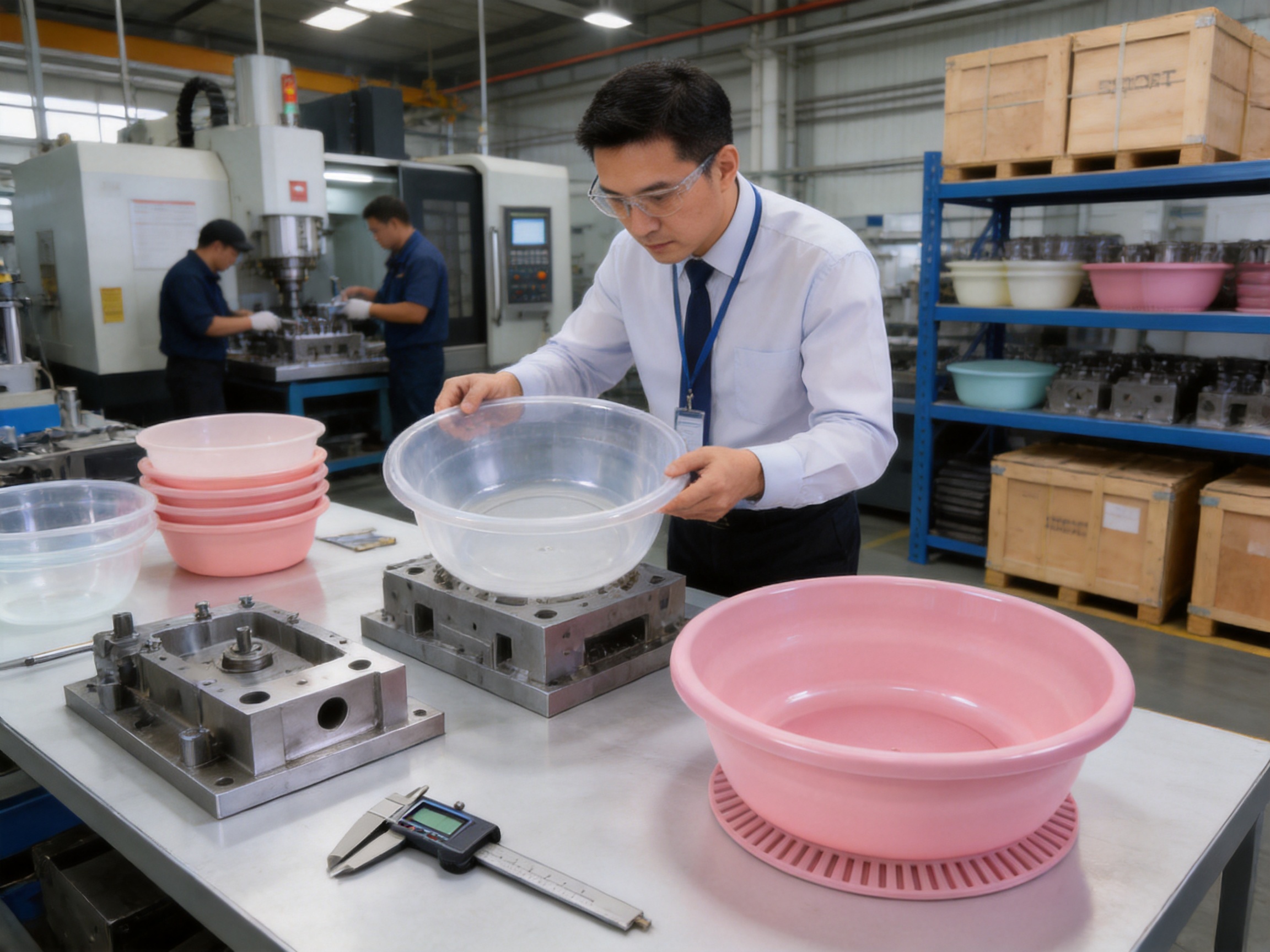
A round thickened washbasin is a practical household product used for face washing, hair washing, foot soaking, light laundry, cleaning, and many other everyday tasks. Although its appearance may seem simple, producing a strong, stable, attractive, and durable basin requires a carefully engineered plastic injection mould. The mould must reproduce the round profile, thickened wall structure, smooth inner surface, stable rim, reinforced base, and anti-slip details consistently in every production cycle.
The round thickened washbasin mould is developed for manufacturers that need reliable high-volume production of PP plastic basins. It combines functional product design with injection moulding technology, suitable material selection, controlled cooling, practical ejection, and efficient maintenance. Compared with basic thin-wall basin moulds, a well-designed thickened basin mould can support better rigidity, improved resistance to deformation, more dependable stacking performance, and a longer service life for the finished household product.
This article explains the product structure, mould design, manufacturing process, material options, quality control procedures, production advantages, and customization possibilities associated with a round thickened washbasin injection mould. It also introduces the capabilities of TaiZhou HuangYan YingXiang Plastic Mould Co., Ltd., a Chinese plastic mould manufacturer specializing in household products, logistics containers, storage boxes, pallets, crates, chairs, and other injection moulded products.
The round thickened washbasin is formed through plastic injection moulding, primarily using polypropylene, commonly known as PP. PP is widely selected for household basins because it offers a useful combination of light weight, chemical resistance, impact performance, moisture resistance, and cost efficiency. It is also suitable for producing smooth, colourful products with a clean appearance.
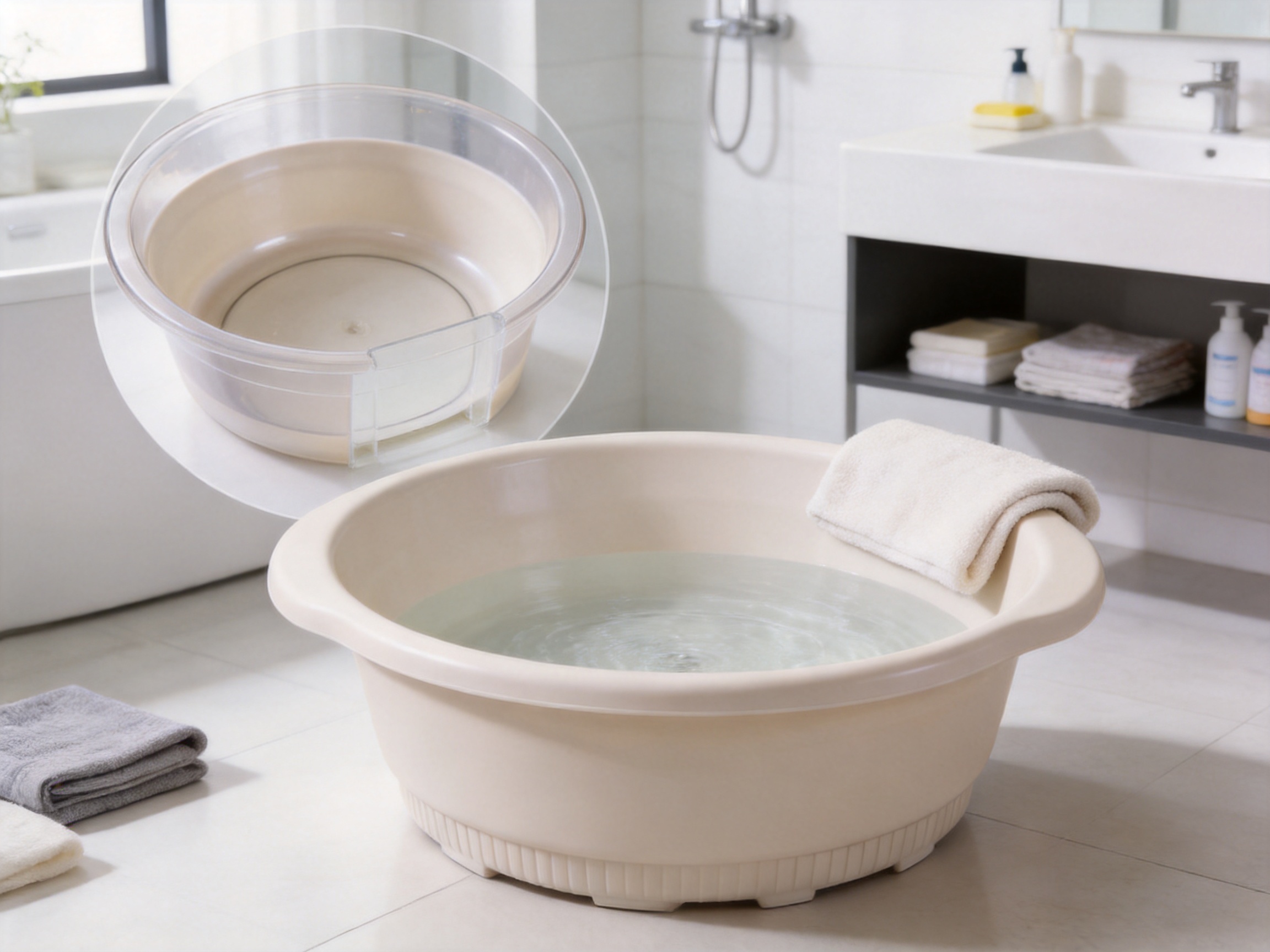
The basin has a rounded body with a relatively thickened wall and bottom. This construction gives the product more rigidity than a lightweight, thin-wall basin. A thicker structure can reduce excessive flexing while the basin is being carried, filled, emptied, or placed on an uneven surface. It also provides a more substantial hand feel, which is often associated with better product quality in the household goods market.
The inner wall is smooth and rounded. This shape supports easy cleaning and helps water droplets move downward after use. The outward-curving rim gives users a comfortable gripping area and increases the apparent stability of the basin. The centre of the bottom is slightly concave, while anti-slip stripes or ribs are arranged around the outer bottom area. This design helps the basin remain more secure when placed on a bathroom floor, kitchen surface, balcony, or other household area.
The mould is not limited to one fixed size or colour. The model, colour, dimensions, and product details can be customized according to the buyer’s requirements. This makes the mould suitable for private-label household product manufacturers, wholesalers, retailers, homeware brands, and injection moulding companies serving different markets.
| Product category | Plastic washbasin mould |
| Product name | Round thickened washbasin |
| Forming method | Plastic injection moulding |
| Recommended product material | PP, with other plastics available according to design requirements |
| Application | Face washing, hair washing, foot soaking, light laundry, cleaning, and household use |
| Product structure | Round body, thickened wall, thickened bottom, curved rim, and anti-slip base details |
| Customization | Size, colour, model, surface details, branding, and selected mould specifications |
| Packaging | Composite wooden box for mould transportation |
| Indicative supply capacity | Approximately 50 mould sets per month, depending on project requirements |
The round body is one of the most important design features of the washbasin. A circular form distributes water pressure and handling loads more evenly than a shape with sharp corners. It also creates a familiar appearance that is easy to use in bathrooms, kitchens, balconies, utility rooms, and outdoor washing areas.
From a moulding perspective, a round product presents both advantages and technical demands. The absence of sharp corners can support smoother material flow and reduce stress concentration in the finished part. However, the designer must still control wall thickness, shrinkage, cooling, and demoulding. Even a circular basin can warp if the wall thickness is inconsistent or if cooling is not balanced around the cavity.
The circular profile also affects nesting and storage. Many household basins are stacked during production, transportation, and retail storage. The mould can be developed with suitable taper and internal clearance so that finished products nest securely without becoming difficult to separate. Proper nesting design may reduce packaging volume and improve logistics efficiency.
The thickened wall gives the basin stronger overall rigidity. When a user lifts the basin while it contains water, the body must resist bending and excessive distortion. A stronger wall can improve handling confidence and reduce the risk of cracking caused by repeated flexing, impact, or accidental contact with hard surfaces.
The bottom is also thickened to provide a more stable foundation. A very thin base may flex when the basin is filled or placed on an uneven surface. The reinforced bottom of this product is intended to improve dimensional stability and support daily use. It must be designed carefully because excessive thickness can increase cycle time, create sink marks, and lead to uneven shrinkage. The purpose of mould engineering is therefore not simply to add material, but to distribute material in a controlled and functional manner.
Ribs, transitions, and rounded corners can be used to increase stiffness without creating unnecessary mass. A good mould design considers the relationship between nominal wall thickness, reinforcement features, gate position, cooling layout, and expected product performance. This balance helps the basin remain durable while maintaining reasonable production efficiency.
The outward-curving rim provides a natural gripping area. Users can hold the basin with one or both hands when carrying water or moving the product. A wider rim may also improve the visual proportion of the basin and make the product feel more substantial.
For mould production, the rim must be designed with smooth transitions and sufficient draft. The mould should allow the finished basin to release without damaging the edge. If the rim is too sharp, too deep, or insufficiently drafted, it can create ejection resistance, whitening, deformation, or visible parting-line problems. Careful edge treatment helps achieve a clean, comfortable, and commercially attractive result.
The inner surface is designed to be smooth and rounded for practical household use. A smooth basin is easier to rinse and clean, and it provides fewer places for dirt or residue to collect. The mould cavity surface has a direct influence on the final appearance. Polishing quality, steel condition, machining accuracy, and maintenance all affect the smoothness of the moulded product.
A smooth interior can also support better water drainage. Water droplets are more likely to slide toward the bottom instead of remaining on irregular surfaces. This is useful in daily face washing, hair washing, and general cleaning applications. The cavity finish can be adjusted according to the desired product appearance, ranging from polished surfaces to controlled textures.
The slightly concave centre of the bottom supports the structural design of the basin. Around the bottom perimeter, evenly distributed anti-slip stripes or ribs can increase contact stability. These features are particularly useful when the basin is placed on a wet bathroom floor, smooth tile, kitchen worktop, or balcony surface.
Small functional details such as anti-slip ribs require accurate machining. The ribs must have suitable height, spacing, and draft so that they can be released from the mould without tearing or sticking. The design must also prevent excessive material concentration, which could lead to sink marks on the visible surface. A well-engineered mould balances grip performance, appearance, mould release, and production cycle time.
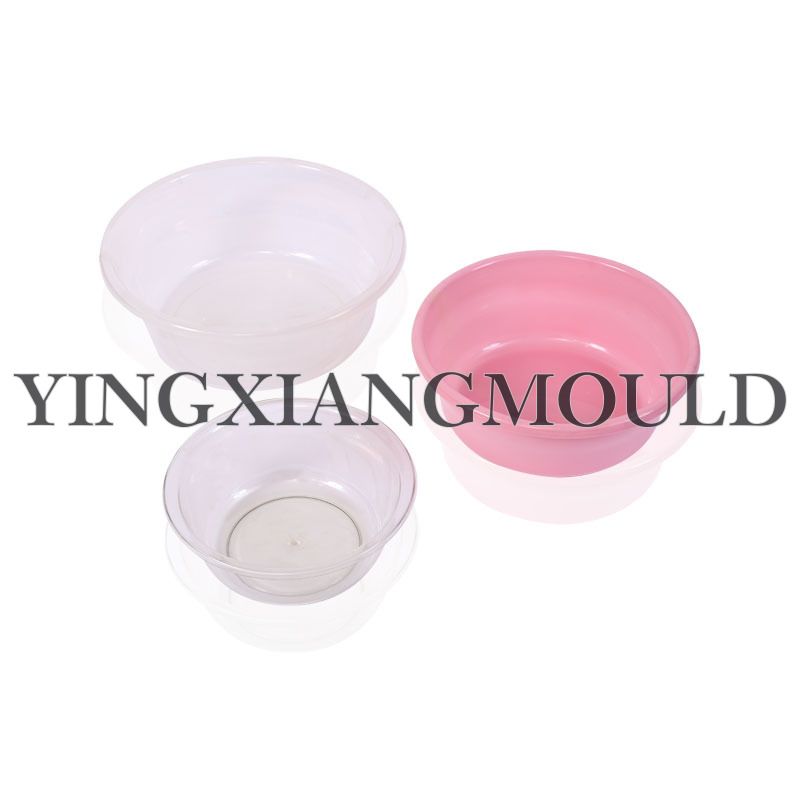
Round thickened washbasin
Many low-cost washbasins are made with very thin walls to reduce material consumption. Although this approach may lower the initial unit cost, it can also create a product that flexes easily during use. A thickened washbasin is designed to provide stronger resistance to bending and deformation. This makes it more suitable for users who expect a stable basin when carrying water or performing household tasks.
The mould supports this performance by controlling the wall and bottom structure. Uniform transitions, suitable radii, and reinforcement details help distribute stress across the product. Compared with a simple thin-wall design, the thickened mould is more focused on long-term handling performance and a stronger product feel.
Cracking can occur when a plastic basin is dropped, squeezed, exposed to repeated impact, or subjected to excessive flexing. Material selection remains important, but product geometry also plays a major role. A thickened wall and reinforced bottom can reduce the likelihood of local stress concentration.
PP is a practical material for this type of application because it combines flexibility and impact resistance. When the mould design and processing conditions are properly matched to the selected PP grade, the finished basin can provide dependable performance for normal household use. The result is a more robust product than a poorly designed thin-wall alternative.
The widened rim and anti-slip bottom features improve the way the basin is handled and placed. A stable base reduces sliding and makes the basin easier to use on wet or smooth surfaces. This can be a meaningful advantage in bathrooms and kitchens, where water is commonly present.
Basic basin moulds may have a flat or minimally detailed base. While such a design can be simple to manufacture, it may not offer the same level of placement stability. The addition of controlled bottom ribs increases functional value without requiring complex assembly or secondary operations.
The rounded profile and curved rim are designed around everyday handling. Sharp or narrow edges can be uncomfortable when the basin is full. A smooth, widened rim provides a more natural gripping point and reduces contact pressure on the hands.
The mould must reproduce the edge consistently around the entire circumference. Inconsistent edge thickness or an uneven parting line can affect both comfort and appearance. Accurate machining and careful mould assembly are therefore essential for producing a uniform rim.
A premium household basin is judged not only by its strength but also by its visual quality. A consistent round shape, smooth interior, clean rim, balanced wall thickness, and well-formed bottom details contribute to a more attractive product. These qualities can help manufacturers position the basin above basic commodity products.
The mould can be adapted to different colours and surface finishes. Bright colours, soft household tones, translucent effects, or textured exteriors may be considered depending on the target market. Colour itself is controlled during injection moulding through the selected resin and masterbatch, while the mould surface determines the level of gloss or texture.
The product is not restricted to one task. It can be used for face washing, hair washing, foot soaking, hand laundry, cleaning vegetables, carrying water, soaking clothes, or organizing household items. Its flexible use increases the potential market and allows distributors to present it as a multi-purpose household basin.
Compared with a product designed only for one narrow function, a multi-purpose basin may appeal to a wider group of consumers. The mould can also be modified in size to create a family of products, such as compact personal basins, medium daily-use basins, and larger utility basins.
The parting line is the location where the mould halves separate. For a round washbasin, the parting line is commonly arranged around the outer perimeter, but the exact position depends on the rim, wall profile, bottom structure, and ejection strategy. Correct parting-line planning helps minimize visible flash and simplifies mould release.
The parting line should be positioned away from important gripping surfaces whenever possible. If a visible line is unavoidable, it must be controlled through accurate mould fitting and polishing. The goal is to produce a clean edge that does not interfere with use or create an unattractive mark.
Draft angles allow the moulded basin to separate from the core and cavity. Without sufficient draft, the part may stick, deform, or require excessive ejection force. The inner wall, outer wall, rim, and bottom ribs all need suitable release angles.
Draft requirements may vary according to surface texture. A polished surface can sometimes be released with a smaller draft angle than a deep textured surface, while ribbed areas generally require careful attention to avoid undercutting. The final draft should be confirmed during design review because it affects both product appearance and production reliability.
The gate introduces molten plastic into the mould cavity. Its location influences filling balance, weld-line position, pressure distribution, shrinkage, and visible gate marks. For a circular basin, the gate design must help the melt travel evenly around the product and fill the thickened sections without creating excessive pressure variation.
Depending on the product size and mould structure, a central gate, hot runner arrangement, edge gate, or another suitable feeding method may be considered. The best choice depends on the basin geometry, selected PP grade, required appearance, production volume, and customer preferences.
A balanced filling pattern can reduce short shots, flow marks, weld lines, and local deformation. Computer-aided analysis may be used to study filling and cooling behaviour before steel machining. This helps the engineering team identify potential risks and adjust the design earlier in the project.
Cooling is one of the most important factors in injection moulding. Plastic must cool sufficiently before ejection, but uneven cooling can cause warpage, dimensional variation, and internal stress. The thickened wall and bottom of the basin make cooling-channel layout especially important.
Cooling channels should be arranged to remove heat from thick areas while maintaining relatively uniform temperatures around the round cavity. The design may require different cooling strategies for the rim, side wall, bottom, and base ribs. Proper cooling can shorten cycle time, improve shape stability, and support consistent production.
Insufficient cooling in a thick region may leave the product soft during ejection. Excessive cooling in one area and insufficient cooling in another can create differential shrinkage. The mould designer must therefore consider channel diameter, spacing, water flow, access for cleaning, and the thermal characteristics of the selected steel.
The basin must be removed from the core without damage to the rim, inner wall, or bottom details. Ejection can be achieved through a suitable combination of ejector elements, stripper structures, or other mechanisms. The preferred solution depends on the product shape and the amount of available space inside the mould.
For a round basin, balanced ejection is essential. If force is applied unevenly, the product may tilt, deform, or become marked. Ejector positions should be distributed in a way that supports the product without creating visible marks in important areas. The ejection stroke and return system must also be reliable for repeated production.
Air inside the cavity must escape as molten plastic fills the mould. Poor venting can cause burn marks, incomplete filling, trapped air, silver streaks, or surface defects. The rim, bottom ribs, and farthest flow areas are possible locations where air may accumulate.
Vents must be deep enough to release air but controlled so that plastic does not flash excessively. Proper venting is especially important when the basin has thickened sections and a wide flow path. The design team can review likely air-trap locations through mould flow analysis and practical experience.
PP is the primary recommended plastic for the round thickened washbasin. It is widely used in household products because it is lightweight, resistant to water, and compatible with high-volume injection moulding. It can be supplied in a broad range of colours and grades, allowing manufacturers to balance impact performance, stiffness, processing speed, and appearance.
Different PP grades have different melt-flow characteristics. A grade with suitable flow can fill the rounded basin cavity effectively while maintaining the desired mechanical performance. The selected material should match the wall thickness, gate system, cooling design, and expected use conditions.
Material drying requirements, processing temperature, injection speed, holding pressure, cooling time, and mould temperature should be established according to the resin supplier’s recommendations and validated through trial production. Correct processing is necessary to obtain the full benefits of the mould design.
The mould material information includes a broad range of plastic options, such as PC, PS, POM, PE, PU, PVC, ABS, and PMMA. Not every material is necessarily suitable for a conventional washbasin, but the list illustrates the manufacturer’s broader capability in plastic injection mould projects.
PE may be considered for certain flexible or impact-resistant household applications. ABS can provide a rigid and attractive surface for other product categories. PC offers high impact strength and transparency potential, while PMMA is often selected where optical appearance is important. PS, POM, PU, and PVC each have their own processing and performance characteristics.
For a washbasin intended for ordinary household use, PP generally remains a practical option. However, the mould can be reviewed if a customer requires a different resin, special chemical resistance, unusual appearance, enhanced stiffness, or a particular market specification.
The basin can be produced in customized colours. Colour masterbatch must be dispersed evenly to prevent streaks, shade variation, or visible contamination. Production teams should use consistent material batches and maintain stable processing conditions.
Additives may be selected to modify impact resistance, stiffness, ultraviolet resistance, antistatic performance, or other properties. Any additive or recycled content should be assessed carefully because it may influence shrinkage, surface appearance, odour, and mechanical performance.
The choice of mould steel influences service life, polishing performance, corrosion resistance, machining accuracy, and maintenance requirements. Available steel options include 1Cr13, 2Cr13, 3Cr13, 4Cr13, S136, CR16, 2316, 718H, P20, and other materials according to project requirements.
P20 is commonly used for many general-purpose mould applications because it offers practical machinability and a suitable balance of strength and cost. Stainless or corrosion-resistant steels such as S136 and related grades may be preferred when the project requires improved polishing, corrosion resistance, or long-term surface stability.
The correct steel depends on the expected production volume, plastic material, required surface finish, mould complexity, customer budget, and maintenance environment. A household basin mould may not require the same steel specification as a high-precision optical mould, but it still needs reliable wear resistance and dimensional stability.
Steel selection should be considered together with heat treatment, hardness, polishing, cooling-channel design, and machining accuracy. A high-grade steel alone cannot compensate for poor mould construction. Performance results from the complete engineering system.
The project begins with a review of the basin design. Engineers examine dimensions, wall thickness, bottom structure, rim shape, draft angle, parting line, gate location, cooling requirements, and ejection method. They also confirm the selected plastic, product application, expected production volume, and desired appearance.
This stage is important because design changes are easier and less expensive before steel is cut. A detailed review can identify areas that may cause sink marks, warpage, air traps, difficult ejection, or excessive cycle time.
CAD software is used to create the product model, mould assembly, core, cavity, cooling system, ejection components, and related structures. The design must account for plastic shrinkage so that the mould produces the required finished dimensions.
CAD data also supports communication between the mould manufacturer and customer. Dimensions, logos, surface patterns, colour zones, and modifications can be reviewed before manufacturing begins. This reduces misunderstandings and helps ensure that the final mould matches the intended product.
Computer-aided engineering can be used to examine filling, packing, cooling, and warpage. The analysis may identify areas where the melt reaches late, where weld lines could appear, or where cooling is likely to be uneven.
For the thickened basin, simulation is particularly useful because the wall and bottom sections may cool at different rates. The engineering team can compare gate locations, modify wall transitions, adjust cooling channels, and optimize process conditions before conducting physical trials.
After design approval, the selected mould steel is prepared and machined. CNC milling creates the main cavity and core surfaces, while drilling equipment forms cooling channels and other internal passages. Electrical discharge machining may be used for fine details or areas that are difficult to produce through conventional cutting.
Machining accuracy affects the basin’s dimensions, roundness, wall consistency, rim quality, and bottom details. Modern equipment allows the mould maker to produce complex features with repeatable accuracy. Skilled technicians remain essential because machine output must be inspected, interpreted, and refined.
The mould surface is polished or textured according to the customer’s requirements. A smooth polish may be used for the inner wall of the basin, while a fine texture may be selected for the exterior to improve visual effect or reduce the visibility of minor handling marks.
Polishing must be uniform around the circular cavity. Uneven polishing can produce inconsistent gloss or visible flow differences in the finished product. Corners, transitions, ribs, and rim areas require special attention because they can be difficult to reach and may influence the final appearance.
After individual components are machined and inspected, the mould is assembled. The team checks alignment, parting surfaces, guide systems, cooling connections, ejection movement, and gate components.
Trial moulding is then conducted to evaluate the actual product. Engineers inspect dimensions, surface quality, filling performance, ejection, cycle time, shrinkage, warpage, and the function of the bottom ribs and rim. Trial results may lead to adjustments in mould steel, venting, polishing, cooling, or process settings.
Several trial stages may be required for a product with demanding appearance or dimensional requirements. The purpose is not merely to produce one acceptable sample, but to develop stable conditions that can be repeated in the customer’s production environment.
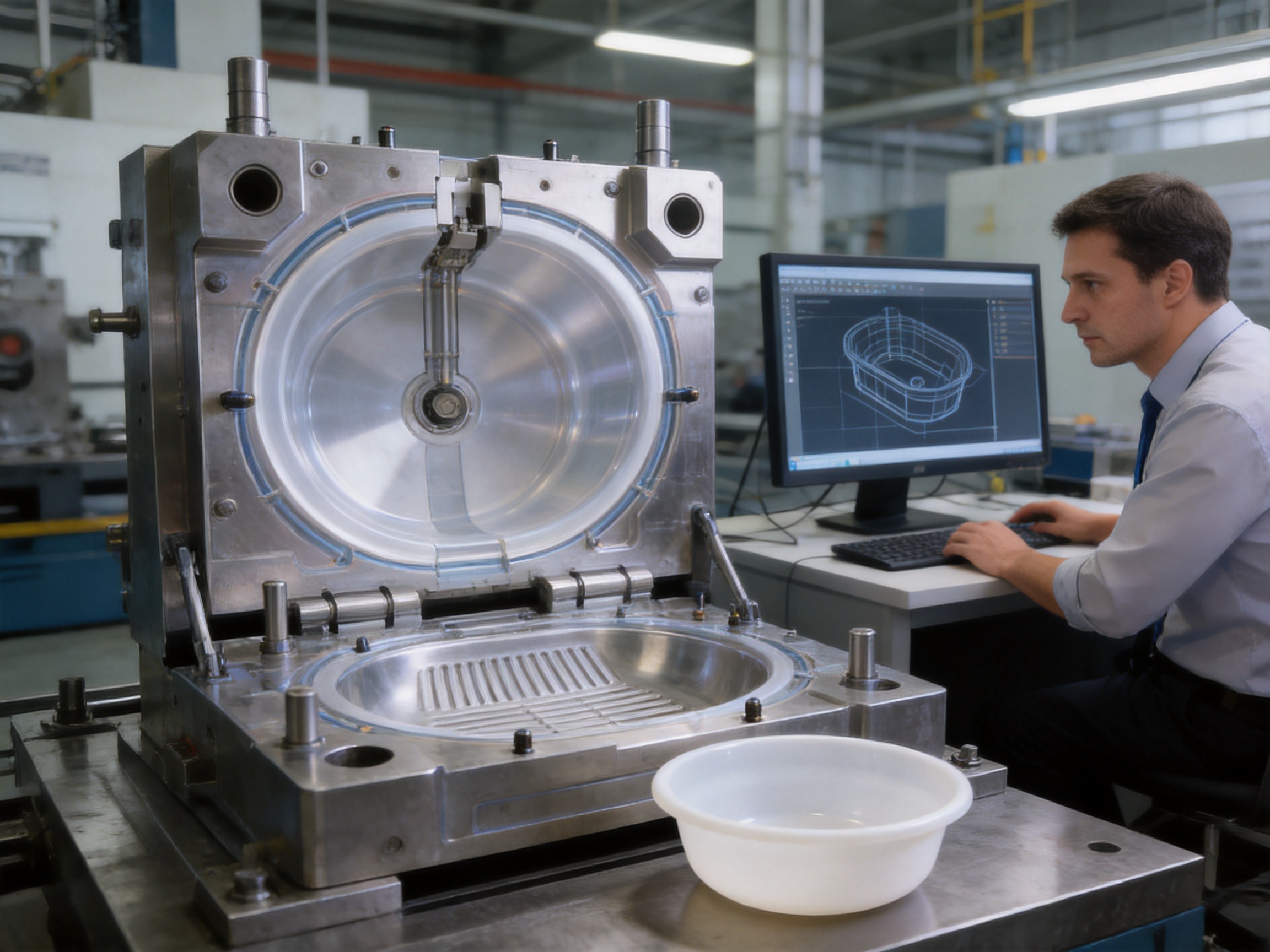
TaiZhou HuangYan YingXiang Plastic Mould Co., Ltd. is located in Huangyan, Taizhou, Zhejiang, China, an area widely recognized for mould manufacturing. Established in 2012, the company operates a plant of approximately 7,000 square metres and has around 50 employees.
The company uses CAD, CAE, and CAM systems together with modern processing equipment. This digital and manufacturing combination supports the development of household moulds, logistics crate moulds, folding box moulds, pallet moulds, beverage box moulds, chair moulds, tray moulds, and other customized plastic injection solutions.
For the round thickened washbasin mould, these capabilities are relevant because the product requires more than basic cavity machining. The mould must integrate functional geometry, controlled wall thickness, practical ejection, stable cooling, accurate circular form, and a suitable surface finish.
An integrated engineering process helps connect product design with mould manufacturing. The product model, mould structure, processing analysis, machining plan, and trial results can be considered as parts of one project instead of separate activities.
This approach helps reduce avoidable design errors. For example, a rim that looks attractive in a product drawing may be difficult to eject if draft is not included. A bottom rib that provides good grip may produce sink marks if its thickness is excessive. Engineering integration allows these issues to be evaluated before mass production.
Experienced technicians contribute practical knowledge in addition to digital tools. They understand how steel behaves during machining, how polishing affects plastic appearance, how cooling influences shrinkage, and how injection settings interact with mould geometry.
Technical experience is especially valuable during trial moulding. When a sample shows warpage, flash, flow marks, or difficult ejection, the cause may involve several connected factors. A skilled team can distinguish between mould-related and process-related issues and recommend an efficient correction.
The company provides OEM service for customers that require customized moulds and plastic products. Customization may include basin diameter, depth, wall thickness, bottom pattern, rim profile, surface texture, branding details, material selection, colour, and packaging requirements.
Customers can provide drawings, three-dimensional files, samples, sketches, or basic product concepts. The engineering team can then review feasibility and develop a mould solution around the required production target.
The indicated supply capacity is approximately 50 mould sets per month, depending on mould size, structure, complexity, and project schedule. Capacity planning allows the manufacturer to organize design, machining, assembly, testing, and inspection activities across multiple projects.
Production schedules should be confirmed according to the customer’s technical requirements and approval process. A simple household mould may move through development more quickly than a complex multi-cavity or multi-component project. Clear communication regarding drawings, materials, samples, and approval timing helps maintain delivery efficiency.
The company focuses on lean manufacturing, long-life moulds, on-time delivery, competitive cost, and customer service. These priorities are important for injection mould users because the mould is a production asset rather than a one-time consumer product.
A reliable mould should support consistent parts over many cycles, allow practical maintenance, and provide access to replacement or technical support when needed. Attention to mould construction and service can reduce production interruptions and protect the customer’s investment.
Quality control begins with the review of customer specifications and continues through design, material purchasing, machining, assembly, testing, and final approval. Each phase affects the performance of the finished mould.
Critical dimensions include basin diameter, height, rim width, wall thickness, bottom thickness, rib spacing, draft angle, and mould alignment. Measuring equipment should be selected according to the required tolerance and feature size.
Dimensional checks are necessary because small deviations in the mould can become visible in the finished product. Roundness errors may affect stacking, while inconsistent rim dimensions can influence handling and appearance.
The cavity and core surfaces are checked for scratches, machining marks, polishing defects, corrosion, and unwanted texture variation. The inner surface receives particular attention because it is highly visible and directly related to cleaning performance.
The mould is tested for opening and closing movement, ejection balance, cooling circulation, water leakage, guide-system operation, and part release. The test should confirm that the mould can operate smoothly under production conditions.
Trial samples are assessed for short shots, flash, sink marks, warpage, flow marks, weld lines, colour consistency, dimensional accuracy, and surface appearance. The anti-slip stripes and curved rim are also inspected because these are important product features.
Sample evaluation should consider not only one part but also repeatability. A mould that produces one good sample but unstable subsequent parts requires further adjustment before approval.
Correct mould maintenance extends service life and helps preserve product quality. After production, the mould should be cleaned to remove plastic residue, dust, grease contamination, and moisture. Cooling channels should be monitored because scale or blockage can reduce heat transfer and increase cycle time.
Moving components should receive suitable lubrication according to the mould maker’s recommendations. Ejector pins, guide pillars, guide bushes, sliders, and other moving parts should be checked for abnormal wear. The parting surface should be protected from impact and contamination because damage in this area can create flash.
When the mould is stored, it should be dried and protected against corrosion. The cavity and core may require an appropriate rust-prevention treatment, especially when the mould is not used for an extended period. The mould should be stored in a dry and secure location, preferably with records identifying its production history and maintenance status.
Processing conditions also influence mould life. Excessive injection pressure, unsuitable material, poor cooling water quality, or incorrect ejection settings may increase wear or damage. Operators should follow an agreed process sheet and report unusual sounds, sticking, flash, leakage, or product deformation promptly.
The round thickened washbasin is suitable for household product manufacturers serving different market segments. In the everyday homeware sector, it can be sold as a bathroom basin, utility basin, laundry basin, or general-purpose container.
Its multi-purpose design also supports sales through supermarkets, home improvement stores, online retail platforms, household goods distributors, and regional wholesalers. Different sizes and colour options can help manufacturers create product series for different consumer groups.
The basin can also be supplied for institutional or commercial use where lightweight, washable, and durable containers are required. Possible environments include dormitories, staff accommodation, rental housing, cleaning services, guesthouses, and utility areas. Product specifications should be adapted to the intended market and relevant regulations.
Private-label customers may use customized colours, packaging, surface details, and branding to distinguish their products. A mould with flexible customization potential can support product differentiation without requiring an entirely new development process for every variation.
Customers should first define the product’s basic dimensions, including diameter, height, capacity, wall thickness, bottom thickness, and rim width. These specifications determine the mould size, steel consumption, injection requirements, cooling design, and expected cycle time.
The next step is to confirm the intended resin. PP is recommended for the standard product, but other materials may be reviewed if they provide a specific benefit. The customer should also identify whether virgin resin, recycled content, or a blended formulation is intended.
Appearance requirements should include colour, gloss level, texture, logo, and acceptable parting-line position. If the basin is intended for retail sale, the customer may also need to confirm packaging dimensions, stacking quantity, and label information.
Production targets should be discussed early. Annual volume, machine size, cycle time, number of cavities, automation level, and expected mould life all influence the mould structure. A low-volume custom basin may use a different solution from a high-volume product intended for continuous factory production.
Finally, the customer should clarify inspection standards and approval procedures. A reference sample, product drawing, three-dimensional file, or technical specification can help the mould maker establish objective acceptance criteria.
PP is the recommended material for the standard basin because it is lightweight, water-resistant, impact-resistant, and suitable for injection moulding. The exact PP grade should be selected according to the required stiffness, impact performance, colour, flow characteristics, and processing conditions.
Yes. The product size and mould model can be customized. Diameter, height, depth, capacity, wall thickness, bottom structure, and rim dimensions should be confirmed before mould design begins.
Yes. Colour can be customized through the selected plastic resin and colour masterbatch. Stable material batches and controlled processing conditions are important for maintaining consistent colour from one production run to another.
A thickened basin generally provides better rigidity, a stronger hand feel, improved resistance to deformation, and greater support when carrying water. The final result still depends on the selected material, mould design, and injection process.
The anti-slip stripes or ribs around the bottom increase contact stability when the basin is placed on smooth or wet surfaces. They are designed to help reduce sliding during normal household use.
Available options include 1Cr13, 2Cr13, 3Cr13, 4Cr13, S136, CR16, 2316, 718H, P20, and other grades according to the project. The best choice depends on production volume, plastic material, surface finish, corrosion requirements, and budget.
The company has experience with various plastic materials, including PC, PS, POM, PE, PU, PVC, ABS, and PMMA. Suitability must be reviewed because every material has different shrinkage, flow, temperature, and cooling requirements.
Warpage is controlled through balanced wall thickness, suitable gate placement, effective cooling-channel design, correct mould temperature, appropriate injection settings, and stable ejection. CAE analysis and trial moulding can help identify and correct potential deformation.
The customer should provide product drawings or samples, dimensions, material requirements, colour, expected production volume, machine information if available, surface finish expectations, packaging requirements, and delivery schedule. More complete information allows the mould manufacturer to prepare a more accurate solution.
Yes. OEM service is available for customized plastic injection mould projects. The service can cover product development, mould design, material review, machining, trial moulding, modification, and delivery preparation.
The mould is packaged in a composite wooden box. The specific export packaging arrangement should be confirmed according to mould size, shipping method, destination, and customer requirements.
The company produces household product moulds, logistics crate moulds, integral box moulds, folding box moulds, pallet moulds, tray moulds, beverage box moulds, chair moulds, stool moulds, storage container moulds, trash can moulds, floor mat moulds, hand basket moulds, and other customized injection moulds.
The round thickened washbasin injection mould is designed to produce a durable, stable, and versatile household basin. Its main product advantages come from the thickened wall and bottom, rounded body, comfortable curved rim, smooth inner surface, slightly concave base, and anti-slip bottom details. These features give it meaningful advantages over basic thin-wall basin designs that may flex easily, feel less stable, or provide fewer functional details.
Achieving these advantages requires careful mould engineering. Parting-line planning, draft angles, gate location, cooling balance, venting, ejection, steel selection, polishing, and trial moulding all contribute to the final result. The mould must be designed not only to create the desired shape but also to support stable, repeatable, and economical production.
TaiZhou HuangYan YingXiang Plastic Mould Co., Ltd. offers customized plastic injection mould solutions from its manufacturing base in Huangyan, Taizhou, Zhejiang. With CAD, CAE, and CAM systems, modern equipment, experienced technicians, a 7,000-square-metre plant, and an established focus on household and industrial plastic moulds, the company can support projects from initial concept through mould production and trial approval.
For customers seeking a practical and customizable washbasin mould, the round thickened design provides a strong foundation for household product development. Its balance of durability, usability, appearance, and production flexibility makes it suitable for manufacturers serving domestic, wholesale, retail, and private-label markets.
1. General principles of thermoplastic injection mould design and mould flow control.
2. Technical data and processing guidance for polypropylene injection moulding materials.
3. Standard practices for plastic product draft design, ejection, cooling, and venting.
4. Industrial guidance on mould steel selection, polishing, heat treatment, and corrosion prevention.
5. Product and company information supplied for the round thickened washbasin plastic injection mould project.
6. General manufacturing principles for household plastic containers, basins, crates, boxes, pallets, and storage products.
If you are interested in any of our products or services, please feel free to ask and we can talk about your ideas.
 QUICK LINKSMOBILE SITE
 FACTORY ADDRESS
 CONTACT INFORMATION



 English
 Español