Plastic furniture has moved well beyond the basic molded chair. Outdoor seating, dining chairs, office furniture, stackable seating, and leisure products now cover a much wider range of shapes and visual styles. That change is also affecting the design of the plastic chair mold, because each new chair concept has to be translated into a structure that can be molded consistently at production scale.
For manufacturers, the mold is more than a tool for reproducing the outside shape. Curves, ribs, openings, edges, surface textures, and connection points all have to work together during injection molding. As chair designs become more distinctive, mold development increasingly starts with the relationship between appearance and structural performance.
Older plastic chairs often relied on relatively straightforward surfaces and a small number of structural features. Newer designs can include curved backrests, open patterns, integrated armrests, concealed reinforcement, and more pronounced ergonomic contours.
These details create additional demands during mold development. A deep curve may influence how plastic flows through the cavity, while a large open section can change local stiffness and cooling behavior. Reinforcing ribs also need to provide support without creating unnecessary variations in wall thickness.
A well-planned plastic chair mold therefore begins with the geometry of the finished chair rather than treating the mold as a separate stage of development.
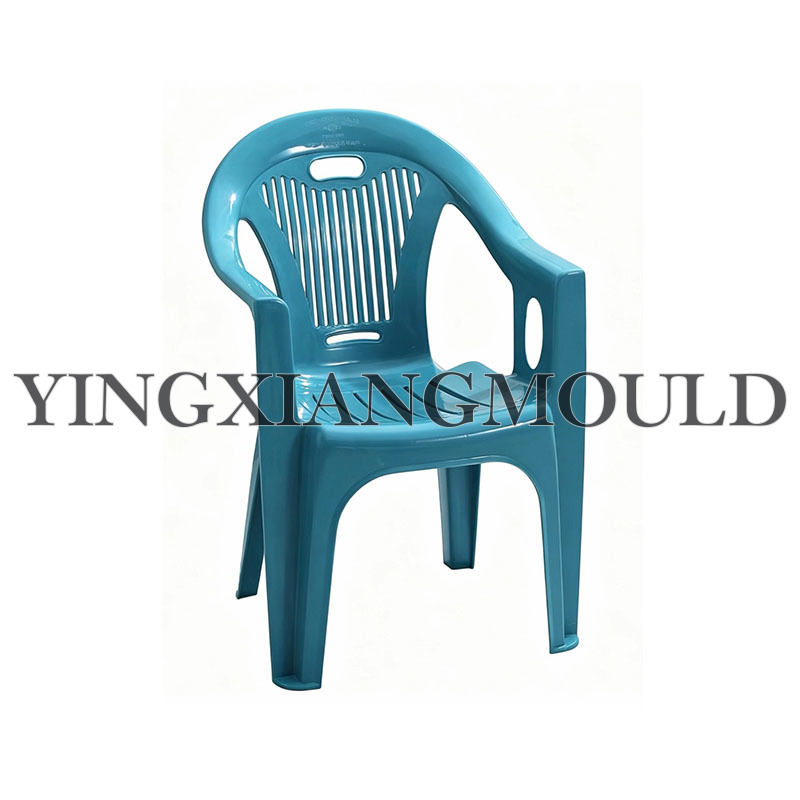
Chair design is closely connected with how the finished product supports the body. A backrest may need a particular curve, while the seat can require a carefully controlled transition between its center and edges.
At the same time, the molded part needs enough structural support for its intended application. Reinforcing ribs can be positioned beneath seats or along the backrest to add rigidity without simply making the entire component thicker.
This creates a balancing act during mold design. The visible surface needs to remain clean and comfortable, while less visible areas can carry much of the structural reinforcement. The core and cavity geometry must reproduce both sides accurately.
PP is widely used for plastic furniture because it can support lightweight molded structures and a broad range of applications. ABS and PC/ABS can also be considered for furniture components where appearance and material characteristics call for another approach.
Different plastics do not behave identically during injection. Shrinkage, flow behavior, cooling, and surface appearance can vary between materials. That means a mold designed around one resin should not automatically be treated as suitable for every alternative resin.
For this reason, material selection needs to be considered early. The cavity dimensions, gate arrangement, cooling layout, and expected product tolerances all relate to the material being processed.
A chair can have the correct dimensions and still fail to deliver the intended appearance if the mold surface does not reproduce the required finish.
Modern plastic furniture can use smooth gloss surfaces, matte textures, leather-like patterns, or decorative molded effects. Texture can also serve a practical role by changing the way minor surface marks are perceived.
The selected finish must be incorporated into the cavity and core surfaces with appropriate attention to product release. Parting-line placement is also important, particularly when the chair has large visible areas where an obvious mismatch or flash could affect the final appearance.
Many chair parts are relatively large compared with everyday injection-molded household components. Uneven cooling across a wide backrest or seat can contribute to dimensional changes and warpage.
Cooling-channel planning consequently becomes an important part of the plastic chair mold. The goal is not simply to remove heat, but to create a reasonably balanced cooling pattern across areas with different wall thicknesses and structural features.
This becomes more challenging when ribs, curved sections, or thick connection areas are introduced. These regions may cool differently from broad flat surfaces, so the mold structure needs to account for those differences during development.
Furniture brands and manufacturers may introduce several chair styles for different markets. Some designs target restaurants and commercial spaces, while others are intended for homes, offices, schools, or outdoor environments.
That variety creates demand for mold solutions that match the expected production volume and product structure. A high-volume single-style chair can justify a different mold configuration from a product family requiring frequent design changes.
The same consideration applies to cavities, ejection arrangements, and replaceable components. The right solution depends on the chair geometry, material, production target, and expected product lifecycle rather than one universal mold structure.
As plastic furniture continues to diversify, the plastic chair mold is becoming increasingly connected with product development itself. Successful mold design has to accommodate the chair's appearance, ergonomics, structural reinforcement, material behavior, surface finish, and production requirements at the same time. That broader approach allows new furniture concepts to move from digital design into repeatable injection molding without losing the details that define the finished product.
If you are interested in any of our products or services, please feel free to ask and we can talk about your ideas.
 QUICK LINKSMOBILE SITE
 FACTORY ADDRESS
 CONTACT INFORMATION


 English
 Español