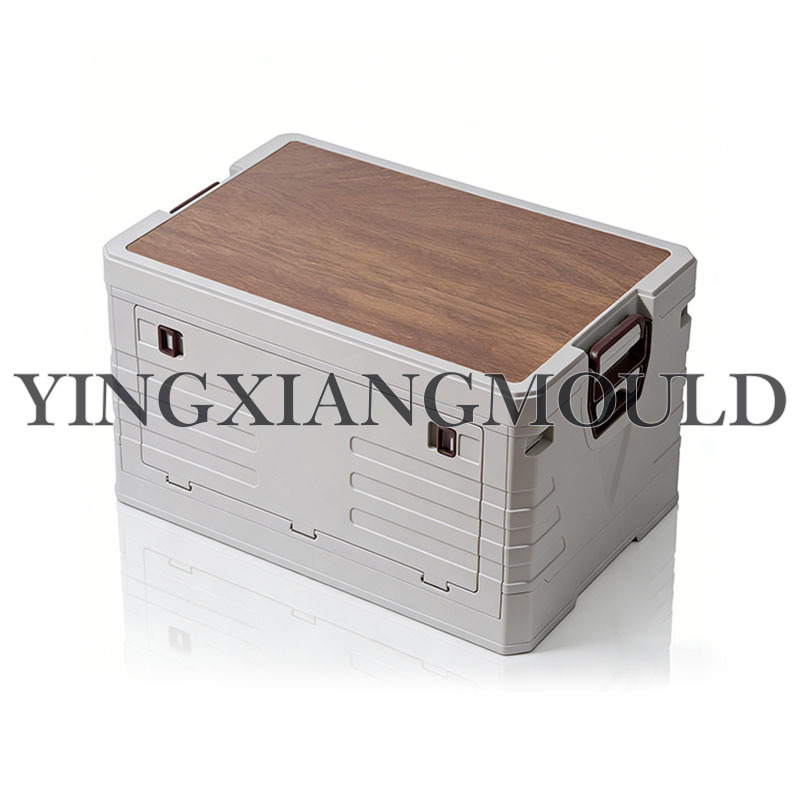
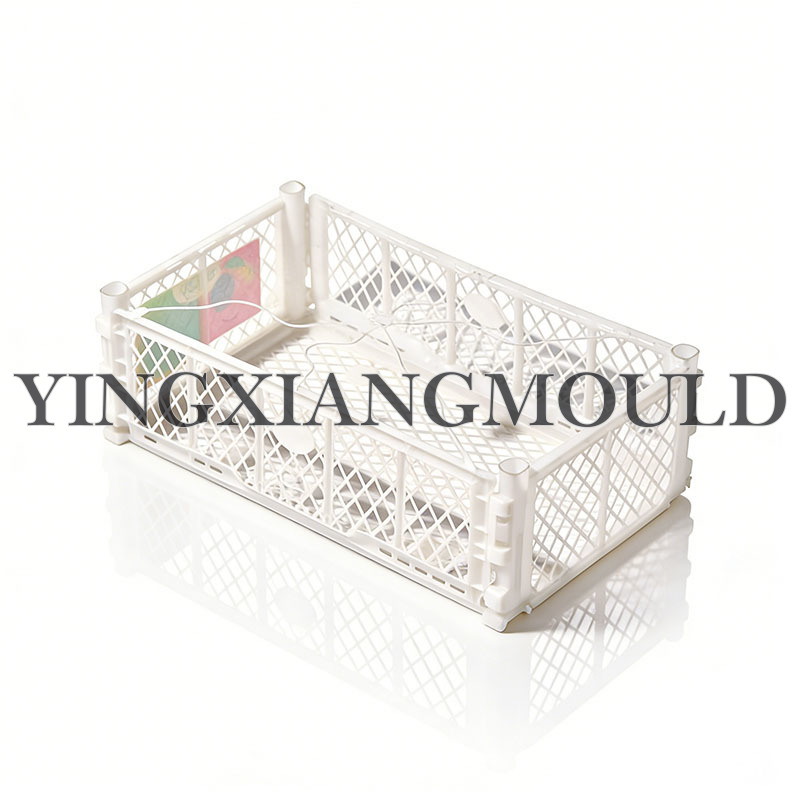
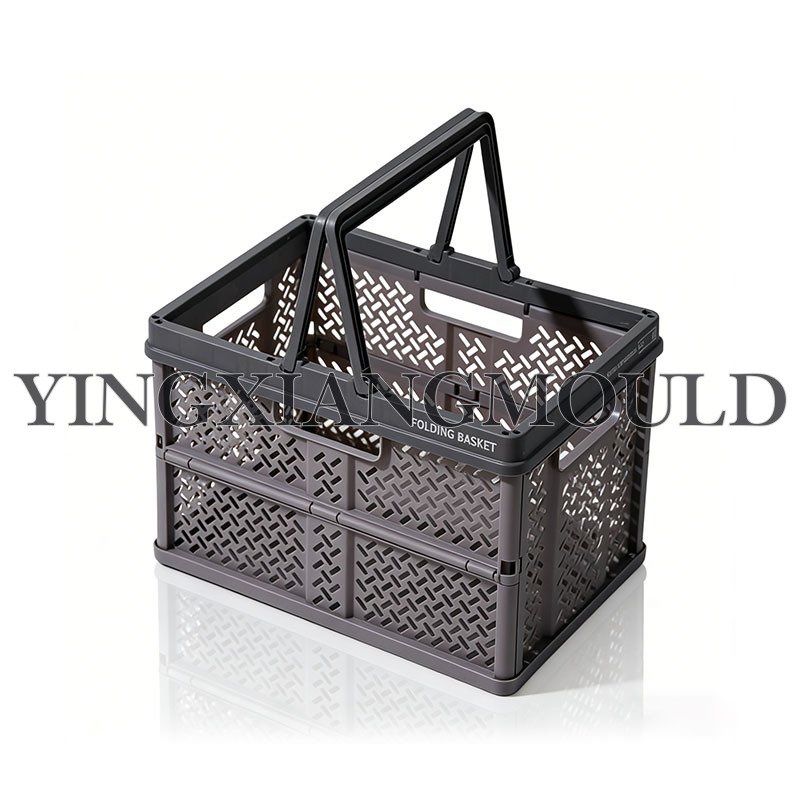
A folding box mold is a specialized injection mold used to produce foldable plastic crates, logistics boxes, and storage boxes. Through injection molding, the box body, side panels, and related connecting components are manufactured, enabling the product to fold and unfold. Folding boxes offer advantages such as saving storage space, reducing transportation costs, and facilitating turnover management, and are therefore widely used in logistics distribution, e-commerce warehousing, agricultural fruit and vegetable transportation, automotive parts, and the retail industry.
Application Scenarios: Which industries need to purchase folding box molds?
1. Logistics & Warehouse Distribution
- Product Types: Standardized logistics folding boxes, express sorting folding baskets, warehouse turnover folding boxes, cold chain distribution folding insulated boxes
- Design Features: Conforms to European standard logistics dimensions of 600x400mm or 400x300mm, compatible with standard pallets; folded height reduced to 20-25% of the original height, saving return transportation costs.
- Performance Requirements: Static load capacity of 30-50kg (stacked 5-6 layers), dynamic load capacity of 20-30kg, impact resistance (drop test from 1 meter without breakage).
- Material Selection: Primarily uses PP (polypropylene, temperature resistance -20°C to 120°C, microwaveable) or HDPE (high-density polyethylene, impact-resistant, UV-resistant), some using fiberglass reinforced composite materials to improve structural strength.
2. Retail & Supermarket Replenishment Replenishment)
- Product Types: Store replenishment folding boxes, promotional display folding baskets, fresh produce delivery folding boxes
- Design Features: Aesthetically pleasing (matches brand colors), lightweight (easy for staff to handle), stackable (saves back-end storage space)
- Functional Requirements: Some models include transparent windows or label slots for easy identification of contents; fresh produce delivery boxes must have ventilation holes or drainage designs
- Market Trends: The retail industry pursues "zero inventory" and rapid replenishment, making folding boxes an efficient carrier connecting distribution centers and stores
3. Agriculture and Fruit & Vegetable Harvesting
- Product Types: Fruit Picking Folding Crates, Vegetable Turnover Folding Boxes, Aquatic Product Transport Folding Boxes
- Design Features: Ventilated mesh structure (drainage and breathability, prevents mold growth on fruits and vegetables), rounded corners (avoids damage to agricultural products), foldable for easy return of empty crates
- Material Requirements: Must pass food contact grade certification; some require the addition of antibacterial agents; resistant to pesticide corrosion and UV radiation (for outdoor use)
- Performance Requirements: Low temperature resistance (cold chain transportation -5°C to 4°C), folding cycles must reach over 5000 times
4. Manufacturing & Automotive Parts
- Product Types: Folding storage boxes for parts, folding baskets for workstation tools, folding boxes for auto parts turnover
- Design Features: Standardized dimensions (suitable for automated warehouses), can be equipped with dividers (for categorizing and storing small parts), anti-static (for electronic components)
- Material Features: Mostly HDPE or PP, with added antistatic agents or conductive carbon black; some require oil and chemical corrosion resistance
- Special Requirements: Must be compatible with automated sorting lines, high dimensional accuracy (within ±1mm)
Purchase Reasons: Why do B2B buyers need to purchase folding box molds?
1. Revolutionary Improvement in Space Efficiency
The core value of folding boxes lies in their 70-80% volume reduction after folding. Through proprietary molds, precise control can be achieved on:
- Folding hinge precision: Ensuring smooth hinge engagement between the side panels and the bottom panel, making folding and unfolding operations effortless, and preventing fatigue breakage even after more than 5000 folds.
- Nested stacking design: Folded boxes can be nested and stacked, saving 60-80% of storage and return transport space, directly reducing logistics costs.
- Unfolding locking structure: One-piece molded snap-on or magnetic locking structure ensures the box is stable and does not loosen after unfolding.
2. Balance between structural strength and lightweight design
Folding boxes must have the load-bearing capacity of ordinary turnover boxes when unfolded. Through mold design optimization, the following can be achieved:
- Reinforcing Rib Network: Scientifically placed reinforcing ribs at the base plate, side plate corners, and hinge connections enhance compressive and impact resistance.
- Wall Thickness Optimization: While maintaining strength, the wall thickness can be optimized to 2.5-3.5mm, reducing single-piece weight by 10-15%, saving raw material costs and reducing logistics expenses.
- Hinge Reinforcement: The hinge area adopts a gradient wall thickness design (from thin to thick and then back to thin) to avoid stress concentration and improve folding life.
3. Material Compatibility and Sustainability Trends
Folding box molds are compatible with a variety of raw materials:
- PP (Polypropylene): Accounting for approximately 34.97% of the injection molding material market, it is the most mainstream folding box material, offering chemical resistance, low cost, microwave heating capability, and easy cleaning.
- HDPE (High-Density Polyethylene): Impact resistant and UV resistant, suitable for outdoor and industrial folding boxes.
- Recycled Materials: Modern mold designs can support raw materials containing 30-50% recycled PP or HDPE, complying with circular economy and carbon neutrality policy requirements. Over 65% of global B2B buyers now prioritize recyclable or biodegradable packaging materials.
Folding Case Mold Procurement FAQ
Q1: How to choose a supplier?
A: Consider three points: Experience in folding case mold making (hinge machining precision), owning mold testing equipment (folding case molds typically require 300-800 tons of clamping force), and providing a folding life test report (over 5000 folding tests).
Q2: Mold price range?
A: Simple household folding case: $5000-$8000; Standard logistics folding case: $8000-$15000; With insulation or complex locking structure: $15000-$25000; Multi-cavity molds: 40-60% higher.
Q3: What services are needed after delivery?
A: Mold testing and machine adjustment parameters, list of vulnerable parts (hinge pins, springs), folding life test report, and mold repair support (adjusting hinge clearance or locking structure).



 English
 Español